Renters may face eviction or other new consequences from smoking marijuana in their home under a new law working its way through Sacramento this spring.
Assembly Bill 2300 explicitly codifies a landlord’s existing right to prohibit pot smoking in the rentals they own, even if the tenant is a qualified medical marijuana patient. The bill has passed several hurdles in Sacramento and heads to the Senate Committee on Rules for assignment this May.
Some medical cannabis advocates oppose the law, which they say narrows the rights of patients to use the drug as they or their doctors see fit. But other advocates note California landlords already have the right to prohibit smoking in rentals, under existing clean air laws, and this law merely codifies it. Patients could also use vaporizers, edibles, tinctures, or other modes to cut down on the potentially skunky smell of cannabis flowers.
Cannabis smoke odor complaints regularly bedevil landlords who manage multi-unit apartments and condos. One in 20 California adults are thought to have used marijuana medically. About six percent of Americans are regular cannabis users.
AB 2300 is but one of several bills touching on marijuana this session in California, according to the state’s bill tracking system.
Chief among them:
AB 821 will allow dispensaries to pay their sales taxes in cash, and goes to the Senate Governance and Finance Committee May 11
AB 1575 makes the foul-sounding Medical Marijuana Regulation and Safety Act (MMRSA) into the more neutral Medical Cannabis Regulation and Safety Act (MCRSA), and calls for other changes to facilitate pot banking, like protection from criminal liability. The bill goes to the Assembly Appropriations Committee May 11. (MRSA is already a popular acronym for sometimes deadly anti-biotic resistant bacterial infection.)
AB 2243 is a tax on medical pot growers of $9.25 per ounce for lowers, $2.75 for leaves, $1.25 per immature plant. It goes to the Assembly Appropriations Committee May 11.
And AB 2385 smooths the way for Los Angeles dispensaries to get state permits. The fix-it bill will be heard in the Assembly Appropriations Committee on May 11.
There were 40 marijuana-related bills listed as active in this session. Many relate to 2015 laws passed, while others have already failed — like a bill to ban glass pipe shops. Another highly watched bill to create a “cottage” license for very small medical pot farmers is in the ’suspense file’ pending other matters.
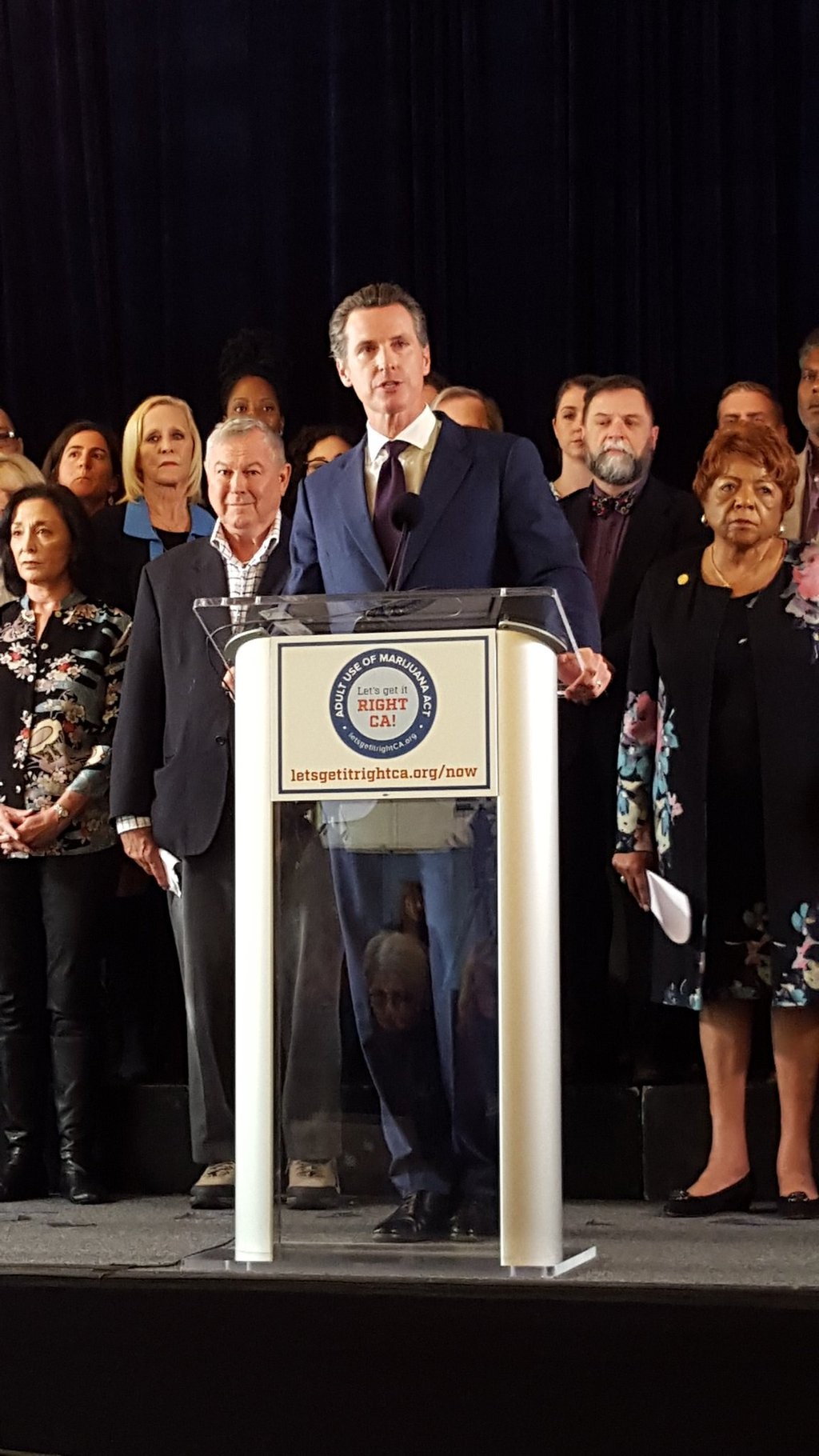
California’s only viable legalization campaign launched Wednesday in downtown San Francisco with an all-star cast of officials from politics, law, activism, and medicine, drawing thousands of press mentions and electrifying the electorate with the tantalizing idea that cannabis could be fully legal for adults on November 9. Let’s Get It Right, California launches in San Francisco Wednesday.
Credits: Commonwealth Club via Twitter
The group behind the Adult Use of Marijuana Act gathered over 600,000 signatures, it reports, and is all but certain to make the ballot.
However, the “Let’s Get It Right, California” far from a sure bet. For one, a poll released Wednesday found a narrow 50 percent majority of the Bay Area in support of legalization. Forty-one percent in the Bay Area were opposed, while about nine percent were undecided.
Normally, initiative campaigns want to start polling in the 60s, because opposition forces will peal away swing voters during the campaign, experts say.
That opposition is going to include a strange bedfellows mix of conservative law enforcement, the Teamsters, and even some pot growers threatened by the end of prohibition.
“as well as Democrat and Republican elected officials”.
The ‘Let’s Get It Right, California’ coalition includes:
Lt. Gov. Gavin Newsom
UCSF Prof. Dr. Donald I. Abrams
former Los Angeles Police Department (LAPD) Deputy Chief Stephen Downing
former President of the California Fish and Game Commission Michael Sutton
California NAACP President Alice Huffman
Blue Ribbon Commission on Marijuana Policy Youth Education and Prevention Working Group Marsha Rosenbaum
the Drug Policy Alliance
Marijuana Policy Project
National NORML
Rep. Dana Rohrabacher
and travel writer Rick Steves among others
The California Medical Association has also endorsed the Adult Use of Marijuana Act, which legalizes one ounce of pot in public and six plants in private, and lays a regulated commercial system for adults 21 and over atop the state’s medical marijuana system. Pot convicts could get records expunged or sentences reduced.
Let’s Get It Right, California has raised $3.3 million to opponents’ $13,635, which is more than 240 times as much money, the nonprofit MapLight finds. MapLight reports:
Carla Lowe, president of CALM, described her group’s fundraising efforts as “really grassroots.”
“If we were able to have even a portion of their money,” Lowe said, “We would do all of the social media, billboards, we would do everything possible to tell people about this highly potent, mind-altering drug.”
Jason Kinney, spokesman for the Adult Use of Marijuana Act campaign argues, however, that the contributions don’t reflect the initiative’s broad base of support.
“When people see that there’s one consensus measure on the ballot supported by the largest coalition ever formed to support a marijuana policy measure. we have every expectation we will be getting contributions both large and small from across the state.”
However, legalization supporters vastly out-raised opponents in donations in 2010, yet still lost 46-54.
It could take $10-40 million to run a winning campaign in California, experts have said.
Recently, Bernie Sanders’ pollster Ben Tulchin increased his odds of California legalization, to 55-45 in favor, due to an expected increase in progressive voter turnout to counter a new arch-nemesis— presumptive Republican presidential nominee Donald Trump.
Credits: File Photo/ Bert Johnson
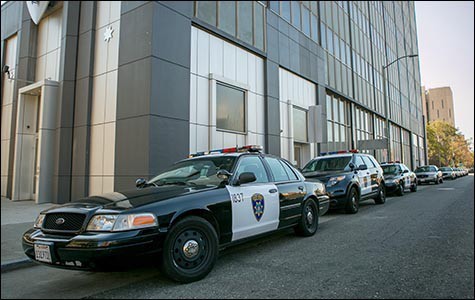
The Oakland Police Department was criticized this week after issuing an announcement on Monday that claimed there is an increased likelihood of drunk driving during Cinco de Mayo.
On Facebook, for example, Oakland Latinos United posted a response stating, “Oakland Police has posted on their Twitter account [they’re] going to put out Extra Patrols for you drunk Mexicans on Cinco de Mayo. How does it feel. As a Mexican Chicano I wonder if OPD will be posting DUI PSAs for every ethnic & culturally based holiday?”
Others pointed out that OPD hasn’t issued similar advisories warning Oakland residents about drunk driving for holidays like St. Patrick’s Day.
[jump]
Oakland resident Joel Tena decided to call out the message online. “As a Chicano, I know the awful legacy of racism against the Mexican community here in the United States,” Tena told the Express. “When I saw this, I was incredibly offended by it.”
Tena linked the OPD message in a post on Nextdoor.com, and responded to it.
“I just received the Tweet, NIXLE, and NextDoor post from the Oakland Police Department regarding drunk driving and Cinco de Mayo. Drunk driving is no joke and I hope folks do not drink and drive no matter what day of the year,” Tena wrote in his original post. “However, I find it extremely problematic that OPD is specifically focusing on DUIs during Cinco de Mayo celebrations – a holiday celebrated by folks like myself, people of Mexican descent who are from the United States (and also Mexicans in general and other non-Mexican folks too).”
But shortly after OPD’s public apology on Tuesday, Tena said his post critiquing OPD’s original statement was removed from the popular private social network by Dan Toone, a Nextdoor lead from the Oakland Lincoln Highlands neighborhood. Tena said he received no warning or explanation about why his post was deleted.
According to Tena, Toone said he removed the post because “OPD removed their nixle posting” and Toone felt “it is appropriate this is removed also at the request of other neighbors.”
Despite OPD’s apology – which Tena called a positive step – he said that Toone’s decision to remove his Nextdoor post doesn’t make sense, and neighbors have a right to discuss the original post made by the police department.
Frustrated by what he said was an act of silencing of important conversation on issues surrounding race and the police, Tena wrote to Nextdoor officials asking for an explanation.
Director of Neighborhood Operations Gordon Strause replied to Tena, stating that “leads should only remove discussions that violate Nextdoor’s Guidelines for Neighborly Behavior,” and if it turned out that this was not the case in this instance, Nextdoor will “follow up to ensure that Lead powers are used appropriately going forward.
But Tena said the response was insufficient and that it did not address the unwarranted censorship some leads have exhibited on Nextdoor to “silence community voices around these issues of racial justice.”
Emphasizing that this is not the first time Nextdoor leads have used their authority to censor controversial discussion or exclude some people’s opinions, Tena pointed to other cases of lead abuse such as that surrounding Hugh Bartlett, who the Express featured last year in an article about racial profiling on Nextdoor.
“[Nextdoor] has to allow for the hard conversations around law enforcement, race, and race relations,” Tena said in an interview. “If we can’t have these conversations on Nextdoor, they are doing the community a disservice.”
Tena has since requested that his original post be restored, and said he has yet to receive another response from Nextdoor officials.
Beef tongue and uni at Salsipuedes.
Credits: Bert Johnson/File photo
Welcome to the Mid-Week Menu, our roundup of East Bay food news.
1) After about a nine-month run, Salsipuedes (4201 Market St., Oakland) has closed in North Oakland. The restaurant specialized in New Baja-style cuisine, a genre of food that isn’t really represented anywhere else in the Bay Area, and served one of the better fried chicken sandwiches in Oakland. But it seems that in the end, the restaurant — with its delicate, and somewhat expensive, small plates — wasn’t the best fit for the mostly-residential neighborhood.
[jump]
“In the end, it just wasn’t exactly the right thing for that place for that moment for that time,” co-owner Jay Porter, who also owns The Half Orange in the Fruitvale district, told Inside Scoop. Chef Marcus Krauss, with his Restaurant at Meadowood pedigree, will relocate to San Diego. Stay tuned for news about a new restaurant that’s tentatively slated to take over the Salsipuedes space.
2) The downtown Oakland pizzeria Hi-Life (400 15th St.) has been rebranded as Five10 Pizza. The restaurant changed management about a year ago after former owner Damon Gallagher was embroiled in controversy over racially charged statements made in the aftermath of a shooting that took place at a nearby nightclub. It’s unclear whether Hi-Life was ever able to shake that stigma, even after the management change — either way, the owners have decided to turn over a new leaf.
When reached by phone, majority owner Marco Senghor (who also owns the nearby Senegalese restaurant Bissap Baobab) said the pizzeria is also “restructuring the hours” for its staff, which apparently will consist of fewer employees than before. According to Senghor, Five10 Pizza will have a bigger focus on delivery, which it will offer through Caviar.
The roast chicken at Mockingbird.
Credits: Chris Duffey/File photo
3) As previously reported, Mockingbird (1745 San Pablo Ave.), the Uptown Oakland Cal-cuisine spot, is gearing up to move to a new location downtown this fall. The old location will be open through Memorial Day weekend, which means customers have a few more weeks to take advantage of the restaurant’s BYOB policy. When the new location opens, the plan is for it to have a full liquor license.
4) A new bakery called Batch Pastries (2220 Mountain Blvd., Ste. 140) has taken over the former Montclair Baking location in Oakland, Inside Scoop reports.
5) Temescal Brewing looks to be on track to open in June. The Express’ new editor gives the thumbs-up to two brews he sampled at a preview event last night.
6) I’m told there a still a handful of tickets available for this dinner/book launch event at Swan’s Market for Farmsteads of the California Coast, by Berkeley-based food writer Sarah Henry. The Cook and Her Farmer will cooking the dinner; see details here.
Got tips or suggestions? Email me at Luke (dot) Tsai (at) EastBayExpress (dot) com. Otherwise, keep in touch by following me on Twitter @theluketsai, or simply by posting a comment. I’ll read ‘em all.
It was an elbow-to-elbow, standing-room-only, three-deep-at-the-bar crowd when I arrived at Hog’s Apothecary last evening just before 6 p.m. The occasion: The debut of two beers from Temescal Brewing.
See also: How a North Oakland Brewery Became a Hub for Local Artists Before It Even Opened
[jump]
The brewery, which attracted attention with its Kickstarter campaign, won’t open its beer garden and facility at 4115 Telegraph Avenue to the public for another month or two. But a couple pale ales were on draft last night at this very New Oakland event. And, be assured, the beers were solid.
Pale ales are a style that new-guard breweries often neglect. Or, when they do brew them, they’re seldom well-executed. Consumers also bypass pales for higher-booze hoppy options, and so they don’t land on draft lists as frequently as they should.
The two pales last night — called Happy Birthday (left, see photo above) and Hello — were tremendous. Both, for lack of a better word, were new-school beers: gently bitter, juicier in body, dry, and with pleasant citrus character.
Hello was copper and, in the glass, appeared as an old-school pale (think Sierra Nevada). The trademark pale-ale bitterness, however, wasn’t there; this one was soft and earthy, which I love. Happy Birthday was also a light-bodied and crushable brew, with a subtle papaya aroma and mild lemon flavors. It was hazy, but not a yeast bomb. Neither boasted any unwelcome sweetness.
I’d wager that Happy Birthday was the more popular of the two, although both kegs kicked well before the 7 p.m. I’d hoped to track down and chat with brewer Wade Ritchey and owner Sam Gilbert, but they had to run around the corner to snag more kegs.
Before leaving, Gilbert did say quickly that he hopes to open Temescal by June. Good: These were high-quality hoppy ales, in the tradition of Cellarmaker, and offer yet another reason to celebrate the Bay’s brew scene.
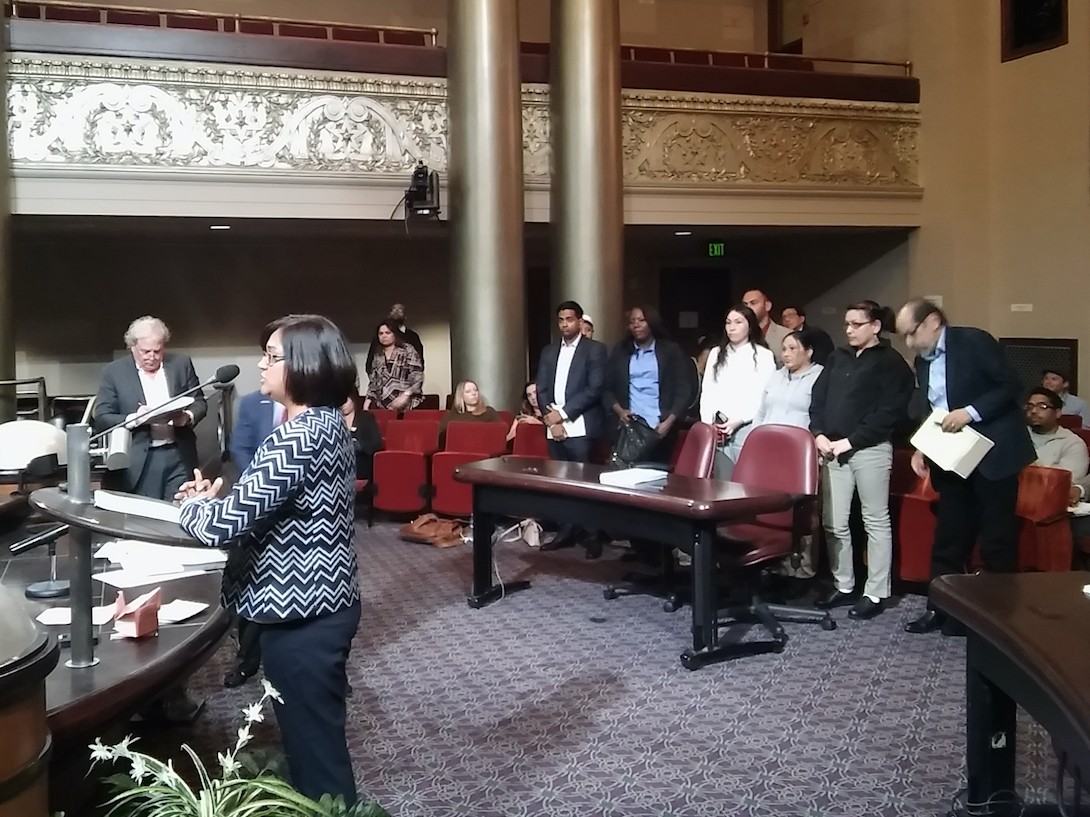
Hotel employees stand behind Sima Patel as she addresses the planning commission.
Credits: Darwin BondGraham
Last night, the Oakland planning commission green-lighted construction of a new hotel in Oakland’s Chinatown, denying an appeal made against the project by the union Unite HERE 2850.
The union argued that variances granted by city staff for the building’s height, and absence of a loading dock, were contrary to the city’s planning code. But the core issue really boiled down to whether the project would create living-wage jobs, and the hotel developer’s track record of following labor laws.
Taylor Hudson of Unite HERE 2850 told the planning commission that, while the hotel development might appear to be a question limited only to land-use issues, it was in fact a decision bearing on the question of inequality, and whether Oakland will implement policies that provide good jobs. Hudson said the planning code requires city staff to take into account the impact a project may have on public services, including affordable housing. He said, that based on the wages paid by the Patels at two existing East Bay hotels they own, the proposed hotel would likely generate low-wage jobs with no health benefits, further fueling Oakland’s housing crisis and demand for already thin-stretched social services for the working poor.
But the Patels told the commissioners their project will generate $1 million in hotel taxes once it’s completed, and that the average visitor will end up spending money and generating more jobs in Oakland.
“We hope to break ground and complete the project as quickly as we can. The business and leisure travel market in Oakland is booming and we want to help fill the needs for rooms and jobs in this community,” said Dhruv Patel in a statement released following the commission’s vote.
The Patel’s also disputed reports that they have mistreated some of their workers and stolen wages.
“We’ve treated our people well. Some of our employees are here tonight,” said Sima Patel at the meeting. Then, she waived her arms and about a dozen of her company’s current employees stood up. A few of the Patel’s employees spoke later in the meeting to say they were paid well and fairly treated.
But some of the Patel’s ex-employees have accused them of wage theft among other labor law violations, and last February the city conducted an investigation of the Holiday Inn Express near the Oakland Airport, which is owned by the Patels, and confirmed that the hotel had violated Oakland’s minimum-wage ordinance.
Nevertheless, planning department staff defended their initial approval of the project last night. Pete Vollman of the planning department told the council that the variances granted to the Patels for a tall parapet wall exceeding height limits, and the absence of a loading dock, were minor and not inconsistent with past practice. As to the core issue of labor, Vollman added that the city did consider the number of new jobs the hotel would create, but he said that planning staff can’t consider anything as detailed as the level of wages paid.
“We don’t feel getting into the individual breakdown of what the wage is gets to the requirements [of the city’s planning code],” Vollman told the commissioners.
Greg McConnell.
Credits: Darwin BondGraham
Greg McConnell, a lobbyist with the Jobs and Housing Coalition said the union’s appeal was really a power play in an effort to try to unionize the Patel’s hotels. “We want everyone to clearly recognize the motivation for this appeal is not some technical violation. It’s whether the developers would agree to submit to card check neutrality so 2850 can organize this hotel,” said McConnell. “Everyone in the room knows it.”
Previously, however, both Unite HERE 2850 and Dan Cohen, a spokesman for the Patels, have said that the union is not attempting to organize the hotels owned by the Patel family. Rather, the union said their objections to the proposed hotel are based on fears that the hotel will drive down wages for hotel workers at other locations. The union said the decision to approve the hotel without taking the jobs question seriously sets a bad precedent whereby the city does not account the record of a company proposing to open a new business, and even rewards those who break the law.
At the end of the night, only one planning commissioner objected to the project. Commissioner Jahaziel Bonilla said the variances granted for the parapet and loading berth were bad decisions.
But commissioners Chris Patillo, Amanda Monchamp and Adhi Nagraj, and Jim Moore all said they agreed with staff’s architectural variances and they were eager to approve a hotel project.
“It’s unfortunate that development in Chinatown has been stagnant way too long,” said Commissioner Patillo. “Chinatown needs to change, grow and evolve.”
Monchamp said in favor of the project that hotels will generate other higher wage jobs in Oakland in sectors like tech, but was unwilling to consider the actual quality of jobs the hotel would directly create. “As to the issue of how much of a wage this hotel owner will bring, we can’t consider how much will be paid,” she said about the workers who will clean and maintain the hotel.
Nagraj acknowledged that the city recently investigated the Patel’s for violating city labor laws at one of their existing hotels, but still he voted to approve the project. “That stuff certainly is troublesome,” said Nagraj, before adding “I’m comfortable passing this.”
The commission’s approval was final with no further appeals available to the union.
On Tuesday afternoon, demonstrators arrived at San Francisco City Hall to protest police brutality.
Credits: Nastia Voynovskaya
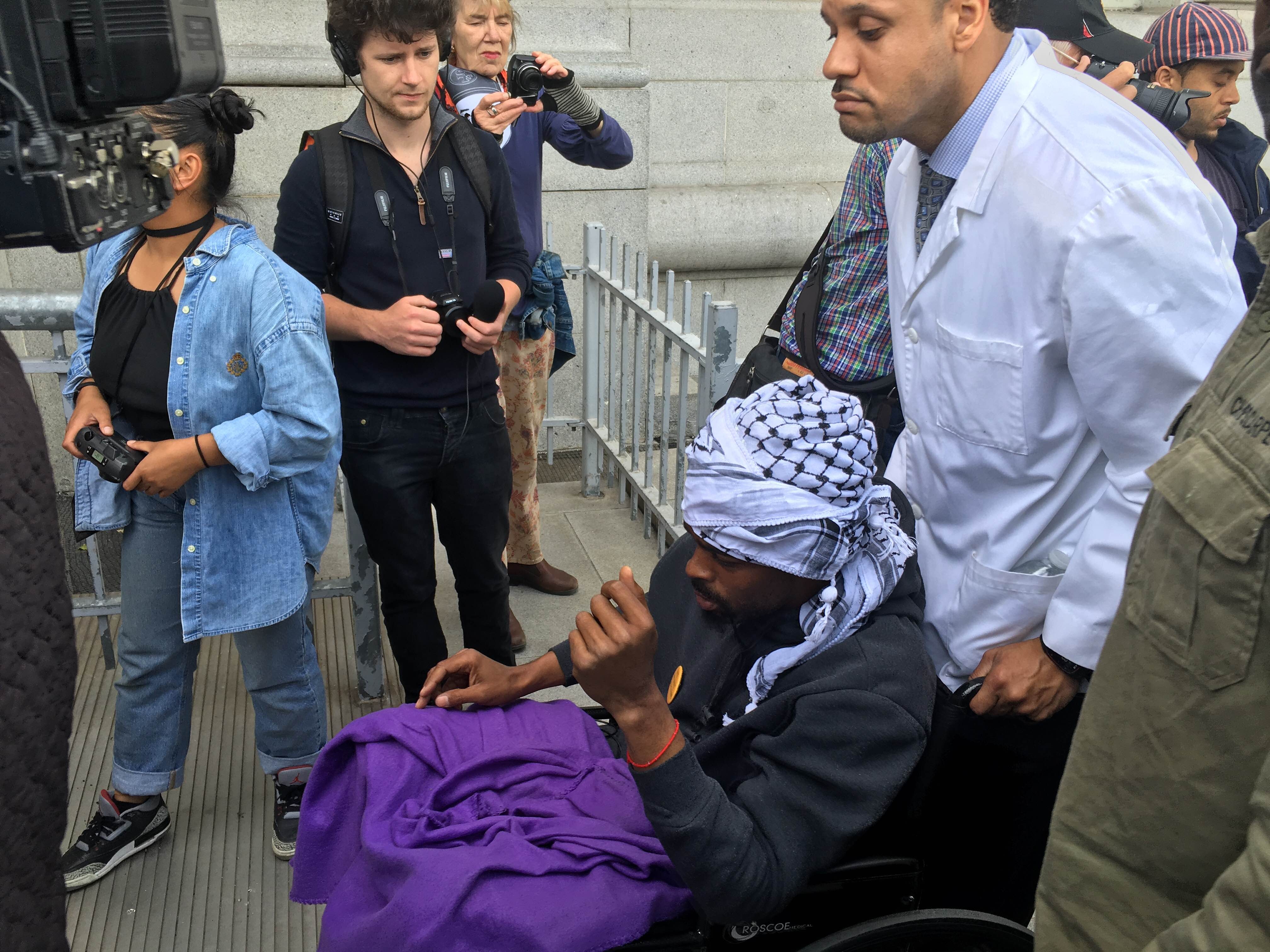
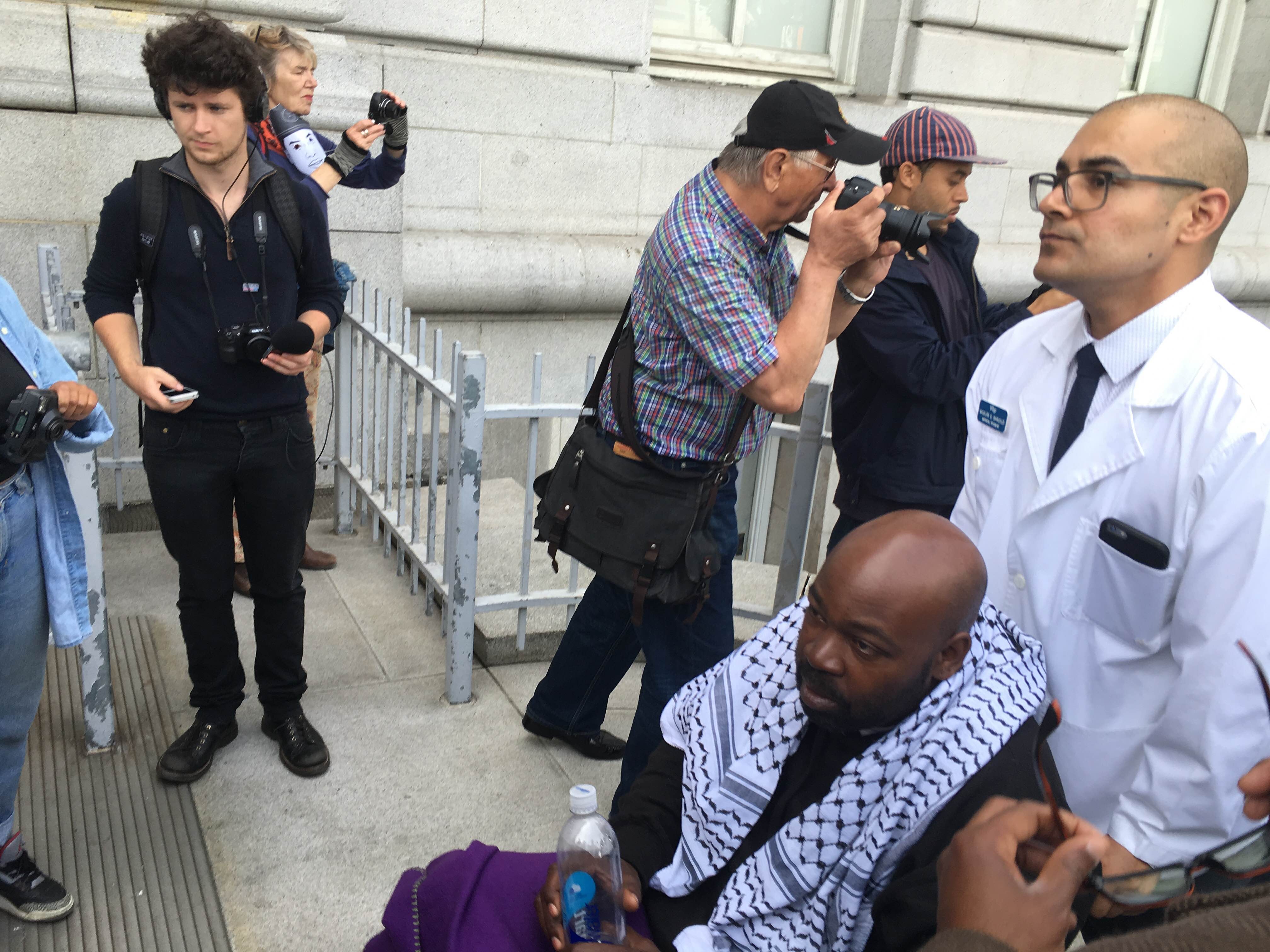
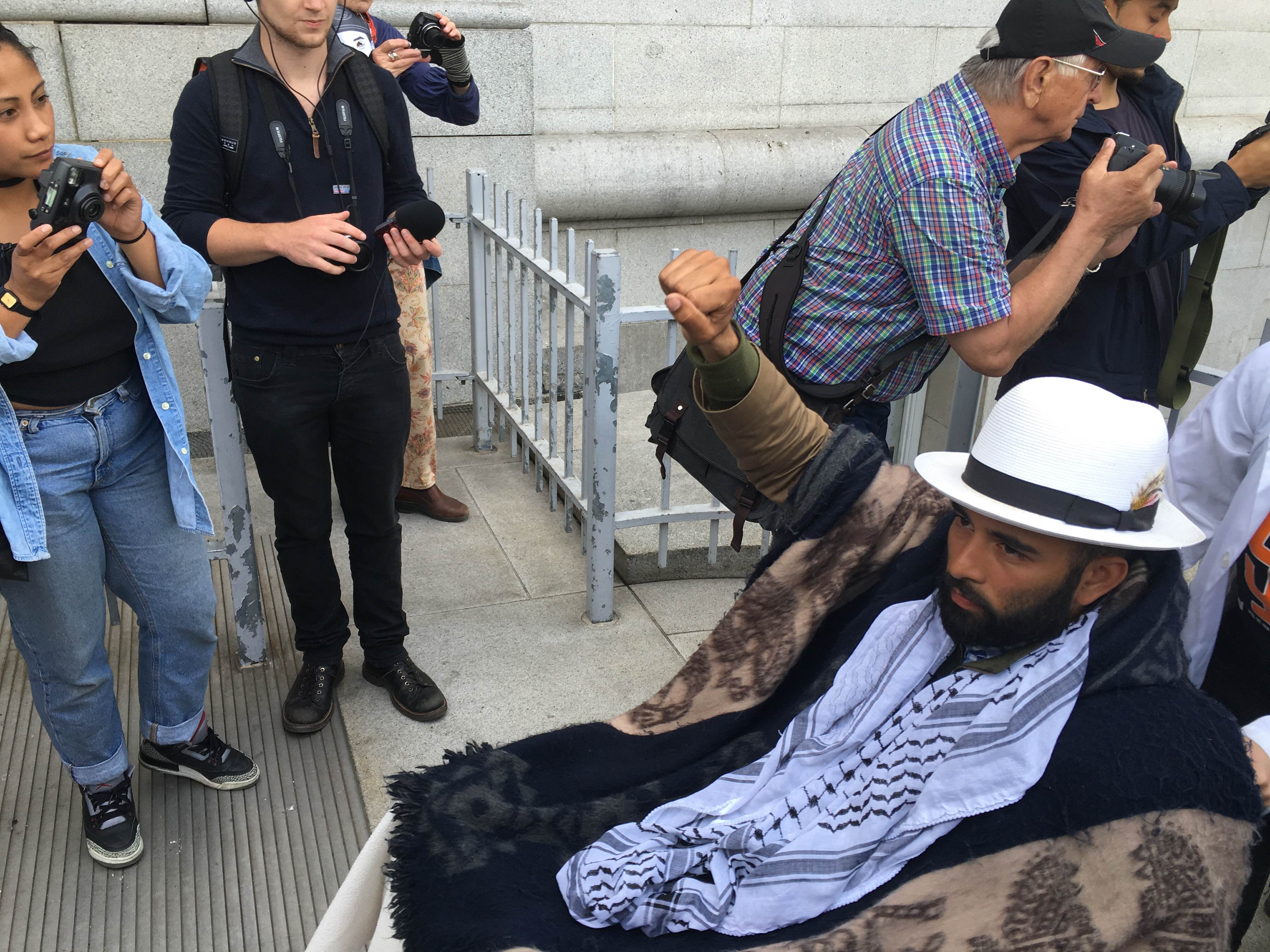
After delivering an impassioned speech on the steps of San Francisco City Hall yesterday following a day of protest, San Francisco rapper Equipto left the scene in a wheelchair looking hopeful despite his visibly famished appearance. The musician and educator was on the thirteenth day of his ongoing hunger strike against police brutality, mass incarceration, and gentrification — issues disproportionately affecting people of color, who are being displaced from the Bay Area’s urban centers at alarming rates.
According to a 2013 report issued by the San Francisco Controller’s Office, 56 percent of inmates in San Francisco jails are Black although only six percent of the city’s population is Black. In light of such alarming statistics, Equipto decided to take action.
[jump]
[embed-4]
Equipto is a well-known underground rapper who’s been at the center of San Francisco’s conscious hip-hop scene since the 1990s. And now, he’s using his considerable platform — and risking his physical health — to galvanize Bay Area residents to lobby local politicians to address issues of systemic inequality. Equipto’s mother, Maria Cristina Gutierrez, the executive director of Compañeros del Barrio preschool; rapper Sellassie; educator and poet Ike Pinkston; and activist and candidate for San Francisco District 9 Supervisor Edwin Lindo have joined Equipto in the hunger strike, and together call themselves the Frisco 5.
Maria Cristina Gutierrez.
Credits: Nastia Voynovskaya
The Frisco 5 have been camping out in front of the police station on the corner of 17th and Valencia Streets for the past two weeks, and yesterday, May 3, they led a march from their camp to San Francisco City Hall to spread their message and present their demands to Mayor Ed Lee. The demands call for the immediate firing or resignation of San Francisco Police Chief Greg Suhr, whom the protestors say has enabled a culture of racist law enforcement practices, resulting in the deaths of several mentally ill or unarmed individuals at the hands of SFPD in recent years. The other two key goals of the protest are to mandate independent investigations of officer-involved shootings, and to indict the officers involved in recent San Francisco police killings, particularly the deaths of Mario Woods and Alex Nieto.
Sellassie.
Credits: Nastia Voynovskaya
At around noon on Tuesday, hundreds of protestors of various ages and ethnic backgrounds gathered at 17th and Valencia — many of them holding signs displaying words of solidarity with the families of the recent police brutality victims, as well as demands for Suhr’s resignation. The Frisco 5, weakened from nearly two weeks without food, sat in wheelchairs pushed along by volunteer doctors from the activist coalition White Coats 4 Black Lives. Around two-dozen protestors linked arms around them to create a protective barrier while the group marched through traffic down Mission Street and, eventually, Market Street towards the steps of City Hall. In a brief conversation before the march, Sellassie — who recently released the heated protest song “Cops Keep Firing” — told me that the Frisco 5 intends to continue the strike until they “get the city back.”
[embed-1]
When the march arrived at City Hall, some protestors entered the building to voice concerns at the Board of Supervisor’s meeting while others gathered outside of it. Volunteers pushed the wheelchair-bound Frisco 5 towards the mayor’s office. News spread through the crowd that Mayor Lee was at a meeting in Bayview. Activists waited for hours, making speeches and singing protest songs, but the mayor never showed up, and the march began to dissipate around 5 p.m. Equipto.
Credits: Nastia Voynovskaya
“Please continue showing support, this is just the beginning,” said Equipto in his concluding remarks on the City Hall steps as the Frisco 5 prepared to head back to the Mission district camp. He continued, quoting the Bay Area Minister of the Nation of Islam: “Like Minister Christopher Muhammad said, ‘It’s a marathon — it’s not a sprint.’ So let’s make sure we keep staying around for the long haul and keep showing support.”
The crowed gathered outside of San Francisco City Hall in solidarity with the Frisco 5.
Credits: Nastia Voynovskaya
In addition to the rappers among the Frisco 5, several prominent figures from music scenes on both sides of the Bay were involved in the rally. Raw-G, an Oakland rapper by way of Mexico, was helping to direct the crowd throughout the march. “This is a global issue. This is not just one cop killing one person,” she said in an interview during the protest. “We’re getting killed all over the world, and being targeted because we’re Black and brown. I’m here to offer my support to Equipto and Sellassie, whatever I can do. … As artists, we have the power to create a huge message and a big impact.” Ike Pinkston.
Credits: Nastia Voynovskaya
Art Sato, Equipto’s father and the host of KPFA’s Latin jazz program, In Your Ear, spoke to the crowd about the need for Asian American solidarity with Black Lives Matter (Sato is Japanese-American, and Equipto is of Colombian and Japanese descent).
Naima Shalhoub, a Lebanese-American Oakland jazz singer whose last album included contributions from women serving time in San Francisco Jail, was also among the protestors linking arms to protect the Frisco 5 from traffic and police during the march.
Edwin Lindo.
Credits: Nastia Voynovskaya
“I’m here to support the Frisco 5 and them demanding justice — not just for the many young Black and brown people and any innocent lives that have fallen because of police injustice, but that connected to the rise of incarceration, and incarceration as a concept of keeping Black and brown people confined. … If one person isn’t free, none of us are free.”
While they were ultimately unable to meet with Mayor Lee, the Frisco 5 deemed the day of action a success. On his Instagram today, Equipto posted another call to action to shut down the San Francisco Police Commission Meeting at 5:30 p.m. in room 400 of San Francisco City Hall, adding that Sellassie has fallen ill and is in the hospital. No further details have been announced, but stay tuned for updates. [embed-3]
[embed-2]
Up to eight more medical cannabis dispensaries per year will be opening in Oakland, as well as more licensed delivery services and the creation of the city’s first-ever licenses for farms, kitchens and labs. Oakland’s cannabis industry continue to flower.
Credits: David Downs
The Oakland City Council voted unanimously after midnight Wednesday to pass two updates to its cannabis ordinances, green-lighting a vast expansion of licensed and regulated medical pot activity in response to state-level regulations. The Council didn’t begin hearing the items until 11 p.m. Tuesday night, and didn’t finish voting until 1 a.m. Wednesday, sources say. (Here was the agenda for last night’s Oakland City Council meeting — as .pdf download.)
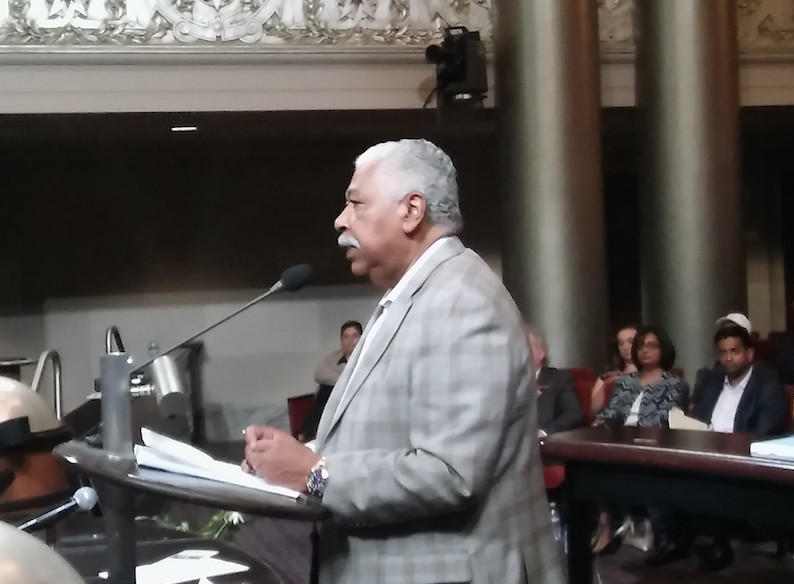
Councilmember Desley Brooks led a contentious effort to add amendments that effectively pick winners in the Oakland pot trade — mandating that half of all new pot business owners come from a few areas of East Oakland. Her goal is to reward low-income communities as well as formerly incarcerated Oaklanders with “priority” for new cannabis licenses, but the specific language was widely opposed by the city’s own Medical Cannabis Commission, and minority advocacy groups.
Oakland’s priority licensees amendments now conflict with state medical pot law, and will not result in benefits for disadvantaged communities, but more exploitation, said Oakland Cannabis Regulatory Commissioner and California NAACP cannabis task force advisor Sean Donahoe.
“They were just happier to pass something rather than look too closely at the details,” he said.
Instead of day-lighting the existing pot trade with licenses, “this will create a licensing bottleneck that discourages present operators from moving into regulated conditions,” he said.
For example, medical cannabis operators of color who live in West Oakland, or who avoided incarceration through plea deals will be disadvantaged for licensing, as well as medical cannabis operators of color who do not reside in Councilmember Brooks’ designated “priority” areas in East Oakland.
“Everything was well-intentioned, but the council had not educated themselves,” Donahoe said.
The members of Supernova Women — a group of minority women canna-business advocates — also opposed the Brooks amendments, saying they “very likely will create a number of unintended consequences.” For example, priority applicants won’t be able to take investment in exchange for equity. Read Supernova’s letter here.
Oakland’s updates to its medical cannabis ordinance must come back to Council for a second reading in the coming weeks. We’ll have the full details on the midnight amendments, when they become public.
Axel Void requested that his portrait not accompany this story. “The show is about Alvie, not me,” the artist insisted while seated in his temporary downtown Oakland studio. The travelling, internationally recognized muralist and painter was referring to Nobody, his upcoming solo show with Athen B Gallery. And, indeed, the show is not about him. The titular “nobody” is actually a San Francisco man named Alvie Morris. Nobody is a forty-minute film, concrete bust, and a series of oil paintings that tells the story of Morris’ quotidian life.
Void was born in Miami but grew up in Spain. He’s been painting since he was a kid, having been brought up in an artistic family. (His great-grandfather was a portrait painter who worked for the Spanish dictator Francisco Franco.) When Axel was around twelve years old, he started painting graffiti. As he grew up, his love of graffiti and figurative oil painting merged. Now, he travels the world painting massive aerosol murals that resemble impressionistic oil paintings.
For Nobody, Axel Void asked Alvie Morris to send him photos from throughout his life.
Credits: Bert Johnson
Axel Void.
Credits: Photo by Bert Johnson
Typically, to prepare for a mural, Void first gets to know the neighborhood. He walks the streets and asks residents for their stories. Then, he chooses a subject. Sometimes it’s a comment on the political climate of the place, the history behind it, or a cultural idiosyncrasy specific to that location. But most often it’s a portrait of an ordinary person who lives there — a symptom of Void’s nearly obsessive interest in everyday people.
In Chennai, India, he chose a homeless elderly woman who slept at the train station he painted. In Paris, it was Elsa, a baby that had just been born in the district where the wall stood.
Three years ago, Void was participating in a mural festival in Atlanta called Living Walls. But the wall he was assigned presented some obstacles: It was secured last minute, and it was in a slightly gentrified neighborhood where he felt it difficult to grasp a sense of the community. So, instead, Void used a photo that he encountered online as his reference: a young blonde boy wearing a striped shirt, with a patch over one eye, and thick rimmed glasses over both. To finish it off, the artist wrote “Nobody” in white letters across his chest.
Not long after, Void received an email from a stranger named Alvie Morris. Attached was a playful photo of the Bay Area native clamping the original source image for Void’s Atlanta mural between his teeth. Morris had seen his mural printed in the pages of the street art magazine Juxtapoz, and he wanted to know why Void had painted his childhood portrait onto the side of a building halfway across the country.
In typical fashion, Void responded with a few answers — and many of his own questions. Over the next few years, the duo remained pen pals and Void began collecting details about Morris’ life: He was born in Tulare in 1970; he used to sing in a metal band and dressed up as Jesus for all of their performances; he struggled with alcoholism, but has been sober for five years; he works as a butcher; and he often cares for his niece, Zoe, who is the center of his world.
Credits: Bert Johnon
Three weeks ago, Void came to the Bay Area to learn even more about Morris, and to work on a show honoring his life. Titled Nobody, it will treat Morris as an important historical figure.
A stately concrete bust, akin to the kind made for world leaders, will sit in the center of the show, surrounded by exquisitely rendered classical oil paintings of pictures from throughout Morris’ life. Plus, a forty-minute film — half shot by Void and half shot by Morris — will offer an example of a typical day as Morris. The show will open on Saturday, May 7, at 7 p.m. in a vacant storefront near Jack London Square (222 Broadway) where Athen B Gallery is preparing a pop-up specifically to host it.
This isn’t the first time that Void has done a whole show about an ordinary person. In fact, Nobody is just the latest addition to a series that he’s been working on for the last ten years called “Mediocre.” By pairing artistic techniques reserved for high-brow portraiture with mundane subject matter, the endearing works celebrate ordinariness. It’s not an entirely original artistic mission, but Void’s earnest selflessness and long-term commitment to elevating others makes his work stand out — especially within the street art world, where egos are often infamously bloated.
“Nobody” is also a subseries within “Mediocre,” of which the work around Morris is merely the latest. Last year, Void did a “Nobody” mural in Montreal. To abide the locals, he used French: “Personne.” But used in different contexts, “personne” can translate to both “nobody” and “somebody.” Void relished how the double meaning captured his intention: that calling someone a “nobody” is but an abstraction of their rich and complex character — an entry into finding out who they actually are.
“That’s the play. As soon as I write ‘nobody’ across the face, everybody is gonna want to know who this person is,” he said. “It’s the same idea with ‘mediocre.’ It’s not mediocre. It’s the quotidian life. It’s very relevant.”
“When Meaningful Work Means Healthy Food,” Sustainable Living, 4/20
Planting Justice
I hired Planting Justice to repair my irrigation system last summer and was pleased with the quality of work and the demeanor of the workers. We need more organizations like this to fight against the tide of poverty!
Silvia Sykes, Oakland
“Greening the Festival Experience,” Sustainable Living, 4/20
Healing the Planet
I have a ton of respect for Paul, Rock The Bike, and all these musicians who load up their Extracycles with sound equipment, and bike to their gigs, and use people power to power their shows. If the planet is healed it will be because of dedicated people like them.
Adrian West, Oakland
“CalPERS Should Refuse to Fund Tobacco,” Raising the Bar, 4/13
Unacceptable
Thank you for drawing attention to this outrageous hypocrisy. At a time when the fossil fuel industry is being compared to Big Tobacco — because of their insidious influence on public health and public policy, not their investment returns — it is unacceptable to even float a trial balloon about having public pension funds return to tobacco. Perhaps as you suggest, desperate investment professionals think that the public has forgotten tobacco’s negative impact on public health. Or they think the public is ready to blame the victims of tobacco addition for their health problems. Or maybe they think the public is ignorant about the reckless hyping of tobacco to underage youth outside the United States. Weren’t the negative returns on tobacco established by the settlement with state attorney generals?
Lisa Lindsley, Gardiner, NY
“Can Cars Be Environmentally Friendly?” Sustainable Living, 4/20
All Technology is Harmful
I generally agree with Darwin BondGraham’s column. The headline asking whether cars can be environmentally friendly is correctly and immediately answered in the sub-headline (“greenest car is no car”). However, as is typical for people who defend our extremely destructive society, BondGraham makes excuses for driving, and the column deteriorates into advocating for buying new cars that are not quite as environmentally harmful to drive.
First and foremost, all human technology is environmentally harmful, even an electric car charged by the solar panels on the owner’s roof. Mining for metals and oil drilling for plastics is required just to be build the car, not to mention all of the toxics from the batteries. Roads themselves are very environmentally and ecologically harmful, which is why conservationists oppose building new ones.
We will never fix the environmental problems caused by harmful activities like driving by making excuses for continuing to engage in those harmful activities. Nor will we fix any serious environmental problems by refusing to admit that technology itself is the problem. We need to move toward living a lot more simply and naturally in order to stop doing such great harm to our planet.
Jeff Hoffman, Berkeley
“Oakland Hotel Approved Despite Minimum Wage Violations,” News, 4/20
Should Be Denied
The Oakland City Council has a very hard time getting anything right, regardless of these small donations to their political campaigns by the various entities involved in this hotel dispute. Of course the Patels should not be approved for another hotel if they are violating the law at the hotels they already operate. Whether that is something the Planning and Zoning Department was allowed to consider, or whether the city council should have considered it separately from the planning report, obviously the Patels’ track record should have been considered. If they are prominent politically, their track record should have been considered to avoid the appearance of favoritism. Their application should be denied. Let a more reputable investor build the hotel instead.
Renters may face eviction or other new consequences from smoking marijuana in their home under a new law working its way through Sacramento this spring.
Assembly Bill 2300 explicitly codifies a landlord’s existing right to prohibit pot smoking in the rentals they own, even if the tenant is a qualified medical marijuana patient. The bill...
California’s only viable legalization campaign launched Wednesday in downtown San Francisco with an all-star cast of officials from politics, law, activism, and medicine, drawing thousands of press mentions and electrifying the electorate with the tantalizing idea that cannabis could be fully legal for adults on November 9.
Let's Get It Right, California launches in San Francisco Wednesday.
Credits:...
The Oakland Police Department was criticized this week after issuing an announcement on Monday that claimed there is an increased likelihood of drunk driving during Cinco de Mayo.
On Facebook, for example, Oakland Latinos United posted a response stating, "Oakland Police has posted on their Twitter account going to put...
Beef tongue and uni at Salsipuedes.
Credits: Bert Johnson/File photo
Welcome to the Mid-Week Menu, our roundup of East Bay food news.
1) After about a nine-month run, Salsipuedes (4201 Market St., Oakland) has closed in North Oakland. The restaurant specialized in New Baja-style cuisine, a genre of food that isn’t really represented anywhere else in the Bay Area, and served one...
It was an elbow-to-elbow, standing-room-only, three-deep-at-the-bar crowd when I arrived at Hog’s Apothecary last evening just before 6 p.m. The occasion: The debut of two beers from Temescal Brewing.
See also:How a North Oakland Brewery Became a Hub for Local Artists Before It Even Opened
The brewery, which attracted attention with its Kickstarter campaign, won’t open its beer garden and facility...
Hotel employees stand behind Sima Patel as she addresses the planning commission.
Credits: Darwin BondGraham
Last night, the Oakland planning commission green-lighted construction of a new hotel in Oakland's Chinatown, denying an appeal made against the project by the union Unite HERE 2850.
The union argued that variances granted by city staff for the building's height, and...
On Tuesday afternoon, demonstrators arrived at San Francisco City Hall to protest police brutality.
Credits: Nastia Voynovskaya
After delivering an impassioned speech on the steps of San Francisco City Hall yesterday following a day of protest, San Francisco rapper Equipto left the scene in a wheelchair looking hopeful despite his visibly famished appearance. The musician and educator was on the...
Up to eight more medical cannabis dispensaries per year will be opening in Oakland, as well as more licensed delivery services and the creation of the city’s first-ever licenses for farms, kitchens and labs.
Oakland's cannabis industry continue to flower.
Credits: David Downs
The Oakland City Council voted unanimously after midnight Wednesday to pass two updates to its cannabis...
Axel Void requested that his portrait not accompany this story. "The show is about Alvie, not me," the artist insisted while seated in his temporary downtown Oakland studio. The travelling, internationally recognized muralist and painter was referring to Nobody, his upcoming solo show with Athen B Gallery. And, indeed, the show is not about him. The titular...
"When Meaningful Work Means Healthy Food," Sustainable Living, 4/20
Planting Justice
I hired Planting Justice to repair my irrigation system last summer and was pleased with the quality of work and the demeanor of the workers. We need more organizations like this to fight against the tide of poverty!
Silvia Sykes, Oakland
"Greening the Festival Experience," Sustainable Living, 4/20
Healing the Planet
I have a...