The ancestors don’t wait at the door. They gather in close and whisper. They move and the room speaks.
Nathaniel Jenkins felt them in the music.
“When I closed my eyes, I could feel my ancestors dancing around me in a circle,” Jenkins said, “and there was just so much love in that moment.”
That was Thursday, Oct. 22, at the Ivy Room in Albany. Hannah Mayree stood onstage, banjo in hand. Percussionist Kele Nitoto played beside them. Bay Area artist Auracle Ash opened. Two nights later, on Oct. 24, Mayree took the banjo to Ashkenaz in Berkeley with a Black Banjo Reclamation Project ensemble.
Jenkins, a friend of Mayree’s, almost missed it. He had forgotten about the show until Mayree reached out. “One of the songs just really touched my heart,” he said.
The ancestors built that instrument in secret. Mayree is carrying it forward.
“This is just trying to create new pathways from the old,” Mayree said, “that people are very much already connected to.”
Mayree is a banjoist, multi-instrumentalist and singer. In 2018, they helped found the Black Banjo Reclamation Project in Oakland. The group has since spread to cities across the country. Their new record, Hannah Mayree, follows their 2017 debut, Thoughts of the Night. Both records came out of the same 10 days in August 2016. One reached listeners in a year. The other took a decade.
So ask Mayree where the banjo comes from. Start with bluegrass. Then go back.
“Old-time is the music that bluegrass comes from,” Mayree said. “It’s the music that predates that, and is music that more or less comes from the African diaspora.”
Mayree traces the fiddle and the gourd back to the African continent, carried by people forcibly removed to other regions of the world. “We brought these different technologies along with us as well,” they said.
And they kept them. In secret. Out of sight.
“Even in times where the drum was banned, even in times when it was secretive to build a banjo and not have it be publicly seen, this was still going on before white people knew what a banjo was,” Mayree said.
Banned. Hidden. Still going.
Mayree hears it everywhere. “When you see the tradition of music that exists in America, that’s what you’re seeing,” they said. “And that’s what we’re hearing: Those traces echoing extremely loudly, booming through the airwaves.”
From the stage, Mayree made the pitch: Bring your banjo. Find other Black people learning it.
“I know that there’s so much amazing banjo history that comes out of the East Coast. And this is true,” Mayree told the crowd. “But we are also here. We are in this diaspora. We’re out here. I think this proves it.”
Mayree’s family proves it, too. Their grandmother emigrated from Florida to Oakland in the 1950s. All of her children were born at Highland Hospital, Mayree’s mother among them.
Mayree put it simply: “That is ultimately why I’m here.”
Mayree spent about five years writing songs, then recorded them with a producer in 10 days. “August of 2016, it was a very different world,” they said. “The first album, Thoughts of the Night—I really didn’t think that was ever really going to be heard by anyone.”
The first record was made to stay hidden. The second was made to be heard.
“I really consider myself kind of like a very philosophical folk artist,” Mayree said. “This album really just portrays that part of me.”
Mayree played every instrument on both records. The first ran bare bones. The second did not. Flutes. Ocarinas. Guitar. Drums. An omnichord. And a theremin.
“I had never played a theremin in my life, but I did on this record,” they said.
One song has no banjo at all. Mayree wrote “Seven Sisters” on guitar.
Mayree has a soft spot for it. “It’s inspired by psychedelic experiences and experiences with nature, which I really also tie to our experience in community, because the land is really the basis of how we connect with each other,” they said.
So why did the record wait 10 years?
Mayree knows why. “This is what artists have to go through. As an independent artist, there’s a lot of things you really have to persevere through. I definitely believed many, many, many times that that would not happen,” they said.
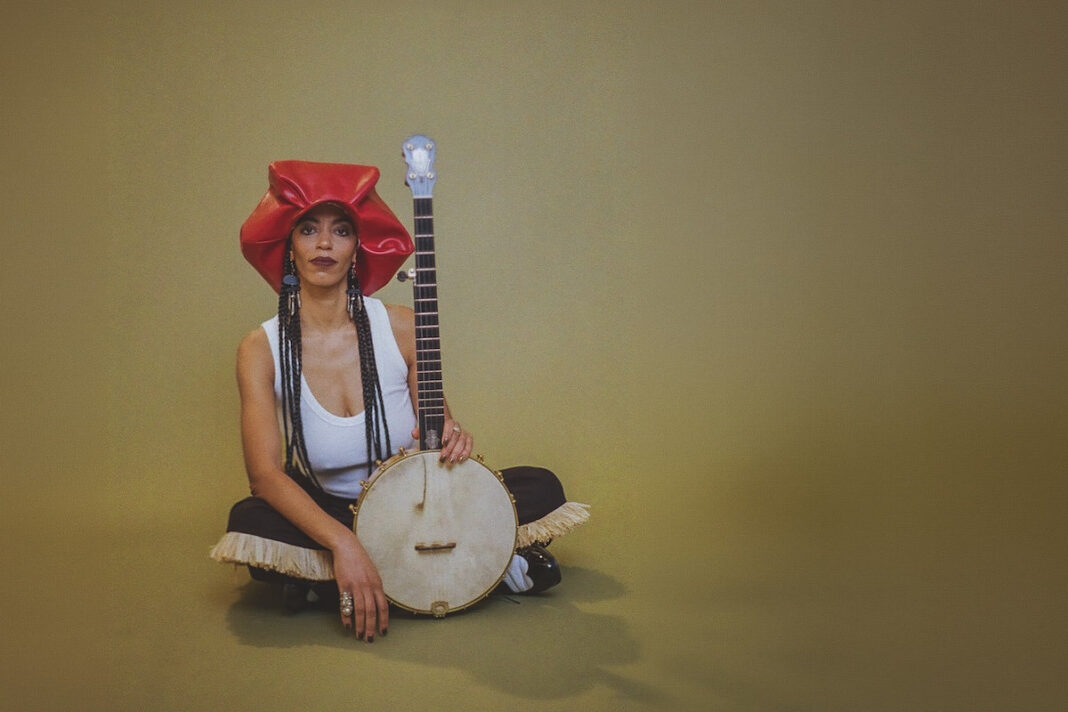
The banjo on the album cover has its own lineage. Brooks Marston built it in Portland, Oregon. Marston modeled it on 1890s instruments, with a goatskin head.
Mayree’s influences run just as wide: the Carolina Chocolate Drops, Ella Jenkins and Taj Mahal, whom Mayree has played music with in person.
Add blues, old time, gospel, soul, Motown and the grunge of ’90s rock.
Would Mayree’s grandmother like it?
“I think she would like it. I think it’s a little too modern for her.” The next album, Mayree said, “will be a little more targeted for the ancestors specifically.”
But the ancestors already showed up Thursday. Nathaniel Jenkins felt them dancing.
Shayla Davis came because of a film. She saw the PBS American Masters short, Hannah Mayree: Songs of Reclamation, at the Women of Color Film Festival earlier this year. Davis remembered the last note.
“Imagine I’m in this theater with all these people …” she said, “and her voice is vibrating through the theater. So I had to go see her live.”
Maybe that is what Mayree hopes Black listeners hear in the banjo: a little of themselves.
“I hope that they take a sense of ownership and stewardship,” Mayree said. “That is my intention. And you don’t really have to tell people twice.”
People already know. Some of them just didn’t know that they knew that they knew.
For Mayree, it reaches past the instrument. “It’s as much about reclaiming our relationship to music and our relationship to self, and how we bring our gifts to the world, as it is an exploration of the banjo,” they said.
From the inside, the record is the upstairs of a house Mayree’s mother used to live in, up a spiral staircase. The room where they slept.
“It’s a place that kind of lives in your mind, and you kind of have to be like, ‘Oh, I can go to that place,’” Mayree said. “But if I want that place to exist outside of here, then I have to do something in this waking life.”
The banjo lived in hiding. The record waited 10 years. And one fan has carried her argument for three decades.
Sonia Beers knows where the banjo comes from.
“For probably 30-plus years, I’ve been fighting with people saying that the banjo is a Black instrument,” Beers said. “It’s an African instrument.”
On Thursday, she didn’t have to argue. She just had to listen, the room filled with people who already knew what she knew.
“I wasn’t going to miss this for all the money in the world,” she said.
Hannah Mayree’s new album, ‘Hannah Mayree,’ is out now on CD, vinyl and Bandcamp. Mayree’s Dirt Friends Tour continues Nov. 15 at the Unitarian Universalist church in Petaluma; they open for Jamila Woods on Wednesday, Nov. 18, 8pm at Rickshaw Stop, 155 Fell St., San Francisco. More info at hannahmayree.com.