
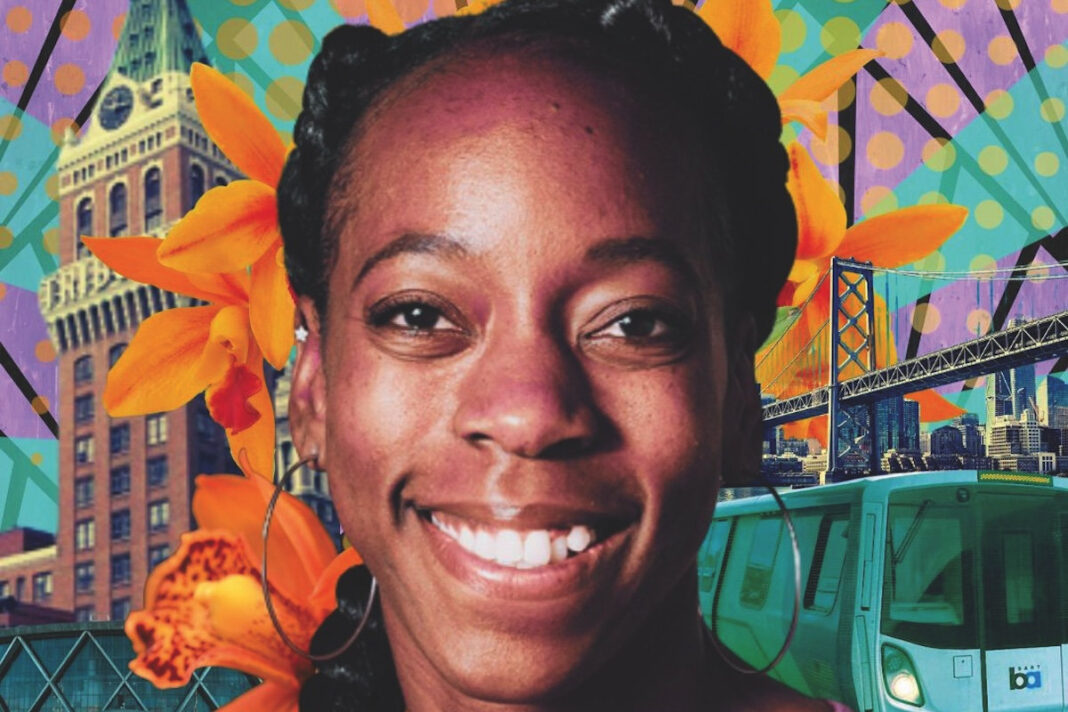
Recognized by the Alameda County Arts Commission with a 2026 Alameda County Arts Leadership Award, Samara Atkins said in an interview it comes at a time of transition. “It’s a surprise and has made me feel seen and held by my community,” she said. “It tells me I’ve reached a pinnacle in my career, and I’m looking into what is next.”
The leadership council selects awardees from the county’s five districts that include Oakland’s District 3, where Atkins resides. Recipients have demonstrated a commitment to the local arts community and are nominated by members of Alameda County.
Atkins is a director, choreographer, dancer, hip-hop instructor and co‑founder, with Jenay “ShinobiJaxx,” of Mix’d Ingrdnts. The all-women dance company established in 2010 is held in high regard for powerful, multidisciplinary street dancing that bears the imprints of ballet, modern and jazz. In the male-dominated street-dance industry, the female-identified dancers represent a rare sisterhood.
With the company’s activities riding the wave of “an iteration where real life happens to women who are now age 30 and over,” Atkins said the group engages in educational events and shows when they arise. “We still function and get together when something comes up, and we talk about being practitioners in the dance world.”
Much of that discussion is about women in street dance and the unity they have achieved. They have used their techniques, learning and diverse backgrounds to forge their dancing into wholeness. They have prioritized safe places for seeing, hearing and responding. Determined to portray an alternative to the hypersexualized street dance of many others, Atkins said, “We wanted little girls to look at us and see themselves in our bodies. We utilized our bodies as revolutionary tools to talk about society, culture, racism, and where street dance is and is headed.”
Moving with life’s struggles is a practice of kinetic, ancient wisdom. Movement is necessary for everyone, Atkins insists, especially in the current climate.
“The weight of this is big in my body,” Atkins said. “Our ‘leaders’ are trying to govern our bodies, to put laws on women’s bodies and reproductive situations. The hip-hop industry was born out of the need to be seen and understood. Because so many things were being taken away from under-resourced communities and areas in the Bay Area, movement was necessary to process and deal with what we’re receiving in our bodies … . We need to process it, make sense of it emotionally, then move and release it.”
When that happens, Atkins knows inner-healing for an individual turns outward. “We make room to effect change,” she added. “We unlearn and decondition ourselves to heal, to have hope for a future that serves all of us.”
The words are not vacuous or without evidentiary basis. “I know I’ve impacted the lives of young people and women in my community,” she said. “I’ve helped people to unlock organic movement, remove blocks from expression, tell stories, release places of stagnant energy. I’ve held space for youth to channel their emotions and make different decisions about the trajectory they’re on. I’ve created places where there is an audience to receive their voice. I create safe, reflective soundboards.”
Using dance as a somatic tool for healing and connecting intergenerationally has reaped awards and positions of authority, such as Atkin’s work as a senior teaching artist and mentor at Destiny Arts Center, and as a leader working with Oakland’s GRAMMY-winning children’s music group Oakland’s Alphabet Rockers, among others. But there are also intrinsic, significant rewards from her lifelong investment in a career most people think of as “rocky,” or a hobby, or fun entertainment—but certainly not as a viable profession.
Naming the rewards, Atkins said she sees young people in street dance holding increased confidence. Youth in her classes are unafraid to use their gifts. Women approach dance forums in greater numbers, with more people championing them.
“Thinking of 10 years ago to now, youth and women in street dance used to have something to prove,” Atkins said. “But now, women take the stage or dance floor and say, ‘I am here. Watch me. I belong here. There are things you cannot do in this street-dance genre. We can do all the things men can do, hang with the best of them, but also tap into our femininity in a way you cannot.’ That elevates our dance styles and skills.”
Moving in a dance world that often seems stuck in a “just women” mentality, Atkins believes the word “liberation” is stronger than any societal shackles. “I’ve never felt freer than when I’m moving,” she said. “If I can give someone permission to access that liberation, that’s what I’m gonna do.”