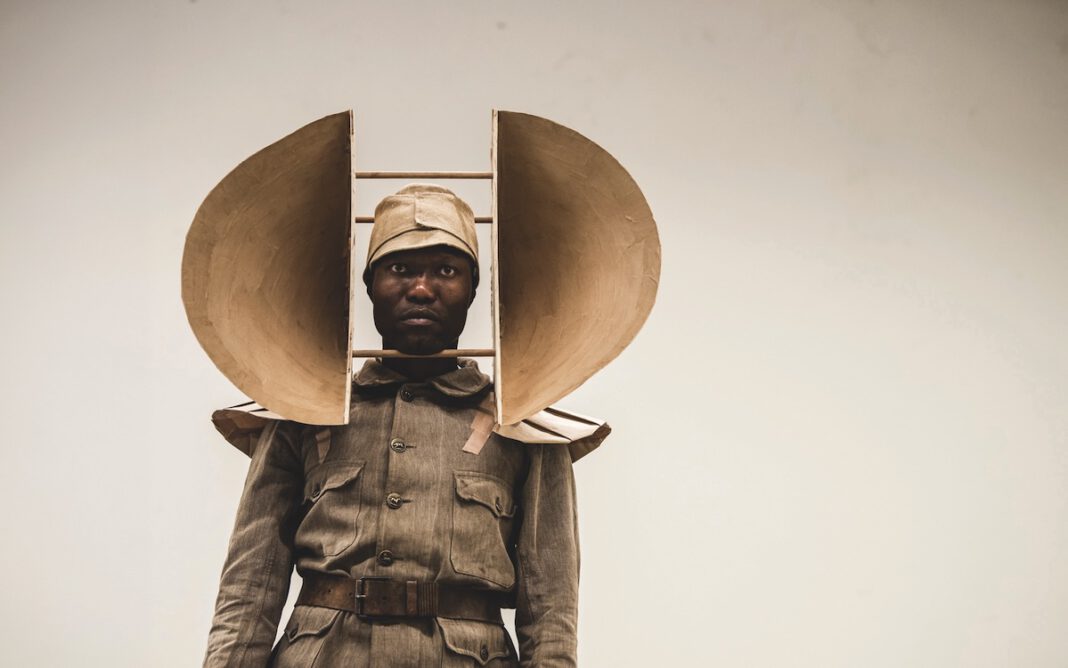
Even in South Africa, their story is not widely known: Two million Africans labored, fought and died during the First World War. In South African performance visionary William Kentridge’s The Head & the Load, presented by Cal Performances Nov. 12-15, this history is brought to light with language, music and dance.
Composer Philip Miller stated in an email: “Even in post-apartheid South Africa, many South Africans also still do not know of this history. We are living in a time, where racism, colonialism and genocide are very much alive. This production reminds us that we cannot move forward unless we recognize and commemorate these histories and challenge the way in which colonial histories are still told in the history books.”
Responding to the same question, “Why does this story matter now?”, choreographer Gregory Maqoma wrote: “Because the mechanisms of erasure have not disappeared. We continue to live in a world where some lives are mourned publicly while others are reduced to statistics, where power determines whose suffering becomes history and whose suffering remains a footnote.”
He continued, “At a time when we are witnessing wars, genocides, displacement and the increasing normalization of violence across the world, the work asks us to reconsider what it means to carry the burden of someone else’s conflict.”
The Head & the Load was first performed in London in 2018 at the Tate Modern. The piece takes its title from the Ghanaian proverb: “The head and the load are the troubles of the neck.” Kentridge’s work has been featured in Cal Performances in 2023 (Sibyl) and 2025 (The Great Yes, The Great No), and the upcoming performance is a West Coast premiere. Series notes state: “[It] continues Kentridge’s exploration of history, language, and artistic and political movements through richly layered and inventive performance works.”
The text uses sources ranging from anticolonial authors to Dada poets, in multiple languages. Performances will take place at Oakland’s Henry J. Kaiser Center for the Arts Arena because a massive stage is required.
Composer Miller has collaborated with Kentridge for more than 30 years, he said. Maqoma noted that his working relationship with Kentridge began more than a decade ago, saying, ‘[It has] developed through a shared curiosity about how different artistic languages can coexist without surrendering their individual identities.”
The Music
Miller’s process in evolving the score was intricate. “Right from the very beginning I wanted to bring a strong emotional and dramatic layer, to evoke in the audience the many conflicting feelings around this complex and untold history” to break a long silencing of this story, he said. This silence gave him “the freedom to imagine a sonic world that was multi-layered and spoke both to colonial musical tropes and to the diverse African musical traditions and languages of the regions from which the soldiers came.”
The voices of African soldiers and porters are “unmuted.” They are, he said, partly a lamentation for their “disregarded and unknown dead.” Miller used historical archives to find a list of “gifts” sent to African soldiers and carriers by the English Committee for the Welfare of Africans. These included gramophone records and musical instruments, including accordions, harmonicas and banjos, which the recipients used to play and likely compose music. This was not recorded, but as Miller composed the score, he included the sounds of these instruments.
He also used texts unearthed in the archives to form lyrics that were absorbed into Kentridge’s libretto. When The Head & the Load was workshopped, the written music was “developed and expanded upon by singers and musicians. This process happened simultaneously with [Kentridge’s] creation of the visual world … during this time we can together start to look at how sound, image and movement dialogue with each other, sometimes interacting in opposition and at other times in sympathy,” Miller said.
He used sonic collage and montage, cutting and reassembling “musical quotations” from both African and European repertoires. He juxtaposed an ancient Zulu war chant with a Paul Hindemith piano sonata, and a cabaret song by Arnold Schoenberg was intercut with “the cacophonous percussive rhythm of the singers slapping their hymn book covers (“mpampa-mpa”) in traditional Methodist Church-style,” Miller added.
He further said, “These compositional techniques create an unpredictability and instability between the geographies and histories of Africa and Europe, unsettling fixed narratives and allowing different histories to resonate simultaneously.”
The Movement
Maqoma again emphasized how and why unearthing these histories is vital. “I was familiar with the broader history of colonialism and the First World War,” he said, “but not necessarily with the full extent of Africa’s involvement … what became profoundly revealing was the scale of African participation, particularly the hundreds of thousands of African porters and laborers whose bodies carried the machinery of war, often without recognition, dignity or choice.
“Growing up in South Africa under apartheid,” he continued, “I understood very early that history is not simply what happened, but what we are permitted to remember.”
Asked how this version of the piece will differ from the 2018 premiere, he noted that a work of this kind is never entirely set. New performers and new times bring new energy to a performance piece. “Memory is not static,” he said, “and neither is performance.”
Maqoma addressed the issue of depicting violence and war through dance, noting that one of the greatest challenges is resisting the temptation to turn suffering into spectacle. “I am less interested in reproducing the literal actions of war than in exploring what war does to the body: How it changes posture, interrupts breath, imposes obedience, creates exhaustion and transforms human beings into instruments of labor and conflict,” he said.
In The Head & the Load, the act of carrying things becomes central to the choreography, both physically and metaphorically. “We carry objects, histories, responsibilities, grief and the consequences of decisions made by others,” he said. The human body under heavy loads might include a collapsing spine or an interrupted movement, communicating what words can’t. “The body does not simply represent violence. It remembers, resists and survives it,” Maqoma said.
Dance can also communicate the totality of experience. “War often reduces people to numbers, uniforms or anonymous masses. Through choreography, I am interested in recovering the humanity and individuality within that collective experience,” he added.
He said the choreography for this work “is not to manufacture the appearance of suffering. It is to create a physical language through which audiences can recognize the weight of history and the persistence of human dignity.”
The Head & the Load is a Cal Performances “Illuminations: Innocence and Experience” event.
‘The Head & the Load,’ Nov. 12-14, 7:30pm; Nov. 15, 3pm. Henry J. Kaiser Center for the Arts, 10 10th St., Oakland. $50-175. 510.642.9988. calperformances.org