
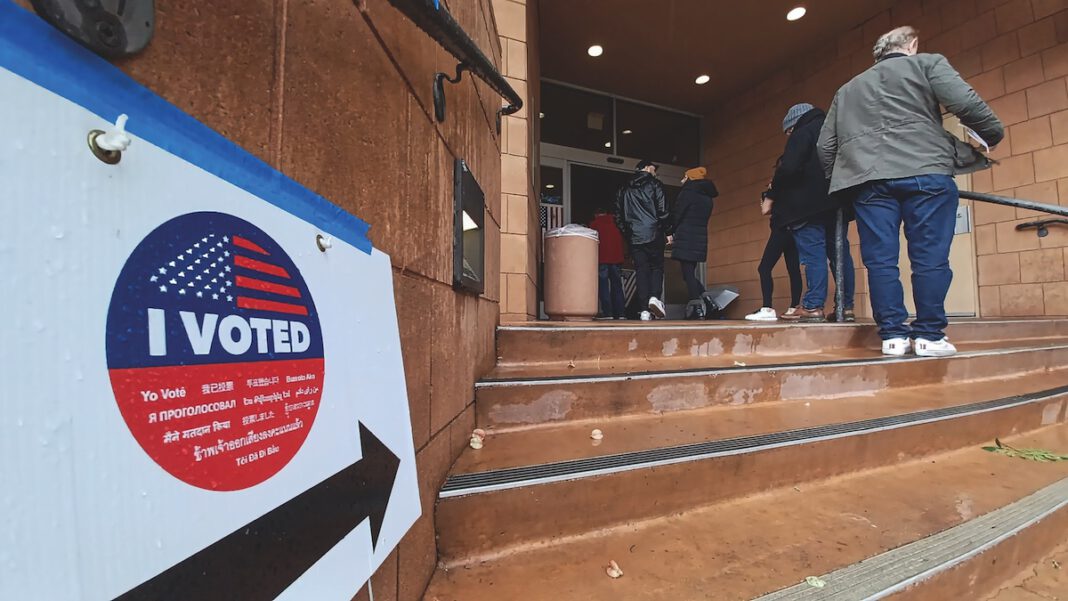
On Tuesday, Nov. 3, 2026, the midterm election day, no one pretended. Exercising their civic duty and right to vote, people in the East Bay and nationwide voiced their displeasure with the current federal administration, Republicans and policies led by President Donald Trump. The dual impact of tariffs imposed by Trump and America’s involvement in multiple global wars that have driven the cost of living through the roof lay at the heart of it all. On a local level, the election was about rising food, gas, housing and health care prices; funding for public transportation; a billionaire tax; and which city officials and city council members are best suited to lead during the next few years. A brief roundup of the results most important to residents in Alameda County—as of Monday, Nov. 9—includes the propositions, measures and elected officials most important to local residents. For further updates—on Nov. 13 and 16—visit alamedacountyca.gov/rovresults/260/.
Oakland Mayor
Barbara Lee won overwhelmingly in her bid to lead the East Bay’s most-populated city. Lee was elected in a special election last year and had the backing of several local unions and former mayors. With 85.36% of voters giving her a thumbs-up and a full term, she told supporters gathered on election night her top priorities have and will continue to be the same as theirs: safer streets, cleaner neighborhoods, affordable housing, good jobs, strong businesses, addressing homelessness and a city hall that works for the people. “No excuses. You wanted results, and we made progress,” she said about her first few months as mayor.
Alameda Mayor
Malia Vella won with 47.77% of the vote, continuing the current 24-year election of female mayors to govern the island city.
San Leandro Mayor
The incumbent mayor, Juan González III, received 68.47% of the vote and approval for another term from voters. Voters waiting to learn about city council member results will have to wait until a potential ballot error is sorted out.
Oakland City Council
Incumbents Kevin Jenkins and Charlene Wang were re-elected. Jenkins was first elected in 2023 to represent District 6, which covers the area around Mills College, Frick and the Hegenberger corridor. He held a commanding lead with 84.17% of the vote on Monday evening. Wang in District 2, which covers the Lakeshore, Cleveland Heights and San Antonio neighborhoods, had 60.64% of the vote. Janani Ramachandran ran unopposed in District 4, which covers Glenview, Redwood Heights, Montclair and Merriwood.
Berkeley City Council
Daria Wrubel (District 1), Igor A. Tregub (incumbent, District 4), Syrak Micael (District 7), Mark Humbert (incumbent, District 8).
Measure EE
Measure EE approval of 73.64% as of Monday night means a strong mayor system at City Hall will position Oakland’s government more in line with larger California cities like San Francisco and Los Angeles. Mayor Barbara Lee cast the tie-breaking vote in June to place it on the ballot. It provides the mayor with the authority to veto legislation and grants her and her successors more direct control over city departments. Opponents said it would potentially increase corruption and highlighted former mayor Sheng Thao and her trial in federal court on corruption charges.The city council’s power will be reduced by Measure EE, but can override the mayor’s vetoes with a two-thirds vote, establish an independent office to help council members craft legislation, and establishes a path to raising their salaries, and other changes. It also allows them to subpoena city staff to testify at public hearings. With 102,104 votes cast in the “yes” column (73.64%) and 36,555 voters (26.36%), the measure passed.
RTM (Regional Transit Measure)
The five-county Bay Area Regional Transit Measure received strong support from voters. As of Monday night, 354,169 voters gave it a 66.83% incline against which the 33.17% voters opposing the measure were not destined to tilt in their favor. The strongest argument for the half-cent sales tax increase Bay Area transit agencies said was crucial, was voters’ need for maintaining service levels, keeping BART stations open, and ensuring city dwellers and others could get from home to work, school and other essential locations. Opponents said the measure was flawed and proposed the RT should be more expeditious, accountable and streamlined in the use of funds already in place, while voters overwhelmingly rejected that position as unrealistic—if worth working towards—and voted to support the measure and avoid disrupting an entire transit system they rely on daily.
Prop 40
The Secretary of State reported that 52.8% of voters opposed the billionaire tax, with 99% of precincts partially reporting results. The one-time tax on billionaires to fund healthcare and education would have required an estimated 200 Californians whose net worth exceeded $1 billion at the start of this year to pay a one-time 5% tax. That money was earmarked primarily for healthcare and tied to “poison pill” Props 41 or 42 that would nullify the tax if they earned more votes than Prop 40. With 52.8% “no” votes and 47.2% “yes” votes, Prop 40 failed to pass.
Prop 41 and Prop 42
Prop 41 would have made it harder to pass new special taxes by requiring the state auditor to review any special tax proposal before it goes to voters. Votes against stood at 54.9%, with 45.1% of voters approving the proposition. Meaning the prop fell. Prop 42 makes it harder to create a wealth tax in California by prohibiting new taxes on the mere ownership of assets such as investment accounts, business interests and personal property. It was placed on the ballot by opponents of the proposed billionaire tax. It passed. As of Monday, it had 51.6% voting “yes,” and 48.4% voting “no.”
Prop 39
This proposition required that IDs be presented when voting. It was defeated. Supporters said it would require citizens to show identification when voting or write the last four digits of their ID number on ballots dropped off or mailed. Opponents successfully argued it was equivalent to voter suppression. Distrust of the Trump administration for protecting people’s right to vote resulted in 60.6% rejecting it, easily topping the (39.4%) supporters.
Prop 45
Environmental reviews are important in building projects in California. Despite environmental groups and others concerned about losing strong protections for air, land, open spaces and other elements, supporters voted to narrow the windows for reviews they say have too many hurdles and impede necessary development in the state. The proposition received 43.9% approval and 56.1% opposition.
Measure Y
In Berkeley, a parcel tax to provide grants for performing arts groups passed, indicating strong support for industries that generate income and contribute to the social and cultural wealth of the city, and the Bay Area at large. It designates $6 million per year to keep the theater and arts scene afloat, and limiting cost to 7 cents per square foot of improvements for the next 12 years. The measure passed with 52.97% support versus 47.03% opposed, as reported by Monday, Nov. 9.