Aries (March 21–April 19): If I warned you not to trust anyone, I hope you would reject my simplistic fear-mongering. If I suggested that you trust everyone unconditionally, I hope you would dismiss my delusional naiveté. But it’s important to acknowledge that the smart approach is far more difficult than those two extremes. You’ve got to evaluate each person and even each situation on a case-by-case basis. There may be unpredictable folks who are trustworthy some of the time, but not always. Can you be both affably open-hearted and slyly discerning? It’s especially important that you do so in the next sixteen days.
Taurus (April 20–May 20): As I meditated on your astrological aspects, I had an intuition that I should go to a gem fair I’d heard about. It was at an event center near my home. When I arrived, I was dazzled to find a vast spread of minerals, fossils, gemstones, and beads. Within a few minutes, two stones had commanded my attention, as if they’d reached out to me telepathically: chrysoprase, a green gemstone, and petrified wood, a mineralized fossil streaked with earth tones. The explanatory note next to the chrysoprase said that if you keep this gem close to you, it “helps make conscious what has been unconscious.” Ownership of the petrified wood was described as conferring “the power to remove obstacles.” I knew these were the exact oracles you needed. I bought both stones, took them home, and put them on an altar dedicated to your success in the coming weeks.
Gemini (May 21–June 20): George R. R. Martin has written a series of fantasy novels collectively called A Song of Ice and Fire. They have sold 60 million copies and been adapted for the TV series Game of Thrones. Martin says the inspiration for his master work originated with the pet turtles he owned as a kid. The creatures lived in a toy castle in his bedroom, and he pretended they were knights and kings and other royal characters. “I made up stories about how they killed each other and betrayed each other and fought for the kingdom,” he has testified. I think the next seven months will be a perfect time for you to make a comparable leap, Gemini. What’s your version of Martin’s turtles? And what valuable asset can you turn it into?
Cancer (June 21–July 22): The editors of the Urban Dictionary provide a unique definition of the word “outside.” They say it’s a vast, uncomfortable place that surrounds your home. It has no ceiling or walls or carpets, and contains annoying insects and random loud noises. There’s a big yellow ball in the sky that’s always moving around and changing the temperature in inconvenient ways. Even worse, the “outside” is filled with strange people that are constantly doing deranged and confusing things. Does this description match your current sense of what “outside” means, Cancerian? If so, that’s okay. For now, enjoy the hell out of being inside.
Leo (July 23–Aug. 22): We all go through phases when we are tempted to believe in the factuality of every hostile, judgmental, and random thought that our monkey mind generates. I am not predicting that this is such a time for you. But I do want to ask you to be extra skeptical toward your monkey mind’s fabrications. Right now it’s especially important that you think as coolly and objectively as possible. You can’t afford to be duped by anyone’s crazy talk, including your own. Be extra vigilant in your quest for the raw truth.
Virgo (Aug. 23–Sept. 22): Do you know about the ancient Greek general Pyrrhus? At the Battle of Asculum in 279 BCE, his army technically defeated Roman forces, but his casualties were so substantial that he ultimately lost the war. You can and you must avoid a comparable scenario. Fighting for your cause is good only if it doesn’t wreak turmoil and bewilderment. If you want to avoid an outcome in which both sides lose, you’ve got to engineer a result in which both sides win. Be a cagey compromiser.
Libra (Sept. 23–Oct. 22): If I could give you a birthday present, it would be a map to your future treasure. Do you know which treasure I’m referring to? Think about it as you fall asleep on the next eight nights. I’m sorry I can’t simply provide you with the instructions you’d need to locate it. The cosmic powers tell me you have not yet earned that right. The second-best gift I can offer, then, will be clues about how to earn it. Clue number one. Meditate on the differences between what your ego wants and what your soul needs. 2). Ask yourself, “What is the most unripe part of me?” and then devise a plan to ripen it. 3). Invite your deep mind to give you insights you haven’t been brave enough to work with until now. 4). Take one medium-sized bold action every day.
Scorpio (Oct. 23–Nov. 21): Galway Kinnell’s poem “Middle of the Way” is about his solo trek through the snow on Oregon’s Mount Gauldy. As he wanders in the wilderness, he remembers an important truth about himself: “I love the day, the sun . . . But I know [that] half my life belongs to the wild darkness.” According to my reading of the astrological omens, Scorpio, now is a good time for you, too, to refresh your awe and reverence for the wild darkness — and to recall that half your life belongs to it. Doing so will bring you another experience Kinnell describes: “an inexplicable sense of joy, as if some happy news had been transmitted to me directly, by-passing the brain.”
Sagittarius (Nov. 22–Dec. 21): The last time I walked into a McDonald’s and ordered a meal was 1984. Nothing that the restaurant chain serves up is appealing to my taste or morality. I do admire its adaptability, however. In cow-loving India, McDonald’s only serves vegetarian fare that includes deep-fried cheese and potato patties. In Israel, kosher McFalafels are available. Mexicans order their McMuffins with refried beans and pico de gallo. At a McDonald’s in Singapore, you can order McRice burgers. This is the type of approach I advise for you right now, Sagittarius. Adjust your offerings for your audience.
Capricorn (Dec. 22–Jan. 19): You have been flirting with your “alone at the top” reveries. I won’t be surprised if one night you have a dream of riding on a Ferris wheel that malfunctions, leaving you stranded at the highest point. What’s going on? Here’s what I suspect: In one sense you are zesty and farseeing. Your competence and confidence are waxing. At the same time, you may be out of touch with what’s going on at ground level. Your connection to the depths is not as intimate as your relationship with the heights. The moral of the story might be to get in closer contact with your roots. Or be more attentive to your support system. Or buy new shoes and underwear.
Aquarius (Jan. 20–Feb. 18): I haven’t planted a garden for years. My workload is too intense to devote enough time to that pleasure. So eight weeks ago I was surprised when a renegade sunflower began blooming in the dirt next to my porch. How did the seed get there? Via the wind? A passing bird that dropped a potential meal? The gorgeous interloper eventually grew to a height of four feet and produced a boisterous yellow flower head. Every day I muttered a prayer of thanks for its guerrilla blessing. I predict a comparable phenomenon for you in the coming days, Aquarius.
Pisces (Feb. 19–March 20): The coming days will be a favorable time to dig up what has been buried. You can, if you choose, discover hidden agendas, expose deceptions, see beneath the masks, and dissolve delusions. But it’s my duty to ask you this: Is that really something you want to do? It would be fun and sexy to liberate so much trapped emotion and suppressed energy, but it could also stir up a mind-bending ruckus that propels you on a healing quest. I hope you decide to go for the gusto, but I’ll understand if you prefer to play it safe.
Minji Sohn’s work is based on endurance — that of the artist and the viewer. Monotonous and difficult to watch, her latest performance piece, Again, and Again, and Again at Aggregate Space Gallery (801 West Grand Ave., Oakland), draws viewers into the artist’s childhood imagination, in which she combats fears and anxieties through obsessive rituals.
At the show’s opening last week, Sohn sat inside of a sprawling installation that resembled a playground sandbox. Over and over again, she shoveled 25 scoops of sand into a plastic pail — counting each scoop as she went — before proceeding to dump its contents back into the pile and starting over. After repeating this action for two hours, she moved to the other side of the room, where there was an installation that featured two bookshelves and a pile of books with blank covers. Sohn counted the pages of each book, one by one, before throwing the book back into the pile and grabbing a new one from the stack.
Minji Sohn counted books’ pages in her performance Again, and Again, and Again.
Credits: Bert Johnson
Minji Sohn counted books’ pages in her performance Again, and Again, and Again.
Credits: Bert Johnson
Watching the performance component of Again, and Again, and Again (the footage of which Aggregate Space plans to project on the walls for the exhibition’s duration) can be taxing. But the exhibition resists our desire for spectacle, and the notion that art should be entertaining.
Despite the show’s tediousness, one of its strengths is its ability to trap viewers inside Sohn’s fictionalized, nostalgic world, not through narrative or even visuals, but through a sort of meditation. As Sohn counts each scoop of sand or each page of a book, her amplified voice makes it impossible for her audience to carry on conversations or even get lost in thought. Viewers have no choice but to be acutely aware of Sohn’s interactions with the objects in the space, which were each carefully curated, like props in a play. Her stylized depiction of the past speaks to the ways our life experiences crystallize into redacted memories that shape our personal stories of who we are.
In moments of panic and anxiety, the calming act of counting often helps people to find their breath and re-ground themselves in reality, dominating negative emotions. That therapeutic effect seems to be what Sohn is attempting to emulate. Two drawings at the gallery’s entrance feature Sohn shoveling, turning pages, and, presumably, counting. But in contrast to the sparse installations, one drawing shows monsters encircling her in the library. In the other, children jeer on the playground as she plugs away at her task.
But the reference to childhood anxieties in the contextualizing drawings feels empty when the rest of the work doesn’t do much to develop this idea either aesthetically or conceptually. Though Sohn’s repetitive performance is boldly demanding, she ultimately doesn’t take full advantage of this process’ potential. Without invoking broader concepts or a more poignant depiction of memory and perception, Sohn leaves an emotional or intellectual takeaway wanting.
I’m a gay man who is ready to start cheating on my boyfriend. We’ve had a wonderful 3.5-year-long relationship full of respect, affection, support, and fun. I love everything about our relationship, and our sex life was great … until he moved in eight months into the relationship. At that point, he lost all interest. I’ve tried everything: asking what I can do differently, being more aggressive, being more passive, suggesting couples therapy, getting angry, crying, and breaking up twice. (Both breakups lasted only a few hours because I honestly don’t want to leave him.) When I bring up an open relationship, he just goes quiet. I’ve moved past most of the anger, frustration, hurt, embarrassment, and sadness. But I won’t accept a life of celibacy. I would like to get some discreet play on the side. My boyfriend is very perceptive, and I’m a bad liar. I don’t want to get caught — but how should the conversation go if (when) I do? I’m leaning toward something like this: “I’m sorry it came to this and I know we agreed on monogamy, and I gave you monogamy for 3.5 years, but part of agreeing to monogamy is the implicit promise to meet your partner’s sexual needs. Everything else about our relationship is wonderful, but we couldn’t fix this one thing, so instead of continuing to push the issue, this is what I decided to do.” Good enough?
Can’t Help Exploring Another Tush
The speech you’re planning to give after you get caught is lovely, CHEAT, but you should give it before you get caught. Tell your boyfriend you love him — you would have to, considering what you’ve put up with for nearly three years — and that you have no desire to leave him. But while your relationship is wonderful in many ways, it’s not sexual in any way. And while you’re willing to settle for a companionate relationship, you’re not willing to settle for a sexless existence.
Rather than being threatened by your occasional, discreet, and safe sexual adventures, CHEAT, your boyfriend should be grateful for them. Because those sexual adventures, and your boyfriend’s acceptance of them, will make it possible for you to stay together. Hopefully he’ll see that the men you’ll be fucking on the side aren’t a threat to your relationship but its salvation.
If your boyfriend can’t see that, if he insists that your relationship remain monogamous and sexless (wouldn’t that technically mean he’s the only person you don’t have sex with?), give breaking up another try. The third time might be the charm.
I’m a woman in a hetero marriage. My husband and I enjoy skimming the Craigslist “casual encounters” section. It’s like people-watching, but NSFW. We recently stumbled on an ad posted by a male friend. The ad was soliciting gay mutual BJ/HJ, with the stipulation that the first one to come (the loser?) gets fucked in the ass by the other (the winner?). Other than the concept of winners and losers during sex, I’ve got no issues. The thing that gnaws at my conscience is this: Our friend is a young guy, bi-curious, and impulsive. Once I got over the giggles of glimpsing a dick pic that was not intended for my eyes, I began to worry about our friend’s risky behavior. Do I say something? I care about this guy, but I don’t want to come off as “mommy” or “creepy.”
Dude’s Extremely Risky Plan Elevates Stress
My first impulse was to tell you to mind your own business —o r MYOB, as the late, great Ann Landers used to say (Google her, kids) — because you don’t actually know if your friend is taking foolish risks. He could be using condoms, taking Truvada, and carefully vetting his play partners. But if I spotted a friend’s dick on Craigslist in an ad that left me the least bit concerned for his safety, I would say something. I don’t mind coming off as “mommy” (meddling mommy impulses are a requirement for this gig), and if looking out for your friends is “creepy,” then I’m a creep.
I’d go with something like this: “I spotted your ad — and your cock — on CL. What you’re looking for sounds hot. But I hope you’re being safe: using condoms, being choosy, taking Truvada. And speaking from experience, getting fucked right after you come sounds sexy in theory, but it’s not much fun in reality. So I hope you’re taking a refractory-period-length break — maybe for ice cream? — before the loser gets fucked.”
I’m a gay man in my late 20s, and I can’t get fucked. I have tried to train my ass, but the largest thing I can place inside remains a small butt plug. If I try anything bigger, the pain is unbearable. I’ve always been a very anxious person, and it’s clear my anxiety goes right to that area. Sometimes, after trying to place something larger inside me (using tons of lube, of course), I will get a hemorrhoid. Since those are horrible to deal with, I think my mind has started to associate any type of anal play with getting hemorrhoids. The problem is that I feel like I’m a bottom. Yes, I will top guys, and I don’t mind it, but I find that the men to whom I’m most attracted want to fuck me, which is something I would like. I’m at my wit’s end because I feel like my relationships/hookups/FWB situations are all negatively affected by my inability to get fucked.
Determined Efforts Fully Enrage Anal Tissues
“Anxiety and fear can definitely make those muscles tighten up. And unfortunately, worrying about pain during sex makes it worse,” said Charlie Glickman, sexuality educator and author of The Ultimate Guide to Prostate Pleasure (CharlieGlickman.com). “His hemorrhoids are probably caused by the anus squeezing really hard and trapping blood in the arteries inside the anus.”
So what can you do to alleviate your anxiety, fear, and squeezing? “The first thing for him to do is use a salve on the skin around and inside the anus,” said Glickman. “Apply it after washing, and it doesn’t take much. It’s like putting lip balm on dry lips. Cocoa butter or coconut oil work well. I also like the golden seal and myrrh formula by Country Comfort. Apply it twice a day.”
Give those balms some time to work before you start exploring again. And once you start: breathe deeply, take it slow, and play with your cock too. “Arousal helps,” said Glickman, “so he should be sure to include cock pleasure before going near his anus. It’ll also help if he explores external anal massage without going inside. That can help his body unwind the tension and let go of the flinch response. There are lots of great external massage moves that can feel amazing on their own or as part of foreplay. Look for the anal massage how-to videos on eroticmassage.com.”
Enjoying a few dozen — or a few hundred — orgasms with your ass in play but not the focus, i.e., your ass is being stimulated but not penetrated, DEFEAT, and you’ll begin to associate anal stimulation with pleasure and victory, not pain and hemorrhoids. Then you can give penetration another go: taking time to warm up, using lots of lube, pivoting to something else if it’s too painful.
Follow Charlie Glickman on Twitter @charlieglickman.
For years, journalists and sports pundits have blamed Oakland and Alameda County officials for the fact that the owners of the A’s and Raiders have yet to come up with viable plans for new stadiums in Oakland. The Bay Area News Group, which owns the Oakland Tribune, the city’s hometown daily, did it again this week, arguing in a page one news story that “if Oakland stumbles in its ballpark bid” for the A’s, then the team will once again be looking to leave.
It’s a strange paradox of the news business — that it’s a given that public officials, who are in charge of safeguarding taxpayer dollars, are responsible for coming up with detailed proposals for new facilities for wealthy owners of sports teams. No other privately owned enterprise enjoys such treatment. Indeed, journalists would typically be quick to question and criticize (and rightly so) if public officials were to use taxpayer resources to devise detailed plans for new facilities for other types of wealthy corporations.
An arial view of the Oakland Coliseum.
It’s not clear when sports team owners started to receive such special treatment from the press. But it’s silly when you think about it — especially in a city like Oakland and a county like Alameda, which both struggle mightily each year to pay for basic services for their citizenry. It’s even more absurd when you consider the fact that both public agencies were badly burned the last time they opened up their wallets for a sports team — the Raiders in 1995 — and today are still each paying $10 million annually to pay off the debt from that ill-advised deal.
In reality, it should always be up to the owners of large wealthy enterprises to come up with their own plans for their own facilities.
And now that the US Supreme Court has rejected the City of San Jose’s attempt to lure the A’s to the South Bay, team owners Lew Wolff and John Fisher no longer have an excuse for not coming up with one in Oakland. That’s especially true given the fact that Oakland and Alameda County also recently parted ways with Coliseum City developer Floyd Kephart. Wolff had made it clear that he had no interest in Kephart’s proposal for a massive mixed-use development on the Coliseum site.
Same goes for Oakland Raiders owner Mark Davis. He, too, had rejected Kephart’s proposal earlier this year, and now no longer has an excuse for not coming up with a plan for a new stadium on the Coliseum site. In fact, the city’s proposal to spend $90 million to $120 million on infrastructure upgrades for new facilities at the Coliseum is more than generous enough.
Oakland officials have said that working on a plan with the Raiders is the higher priority, because the team is also seriously eyeing a proposal to build a new stadium in Southern California with the San Diego Chargers (or, perhaps, the St. Louis Rams). But hammering out a deal with the Raiders also could be tougher — primarily because Davis is not as rich as other sports team owners.
As it currently stands, the Raiders have a significant shortfall — Davis only has about $500 million for a new football stadium that is estimated to cost $900 million. And $200 million of the Raiders’ $500 million would come from a loan from the National Football League that the team would have to pay back. In other words, even though he has said repeatedly that remaining in Oakland is his first choice, Davis faces some serious financial issues in building a stadium here. It seems clear that he’s going to have to find some other revenue source — perhaps from developing his own mixed-use project on the site — in order for an Oakland stadium plan to pencil out. But it’s his responsibility to do so, not the city’s or the county’s.
Oakland and Alameda County, of course, have no money to spend on a new football stadium beyond the infrastructure upgrades. Indeed, Oakland Mayor Libby Schaaf deserves much credit for repeatedly promising to not use public dollars — and to not push the city further into debt — to build new sports facilities.
The A’s owners, Wolff and Fisher, by contrast, face fewer financial hurdles than the Raiders. For starters, a baseball park is cheaper to build because it’s smaller — it might cost as little as $600 million. Moreover, Fisher, co-owner of The Gap clothing empire, is a billionaire who is far more wealthy than Davis. The A’s have also said repeatedly that they don’t need public dollars for a new ballpark.
Nonetheless, Wolff and Fisher have continued to drag their feet on an Oakland stadium plan. Maybe it was because they were holding out hope for San Jose’s lawsuit against Major League Baseball. San Jose had argued that MLB used illegal monopoly powers to block the A’s from moving to the South Bay. On Monday, however, the Supreme Court dismissed San Jose’s claim.
In short, it’s time for Wolff and Fisher to step up to the plate. 
The strange glances are starting to become more frequent. James Fisher, a fourteen-year-old freshman at Oakland Charter High School, has noticed that as he gets older, more people on the street eye him with suspicious or fearful stares. “Some of them just look at me, and then they’ll look away,” he said. “Or sometimes, I go into stores, and they look at me like they think I’m going to do something bad.”
James is a Black teenager who is soft-spoken and looks about three years older than his actual age. On a recent afternoon last month, I chatted with him and Emma, his thirteen-year-old sister, at their house in the Upper Dimond neighborhood in the Oakland hills. The two siblings told me about their first weeks of high school and how they have enjoyed the freedom at times to walk around Oakland’s Chinatown district without their parents.
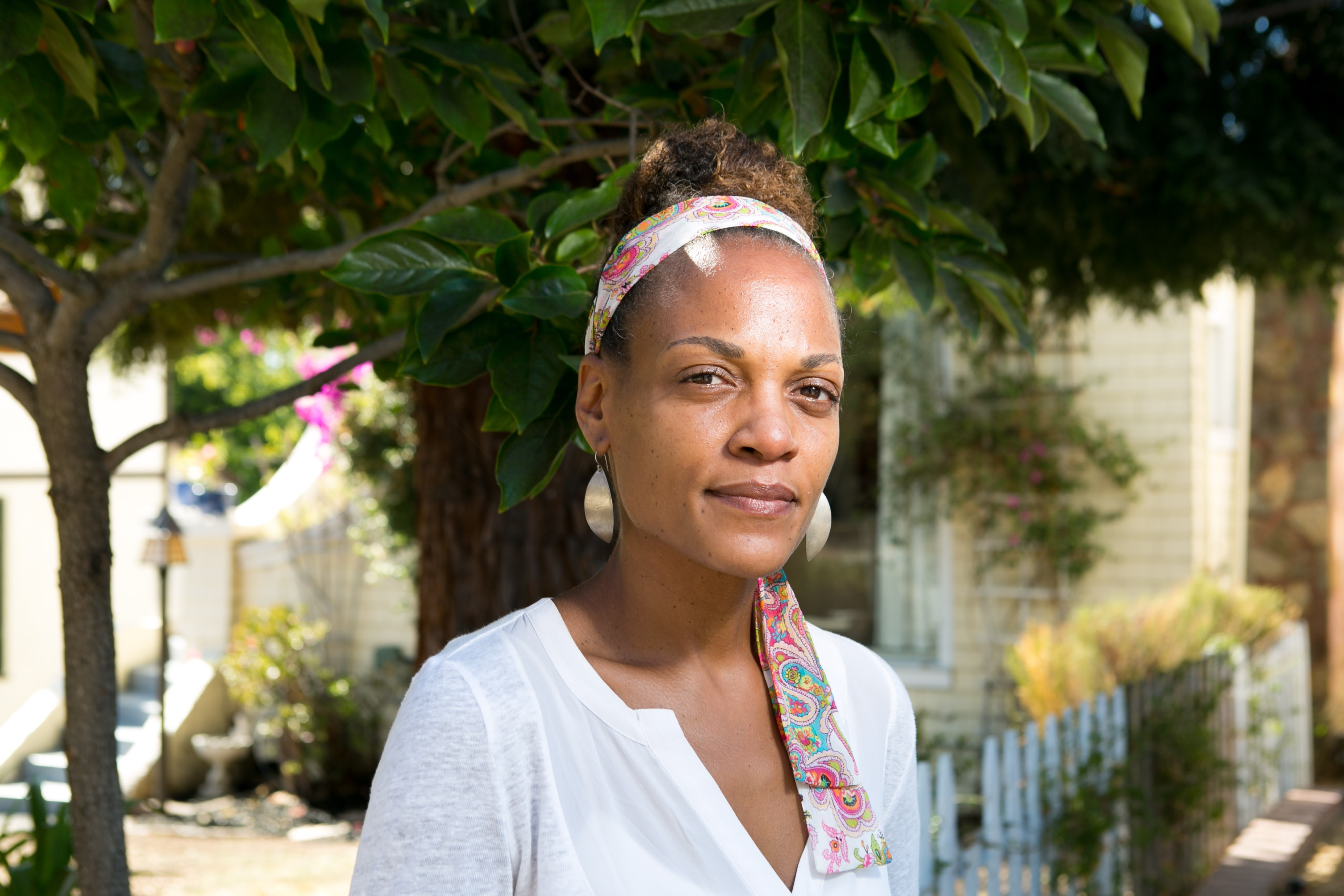
Shikira Porter, an Upper Dimond resident, has asked her neighbors to stop racially profiling Black Oaklanders on Nextdoor — but has faced significant pushback from Nexdoor users and the group moderator.
Credits: Bert Johnson
After a private security guard shot a Black teenage burglarly suspect in their neighborhood, Mitsu Fisher and Ann Nomura decided not to let their kids walk alone in the Upper Dimond anymore.
Credits: Bert Johnson
But they never walk around their own neighborhood alone.
The tree-lined residential street of large single-family homes where the Fishers live more closely resembles suburbia than a densely populated city. Positioned at the top of a steep hill near Dimond Canyon Park, their house feels worlds away from the busy urban bustle of MacArthur Boulevard and the Fruitvale district just to the southwest. On the surface, their block looks like an ideal place to raise kids — safe, family-friendly, and quiet. Although their individual street is very diverse — with about ten Black or mixed-race kids now living nearby — white residents are by far the largest racial group in the surrounding area. And it’s in this neighborhood, perhaps more so than any other part of Oakland, that James feels most like a target for the uncomfortable glances that are becoming increasingly common in his life.
Credits: Illustration by Roxanne Pasibe
But he and his parents are not just worried about hurtful stares from neighbors or passersby. Over the last two years, their neighborhood has become overrun with racial profiling — but not by police, rather by mostly white residents incorrectly assuming that people of color who are walking, driving, hanging out, or living in the neighborhood are criminal suspects. These residents often don’t recognize that they may have long held racial prejudices or unconscious biases, but recently, they’ve been able to instantly broadcast their unsubstantiated suspicions to thousands of their neighbors with the click of a mouse.
Nextdoor.com, a website that bills itself as the “private social network for neighborhoods,” offers a free web platform on which members can blast a wide variety of messages to people who live in their immediate neighborhood. A San Francisco-based company founded in 2010, Nextdoor’s user-friendly site has exploded in popularity over the last two years in Oakland. As of this fall, a total of 176 Oakland neighborhoods have Nextdoor groups — and 20 percent of all households in the city use the site, according to the company.
On Nextdoor, people give away free furniture or fruit from their backyards. Users reunite lost dogs with their owners. Members organize community meetings and share tips about babysitters and plumbers. But under the “Crime and Safety” section of the site, the tone is much less neighborly. There, residents frequently post unsubstantiated “suspicious activity” warnings that result in calls to the police on Black citizens who have done nothing wrong. In recent months, people from across the city have shared with me Nextdoor posts labeling Black people as suspects simply for walking down the street, driving a car, or knocking on a door. Users have suggested that Black salesmen and mail carriers may be burglars. One Nextdoor member posted a photo of a young Black boy who failed to pick up dog poop and suggested that his neighbors call the police on him.
White residents have also used Nextdoor to complain and organize calls to police about Black residents being too noisy in public parks and bars — raising concerns that the site amplifies the harmful impacts of gentrification. On Nextdoor and other online neighborhood groups — including Facebook pages and Yahoo and Google listservs — residents have called Black and Latino men suspicious for being near bus stops, standing in “shadows,” making U-turns, and hanging around outside coffee shops. Residents frequently warn each other to be on the look out for suspects with little more description than “Black” and “wearing a hoodie.”
“These posts cast such a wide net on our young Black men,” said Shikira Porter, an Upper Dimond resident, who is Black. “You start seeing this over and over again, and you understand quickly that, oh, it’s the Black body that they’re afraid of.”
In some Nextdoor groups, when people ask their neighbors to think twice before labeling someone suspicious, other users attack them for playing the “race card” and being the “political correctness police.” Some groups have even actively silenced and banned the few vocal voices of color speaking up on the websites, according to records that I reviewed.
This sometimes toxic virtual environment has real-world impacts. Residents encourage each other to call police, share tips on how to reach law enforcement, and sometimes even alert cops and security guards about suspicious activity they’ve only read secondhand from other commenters. I spoke to longtime Oaklanders who say the profiling is getting worse, noting that they have recently had neighbors question them on their block or in their own driveway — suspicious of whether they might be up to no good. People of color described stories of white residents running away from them, screaming at them to leave a shared garden space, and calling police on young children in their own home. In some areas, the profiling is further exacerbated by the growing presence of private patrol officers whom residents have hired to guard the streets.
Even high-ranking officials with OPD, which has a formal partnership with Nextdoor, have admitted that the department is sometimes forced to respond to baseless suspicions about residents of color — the kind of profiling that can go unchecked in online groups. “If … they’re all feeding off of the same bias, then that could be harmful,” said OPD Assistant Chief Paul Figueroa. He later added, “Fear can really drive the application of bias.”
Now, a group of Oakland residents calling themselves Neighbors for Racial Justice is trying to fight back against the rampant profiling online and in their neighborhoods. But Nextdoor officials and the white residents who control and dominate the online groups do not appear to be taking their concerns seriously or willing to make substantive changes.
And as long as the profiling and prejudiced online posts persist, Mitsu Fisher, the father of James and Emma, is not letting his kids play outside or walk the streets of their own neighborhood without supervision. Mitsu made that an official policy in February 2014 after a patrol officer in the Oakmore neighborhood — who was working for a private security company and was not supposed to be armed — chased and shot a Black teenage boy suspected of committing a burglary, according to police. The fact that a private guard shot a young suspect was upsetting enough to Mitsu, but it was the response from his neighbors online that led him to truly fear for his own kids’ safety.
On Nextdoor and a neighborhood Yahoo group, residents celebrated the private security guard for shooting the teenager — and organized to buy him a thank-you gift.
When I first met Audrey Esquivel for coffee in the Laurel district, she handed me a grainy photocopy of a one-page document dated June 15, 1937. The report, from the government-sponsored Home Owners’ Loan Corporation, offered a formal description of the housing characteristics and desirability of the Fruitvale district in East Oakland. Based on information from a City of Oakland building inspector, the report stated that the neighborhood’s “favorable influences” included its convenience to local transportation, schools, and shopping centers. There was, however, one main “detrimental influence” that made the neighborhood undesirable: “proximity to area [infiltrated] by Negroes.” And the area would likely become increasingly less desirable over the next decade due to continued “infiltration,” the report added.
Credits: Illustration by Roxanne Pasibe
Esquivel, who is mixed-race Black and lives in the nearby Glenview neighborhood, recently stumbled upon the document while reading about “redlining” — the decades-long process by which the government and banks systematically enabled white neighborhoods to prosper with mortgage loans while denying housing opportunities to communities of color. Like cities across the country, Oakland became very segregated because of redlining with wealthier white communities thriving in the hills and poorer Black neighborhoods languishing in the flatlands.
“We can show how the history of the neighborhood is playing out over time,” said Esquivel, who is a member of the Neighbors for Racial Justice group. “We went from this time when segregation such as this was legal, and it was okay to be openly racist and little Johnny could call Black people the ‘n-word.’ Now, it’s ‘Don’t call them anything. We’re all just human.’ There’s never been any education on how to successfully transition to integration.”
Oakland is much more integrated today than it was in the 1930s, although the hills are still largely white. In the 94602 zip code — which includes Glenview, Upper Dimond, and Oakmore — whites make up 46 percent of the population, Blacks make up 18 percent, and Latinos comprise 14 percent. The East Oakland flatlands neighborhoods to the south are majority Latino or Black.
Although Oakland may have come a long way since the days of redlining, Esquivel said that subtle racial tensions and prejudices are pervasive in her neighborhood and that she often encounters white residents who are, to varying degrees, uncomfortable with the presence of people of color. When she moved from North Carolina to the East Bay, she thought she would be joining a progressive community — one in which she would not feel ostracized or unwelcome due to the color of her skin. But the fears that her white neighbors have when they see her are real and damaging, she said.
For people of color living in Oakland neighborhoods that are still predominantly white, many of the concerns regarding racial profiling stem from community and police efforts to fight crime. Even as overall crime continues to decline here, Oakland consistently ranks as one of the top ten cities for violent crime per capita. In terms of crime prevention efforts, much of the neighborhood-level organizing has focused on robberies, burglaries, and car break-ins — the criminal offenses that can plague certain areas in waves and shake people’s sense of security in their own neighborhoods or homes. As a snapshot, through mid-September, in OPD’s Area 3 — which includes Lakeshore, Eastlake, Dimond, Laurel, and Fruitvale — there had been 651 reported robberies, 1,388 burglaries (893 of which were car burglaries), and 348 aggravated assaults.
But OPD also responds to a considerable number of calls from citizens concerned about the people they see in their neighborhoods: Across the city during the past two years, according to data that the department provided to me, police have received an average of roughly 730 calls for suspicious people or vehicles every month.
Through Neighborhood Crime Prevention Council meetings and other local organizing groups, residents in the hills have pressured the city for years to devote more police officers to patrolling their streets and investigating property crimes and violent offenses in their neighborhoods. Motivated by the belief that OPD prioritizes resources in high-crime areas and does not do enough to protect their homes in the hills, residents have repeatedly taken matters into their own hands. Some have formed traditional neighborhood watch groups in which volunteers walk the streets. Others have installed security cameras. And many neighborhoods have launched private email listservs that enable residents to efficiently communicate with their neighbors. In the early days of the listservs, the idea was that residents could use the online communities to coordinate efforts to push for police officers — and also share tips about suspicious activity or crimes in real time.
One of the first in Oakland was a Dimond email listserv that launched roughly seventeen years ago, according to Ann Nomura, who is Mitsu Fisher’s wife and the mother of James and Emma. “It was very much a grassroots tool for organizing,” said Nomura. “It was really focused on getting basic services.”
But as more of these lists emerged and grew in membership — and as concerns about crime escalated — the tone shifted, according to Nomura, who has subscribed to numerous listservs over the years. Eventually, many groups frequently attracted inflammatory posts or racially insensitive messages about crime trends and suspicious people, she said. Nomura sent me one 2012 example from the Dimond group in which a white woman warned of a “light skinned black female” talking on her cell and walking her dog. “I don’t recognize her. Has anyone described any suspect of crime like her?” the neighbor wrote. Although some responded that the post seemed unnecessary, others thanked her for sharing the information and agreed that the woman seemed suspicious. Eventually, a neighbor chimed in to say that the woman lived a few streets away and has lived in the same house her whole life.
When lifelong Oakland resident Leland Thompson joined “Glenfriends” — a Yahoo group for the Glenview neighborhood that started in 2001 — he was shocked to see how many posts described suspicious people with vague descriptions that matched him: “Black man, five-ten, 160 pounds, bald,” he said. Thompson told me that he and his wife, who is white, now have a running joke in which she’ll read the listserv and tell him, “‘Oh, you’re on Glenfriends again!'”
Emma and James Fisher don’t walk around the Upper Dimond due to concerns about racial profiling.
Credits: Bert Johnson
After seeing so many posts warning of dangerous Black men, Thompson, who grew up in the projects of East Oakland and has lived in Glenview for seventeen years, said he stopped wearing hoodies. “It’s sad because people are not seeing individuals. They’re just seeing profiles and they’re acting on it,” he said. “Even though this is my community and my home, they just see a silhouette.”
Thompson, an executive coach and leadership trainer, used to go jogging at 5:30 a.m. in his neighborhood, but he said residents would clearly get scared of him, and eventually he decided it was only a matter of time before someone called the police on him. He never runs in his neighborhood anymore. “How come I have to change to make you comfortable? I have to show you that I’m not threatening as opposed to you making the assumption that based on my behavior, I haven’t posed a threat?” he said with a loud sigh.
While lists such as Glenfriends became increasingly divisive over time, they weren’t necessarily reaching wide audiences in Oakland and tended not to have formal partnerships with OPD. But in 2011, Nextdoor.com entered the Oakland market, offering a more advanced, well-designed website for neighborhood messaging — a platform that eventually attracted interest from police. And both supporters and critics of the company now agree: It was a game-changer for online communication and crime reporting in Oakland.
When Oakland Police Lieutenant Chris Bolton first learned about Nextdoor, it was clear to him that the website offered an unprecedented opportunity. Bolton — who is the department’s social media guru and is known for his active use of Twitter — said a resident of the Golden Gate neighborhood in North Oakland suggested to him in 2013 that police consider using the site to communicate directly with residents. At that point, there were roughly 7,500 Oakland residents on Nextdoor.
“I was drawn to it personally because of the organic way that neighborhoods formed and chose to communicate with one another,” Bolton said in an interview. “I just feel that the more people talk with one another, the more we know our neighbors. And the more we share information, the stronger that neighborhood can be.”
In June 2013, the department launched a pilot partnership with Nextdoor in North Oakland, which enabled OPD to have a profile on the site that officials could use to send out messages to residents. In April 2014, OPD and Nextdoor launched a formal citywide partnership, and today police regularly publish alerts, suspect photos, missing person reports, crime statistics, and other public safety information. Sometimes, police send out citywide alerts, but more often local area commanders write neighborhood-specific posts for limited clusters of users.
Since Bolton first heard about Nextdoor, the site’s user base has grown exponentially in Oakland and now includes nearly 43,000 total members spread out across 31,000 homes in the city, he said. When I met Bolton in early September, he told me that 2,000 Oakland users had joined in the previous thirty days. In order to join, users have to verify their addresses and use real names — so that when police officers send out messages, they know they are reaching city residents. Bolton said the department doesn’t have access to neighborhood posts and doesn’t monitor crime and safety messages unless users send them directly to OPD.
Since Nextdoor launched in 2010 with its first neighborhood group in Menlo Park, Oakland has been at the forefront of the website’s expansion. Headquartered in downtown San Francisco, the company expanded nationally in October 2011 and now boasts more than 75,000 groups with an average of 100 new neighborhoods joining every day. The site, co-founded by tech entrepreneur and CEO Nirav Tolia, has also partnered with more than 1,200 government entities, mostly police departments, throughout the United States. That includes more than 35 law enforcement agencies in the Bay Area. The Nextdoor Oakmore group was one of the first neighborhoods on the site, and OPD partnered with the company before it had even rolled out its platform for public agencies.
Today, the five largest Nextdoor neighborhoods in Oakland are Adams Point, Golden Gate, Maxwell Park, Crocker Highlands, and Oakmore, according to the company. Because Oakland has long had active Yahoo and other email groups, Nextdoor was an easy sell for many neighborhoods, said company spokesperson Kelsey Grady, in a recent interview. “Oakland has been a community that has been interested in organizing for a long time. The adoption has been so great there.”
In Oakland, roughly 20 percent of all Nextdoor conversations are about crime and safety. The rest cover events, lost and found, free items, classifieds, and recommendations. In my review of Nextdoor crime posts from neighborhoods in North Oakland, East Oakland, and around Lake Merritt, I found that the vast majority of comments about suspicious behavior involved Black suspects. In a given month in a single neighborhood, out of several dozen total crime and safety posts, a small number of posts — usually three to five — typically feature descriptions of suspicious behavior with questionable justifications. And in many more posts that cite reasonably suspicious behavior or actual alleged crimes, users described suspects with few specifics beyond “African American,” male or female, old or young.
Oakland native Leland Thompson became so frustrated with Glenview residents profiling him and fearing he might be a criminal suspect that he stopped jogging in his own neighborhood.
Credits: Bert Johnson
“I get so nauseous and so angry,” said Porter, the Upper Dimond resident, who is also a member of Neighbors for Racial Justice. When I met her for coffee, she handed me a stack of Nextdoor Oakmore printouts with racially biased reports of suspicion.
One user told people to be alert after seeing an “African American driver” inside a white commercial van, wearing a “bright green vest,” parked on the street at 2 a.m. — nothing else suspicious. In a post this summer, a resident warned others to watch out for “two young African Americans, slim, baggy pants, early 20s” who said they were looking for a lost dog. Noting that they did not have “anything like bags to carry stuff out of a house they might break into,” the woman said the situation may be “benign,” but added, “I have a sense that it wasn’t.” In another post, a man warned of a “nefarious individual” — a Black youth who appeared to be sixteen years old — who came to his door saying he was looking for his friend. Another posted about a Latino man, describing him as a “suspicious character” who appeared “visibly nervous” and was “hiding near the bus stop.”
In another case, a user suggested that a Black salesman working for a security company and going door-to-door was clearly casing homes in search of a place to burglarize. Even after a resident confirmed with the company in question that he was an authorized salesperson and posted that on the message thread, people still chimed in saying he seemed shady and could be a potential threat.
These kinds of posts aren’t isolated to the hills. In a North Oakland neighborhood, one woman recently titled a post “Attempted Robbery” and described a “lighter skin colored African American about 6’3” who “kept in the shadows as he approached,” then seemed to hesitate near her and her husband and son. “That guy totally seemed like he was up to no good,” she wrote. There was, based on her description, no attempted robbery or even any verbal or physical contact whatsoever, but after receiving encouragement from fellow commenters, she called the police to report the man.
Near Lake Merritt, residents have increasingly used Nextdoor to organize coordinated noise complaints against music and parties in the park — in some cases, mostly white users of the site lament about the activities of people of color who have long hung out and held social events there. Earlier this year, OPD responded on Nextdoor, saying police would be increasing patrols around the lake in response to people’s complaints about noise and parties.
Some Black residents and activists say people of color who have lived for a long time near Lake Merritt are now subject to harassment. “These people aren’t thugs trying to rob you — these are people who actually live around here,” said Davey D Cook, a Black radio journalist and longtime Oakland resident. He credited Nextdoor for the increased police presence around the lake — including recently when a group of cops responded to calls from a white man about a small Sunday night drum circle exclusively made up of people of color.
“When we see new people coming in and using these apps, it’s very discouraging,” said Theo Williams, a Black Oakland native and one of the musicians who had to face police questions over his drum circle. “It’s like now you have a new acronym — ‘partying while Black!’ … It’s disturbing and sad.”
In Adams Point last March, multiple users publicly complained about a Black boy who was apparently not picking up his dog’s poop. After one woman described him as a “very nice African American young boy who regularly walks a rather scary looking pit-mix,” and asked for suggestions on how to get him to pick up the dog’s waste, one commenter suggested she call police. That commenter wrote: “Not picking up poop from your dog is against the law — it’s a health violation.” This commenter also suggested she contact the boy’s school. Another man chimed in with an image of the boy: “Here’s his photo. OPD might find this handy.”
Later, the commenter who posted the photo suggested that the city aggressively target his family with fines, writing: “I’m sure they don’t have that kind of money… but they could at least put a lean [sic] on their home and vehicles.”
Audrey Esquivel, a Glenview resident, was profiled in her own neighborhood when a nearby resident feared she might be trying to break into her home.
Credits: Bert Johnson
Cedric Bedford-Chalale, a longtime Adams Point resident and Nextdoor user, was shocked by the conversation. “That was really crossing the line,” said Bedford-Chalale, who is Black and provided me with copies of the comment thread. “To call the authorities about something as small as dog shit? This is how little black Boys end up getting shot.” Bedford-Chalale said it feels like the racist posts are constant in his neighborhood. “Every time there’s a Black person, it’s ‘Call the police! Call the police!'”Bedford-Chalale, who said he is one of the few voices of color who comments in his Nextdoor group, has at times posted comments raising concerns about racial profiling. When he does, few appear to support his message, he said. And sometimes, Bedford-Chalale’s neighbors go beyond simply stating their disagreement with him. On multiple occasions, users have flagged his comments about profiling as abusive or inappropriate, he said. One time after he posted about profiling, a user complained to Nextdoor that Bedford-Chalale wasn’t using his real name on the site, which wasn’t true. Nextdoor, however, temporarily suspended his account.
When users face accusations that they are engaged in racial profiling on Nextdoor, they often respond with one or more of several common defenses. For instance, they argue that if residents have a bad feeling about someone, it’s better to be safe than sorry and that residents should trust their instincts and inform their neighbors. When pressed about the potential harm of a post that describes a “Black male” with few other characteristics, residents argue that descriptions of race are relevant and they should share every detail of a suspect or suspicious person — even if all they can recall is race.
I’ve also read posts in which Nextdoor users argue that commenters who raise concerns about racial profiling are engaging in victim-blaming — that residents who have faced traumatic crimes in their own neighborhoods or homes are understandably frightened for their safety and have a right to post their suspicions without being called a racist. They sometimes further argue that a majority of the suspects committing the crimes affecting their communities are Black, and that, as a result, it’s logical to be suspicious of people of color they don’t recognize.
Except for the comments made by a few blatantly racist trolls, the majority of biased posts in these groups appear to stem from a place of genuine fear and concern. But activists argue that residents should proactively work to check their biases and recognize that, statistically, only a tiny fraction of Oakland’s Black population is engaged in criminal activity.
Debby Weintraub, a white Rockridge resident, has twice had burglars break into her home — including a recent incident in which suspects took more than $10,000 worth of her family’s belongings, including many sentimental items. As a victim of these crimes, she said she understands the pain and fear that people in her neighborhood feel, but said she is still disturbed that people freely publish their suspicions even when there’s no evidence of wrongdoing. She said she tries to recognize that her own suspicions are simply not worth broadcasting. “I certainly don’t want to go around suggesting that somebody who might’ve made me feel uncomfortable for whatever reason is necessarily [a suspect],” she said. “I don’t want to live my life like that.”
Esquivel, the Glenview resident, said there is no acceptable defense for suspicious activity posts that turn all people of color into crime suspects in their own neighborhoods. “When lives are on the line and personal safety is on the line, it ceases to be okay to air these kinds of beliefs,” she said. “And this is ineffective crime reporting. You need to target the suspicious behavior. Skin color is not a crime, and skin color is not a suspicious behavior.”
The issue became much more urgent for her after she was profiled in her own neighborhood in 2013. Esquivel had asked her neighbors on Glenfriends, the Yahoo group, if anyone had lemons to spare. A white woman responded and said she could come over anytime and grab some from her tree — even if she wasn’t home. When Esquivel stopped by one morning a few days later, she plucked some lemons and then rang the front doorbell to see if the woman was home so she could say thank you.
The woman looked out the window and refused to open the door. Esquivel recalled seeing the woman tell someone on the phone, “No way I’m opening the door.” The woman, it turned out, thought Esquivel was trying to break into her home. “I was absolutely visibly shaken,” Esquivel said. “I just started crying.” She said she was so upset she couldn’t even drive anymore; her partner, who is white and had waited in the car, had to take the wheel.
After that incident, Esquivel felt that she had to do something to speak out about the profiling in her own neighborhood. She subsequently joined Neighbors for Racial Justice, a small group of both white residents and people of color who came together in 2013 to speak out against prejudiced posts on Nextdoor and on Yahoo and Google listservs (many of which remain active). The group, which now has roughly twenty members, has given presentations on racial profiling at community meetings, hosted film screenings on racial inequities, led Black Lives Matter vigils, and has brought its concerns to OPD, Neighborhood Crime Prevention Council meetings, and Nextdoor.
The group has also written guidelines about how to report suspicious activity online, including encouraging users to focus on behaviors — meaning specific actions that suggest criminal activity — and emphasizing distinct characteristics, such as shoes, facial hair, tattoos, and car model. Race must be secondary to all that, and if you can’t describe behaviors and other specific descriptors, then don’t post. Otherwise, “We see African-American men in every single post not doing anything suspicious,” said Porter.
To illustrate the clear racial biases in people’s posts and language, Porter provided me with a handful of the rare Nextdoor Oakmore posts that feature suspicious people who are white. In clear contrast to the posts about Black men — described as “thugs” and “thieves” with baggy clothes or hoodies — users described white suspects in more sympathetic terms. One, for example, described a “clean cut, college age-ish white guy” who had a suspicious door-to-door sales pitch. Another described a “Hippy White guy” who was literally standing in someone’s backyard. A third posted a photo of two suspicious white men with a lengthy disclaimer, stating that if someone could identify them as neighbors, she would “apologize to them personally for thinking they were up to something.”
Black neighbors never receive this kind of benefit of the doubt, Porter said, and even when residents subsequently prove the innocence of a profiled person, there rarely are apologies or even public acknowledgements that the suspicion was false. On the contrary, Neighbors for Racial Justice has faced a significant uphill battle in its efforts to push moderators of the online groups to actively discourage racial profiling and adopt explicit, enforced policies against discriminatory posts.
On Glenfriends, Esquivel has asked her neighbors on multiple occasions to consider how people of color might feel about their questionable posts. In response, she has faced harassing, aggressive, and bullying comments. For example, she once wrote a post that said in part: “Do you realize when you send fear-based emails that put folks on HIGH ALERT for a person of color, without describing truly suspicious behavior, vehicle description, or anything beyond skin color, you are targeting ME?”
One neighbor responded: “Where the hell do you get off, Esquivel? Is your presumptuous, condescending, ignorant profiling of White neighbors the full measure of your mastery of racial sensitivity? [A neighbor] reported suspicious activity of yet another crew of black thugs in very temperate, neutral language that was verified by [a different neighbor’s] video cameras.”
Esquivel subsequently asked for that commenter to be removed, and although some supported her, many defended the commenter, saying he had free speech rights to voice his opinion and that his language did not constitute abuse. Eventually, the moderator of the discussion, who is a white man, banned Esquivel from posting on Glenfriends.
“I’m one of the few voices of color that dares to speak on this listserv and now I’m censored!” she said in an interview. “So, you’re not hearing from any Brown or Black people.”
On Nextdoor, moderators are called “leads,” and they are often one of the founding or early members of a neighborhood group. They manage their neighborhood’s Nextdoor Crime and Safety Resources section and can remove inappropriate messages and close comment threads. In the Oakmore group, Neighbors for Racial Justice has had significant conflicts with longtime lead Hugh Bartlett, who is white and has shut down discussions about race issues and Black Lives Matter on multiple occasions, arguing that they are not relevant to Nextdoor. For example, Nomura posted an Express article about racial profiling on BART — and Bartlett closed the discussion to comments saying it was not appropriate for a group focused on neighborhood issues. However, he has permitted discussions on coal exports in Oakland, pesticide use in the Bay Area, and Oakland teacher contracts.
From his posts on Nextdoor and his comments during a phone interview, it’s clear that Bartlett views the discussion about profiling as something of an annoyance that unnecessarily clogs up the site’s newsfeed. In shutting down the post on BART profiling, he wrote that he couldn’t permit everyone to post about their “favorite axe to grind.” And once in response to a post about a “super shady-looking dude,” Bartlett responded: “Not to start a race war, but what skin color was he?” After immediately deleting one of Porter’s posts on racial profiling, he wrote a message to her that said: “If these posts continue, you will be reported to Nextdoor.”
He told me by phone: “There is definitely, in our neighborhood, a specific group that is pretty aggressive at being the political correctness police.” He acknowledged that “our neighbors tend to be more suspicious of African-American people,” but said that given the frequent complaints about profiling from Neighbors for Racial Justice, “the consciousness in our neighborhood is pretty high.”
When I asked Bartlett — who is also the lead organizer for his local private patrol group — how he felt about the concerns from families of color who fear that Nextdoor profiling and the presence of guards is a toxic mix, he responded, “I think it’s paranoia.”
In the early days of Nextdoor, the company did not envision that the site would be used for public safety and crime prevention, said Grady, the company spokesperson. “We’ve really seen Nextdoor evolve into the virtual neighborhood watch,” she said, noting that she often hears about new members joining specifically because they are concerned about safety and want to share and receive information about criminal activity. From the start, the philosophy of Nextdoor was that residents would drive the creation and growth of their neighborhood sites — with residents founding their local groups, inviting other neighbors to join, writing about the topics that most interest them, and self-moderating controversial posts and discussions. “What people love about Nextdoor is it’s a very democratic platform,” Grady said.
When it launched, Nextdoor published “guidelines” stating that users should refrain from publishing profanity or discriminatory posts. And in April of this year — in response to growing concerns about racially prejudiced comments — the company added a specific guideline that users should not post anything that could be perceived as “profiling.” Buried in an FAQ section, the company defines profiling as the “act of making assumptions about a person’s character or intentions based on their appearance or identity rather than their actions.” The Nextdoor “leads” are in charge of interpreting and enforcing the guidelines, and users can contact the company if they are unhappy with a lead’s actions — or inaction.
For more than a month, Neighbors for Racial Justice has complained to the company about Bartlett, the Oakmore lead. At one point in August, a Nextdoor representative agreed that Bartlett’s deletion of posts about racial justice was inappropriate, writing in a direct email to one of the members: “We deeply appreciate you [bringing] this to our attention as we take issues of lead abuse very seriously.” That Nextdoor official went so far as to remove Bartlett as a lead. But emails show that, later that same day, the company backtracked and restored his status with little explanation.
“He just allows these [racial profiling] posts to fly, and anytime we challenge that or any neighbors say ‘I feel endangered by this,’ he shuts it down,” Porter said of Bartlett. She was particularly frustrated when a Nextdoor representative responded to her complaints with a message critiquing her posts in the group, writing, “I’d definitely encourage you to use a bit more tact while communicating your points to neighbors.”
Last week, after much back and forth, Nextdoor agreed to make Mitsu Fisher a “co-lead” of the Oakmore group alongside Bartlett, according to Fisher.
Grady said the company takes concerns about racial profiling seriously and that Nextdoor is considering possibly requiring new members to sign an agreement saying they will abide by its guidelines. But she also said she believes that members tend to speak up about racial profiling when it occurs. “We’re starting to facilitate a lot of really healthy conversations on racial profiling,” she said. She further said that the company rarely receives complaints about profiling from users, noting that 0.25 percent of all posts are flagged as abusive (which could be for a wide variety of reasons, including profiling).
But the advocates with Neighbors for Racial Justice, along with experts on racial profiling, said Nextdoor can and should do much more. On a basic level, the company could post clear and strongly worded warnings directly in the Crime and Safety section stating that it will not tolerate any profiling. The company could also take a more active role in deleting offensive posts or banning users who continue to engage in profiling after they’ve been warned. Activists further suggested that the company require neighborhood leads to participate in basic training on profiling and how to moderate comments.
OPD — which Nextdoor says has been one of its most successful municipal partners — has also emphasized that it does not want to get calls about suspicious people who aren’t actually doing anything suspicious. Bolton, the lieutenant who spearheaded the Nextdoor partnership, noted that he has heard officers responding to calls for service ask, “Why, exactly, am I going to this call? You haven’t given me anything. … What do you want me to do with this?”
Internally, OPD has long been plagued by racial biases within its department with data consistently showing that police stop and search people of color at disproportionately high rates; Black residents made up 57 percent of 2014 police stops, even though they constitute only 27 percent of the city’s population. OPD, which is under federal oversight due to its history of racially biased policing, has been working to combat its biases through ongoing training and research efforts. But experts note that police departments are more limited in their ability to eliminate profiling when it comes to citizens’ calls. In other words, when residents engage in racial profiling, police generally have to investigate, which creates yet another pathway for people of color to face unjustified contacts with police — beyond the racially biased stops and searches cops are already doing on their own.
“If they are just looking around furtively or they look out of place, that’s not a valid basis of suspicion,” said Jack Glaser, UC Berkeley public policy professor and expert on racial profiling. “If you call the police on them, it puts the police in this bind. It forces the police to deprive them of their constitutional rights.”
Figueroa, OPD assistant chief, said the department is working to eliminate racially biased policing at all levels, not just in stops and searches. That includes ensuring that a citizen’s questionable report of suspicious activity does not lead to an unwarranted and biased police response. But he acknowledged that when people opt to call police on anyone they deem suspicious, it can put a person of color on a path into the criminal justice system, which is plagued by many biases.
After citizens call police, for example, dispatchers who have to translate that information and pass it along to officers may be influenced by their own unconscious biases, Figueroa explained. Then, the officers “apply their own judgments as to what they’re hearing, how to react, and how they’re going to approach the call,” he said. Even if a subsequent stop is, at that point, legally based on “probable cause,” the officers’ biases can influence what steps they take during the stop, he said. “There are so many layers involved in this. … I am focused on trying to determine where implicit bias enters the process, then how can we control for that at each step.”
But as long as profiling by neighbors and police continues, the damage remains severe — for all residents. Glaser noted that when police spend time profiling innocent people, they are diverting resources away from those who are actually engaged in criminal activity. Profiling also breeds deep mistrust in law enforcement, which in turn makes it much harder for police to work with communities of color and investigate and solve crimes.
For those who are profiled, the psychological and emotional suffering can have lasting effects. It can make people afraid to leave their own house and walk to the grocery store at night or make them cautious about spending time in certain public places. And the harsh reality for some is that they aren’t even safe from profiling in their own homes.
Shikira Porter said a white man recently stared her down while she was in the driveway of her Upper Dimond house one morning, getting ready to take her son to school. “Finally, I said to him, ‘Yeah, I live here,'” she said. And two white women, she added, recently questioned her when she pulled over and briefly parked her car a few blocks from her home to answer a call on her cell from her son’s school. When these incidents happen, it can feel difficult to resume normal activities. “You’re supposed to go into your day and show up to work and not be angry,” she said. “It’s all these ways people of color have to try to hold it together.”
Leland Thompson, the Glenview resident, told me that white women have darted across the street to avoid him on his own block. He said that when that happened recently, he became so angry and frustrated that he was visibly shaking by the time he got home.
Vanessa Graham, who is Black and has lived in Rockridge for two decades, told me that about eight years ago, someone called OPD on her sons while they were home alone in their backyard after school one afternoon. The boys, then in sixth and eighth grades, came face-to-face with an OPD officer who showed up to their yard and demanded that the boys prove that they belonged there, she said. “‘How do I know you really live here?'” the cop told her sons, she recalled. When the family’s Labrador retriever started aggressively barking at the officer, he said something to the effect of, “‘If you don’t get that animal under control, I will shoot it,'” she said.
Graham still thinks about the incident to this day — especially when she sees people raising suspicions about young Black boys in her Nextdoor group. She wonders what would’ve happened if the officer had fired at their dog. The question that really haunts her is, “What if he had missed?”
Cedric Bedford-Chalale, a longtime Adams Point resident, was horrified when members of his Nextdoor group encouraged each other to call the police on a young Black boy who hadn’t picked up his dog’s poop.
Credits: Bert Johnson
For Ann Nomura and Mitsu Fisher, it’s not worth the risk to have their kids out in their neighborhood alone. “This looks like a good neighborhood until you get on the internet and see some of this craziness,” Mitsu said. Ann added: “I have no assurance that police would not grab my kid for no good reason.”
When I asked their kids James and Emma if they were frustrated with their parents’ policy demanding they stay indoors in the Upper Dimond, they expressed ambivalence. “It’s just not a very comfortable experience to live in a place where your neighbors might call the cops on you,” Emma said.
James said he wasn’t sure what would make him feel safer in his neighborhood — but said that getting rid of private patrols would be a good place to start. “It’s kind of unnerving to see a fake cop … hired by the neighbors driving around,” he said, adding, “I don’t know what you can do to stop the racism.”
Correction: The original version of this story erroneously stated that James Fisher is mixed-race Black. James, who is adopted, is not mixed-race.
Clarification: The original version of this story stated that Audrey Esquivel said the moderator of Glenfriends had banned her from posting. The story has been updated to clarify that Esquivel had said the moderator of a discussion on crime and safety had banned her.
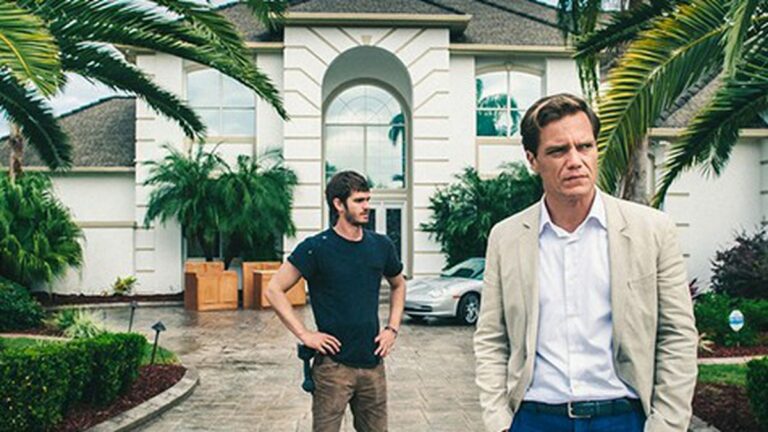
99 Homes is a melodrama of the topical kind. A non-union construction worker (Andrew Garfield) can’t keep up the mortgage payments on the home where he, his mother (Laura Dern), and his young son (Noah Lomax) live, so they are evicted. Forced out with extreme prejudice, it seems to us, because the real estate agent doing the evicting on behalf of the bank (Michael Shannon) performs his task with such vicious eagerness. It then happens that the tossed-off man, Dennis Nash, comes to work for Rick Carver the real estate man, and gradually takes to his new job, setting up a moral quandary. What will happen when Dennis, a thoughtful family type with a tender nature, is asked to do something he considers immoral?
Director Ramin Bahrani, a North Carolina native who wrote the screenplay with Bahareh Azimi and Amir Naderi, has a flair for social commentaries, as in his Midwestern family farm saga At Any Price, his cross-cultural character study Goodbye Solo, and Man Push Cart, the tale of a Pakistani immigrant selling coffee on the streets of Manhattan. In common with those postcards from Tough Luck, USA, 99 Homes fleshes out Dennis Nash’s dilemma with precisely drawn scenes and ironic details all too familiar to those who navigated the Great Recession only to capsize in the new Gilded Age.
Andrew Garfield and Michael Shannon star in 99 Homes.Andrew Garfield and Michael Shannon star in 99 Homes.
The reason Dennis can’t make it is because the builders he works for often go out of business and don’t pay the freelance craftspersons for their labor. His mom Lynn brings in some money running a hair salon out of their home, but that’s not enough to keep a roof over their heads. What happens next is something we’ve seen in Michael Moore’s documentary philippic, Capitalism: A Love Story — a man with a piece of paper in his hand arrives one morning accompanied by sheriff’s deputies, and no matter what the distraught family members may say, no matter how much they cry or cuss, in two minutes their belongings go out on the curb while their neighbors stand around gawking. In Dennis’ case, most of his tools get stolen into the bargain. Then it’s off to the seedy motel where all the other locked-out families end up, casualties of the foreclosure wave that is sweeping over Orlando, Florida in 2010.
Rick the foreclosure vulture, a hustler with ambition, has it down to a fine art. He makes it clear, in one of those Michael Shannon speeches that brings the movie to a breathless stop, that he, too, came from a poor family, and he’s figured out that the only way to survive is to think smarter, hit harder, and grab some of that money the government leaves behind when the suckers get forced out. That, and any air conditioners and water pumps that aren’t nailed down. Besides, opines Rick, most of these chumps deserve to lose because they were fools, spending money they didn’t have on swimming pools and add-ons they didn’t need. Dennis’ heart sinks on hearing these words, but he sucks it up and goes to work running his own crew for Rick and ripping off Fannie Mae. The ready cash and throwaway McMansions impress Dennis, but only temporarily. He is not a killer.
Garfield, Dern, and most of all Shannon lift this sad story to heights it probably doesn’t quite merit, but 99 Homes — the title refers to a quota Rick needs to fill in order to become the real estate baron he dreams of being — is no art film. It mostly aspires to let us see what happened in a specific place in a recent time, and to remind us that people like Dennis and Rick exist, and that every day someone has to make a deal with the devil. Dog eat dog. One side or a leg off, I’m getting mine.
California’s pension fund for public school teachers invested hundreds of millions of dollars in a company that has been criticized for foreclosing on property owners and kicking them out of their homes, including dozens in the East Bay, records and interviews show. The company, Caliber Home Loans, is owned by the private equity firm Lone Star Funds and was featured in a New York Times story last week because of its controversial practices.
In an email to the Express, officials for the California State Teachers Retirement System (CalSTRS) confirmed that the pension fund invested $660 million in two different funds managed by Lone Star, and that the company has used the money to buy up distressed home loans, foreclose on the homeowners, and resell the homes. CalSTRS spokesperson Ricardo Duran said that Lonestar officials have told pension fund managers that the investment has resulted in a lower rate of foreclosure than the industry standard. But according to Duran, CalSTRS has not been provided with data from Lone Star to substantiate these claims.
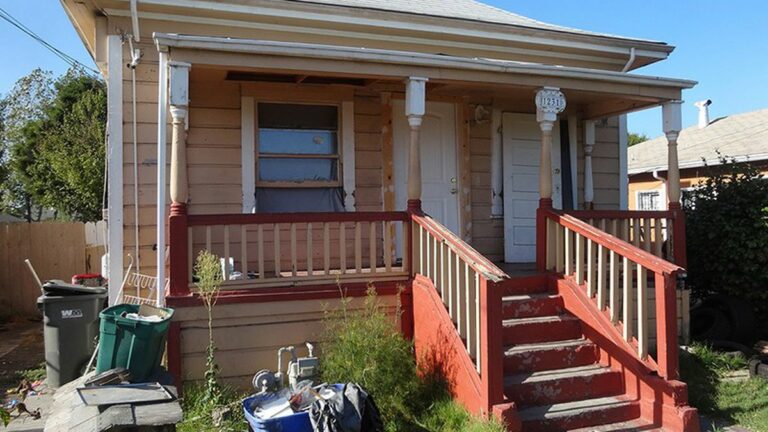
After Lone Star forcelosed on her, Jacqueline Collins’ home in East Oakland has fallen into a state of disrepair.
Credits: Darwin BondGraham
At the same time, complaints made to the federal Consumer Financial Protection Bureau against Lone Star’s Caliber Home Loans company have been rising. Complaints jumped from 191 in 2013 to 428 in 2014. So far this year, Caliber has been the subject of 433 complaints. And according to TheTimes, Lone Star has foreclosed on at least 1,500 of the loans it has purchased from the federal government and government-sponsored housing agencies since 2010, and most of these foreclosures have been initiated in the last five months. In Alameda County, according to public records we reviewed, Lone Star, through multiple entities with obscure names such as “LSF7 Bermuda NPL III Trust,” owns dozens of mortgages. These entities have been named in official county documents recording the foreclosures of upwards of sixty homeowners in Oakland, San Leandro, Hayward, and other East Bay cities.
Over the years, Lone Star has relied on billions of dollars from public employee pension funds to buy out “distressed” home mortgages. And CalSTRS, which manages the retirement savings of 879,000 California public school employees, is among Lone Star’s biggest investors. The scale of Lone Star’s mortgage business is dizzying. Lone Star has purchased 18,747 mortgages worth $3.16 billion from the federal government and government-sponsored housing agencies since 2010, according to records maintained by the US Department of Housing and Urban Development (HUD). The acquisition of these mortgage loans was made through a government program that policymakers claim was intended to reduce foreclosures — not make them worse.
One of the homeowners impacted by Lone Star’s actions in the East Bay was Jacqueline Collins, a senior citizen who had owned a home in the 1200 block of 80th Avenue in East Oakland since 1987. Lone Star acquired Collins’ mortgage in one of the pools of loans it bought from the federal government, and then foreclosed on Collins in May of this year. We visited the house last weekend. It appeared blighted and empty. The front yard was strewn with trash. A chicken wandered the driveway. A window facing the street was half open. Several lock boxes were fastened to the fence. Two men setting up tables in front of the house next door for a children’s birthday party said Collins’ foreclosed home has been empty for months, and it’s not clear when it will be sold or inhabited again.
One of the men, who identified himself as Wally, said Jacqueline was his grandmother. “Squatters and homeless people crawl into the window at night to sleep inside,” said Wally, who declined to provide his last name. “My grandmother, she just couldn’t make the payments anymore. I remember the day the sheriffs came to move her out, I didn’t think she was gonna leave, but she had to.” We were unable to track down Collins for this report. It’s unclear what has happened to her since her eviction, but her former home has fallen into a state of disrepair.
Caliber Home Loans is run by former officials from Countrywide, the disgraced home loan company that played a central role in the financial crisis of 2008. Last year, the Los Angeles Times highlighted the problems associated with private equity’s attack on financially troubled homeowners. And last week, Senator Elizabeth Warren accused HUD and the Federal Housing Financing Agency of “lining up with the Wall Street speculators.” According to The New York Times, demonstrations are planned for next week outside Lone Star’s headquarters in Dallas, Texas.
According to CalSTRS records, the pension fund first made an investment in Lone Star in 2004 when it committed $360 million in teacher retirement savings. Then in 2008, just as the foreclosure crisis was ramping up, CalSTRS committed another $300 million in a second Lone Star investment fund that was used to buy mortgage securities.
Duran, the CalSTRS spokesperson, wrote in another email to us that the pension fund’s investment staffers were aware that Lone Star has been pursuing a “distressed situations” investment strategy, involving the acquisition of thousands of mortgages packed into securitized pools with high rates of default, and that foreclosing on some of these mortgages was a possibility. “Not every loan can be reworked,” wrote Duran. “However, CalSTRS continues to monitor the situation and is in close contact with Lone Star on the matter.”
A spokesperson for Lone Star and Caliber provided the Express with a statement from the company via email. “Caliber has one of the highest loan modification rates, and lowest re-default rates, in the residential mortgage servicing industry,” Caliber claimed in the email. A high rate of loan modifications and low rate of defaults would mean that Caliber is foreclosing on homeowners less frequently than other companies. “Foreclosure, while a necessary action in certain cases, is the least attractive outcome for Caliber Home Loans and its investors, and the Company is incentivized to avoid that outcome whenever possible.”
We asked Lone Star for data supporting its claim that its mortgage business has a high loan modification rate, and a low default rate. The company did not provide the data by our deadline.
Homeowners whose loans have been bought by Lone Star have been among its harshest critics. Two of these homeowners, Charles and Pamela Hubbard, residents of Sacramento whom The New York Times said had “briefly lost their home when Lone Star’s Caliber subsidiary dealt harshly with their request for a loan modification. The couple said they had submitted the application to reduce their monthly mortgage payments four days before a planned foreclosure sale, but the Lone Star subsidiary said the Hubbards had been late in completing the application and pushed ahead with the sale. Within a month, the three-bedroom house that the Hubbards had lived in for two decades was auctioned off to another affiliate of Lone Star with the right to resell it later. The foreclosure was rescinded only after the couple went to court.”
CalSTRS’ investments in Lone Star’s “distressed situations” strategy targeting home loans is part of a pattern of private equity and hedge fund investments made by the teachers’ pension fund that squeeze middle-class Americans to turn a profit (see “Financing the Destruction of American Lives,” 6/17). CalSTRS, which also has come under fire in recent years for its large investments in gunmakers and its backing of Wall Street corporate raiders, has argued that it must engage in these activities in order to earn a sufficient financial return on its investments so it can pay the pensions of California teachers. But this claim has recently been exposed as questionable. The well-respected blog NakedCapitalism.com has revealed that CalSTRS, along with other public pension funds, has no real idea of its financial relationship with private equity, including what it pays in fees to firms like Lone Star, or the actual financial return it gets from investing in their strategies.
All of this has teachers worried about what their retirement savings are invested in. Fred Glass, communications director of the California Federation of Teachers, said his union was unaware of CalSTRS’s investment in Lone Star, and that his members generally don’t appreciate having their retirement savings invested in predatory corporations. “Tracking every dollar in a fund the size of CalSTRS is a daunting task,” he said, “but CFT does try to steer the system away from holdings whose values don’t match up with ours.”
Three and a half years ago, Mark Johnson was an inmate at Santa Rita Jail. Today, he’s a student at UC Berkeley who wants to get a graduate degree. It’s a transition that he said might not have been possible without the help of a nascent group of former inmates who are operating a program called the Underground Scholars Initiative at Cal.
Johnson grew up in Oakland and spent his youth hanging out around the Berkeley campus, but he said he never imagined himself enrolled there. He spent much of the past fifteen years struggling with an addiction to methamphetamine, homelessness, and bouts of jail time resulting from drug-related crimes.
Members of the Underground Scholars Initiative are hoping to create a “prison-to-school” pipeline, helping former inmates attend universities like Cal.
Credits: Erin BaldassariUnderground Scholars director, Steven Czifra.
Credits: Erin Baldassari
Johnson said that each time he wound up in jail, he used the time to get clean and would make plans to stay that way when he got out, but then he would relapse. “I’d start communicating with my family again, doing push-ups and sit-ups and eating better, and towards the last couple months I would be talking about how I can’t wait to get out,” Johnson said. “But not even four hours after being out, I’d be right back doing the same thing again.”
The last time Johnson was in jail, though, he enrolled in a GED program, and that helped him start to turn his life around. “From that point, I became a teachable person because up until then, I had been working on my own will and had no real trust in anybody’s suggestions,” Johnson said. “Someone suggested I address my drug problem, and it’s by God’s grace that I made it to a rehab.”
Johnson went straight from Santa Rita Jail to a residential rehab program in Berkeley. After a year focused on his recovery, he enrolled in community college courses with the intent of becoming a drug counselor and therapist.
Now that he’s a student at Berkeley, Johnson said the range of possibilities for his future is expanding. He’s hoping to embark on a research project through the prestigious McNair Scholars Program or do a senior capstone project. He still intends on becoming a drug counselor, but he is also planning on getting a master’s degree in social work or public health.
Johnson credits much of his success at Cal to the Underground Scholars program, which began two years ago, is run by a former prison inmate, and grew out of a campus seminar on prisons taught by UC Berkeley Ethnic Studies professor emerita Patricia Hilden. Hilden pointed out that although there are many studies linking educational attainment with reduced recidivism, there is a paucity of information about how many formerly incarcerated people make it to college or receive higher degrees after incarceration. Hilden said there’s good reason for that. “The intuitive response is to reach out to people [who were incarcerated], but, in fact, it’s a real invasion of someone’s privacy,” she explained.
Mark Johnson.
Credits: Erin Baldassari
Part of what Underground Scholars does is allow people to be open about their past and in that way, empower them, said the program’s director, Steve Czifra. “Having other people around who are open about being formally incarcerated has allowed other students to do Cal in a way that isn’t fractured,” he said. “They don’t have to section-off parts of who they are and be secretive about their past and be shameful. … They can be empowered to be who they really are.”
Czifra took the course that Hilden taught after a serendipitous encounter with Danny Murillo, a former inmate who became one of the co-founders of the Underground Scholars program. Both Murillo and Czifra were convicted as teenagers of serious felonies, and both were sentenced to prison. They served their sentences in separate facilities, but each was eventually transferred to Pelican Bay State Prison, where they spent several years in the facility’s notorious solitary confinement units, known as Security Housing Units, or “the SHU.”
Murillo had enrolled in a GED program while he was in the SHU during the last several years of his prison term, and thanks to a neighboring cellmate, he was able to get the books he needed to begin college courses there.
Czifra, however, didn’t enroll in community college until several years after getting out of prison, and then it took him several attempts before he earned his Associate’s degree. But both men found themselves starting at Cal at the same time. Murillo spotted Czifra as he was walking on campus, Czifra recalled. “Danny just walked right up to me,” Czifra said. “We sort of sniff out our own.”
Czifra said that when Murillo invited him to a seminar on prisons led by Hilden, it was the first time that he had found a community at the school. “I was a fish out of water. I was surrounded by privilege … and I didn’t feel community in any of [the student] populations,” Czifra said, adding that during the seminar, that changed. “We were talking about prisons and now I know the most. There wasn’t a PhD in there that knew one thing about spending one day in prison.”
Hilden said the seminars would often last much longer than their designated three hours and would spill over into coffee shops and other venues. Most of the people in the seminar had either been incarcerated or had family members who were incarcerated, she said.
“The group grew very close just because of the subject matter and the circumstances,” Hilden said. “The summer that followed, several of them decided to organize meetings once a week, and they began to develop what eventually became the Underground Scholars.”
Mark Johnson.
Credits: Erin Baldassari
The group received a grant from the university in 2013, and then at the end of 2014, was able to secure a small office space with two desks and a couch in Stiles Hall, where it continues to meet once a week.
Some Underground Scholars also volunteer their time to mentor new students coming into the program, which includes helping them select which classes to take, advising them on who to go to for help with housing or other needs, or even proofing a paper before it’s sent in to a professor. “They were patient and sat down with me and showed me how to do the reading,” Johnson said. “They were basically helpful in helping me arrange my classes so I’m not taking too many academic units.”
Czifra said that informal self-help is now morphing into what he hopes will become a more institutionalized presence at the university, a so-called “prison-to-school pipeline” that makes it easier for people coming out of prison to get into universities like Cal.
That entails changing the way incarcerated people view UC Berkeley, working with admissions to find out how to best prepare applicants to be accepted into the school, and enrolling them at the school concurrently with community college classes to give them a leg-up in the application process, Czifra said. “We’re also tutoring the hell out of them and just staying close,” he said.
For Johnson, however, the program has also helped remove that stigma of having spent time in jail. “Underground Scholars saved me from having the burden of a secret. I didn’t want anybody to know I had been incarcerated,” Johnson said. “Now, I’m able to be proud of my accomplishments, and I don’t shy away from the past.”
Everyone knows the music industry is in the dumps — shattered by the collapse of sales of physically recorded music. But what few people know is the surging weed industry is helping to prop things up.
Rapper Snoop Dogg is an investor in the leading weed delivery app, Eaze, and late last month, he launched the digital weed media empire Merry Jane. Willie Nelson, as well as the estates of Jimi Hendrix and Bob Marley, are all readying branded pot strains.
Amoeba’s flagship store in Berkeley.
Credits: Courtesy of Amoeba MusicAmoeba’s flagship store in Berkeley.
Credits: Courtesy of Amoeba Music
Now, the Bay Area’s recorded music mecca, Amoeba Music, is making a play. A one-year-old medical pot clinic in Amoeba’s San Francisco store is helping to keep the iconic store from meeting the fate of other music retailers.
And this fall, Amoeba Music is seeking a permit for a medical marijuana dispensary inside the company’s 25 year-old flagship store on Telegraph Avenue in Berkeley. Not to be too blunt, but can legal weed save music? “Yes,” said Amoeba co-owner David Prinz. “Weed can help save music — absolutely. Here’s a way.”
Prinz co-founded Amoeba in 1990, competing against Tower, Rasputin, and myriad other record stores at the height of recorded music sales, which hit $38 billion in 1997. Amoeba expanded to three locations, adding vast, world-class stores to San Francisco and Los Angeles. The company has employed countless thousands of California musicians.
But Amoeba’s expansion coincided with the rise of iPods and iPhones, which tore into CD sales. So Amoeba became the king of re-sales. The company created its own online retail platform, and commissioned deep biographies of artists. Amoeba sells vinyl, throws events, and publishes the last great guide to new music, Music We Like. But it’s not enough. The Berkeley flagship is listing — badly. Global recorded music industry hit a new low of $14 billion in estimated sales in 2014. “College kids don’t buy as much music as they used to,” Prinz explained.
“Physical media is toast, I hate to say it,” said Brian Zisk, founder of the annual SF MusicTech Summit, which returns to the Hotel Kabuki on November 10. “One problem is, people no longer have the means to play physical music,” Zisk continued. “Once that happens, that part is gone.”
As for an Amoeba dispensary: “I fucking love it.” Zisk said. “Music and weed go together like — music and weed.”
Louie Armstrong preferred tokers in his bands, Prinz pointed out. Notable legalization advocates include: Melissa Etheridge, Sting, Jack Black, Alanis, John Mayer, Miley Cyrus, Justin Timberlake, Tony Bennett, Carlos Santana, and John Legend. Bob Marley sold 75 million records and was named the eleventh greatest artist of all time by Rolling Stone.
“People are already getting stoned and ending up at Amoeba,” Zisk said. “They’re going to spend four times as much.”
Getting your cannabis recommendation at the region’s premier record store is pretty sublime. We highly recommend it. You start out on Haight Street — a legendary district with a quirky rule that says doctor’s offices can only be on the second floor of buildings. There is almost no second floor doctor’s office space on Haight Street, but Amoeba had some, and needed the money. “It also fits in with what we do, who we are,” Prinz said. “It’s counterculture to a very high degree.”
The medical cannabis office — Green Evaluations — is affordable, fast, professional, and has the best vintage rock posters of any clinic in the history of mankind. Prinz said the clinic also draws foot traffic into the record store.
When the City of Berkeley opened its application process for a fourth permit this year in the city, Prinz saw a chance to help Amoeba’s flagship and fulfill a lifelong dream. “We need supplemental income,” Prinz said. “That’s the real truth. This helps keep us open and enables us to do some amazing shit.”
Under Amoeba’s dispensary permit proposal, the Telegraph Avenue store would undergo a renovation to add a dispensary in what is now the jazz room. “That street could really frickin’ use this,” Prinz said. “The whole neighborhood would like the street to be more civilized.”
Amoeba is going up against five other groups seeking the city permit. After a round of public hearings, the city council will pick the winner. Prinz said he hopes Amoeba’s track record as a time-tested retailer and stalwart community booster will be rewarded.
Plus, the synergies would be world-class: cannabis/music pairings and other events. Which begs the question, does Amoeba have any decent hook-ups?
“Amoeba has some really good friends who really grow some beautiful strains,” is all Prinz would say for now.
Thursday, October 8
The Healing (90 min., 2012). CESAS film series. In Tagalog with English subtitles (UC Berkeley, Doe Library, Room 180, 5:00)
They Were Promised the Sea (74 min., 2013). Conscientious Projector series (Berkeley Fellowship of Unitarian Universalists' Hall, Berkeley, 7:00)
The Who in Hyde Park (120 min., 2015). (AMC Bay Street 16, Emeryville, 7:30)
A Nightmare on Elm Street (91 min.,...
Aries (March 21–April 19): If I warned you not to trust anyone, I hope you would reject my simplistic fear-mongering. If I suggested that you trust everyone unconditionally, I hope you would dismiss my delusional naiveté. But it's important to acknowledge that the smart approach is far more difficult than those two extremes. You've got to evaluate each person...
Minji Sohn's work is based on endurance — that of the artist and the viewer. Monotonous and difficult to watch, her latest performance piece, Again, and Again, and Again at Aggregate Space Gallery (801 West Grand Ave., Oakland), draws viewers into the artist's childhood imagination, in which she combats fears and anxieties through obsessive rituals.
At the show's opening last...
I'm a gay man who is ready to start cheating on my boyfriend. We've had a wonderful 3.5-year-long relationship full of respect, affection, support, and fun. I love everything about our relationship, and our sex life was great ... until he moved in eight months into the relationship. At that point, he lost all interest. I've tried everything: asking...
For years, journalists and sports pundits have blamed Oakland and Alameda County officials for the fact that the owners of the A's and Raiders have yet to come up with viable plans for new stadiums in Oakland. The Bay Area News Group, which owns the Oakland Tribune, the city's hometown daily, did it again this week, arguing in a...
The strange glances are starting to become more frequent. James Fisher, a fourteen-year-old freshman at Oakland Charter High School, has noticed that as he gets older, more people on the street eye him with suspicious or fearful stares. "Some of them just look at me, and then they'll look away," he...
99 Homes is a melodrama of the topical kind. A non-union construction worker (Andrew Garfield) can't keep up the mortgage payments on the home where he, his mother (Laura Dern), and his young son (Noah Lomax) live, so they are evicted. Forced out with extreme prejudice, it seems to us, because the real estate agent doing the evicting on...
California's pension fund for public school teachers invested hundreds of millions of dollars in a company that has been criticized for foreclosing on property owners and kicking them out of their homes, including dozens in the East Bay, records and interviews show. The company, Caliber Home Loans, is owned by the private equity firm Lone Star Funds and was...
Three and a half years ago, Mark Johnson was an inmate at Santa Rita Jail. Today, he's a student at UC Berkeley who wants to get a graduate degree. It's a transition that he said might not have been possible without the help of a nascent group of former inmates who are operating a program called the...
Everyone knows the music industry is in the dumps — shattered by the collapse of sales of physically recorded music. But what few people know is the surging weed industry is helping to prop things up.
Rapper Snoop Dogg is an investor in the leading weed delivery app, Eaze, and late last month, he launched the digital weed media empire...