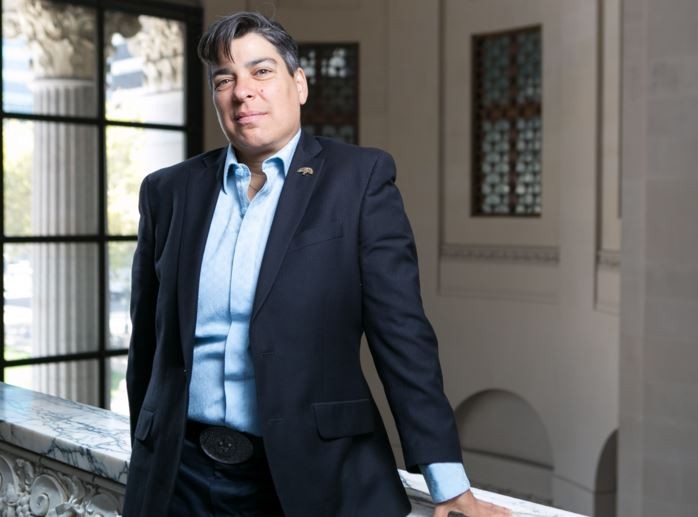
Don Lindsey, who is one of Alameda’s most powerful landlords and is a leader among property owners strongly opposed to rent control on the Island, is under investigation by the California Bureau of Real Estate for alleged financial improprieties. A state investigator is accusing Lindsey of failing to provide proper accounting for various tenants’ fees, according to a complaint filed last month with the Bureau of Real Estate. If proven, the charges could result in Lindsey losing his real estate license, the complaint states.
The complaint, filed December 16, includes an allegation by a state investigator that Gallagher & Lindsey Property Management, the firm co-founded by Lindsey in 1967, collected $2,124 from three prospective tenants, but failed to deposit the proceeds into a trust fund or specific bank accounts as required by law.
And an audit of Lindsey Properties, Inc. in December 2014 found that bank accounts reported to contain property management fees charged to renters was $72,465 less than what it should be under the law. In addition, withdrawals were made from the accounts without proper consent given by the renters. The complaint also alleges Lindsey’s companies failed to place financial proceeds into a dedicated trust fund in the name of each tenant and that withdrawals were made from the account by two unlicensed individuals. In addition, Lindsey failed to provide copies of cancelled checks from the bank account to the investigator, according to the complaint, which was first reported by Indymedia.
In an interview, Lindsey said the allegations have been remedied and he denied any wrongdoing. “I have a thirty-year history of no complaints and a spotless history,” he said. “I know this makes good headlines, but it’s not true.”
[jump]
Lindsey alleged that the auditor who noted the $72,465 deficiency in one bank account was not familiar with Yardi, the accounting system used by Lindsey’s company. Lindsey also said he had a dispute with the auditor over the definition of “advanced fees.” Lindsey asserts that fees charged to tenants for moving them into housing units are not advanced fees, but rather, services earned.
Lindsey said the two unlicensed individuals alleged to have made withdrawals from the account were family members who were licensed signatories at the time the account was created, but no longer write checks. In addition, Lindsey said cancelled checks were not provided to the auditor because the bank no longer provides them in hard copy form.
However, the Alameda Renters Coalition, which has been pushing for rent control in the city, was quick to seize on the allegations against Lindsey, who has led the early opposition to rent control by landlord groups on the Island by way of his public comments and an opinion piece urging for utilizing the existing Rent Review Advisory Committee instead of far-reaching rent restrictions. Lindsey prominence, in fact, has led some members of the renters’ coalition to refer to him as the “landlord-in-chief.”
Catherine Pauling, a spokesperson for the Alameda Renters Coalition said the allegations against Lindsey are significant. “He holds so much sway in Alameda and is so powerful,” said Pauling.
The renters’ coalition also has called for greater protections for tenants’ fees, such as security deposits. “These allegations really point out why this isn’t a small issue,” said Pauling. “Too often we find landlords are treating these accounts like their own personal money.”
Anne Campbell Washington.
The National Rifle Association and its state chapter, the California Rifle and Pistol Association, are threatening to sue the Oakland City Council to prevent implementation of new firearms safety laws.
Attorneys for the NRA and the CRPA notified the Oakland City Council in two separate letters dated January 4 that they intend to file lawsuits to stop implementation of the new laws. One would require firearms in people’s homes to be secured in a locked container, or disabled with a trigger lock, while the other involves a citywide ban on gun magazines that can hold ten or more cartridges.
The Oakland City Council approved both laws on Tuesday at its regular meeting. Councilmembers also approved a new law that prohibits storage of unsecured firearms in vehicles parked on public streets.
“Adoption of such an extreme and unconstitutional law will result in litigation against the City to enjoin enforcement and have it declared invalid,” attorneys for the gun lobbying organizations wrote in one of the letters sent to the council. The pro-gun groups argue that both laws infringe on gun owner’s Second Amendment rights, and that both are preempted by state laws.
Councilmember Anne Campbell Washington, co-author of the laws banning high capacity gun magazines and the home gun storage rules, said she is confident that the new laws are constitutional and enforceable.
“We cannot be held hostage by gun radicals,” Campbell Washington wrote in an email to the Express. “Not only do recent court decisions clearly support the power of municipalities to institute commonsense regulations regarding firearms, but responsible gun owners agree with these commonsense regulations.”
[jump]
Rebecca Kaplan.
Credits: Bert Johnson
Mark Selmi, the chief public affairs officer with Michel & Associates, the law firm representing the NRA and CRPA, said that the pro-gun groups didn’t take a position on the new city law that requires firearms stored in unattended vehicles parked on public streets to be secured. Regarding the other two new gun control measures, he said he could not comment on potential litigation.
Councilmember Rebecca Kaplan co-authored the law requiring secured storage of guns in vehicles. Kaplan said that Oakland won’t be swayed by threats of litigation from the NRA.
“Congress just rolls over to them,” Kaplan said about the lack of federal action on gun violence.
Campbell Washington provided the Express with a copy of a legal opinion from the Law Center to Prevent Gun Violence that supports the legality of the new laws. According to the letter, four California cities and the state of Massachusetts have enacted “safe storage ordinances” similar to Oakland’s new laws. The letter also states that between 2004 and 2015 approximately 300 firearms were stolen from vehicles in Oakland.
“We refuse to allow NRA lobbyists to dictate public policy,” said Campbell Washington in response to the threat of a lawsuit by the NRA.
1. Corizon, the private health care provider at Alameda County’s jails, has fired 49 nurses at facilities in Oakland and Dublin, forcing the remaining nurses to work double shifts and scramble to provide proper care to inmates, the Bay Area News Group$ reports. “According to the nurses in the jails, it’s a disaster,” Dennis Dugan, an organizer for the National Union of Healthcare Workers, told the newspaper. Corizon has come under intense fire for providing inadequate care at the jails and was blamed for at least two in custody deaths.
3. The US Environmental Protection Agency has concluded that a widely used pesticide is threatening honey bee populations nationwide, the LA Times$ reports. The EPA’s determination could result in a ban on imidacloprid, a pesticide made by Bayer CropScience that is used on wine grapes, tomatoes, oranges, and cotton. Honeybee colonies have collapsed throughout the country in recent years.
5. Yellow Cab Coop, the largest taxi company in San Francisco, may file for bankruptcy, the Chron$ reports. Yellow Cab has been rocked by unregulated ride companies like Uber and Lyft and was hit by a $8 million jury award last year to a passenger who suffered brain damage in a crash.
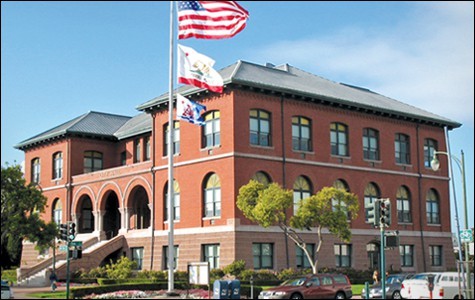
Alameda City Hall.
After eight hours of public testimony and deliberation, the Alameda City Council on Wednesday morning voted to extend the city’s current moratorium on rent increases and evictions for another sixty days. The council, however, did not approve any of the three rent control ordinances that were proposed, and told staffers instead to create compromise legislation during a meeting that did not end until after 4 a.m.
Tuesday night’s debate underscored the growing anxiety for renters who have facaed exorbitant rent increases and mass evictions by landlords during the past year. At a raucous November 4 council meeting concerning soaring rents, two residents were arrested at City Hall and one was bloodied by police.
Tuesday night’s meeting was not as intense. To accommodate a large crowd, the city held the meeting in the cavernous Kofman Auditorium.
But the council was unable to agree on any of three rent ordinances proposed by city staffers. The proposals included a landlord-friendly plan to strengthen the city Rent Review Advisory Committee (RRAC); an ordinance somewhat favorable to renters that included binding arbitration for settling rent disputes and some restrictions on no-cause evictions; and a third, compromise solution.
Following a recess at 12:40 a.m., councilmembers discussed the proposals until 3:55 a.m., and then directed city staffers to bring back a rent ordinance in mid February that includes the following: Adding binding arbitration to settle rent disputes at the RRAC; requiring landlords to petition the RRAC for any rent increases of more than 5 percent; requiring landlords to offer one-year leases to tenants during their first year; relocation fees based on the length of tenancy, in addition, to $1,500 for moving expenses; and a yet-to-be determined cap on evictions.
[jump]
The council’s orders, however, likely will not dissuade the Alameda Renters Coalition, a growing force in the city’s politics, from launching a ballot measure drive in order to enact much stronger rent control restrictions. Before Tuesday’s meeting, the renters group voiced opposition to all three proposed ordinances, saying they would do little to help struggling Alameda renters. “The Alameda Renters Coalition believes none of the proposals offered to the City Council, as currently written, truly address soaring rents and unfair evictions,” the group stated. Instead, the renters’ coalition has advocated for tying rent increases to the Consumer Price Index, along with prohibiting no-cause evictions. Duane Moles, a spokesperson for the Alameda Renters Coalition, told the council, “It’s family stability on one side and profit margins on the other.”
Talk of restrictions on rents and evictions in Alameda has gained the attention of large-scale property owners and the statewide California Apartment Association. Greg McConnell, a well-known Oakland consultant who was representing Alameda landlords on Tuesday night, urged the council to avoid options rent control. “A lot of people have suggested that you need to follow Oakland as though they work,” McConnell said of Oakland’s rent control laws. Such restrictions are also expensive, said McConnell. “Be prepared for a significant cost of payment,” he warned. Later, a representative from the California Apartment Association labeled rent control as a “tax-free subsidy” for renters.
A diagram of a secondary housing unit behind a single family home.
Credits: City of Santa Cruz
Last night, the Oakland City Council voted to ease restrictions on the construction of secondary housing units, or backyard cottages. The new rules promote more rental housing by easing parking requirements, allowing homeowners to transform existing backyard buildings like sheds and garages into living spaces, and relaxing height and setback requirements.
“This is the best way to quickly build our stock of much-needed rental housing,” said Oakland Mayor Libby Schaaf in a press release. “This will also help preserve the diversity of our communities by keeping renters and owners in the same neighborhoods, while creating income opportunities for homeowners who also feel the pressure our region’s high cost of living.”
[jump]
Other Bay Area cities have passed, or are considering similar relaxed rules to promote the construction of new secondary housing units. For example, Berkeley passed new secondary unit rules in March of last year.
Parking requirements are one of the biggest impediments to the addition of backyard cottages, according to a UC Berkeley report on the subject that was issued in 2012. Most East Bay cities require homeowners to build new parking spaces on their property if they construct a secondary unit. The cost of building a parking space, and loss of green space that gets paved over, has dissuaded homeowners from building backyard cottages.
Oakland’s previous parking rule required the construction of one parking space for each new backyard housing unit built. Under the new rules, a homeowner within one half mile of a BART station or bus rapid transit line can build a new secondary unit without adding a parking space. This area covers much of the city.
One policy that Oakland didn’t include in its new secondary unit regulations is a restriction on the rental of new backyard cottages as short-term rentals through services like Airbnb. Berkeley, by contrast, banned the rental of new secondary units as short-term rentals because city leaders want to maximize the number of new rental units that will provide housing for residents, rather than serve as hotel accommodations for visitors.
The ‘Shroom pizza at Buma’s (via Facebook).
Welcome to the Mid-Week Menu, our roundup of East Bay food news.
1) Buma’s Pizzeria (325 19th St.), Jon Kosorek’s East Coast-style pizzeria in Uptown Oakland, rang in the new year by announcing that it has closed for business. Kosorek posted the announcement last night on the restaurant’s social media accounts, citing the rigors of the long commute since the chef and his family moved to Napa 2011. Buma’s — an excellent pizza shop and winner of the award for “Best Pizza for Umami Lovers” in the Express’s most recent “Best of the East Bay” edition — was the second restaurant that Kosorek ran out of the tiny 19th Street storefront. I still miss the first, a whole-animal sandwich shop called Marrow.
Kosorek is currently seeking a manager or buyer for Buma’s, which leaves open the possibility that the pizzeria might eventually reopen in some form, with someone new running the show.
[jump]
2) In other disappointing Oakland news, the Glenview neighborhood’s pan-Latin nightspot Rumbo al Sur (4239 Park Blvd.) has closed, Inside Scoop reports. The writing may have been on the wall for a while for the À Côté spinoff, which has kept extremely limited hours — just three nights a week — for the past several months.
3) One last downer: The Chronicle reports that local Dungeness crab won’t be making an appearance in grocery stores and restaurant menus anytime soon, as tests show that many crabs still have levels of the toxin domoic acid. It sounds like a late-January season opening is the earliest that diners — and, more importantly, devastated local crab fishermen — can hope for.
4) The first West Coast location of Ippudo, a Japanese ramen chain that has many international locations — including one (quite good) ramen shop in Manhattan — will open in downtown Berkeley. Berkeleyside Nosh reports that Ippudo will be located at 2011 Shattuck Avenue, in the same building as a new Blue Bottle coffee shop.
Dwenjang tonkotsu ramen at Modu (via Facebook).
5) Kushido (4828 Telegraph Ave.), the Temescal yakitori joint that’s currently closed for renovation, will reopen early this year as Modu (“together,” in Korean), a Cal-Asian small plates restaurant. Owner Jonathan Moon — who also owns nearby Blackwater Station, the subject of my restaurant review this week — will turn the kitchen over to chefs Albert Ok (who had been testing out recipes for Modu at an earlier popup incarnation of Blackwater Station) and Quang Le, both of whom cooked previously at Berkeley’s Iyasare. Johnathan Saelee (BDK Restaurant, Hawker Fare SF) will be the general manager. One of the dishes that may make an appearance on the menu? More ramen — tonkotsu style, but with a Korean slant.
6) The 40-year-old Berkeley collective Nabolom Bakery (2708 Russell St.), which closed this past summer, will reopen under new ownership, Inside Scoop reports. New owner Julia Elliott previously worked at Arizmendi and The Cheese Board.
7) Oakland’s Terrace Room (1800 Madison St.) has a new chef who may be a familiar face to longtime East Bay diners: Former BayWolf executive chef Louis Le Gassic now heads up the kitchen and has revamped the menu with such French classics as coq au vin and duck a l’orange — the kind of throwback dish you don’t see on a lot of East Bay menus these days.
8) AlaMar (100 Grand Ave., Oakland) will team up with Pinx Catering to host brunch popups on two successive Sundays, January 17 and 24, with a $30 prix-fixe menu served 10:30 a.m.–2:30 p.m. 9) Finally, Hopsy, the beer growler delivery service I wrote about a couple months back, officially debuted its service this week.
Got tips or suggestions? Email me at Luke (dot) Tsai (at) EastBayExpress (dot) com. Otherwise, keep in touch by following me on Twitter @theluketsai, or simply by posting a comment. I’ll read ‘em all.
1. Even though California has reduced its prison population by about 30,000 inmates in the past few years, the state is still spending roughly the same amount on its prison system, Reuters reports. The reason is largely due to the fact that the state has not reduced its number of prison guards and staffers, even though there are now fewer inmates. In fact, the cost to house an inmate has risen from $49,000 a year to $64,000 because of the excess guards and staffers.
San Onofre nuclear power plant.
3. The administrative law judge overseeing the closure of the San Onofre nuclear power plant in Southern California has suddenly retired amid disclosures that she engaged in backchannel communications with plant owner Southern California Edison, the San Diego Union-Tribune reports (h/t Rough & Tumble). Criminal investigators are now probing communications made by CPUC Administrative Law Judge Melanie Darling. The deal to close the nuclear power plant has come under intense criticism because it calls for ratepayers to pay 70 percent of the costs.
[jump]
4. A tearful President Obama referenced the mass killing of young children as he announced executive orders that place new restrictions on gun purchases nationwide, the Chron$ reports. However, Obama’s orders fall well short of what gun control advocates have been seeking, primarily because the president is limited in what he can do without the consent of the GOP-controlled Congress.
Aries (March 21–April 19): John Steinbeck won the Nobel Prize for Literature in 1962. His novel Of Mice and Men helped win him the award, but it required extra persistence. When he’d almost finished the manuscript, he went out on a date with his wife. While they were gone, his puppy Toby ripped his precious pages into confetti. As mad as he was, he didn’t punish the dog, but got busy on a rewrite. Later he considered the possibility that Toby had served as a helpful literary critic. The new edition of Of Mice and Men was Steinbeck’s breakout book. I’m guessing that in recent months you have received comparable assistance, Aries — although you may not realize it was assistance until later this year.
Taurus (April 20–May 20): Remember what your life was like during the first nine months of 2004. I suspect that you fell just short of fulfilling a dream. It’s possible you were too young to have the power you needed. Or maybe you were working on a project that turned out to be pretty good but not great. Maybe you were pushing to create a new life for yourself but weren’t wise enough to make a complete breakthrough. Twelve years later, you have returned to a similar phase in your long-term cycle. You are better equipped to do what you couldn’t quite do before: Create the masterpiece, finish the job, rise to the next level.
Gemini (May 21–June 20): To become a skillful singer, you must learn to regulate your breath. You’ve got to take in more oxygen than usual for extended periods, and do it in ways that facilitate rather than interfere with the sounds coming out of your mouth. When you’re beginning, it feels weird to exert so much control over an instinctual impulse, which previously you’d done unconsciously. Later, you have to get beyond your self-conscious discipline so you can reach a point where the proper breathing happens easily and gracefully. Although you may not be working to become a singer in 2016, Gemini, I think you will have comparable challenges: 1. To make conscious an activity that has been unconscious; 2. To refine and cultivate that activity; 3. To allow your consciously crafted approach to become unselfconscious again.
Cancer (June 21–July 22): Ancient humans didn’t “invent” fire, but rather learned about it from nature and then figured out how to produce it as needed. Ropes had a similar origin. Our ancestors employed long vines made of tough fiber as primitive ropes, and eventually got the idea to braid and knot the vines together for greater strength. This technology was used to hunt, climb, pull, fasten, and carry. It was essential to the development of civilization. I predict that 2016 will bring you opportunities that have metaphorical resemblances to the early rope. Your task will be to develop and embellish on what nature provides.
Leo (July 23–Aug. 22): British author Anthony Trollope (1815–1882) had a day job with the postal service until he was in his fifties. For years he awoke every morning at 5:30 and churned out 2,500 words before heading to work. His goal was to write two or three novels a year, a pace he came close to achieving. “A small daily task, if it really be daily,” he wrote in his autobiography, “will beat the labors of a spasmodic Hercules.” I recommend that you borrow from his strategy in 2016, Leo. Be regular and disciplined and diligent as you practice the art of gradual, incremental success.
Virgo (Aug. 23–Sept. 22): Umbrellas shelter us from the rain, saving us from the discomfort of getting soaked and the embarrassment of bad hair. They also protect us from the blinding light and sweltering heat of the sun. I’m very much in favor of these practical perks. But when umbrellas appear in your nightly dreams, they may have a less positive meaning. They can indicate an inclination to shield yourself from natural forces, or to avoid direct contact with primal sensuality. I hope you won’t do much of that in 2016. In my opinion, you need a lot of face-to-face encounters with life in its raw state. Symbolically speaking, this should be a non-umbrella year.
Libra (Sept. 23–Oct. 22): Around the world, an average of 26 languages go extinct every year. But it increasingly appears that Welsh will not be one of them. It has enjoyed a revival in the past few decades. In Wales, it’s taught in many schools, appears on road signs, and is used in some mobile phones and computers. Is there a comparable phenomenon in your life, Libra? A tradition that can be revitalized and should be preserved? A part of your heritage that may be useful to your future? A neglected aspect of your birthright that deserves to be reclaimed? Make it happen in 2016.
Scorpio (Oct. 23–Nov. 21): Fourteenth-century author Geoffrey Chaucer produced a collection of stories known as The Canterbury Tales. It became a seminal text of English literature even though he never finished it. The most influential book ever written by theologian Thomas Aquinas was a work he gave up on before it was completed. The artist Michelangelo never found the time to put the final touches on numerous sculptures and paintings. Why am I bringing this theme to your attention? Because 2016 will be an excellent time to wrap up long-term projects you’ve been working on — and also to be at peace with abandoning those you can’t.
Sagittarius (Nov. 22–Dec. 21): A bottle of Chateau Cheval Blanc wine from 1947 sold for $304,000. Three bottles of Chateau Lafite-Rothschild 1869 went for $233,000 apiece. The mystique about aged wine provokes crazy behavior like that. But here’s a more mundane fact: Most wine deteriorates with age, and should be sold within a few years of being bottled. I’m thinking about these things as I meditate on your long-term future, Sagittarius. My guess is that your current labor of love will reach full maturity in the next 18 to 20 months. This will be a time to bring all your concentration and ingenuity to bear on making it as good as it can be. By September of 2017, you will have ripened it as much as it can be ripened.
Capricorn (Dec. 22–Jan. 19): In her poem “Tree,” California poet Jane Hirshfield speaks of a young redwood tree that’s positioned next to a house. Watch out! It grows fast — as much as three feet per year. “Already the first branch-tips brush at the window,” Hirshfield writes. “Softly, calmly, immensity taps at your life.” I suspect this will be an apt metaphor for you in 2016. The expansion and proliferation you have witnessed these past few months are likely to intensify. That’s mostly good, but may also require adjustments. How will you respond as immensity taps at your life?
Aquarius (Jan. 20–Feb. 18): Centuries ago, lettuce was a bitter, prickly weed that no one ate. But ancient Egyptians guessed its potential, and used selective breeding to gradually convert it into a tasty food. I see 2016 as a time when you could have a comparable success. Look around at your life, and identify weed-like things that could, through your transformative magic, be turned into valuable assets. The process may take longer than a year, but you can set in motion an unstoppable momentum that will ensure success.
Pisces (Feb. 19–March 20): Imagine that a beloved elder has been writing down your life story in the form of a fairy tale. Your adventures aren’t rendered literally, as your waking mind might describe them, but rather through dream-like scenes that have symbolic resonance. With this as our template, I’ll predict a key plot development of 2016: You will grow increasingly curious about a “forbidden” door — a door you have always believed should not be opened. Your inquisitiveness will reach such intensity that you will consider locating the key for that door. If it’s not available, you may even think about breaking down the door.
For the past year or so, the restaurant at the corner of 49th Street and Telegraph Avenue has had something of an identity crisis. The prominent spot in Oakland’s Temescal neighborhood had been home to Barlata, one of the city’s better tapas bars, but last spring, the place reopened under new ownership as Grange Hall, a combination cocktail bar and upscale burger joint that lasted less than five months before its owners shut it down and tried to figure out a new concept. It became a popup that seemed to serve mostly Asian-inspired dishes to go with those cocktails until, earlier this fall, the popup became “permanent” — but then the food wasn’t Asian anymore.
For a while, I put off dining at the latest iteration because I wasn’t sure exactly what it was supposed to be, and whether it was meant to stick around for the long haul. Part of the problem is the confusing name, which, if it rings any bells at all, might appear to be an odd reference to coal production, or the controversial Iraq War-era military contracting firm. Instead, “Blackwater Station” is a rather obscure allusion to the name of a gas station and speakeasy operated by Prohibition-period moonshiners, as portrayed in the 2012 film Lawless, explained bar manager Jason Huffman, who is a partner in the business along with majority owner Jonathan Moon.
Grilled chicories salad.
Credits: Bert Johnson
Pork shoulder meatballs.
Credits: Bert Johnson
What the name indicates, in part, is that Blackwater Station is more of a craft cocktail bar than anything else — the kind of place that makes an assortment of elixirs, tinctures, and sodas in-house, and serves booze-heavy concoctions with long lists of fancy ingredients, but also served me a very solid and decidedly non-fussy variation on a rum and Coke.
Clockwise from left: pork shoulder meatballs, grilled chicories salad, and braised beef cheek.
Credits: Bert Johnson
Even as a bar, the place is a little bit hard to pin down, with its relatively tiny physical bar counter and preponderance of two-tops. And if the place is meant to function as more of a sit-down restaurant, it’s notable, then, that during both my visits, there seemed to be only one server working the floor (who, it should be noted, held down the fort reasonably well).
But any doubts you might have about the bar’s worthiness as a food destination will be put to rest the moment you take a bite into one of chef Jonathan De La Torre’s pork shoulder meatballs — the best of several very good small plates I tried on the concise but muscular menu. It seems trite to say that the meatballs, whose 30-percent fat content was boosted by an infusion of bacon fat, were as soft as clouds or pillows, and yet: You can order meatballs at every Italian joint in town, and you still might not find another version that’s as light and as loaded with porcine savoriness. The sauce was just as notable: a “brassicas bolognese” made by braising the puréed bits of broccoli and cauliflower stems and the Brussels sprout parts left over from another dish for several hours in white wine and olive oil, until the vegetables practically melt into a sauce so silky and flavor-packed, you’d be hard-pressed to tell apart from a traditional meat-based “bolognese.”
You don’t expect a cocktail bar that has this kind of modern, sophisticated ethos — with its requisite elements of taxidermy and reclaimed lumber — to serve “homey” or “soulful” food. Or at least I don’t. But I wouldn’t have blinked twice if you had told me someone’s nonna had been making these meatballs the same way since she was a small girl in the Italian countryside. De La Torre’s most impressive dishes had this seamless quality, wherein all the chef-y fine-dining techniques stayed hidden below the surface, contributing flavor and texture without calling attention to themselves. It’s not surprising that De La Torre’s résumé includes stints at well-regarded Italian restaurants Nopa and Quince (both in San Francisco) and also an eight-month apprenticeship at the Oakland fine-dining temple Commis.
Jason Huffman stirs a cocktail.
Credits: Bert Johnson
In any case, it’s lucky that my meals all took place during the winter because is there any other foodstuff known to humankind more comforting in cold weather than rustic Italian cuisine? Apart from those meatballs, the other big highlight was a hunk of braised beef cheek (a half-cheek, at least) that had been cooked for some five hours until it was gorgeously jiggly and tender enough to eat with a spoon. This was served over a mound of soft, creamy polenta, in the proper Italian way, but also with shishito pepper emulsion that added a smokiness and a tangy heat that veered the dish toward Mexico, like a deconstructed cabeza taco.
In general, the dishes at Blackwater Station tend to feature big, bold flavors that kind of punch you in the face at first bite — or at least grab you by the collar and give you a good shake. De La Torre explained that because the format of the menu lends itself to sharing, he figures he needs to make an impression in the first bite or two. (I should note here, however, that the portion sizes are reasonable for this kind of place.) It’s easy for this kind of “go big or go home” cooking philosophy to go terribly awry, but De La Torre mostly succeeds in creating dishes that are bold but still well balanced. In a chicory salad, he tempers the characteristic bitterness of the green by grilling a portion of them until nicely charred, and by adding counterbalancing sweet (apple) and salty and pungent (anchovy) elements — the latter being the brashest and most insistent note, and the one that kept me coming back for more.
Clockwise from left: pork shoulder meatballs, grilled chicories salad, and braised beef cheek.
Credits: Bert Johnson
Other vegetable-centric dishes were similarly plucky. Toasted soffritto bread crumbs gave a plate of grilled broccolini a flavor boost, as did a grayish purée made from pine nuts and the hard ends of the broccolini, which often just get thrown away — a clever bit of thrifty “whole vegetable” cooking that for whatever reason struck me as perverse: poor broccolini dismembered and served in a sauce of itself. An oyster mushroom and farro dish was spiked with a deliciously soppable black garlic olive oil, though the mushroom portion was too skimpy for the dish to rank among my favorites.
For much of the menu, De La Torre leans on his background in Italian cooking, making his own pasta in-house, for instance — surely a rare feature for a cocktail bar. But mostly Blackwater Station proudly takes up the mantle of New American cooking that many of today’s Bay Area restaurants practice, even if they eschew the label — for fear of seeming too fusion-y or not ingredient-centric enough, I suppose. And that was one of the things I liked about the food at Blackwater Station — how the fried chicken, for instance, was like a cross between Japanese karaage and buttermilk-marinated fried chicken popular in the American South. The boneless thighs were hot and moist, but had a craggy crust and were served with a side of sweet bread-and-butter pickle slices. Dessert was a scoop of cardamom-and-coconut ice cream topped with a cilantro-yogurt purée and a scattering of sesame seeds. For all intents and purposes, it could just as easily have come from an upscale Indian restaurant.
Of course, Blackwater Station is hardly the only bar in Oakland that’s serving food of this quality. That’s one of the hallmarks of our upstart dining scene. Still, after all the conceptual tweaks, it was nice to see the place full late on a Tuesday night, mostly with couples grabbing drinks and sharing a plate of food or two. Here’s to hoping this latest version will stick around for a while.
Anyone who goes to the movies regularly has seen a female coming-of-age pic at one time or another. It usually involves high school, bitchy behavior among purported friends, and awkward attempts at sex — in Hollywood, adolescence is routinely played for laughs. But how many of us have looked at a Turkish female coming-of-age movie? Filmmaker Deniz Gamze Ergüven has made one, and it’s an eye-opener.
Ergüven’s debut feature Mustang introduces us to five orphaned teenage sisters — all of them beautiful, all intensely curious about life, and all squirming under the thumb of their conservative, religious-minded, extended family in a small seaside community in contemporary Turkey. The youngest sibling, Lale (played by Günes Sensoy), already has a definite rebellious streak, but when all five of them are summarily locked up inside their uncle’s home for the crime of swimming at the beach with some boys, their unified resistance startles the family. None of the girls really wants to be part of a “bride factory,” herded into an arranged marriage. The confiscation of all “corrupting influences” — TV, computers, phones, makeup, etc. — is the last straw. Forget Little Women, this has more in common with The Great Escape.
Mustang introduces us to five orphaned teenage sisters in this coming of age film.
Mustang introduces us to five orphaned teenage sisters in this coming of age film.
Actress-turned-writer-director Ergüven, a graduate of the French national film school La Fémis, sets up the potentially tragic social drama as a comparatively light-hearted commentary on the inadvisability of forcing women — even provincial ones from traditional Muslim backgrounds — into rigidly defined roles against their will. Once we get to know Nur, Ece, Selma, Sonay, and feisty little Lale, it’s obvious that no one is going to make them do anything they don’t want to. Lale gets a friendly truck driver to teach her how to drive. One grabs a secret quickie in the back seat while the adults are in town. Another one sneaks out and has sex “the back way” with her boyfriend, so as still to “technically” remain a virgin (Dan Savage could get a month’s worth of advice columns off this group). And so on.
Where a typical H’wood teenage flick takes a generalist approach to its subject, Ergüven’s film glories in its specifics. The poor worried, grouchy old folks try in vain to control human nature while the girls giggle and hatch their plot. The old world is rapidly changing. Girls just want to have fun. Hooray for Mustang.
Don Lindsey, who is one of Alameda’s most powerful landlords and is a leader among property owners strongly opposed to rent control on the Island, is under investigation by the California Bureau of Real Estate for alleged financial improprieties. A state investigator is accusing Lindsey of failing to provide proper accounting for various tenants' fees, according to a complaint...
The National Rifle Association and its state chapter, the California Rifle and Pistol Association, are threatening to sue the Oakland City Council to prevent implementation of new firearms safety laws.
Attorneys for the NRA and the CRPA notified the Oakland City Council in two separate letters dated January 4 that they intend...
Stories you shouldn’t miss:
1. Corizon, the private health care provider at Alameda County’s jails, has fired 49 nurses at facilities in Oakland and Dublin, forcing the remaining nurses to work double shifts and scramble to provide proper care to inmates, the Bay Area News Group$ reports. "According to the nurses in the jails, it's a disaster," Dennis Dugan, an organizer...
After eight hours of public testimony and deliberation, the Alameda City Council on Wednesday morning voted to extend the city’s current moratorium on rent increases and evictions for another sixty days. The council, however, did not approve any of the three rent control ordinances that were proposed, and told staffers instead to create compromise legislation during a meeting...
A diagram of a secondary housing unit behind a single family home.
Credits: City of Santa Cruz
Last night, the Oakland City Council voted to ease restrictions on the construction of secondary housing units, or backyard cottages. The new rules promote more rental housing by easing parking requirements, allowing homeowners to transform existing backyard buildings like sheds and garages into living...
Welcome to the Mid-Week Menu, our roundup of East Bay food news.
1) Buma’s Pizzeria (325 19th St.), Jon Kosorek’s East Coast-style pizzeria in Uptown Oakland, rang in the new year by announcing that it has closed for business. Kosorek posted the announcement last night on the restaurant’s social media accounts, citing the rigors of the long...
Stories you shouldn’t miss:
1. Even though California has reduced its prison population by about 30,000 inmates in the past few years, the state is still spending roughly the same amount on its prison system, Reuters reports. The reason is largely due to the fact that the state has not reduced its number of prison guards and staffers, even though there...
Aries (March 21–April 19): John Steinbeck won the Nobel Prize for Literature in 1962. His novel Of Mice and Men helped win him the award, but it required extra persistence. When he'd almost finished the manuscript, he went out on a date with his wife. While they were gone, his puppy Toby ripped his precious pages into confetti. As...
For the past year or so, the restaurant at the corner of 49th Street and Telegraph Avenue has had something of an identity crisis. The prominent spot in Oakland's Temescal neighborhood had been home to Barlata, one of the city's better tapas bars, but last spring, the place reopened under new ownership as Grange Hall, a combination...
Anyone who goes to the movies regularly has seen a female coming-of-age pic at one time or another. It usually involves high school, bitchy behavior among purported friends, and awkward attempts at sex — in Hollywood, adolescence is routinely played for laughs. But how many of us have looked at a Turkish female coming-of-age movie? Filmmaker Deniz Gamze Ergüven...