Some events burn through a place. Others continue burning quietly inside the people who lived through them. Multimedia artist Merlin Coleman has made a work that listens to both. Her new work, DISPATCHES from the CHARCOAL FOREST, opens May 1 in the East Bay.
Part choral performance, part sound installation, part reckoning, the piece draws from interviews with cleanup workers, survivors, dispatch audio and others touched by the Tubbs Fire, which raged through Santa Rosa in 2017. Presented in the round, with singers moving through the audience, it surrounds listeners in voices, fragments, rhythms and raw emotion.
Coleman, who lives in Sonoma County and grew up here, said the project began simply enough—with a need to face what happened.
“I wanted to make a piece about fires,” she said in a recent interview on The Drive 95.5 FM. “That just felt like a really important subject to all of our hearts, obviously.”
From there, the work grew organically, as many of her projects do. She began listening, gathering stories, and one of the most affecting came by chance.
She met a man working on a road crew near her home. They struck up a conversation. He mentioned that after the 2017 fire, he had served on a cleanup crew.
That chance encounter became “Purple Heart,” one of the project’s centerpiece sections. In it, the worker recounts arriving at a leveled home in Fountain Grove, where the owner asked if he might look for a lost military medal in the ashes.
“There’s nothing, right? Zero,” Coleman said. “And he’s like, well maybe it’s over here. And the worker goes and finds it.”
It’s the sort of story that reveals how disasters are experienced not only through parsing the catastrophe they bring, but through tiny recoveries: an object, a gesture, the proof that something endured.
Coleman’s method is unusual and deeply musical. She takes spoken interviews and listens for their hidden tonalities—the cadence, syntax and melody already embedded in everyday speech. Then she builds compositions around them, layering her own voice or, in this production, a live vocal ensemble.
“The whole syntax and the musicality and the rhythm of his voice really—if you start listening and breaking down any human speech and looping it, you’ll start to hear melodies,” she said. “You only have to loop it three, four, five times.”
The upcoming staging takes what was once multitracked by Coleman herself to the stage with live singers who had to learn intricate cues and precisely timed elements built around spoken narration—a process that required “a lot of real precision,” Coleman noted.
Yet technical rigor is only half the challenge. The material itself is emotionally volatile. Another major section of the piece centers on a man who lost his parents in the Tubbs Fire. Coleman spoke candidly about the responsibility of shaping real grief into art.
“I take a great responsibility in illustrating these stories and in what I hope is an appropriate way,” she said. That meant making choices about restraint as much as intensity. She deliberately avoided using literal sirens in the work, for example.
“That seemed too literal,” she explained. “Too triggering.”
Instead, she created vocal sounds that evoke the “sirens” of Greek mythology. It’s a subtle distinction, but an important one.
“My intention is for DISPATCHES to be a contribution to a collective healing,” she said. “I hope that this performance will create a space that can ultimately help people process these events.”
Merlin Coleman’s ‘DISPATCHES from the CHARCOAL FOREST’ will be performed at 8pm, May 1 & 2, at Dresher Ensemble Studio, 2201 Poplar St., Oakland (where Coleman shares the bill with Amy X Neuburg), and May 8 & 9 at Milkbar, 241A South 1st St., Richmond. For tickets and more information, visit merlinman.com.
For years, California suffered from a reputation as a pizza desert. Having grown up in an East Coast family with roots in Naples, I was keenly aware of the deficit when my parents moved us West.
“It was just different out here. We still had great pizza,” says Tony Gemignani, the world pizza champion who grew up in southern Alameda County. “But you had to really know where to find it. It wasn’t on every corner.”
As it turns out, Gemignani was one of two chefs, both of whom honed their craft in the East Bay, who were pivotal figures in the West Coast pizza revolution. The other, as with many things culinary, was Alice Waters.
The Bay Area, as a result, is no longer a pizza backwater. Gemignani helped establish it as one of the craft’s leading outposts when he became the first American to win the World Pizza Cup crown in Naples, Italy. He has won 13 world pizza titles and been called the Michael Jordan of dough tossing.
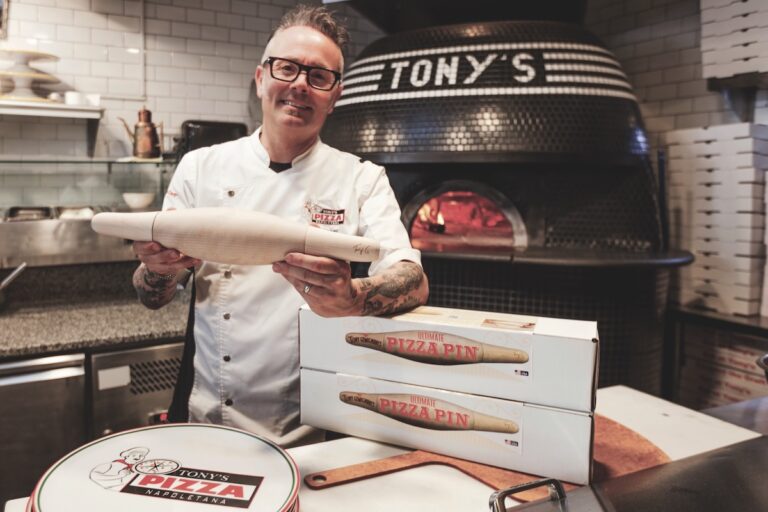
Since becoming America’s best known pizzaiolo, Gemignani has designed a pizza pin bearing his name and lent his brand to a premium pizza flour, while resisting commoditization beyond core craft essentials.
Gemignani, who spoke with us on a recent Tuesday, opened Tony’s Pizza Napoletana in San Francisco’s North Beach district in 2009 and soon began selling pizza by the slice at a storefront next door to it.
The outgrowth of that enterprise is Tony’s Slice House, a fast-expanding franchise which continued with an Oracle Park location in 2010, followed by Market Street and Haight Street locations in 2016, as well as a Walnut Creek shop the same year. A location at Chase Center opened in 2019; a San Leandro shop opened in 2021.
His Slice House restaurant in Haight Ashbury will participate in Bay Area Pizza Week through May 3, a promotion organized by the Weeklys Media Group.
VARIETY Gemignani’s pizza ovens embrace multiple regional varieties: New York, Sicilian, Detroit and ‘Grandma style.’ (Photo by Raymond R. Rodriguez Jr.)
Like most things remixed in California, pizza’s culinary trajectory was bent when Waters installed a woodburning oven and added pizzas to the menu at Berkeley’s Chez Panisse. That led to the rise of artisanal pizza, with ingredients like nettles, figs and goat cheese.
Waters’ addition of pizza to a fine dining menu prompted Wolfgang Puck to bring the Italian working class people’s food to Hollywood’s Spago restaurant and give it a celebrity veneer—with dill-infused crème fraîche, caviar and smoked salmon.
Gemignani has done the opposite, devolving the pretense of street eats as haute cuisine. He appreciates that not everyone wants to invest time or spend money for sit-down dinners, and doesn’t need a full bar or table service. Hence the concept of a refined product in a fast-casual environment.
Nathan Myhrvold and Francisco Migoya’s three-volume opus, Modernist Pizza, credits Gemignani with championing a return to authenticity by embracing both Neapolitan purism and Italian American urban traditions. Along with an emphasis on temperature and technique, Gemignani fires his pies in coal-, wood- and electric-burning ovens—and even worked with a manufacturer to design a triple-stacked oven that fits six large pizzas on each deck. “We do 20-inch rounds. That’s our biggest pizza,” Gemignani says. “I designed it so it could do 18 20’s at once.”
Rather than simply focus on one style of pie, Gemignani serves several U.S. regional varieties that grew in popularity after returning servicemen sampled different styles of pizza during their tours of duty in Europe. So, along with thin-crust, New York-style slices, there are thicker-crusted Sicilian style rectangles, a square pan “Grandma-style” pizza and a Detroit-style square pizza.
The focus on basics has served as a foundation for—rather than a filter of—innovation. Brightly colored purple potato slices garnish a signature dish at the Slice House.
Gemignani credits the easy access to ingredients through online platforms, the proliferation of plug-and-play backyard ovens and a more educated consumer audience as factors in pizza’s accelerating popularity. “You have equipment. You have ingredients. You have procedures. There’s almost too much information now online. There’s way more than there was when I started 37 years ago. There were only like a couple of books about pizza,” he says.
He continues: “You’re able to make really great restaurant-quality pizza at home. And I think that that’s exciting. The funny thing is, well, has that [negatively] affected the pizza business? Not for me. I’ve been growing. I’ve written books. I’ve done a lot of podcasts. I’ve answered a lot of questions about making great pizza at home. I think the whole craft is elevated.”
The easy access to knowledge, ingredients and technology has coincided with the growth of craft varieties at Bay Area restaurants. From Roman to Saint Louis style, you can get pretty much any style of pizza in the Bay Area.
“It was never like that 30 years ago—or even 20 years ago,” Gemignani says. “It’s really evolved, and it’s great. It’s not just good pizza, it’s great pizza, and you can find it up and down the peninsula and all over now.”
Call it the scars of a beer bottle broken across the face of storied Black Oakland, severing the twin nerves of prosperity and progress. The freeway system that slashes through this city—from South Berkeley through Temescal to Downtown—was never meant to aid Oakland. The Oakland of the 1960s was a city on her mid-20th-century path, blazing toward the capable, futuristic metropolis that all her manufacturing, wartime industry and technological innovation had primed her for.
Starting from its very inception, the freeway system in Oakland was designed to direct resources above and away from the city, not through it.
It’s the last Sunday in September 2025, and the sky has started to fall in that overcast, secretive Bay Area mix of mist and drizzle—a weather phenomenon best coined here as “mizzle.” At the end of the block, a heavy-duty green cab truck is parked, presumably idling between runs from the Oakland dump. A Black school bus sits nearby, fitted with solar panels on the roof—a nice build.
The sidewalk is impeded by vegetation and feral fruit trees spilling out from carefully curated plots caught somewhere between purposeful manicuring and radical neglect. This community treats street corners like thrift shops, and residents leave gently used things out for one another: a North Face backpack, a bicycle tire, a barely used pair of leather gloves in front of one of the houses.
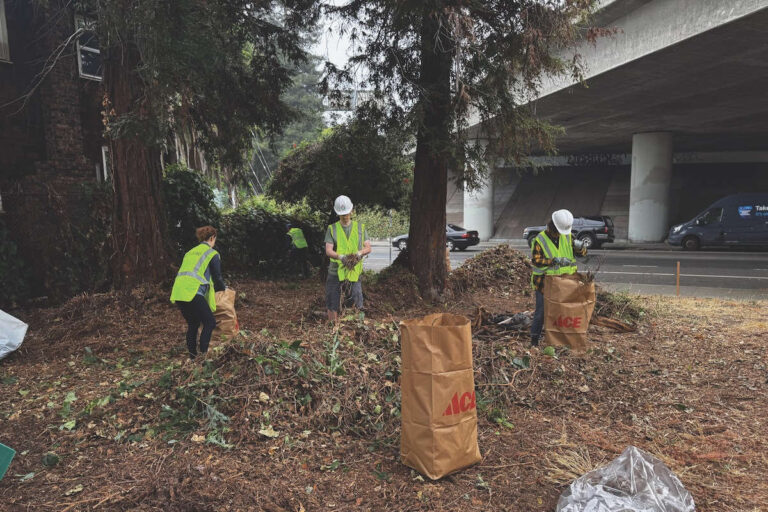
At 606 54th St., where the corner meets Shattuck, Karen West packs a large brown paper ACE garden trash bag that nearly matches her in height. Recently retired from Children’s Hospital in July, she found her way here through the Temescal Street Fair, where she met the garden committee and followed up on their calls for volunteers.
“I like being outside, and I like gardening,” she says. She knows that as a community resident she will have pride in the finished space, and thinks that people will enjoy “driving by it and seeing the park.” Karen loves the idea of a pollinator garden filled with California natives and a play area for kids.
The idea didn’t originate from a planning document or a city committee. It emerged after Caltrans rejected the concept of the garden producing food. So the community pivoted, and in that pivot found something better. The vision came from someone familiar with the land: Khaled Almaghafi, a beekeeper and owner of Bee Healthy Honey Shop at 2950 Telegraph Ave., who lives next door to the vacant corner lot.
Living with the overgrown, ivy-strangled parcel, Almaghafi saw not blight but potential—specifically, the native flowering habitat that sustains the bees he has built his livelihood around. His vision of a pollinator corridor in the heart of Temescal gave the project its ecological soul, connecting the community’s radical political inheritance to the most intimate workings of the natural world: the quiet, essential labor of bees moving from flower to flower, sustaining life without asking permission.
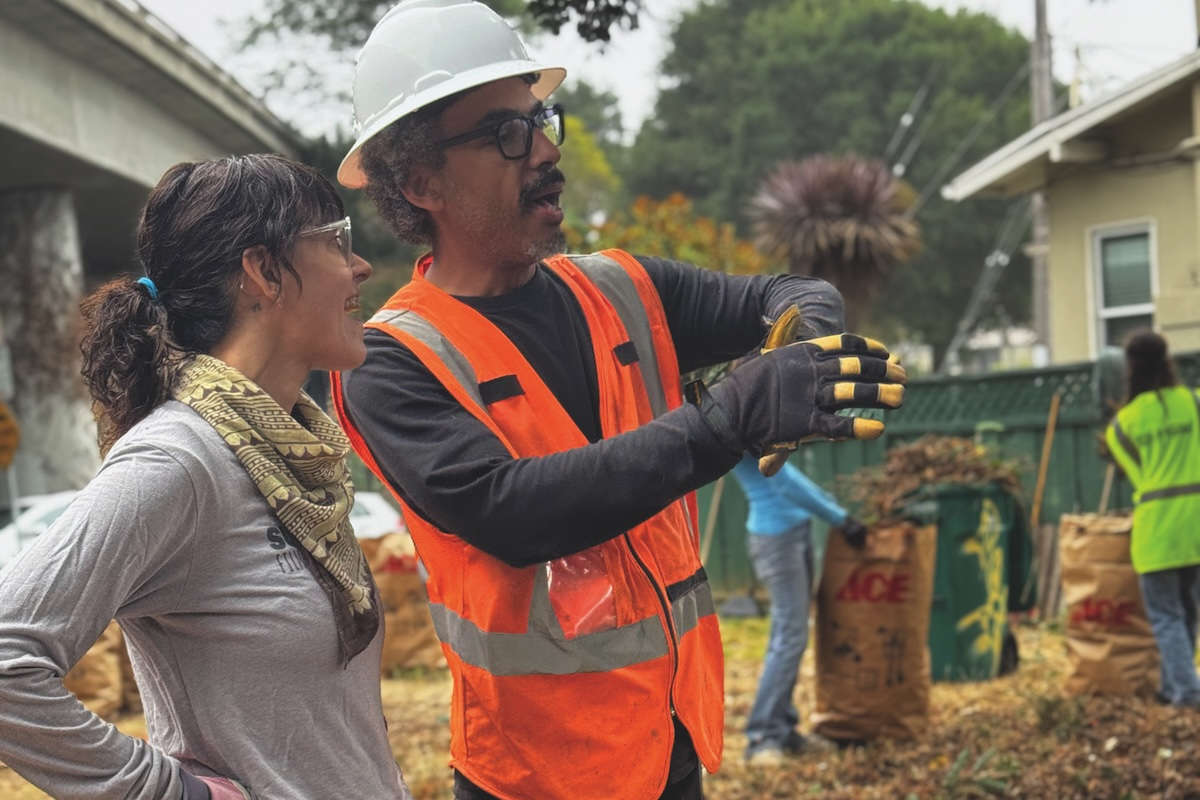
Jack Porter, North Oakland community organizer and Merritt landscape architecture student, is in his element this morning. A hardhat perched atop his salt-and-pepper curly natural mane, his smile is wide and welcoming—illuminating, slashing through the mizzle.
In the shadow of the neighborhood where one of the country’s foremost radical political parties once organized, a pollinator garden is being planted. Radical, because this is a re-matriation of land taken from the community through eminent domain to build a freeway meant to break the back of the Black community and break the heart of radical Black organizing.
It’s reductive to claim that this garden’s sole purpose is to address blight. Furthermore, it’s incendiary because it fuels the national media’s negative portrayal of Oakland. The land this garden occupies was only able to be taken because a careless and intentional report labeled the area as blighted. Words like “blight” hold particular power in Oakland.
On the northeast corner of 54th and Shattuck sits a former residential lot owned by Caltrans— “only because they have one of their freeway columns on the corner,” Porter notes. “We’re here today because we have a permit from Caltrans, and we are taking over this site, installing a 100% native pollinator garden. Today we are removing ivy and the redwood suckers from the base of the redwood grove at the northern part of the lot. The ivy is an invasive species. It’s choking out the redwoods. And really, we want to provide a nice play area for kids to be under the trees.”
For Porter, the planting carries additional meaning—a reversal of deliberate disinvestment. “In the ’70s and into the ’80s, law enforcement across the country removed a lot of trees in predominantly Black and poor neighborhoods as a way for police helicopters to better find suspects,” he says. The practice, documented by National Geographic, stripped urban canopy from the communities that needed it most. “You see a lot of empty tree wells all over neighborhoods, broken sidewalks where trees used to be, and all I see are opportunities to provide people with shade. Opportunities to cool the city and make it a more livable place,” he adds.
This land has a long memory. The Grove-Shafter corridor—Route 24—was never supposed to run through Oakland at all. The original plan traced a path through Berkeley, along Ashby Avenue, threading through a city with the political will to push back. When planners encountered that resistance, they turned south and found Oakland—more welcoming, they decided, which is a polite way of saying less protected. The Federal Housing Administration’s own underwriting manual stated plainly that highways were “effective in protecting a neighborhood and the locations within it from inharmonious racial groups.”
The freeway wasn’t incidental. It was a weapon—a concrete wall purpose-built to quarantine a community as it organized, connected and ignited. The Congress for the New Urbanism has named I-980 among the top 10 “Freeways Without Futures,” noting the damage fell “disproportionately in minority communities.” Disproportionately. That word is doing enormous work. It means Black. It means intentional.
The building at 5605 Grove—today It’s All Good bakery on Martin Luther King Jr. Way—was once the headquarters of the Afro-American Association, the reading group that pioneered Black Nationalist philosophy on the West Coast and directly influenced the founding of the Black Panther Party. That history informs the concept of this re-matriated garden. This land is not meant for exploitation. It is intended for people to rest, enjoy and play in—a place for children to explore, for early morning meditation, for watching bees work a row of California natives in the quiet light.
BEE INSPIRED The community pivoted to a pollinator garden after Caltrans rejected the concept of the garden producing food. Pictured: Rivkah Meadow (left) and Jack Porter.
Rivkah Meadow, a 15-year neighborhood resident, puts it plainly from behind a pair of pruning shears: “There’s just no better way to connect with community and root into the land than volunteering with neighbors and knowing each other. We keep each other safe, especially with all what’s going on right now in our politics. It feels just even more important to weave together locally and help protect our land and soil and protect each other.”
Porter knows the truth that romantics prefer to ignore: This work is never finished. The ivy will come back. It comes back every year, reliable as the mizzle, indifferent to how thoroughly it was pulled the season before. He calls it what it is—not a defeat, but a calendar. The annual ivy-pulling will be “a great opportunity for folks to come together and get a little bit of work in.” Not a single heroic morning, but a standing date between a neighborhood and its land.
Rob Selna, co-director of Sidewalk Trees and Gardens—fiscal sponsor and Caltrans liaison—came to this work through his background as a land-use and real estate lawyer. Their first project at 43rd and Dover built a 2,500-square-foot edible garden that has thrived for a decade. “We decided we needed to do even more things in the city,” Selna says, “because there was such a need.”
The community has raised $30,000 of the $40,000 needed, with the garden being laid out by Oscito, a Bay Area landscape design firm. Planting began the weekend of March 28. Volunteers and donations are always welcome.
For Porter, the mission is personal and political in the same breath. “It’s a lot about third spaces, about communal spaces, about re-matriation of the commons that the colonial capitalist project has robbed from people—not just here in modern U.S.A., but people all over the world. And yeah, we’ve got to fight that.”
In the shadow of a freeway built to break a community, a pollinator garden is being planted. The first order of business is pulling ivy—invasive, persistent, quietly strangling everything it touches. Redlining spread the same way. So did the freeway. Patient, creeping, dressed up as progress.
But here is what the planners never modeled: ivy comes back. And so does this community. They cut it down. It returns. They pave it over. It returns. Resistance propagates—its roots run deeper than anything built to contain it. Oakland wears her scars as testament. And sometimes, it starts with a beekeeper looking at a patch of choked earth and seeing, instead, a field of flowers.
The challenges and rewards involved in biological and cultural regeneration churn like undercurrents in the work of Alec Marin. Whether investigating the mechanisms that drive the brain’s neurorehabilitation following a stroke, teaching himself how to paint, or exploring his Chicano identity and ancient Mexica (Aztec) culture, the Oakland-based artist/neuroscientist is captivated by the discovery of connections.
These and other dimensions of Marin’s interests are on display in “All That You Change/Changes You,” an exhibition through May 2 at Mercury 20 Gallery in Oakland. Approximately 16 paintings, organized by theme more than chronologically, vary widely in what they depict, but establish strong inter-relatability by clustering around teotl. The Aztec concept of divine energy involves the ever-flowing oscillation between life’s polarized realities: day and night, birth and death, fire and water, and so on.
Born in Harlingen, Texas, Marin grew up in Brownsville, close to the Mexican border. While he drew with graphite when young, he focused on biology during high school. He pursued a bachelor’s degree from the University of St. Thomas in Houston and a doctorate from Baylor College of Medicine, then completed post-doc research at UCLA’s Department of Neurology. After publishing a few papers, Marin left academia for the private sector. The Bay Area’s high volume of biotechnology companies attracted him first to Fremont, then Oakland.
“I love the culture, people and art scene of Oakland,” he said. “The vibe is open, friendly, welcoming.”
As a self-taught artist, other than a single art class he took, Marin has been his own, primary teacher. “In college I was super-focused on biology and didn’t do art because the program was too intense,” he said. “But in grad school, when I got my first paycheck and had spare time in the evenings, I spent all my money on paint, canvases and other supplies.”
His first attempts were messy.
“My instinct was to just throw paint on the canvas,” he said. “My dorm in L.A. was near the Rothko Chapel, and I was surrounded by abstract art [collections]. Initially, I just enjoyed mixing paint, throwing a couple tones on a canvas. Then, I wanted to do portraits and landscapes. I worked on form, which took years of trial-and-error to figure out. Eventually, it just clicked. From there I transitioned to oil, which is now my primary medium.”
A strong secondary influence was a book Marin read, Aztec Philosophy: Understanding a World in Motion, by James Maffie. In paintings exploring his cultural identity, spirituality and relationship with the natural world, Marin’s newest work delves into the teotl philosophy that is the keystone of Mexica philosophy.
The single thread running through all his work is the principle of cycles. The Mexica conceptualized the universe as an oscillating struggle between paired opposites. “The challenge that idea presents to boundaries and delineations fascinates me. These things exist in relationship to each other, and everything we understand about the universe emerges from renewal and regeneration,” he said.
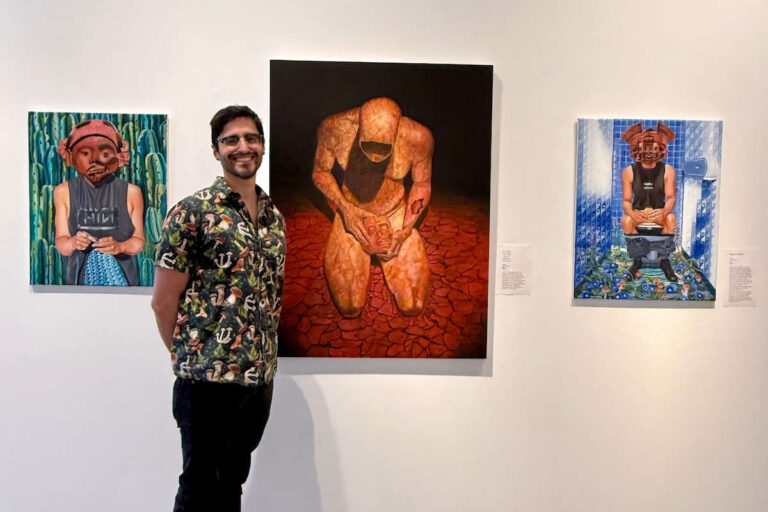
Momentary Condensations of Teotl demonstrates this concept and Marin’s propensity for combining ancient Mexica symbols in contemporary settings. A figure wears a split, life/death clay mask and a t-shirt with a Nine Inch Nails logo, the two “N’s” mirroring each other. The person is crocheting using a Mezzo-American, stepped-fret pattern resembling waves going in opposition to each other. “I’m indicating he is weaving teotl and existence into reality,” Marin said.
The architecture of Marin’s art and science endeavors finds its structure through mastering new techniques and skills, experimenting, troubleshooting and maintaining flexibility of mind. Moving forward, he appears intent on finding holistic discoveries and on bridging the gaps between opposites that do not at first seem interrelated, but are.
Alec Marin, ‘All That You Change/Changes You,’ through May 2 at Mercury 20 Gallery, 475 25th St., Oakland. Open Fri-Sat: noon to 5pm and by appt.; Oakland Art Murmur / First Friday: May 1, 5-9pm. mercurytwenty.com
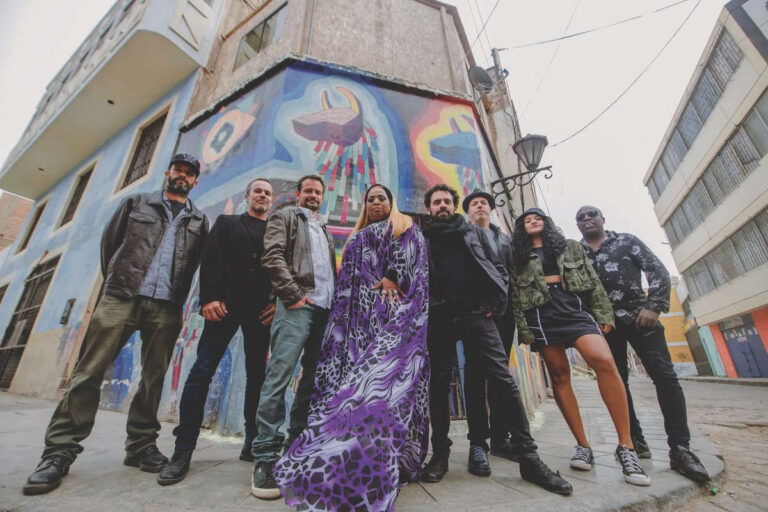
The tragedy of African slaves brought to Peru in the 1500s gave the foundation for Novalima. The group’s music has the rhythms of Africa, melding the melodies and instruments of Europe and the Andes. The results are a rich cultural stew, especially as the four founders grew up investigating not just Afro-Peruvian music, but also rock, dub reggae, Latin and electronic music. The band’s visibility has been boosted by coverage from NPR,UK Guardian andWall Street Journal, along with a Latin Grammy nomination and strong reviews for their albums, Novalima, Coba Coba, Karimba and their newest release from San Francisco-based Six Degrees Records, La Danza. – LOU FANCHER
Percussionist Sameer Gupta’s Rootstock Arts organization has presented monthly music series at Wyldflowr Arts in West Oakland for several years, focusing on raga-based music. Now he’s created a North Oakland arts center with an array of resources available for various creative pursuits, including a performance space that East Bay bassist Mat Muntz is inaugurating with a three-night residency. He kicks it off with Phantom Islands II – Bag of Winds, a body of original tunes featuring Muntz on Balkan bagpipes and bass, Ben Goldberg on clarinets, Kasey Knudsen on alto sax and Scott Amendola on drums. Friday features Muntz with his wife, Astrid Kuljanic. And Saturday’s program features an improvisation-powered trio. – ANDREW GILBERT
“Workers of the world, unite!” might have been made famous by Marx—Karl, not Groucho—but International Workers Day actually commemorates the 1886 general strike that led to the eight-hour workday. Celebrate the people who keep the world moving with Oakland Sin Fronteras and their guests, Oakland rapper and community organizer Bambu, filmmaker Boots Riley and Riley’s legendary civil rights activist dad, Walter, who turns 82 on May 1. The party follows the International Workers’ Day March & Resource Fair, beginning at 2pm at Fruitvale BART Plaza. As union members say, “Unions—the folks who brought you the weekend.” – JANIS HASHE
INFO: Fri, 8pm, La Peña Cultural Center, 3105 Shattuck Ave., Berkeley. $10-$25. 510.849.2568.
FRIDAY, MAY 1 SATURDAY, MAY 2 & SUNDAY, MAY 3
BLUEGRASS
BERKELEY BLUEGRASS FESTIVAL
Berkeley embraced bluegrass in 1959, when Mayne Smith and some Berkeley High buddies launched the Bay Area’s first bluegrass combo, the Redwood Canyon Ramblers. Their legacy manifests this weekend at The Freight with the two-day Berkeley Bluegrass Festival, which features workshops, jams and evening concerts. Friday’s triple bill features Kentucky fiddler Jason Carter, the Tennessee quartet Chris Jones & the Night Drivers, and Berkeley’s own Laurie Lewis and the Right Hands. Saturday’s program includes fiddler Tatiana Hargreaves Band with guitarist and vocalist Michael Davis, the new Portland combo Caleb & Reeb with the Cali Cutups, and the trio of string wizard Tony Furtado. – AG
INFO: Sat-Sun, May 2-3, The Freight, 2020 Addison St., Berkeley. $44-$69. 510.644.2020.
SATURDAY, MAY 2
EMO
EVERYONE ASKED ABOUT YOU
Originally formed in 1996 in Little Rock, Arkansas, Everyone Asked About You was part of the second wave of emo music. However, they wouldn’t make a name for themselves until much later as their blend of emo and indie-pop was way ahead of its time in the late 1990s. They disbanded in 2000 and members went on to form other groups like American Princes and experimental metal favorites, the Body. However, in 2022, archival record label Numero Group announced they were reissuing the band’s discography. One thing led to another and Everyone Asked About You decided to do a reunion show, which led to another, which led to the release of new music. – MAT WEIR
Bert Kreischer’s comedy runs on long-form stories that spiral into outrageous confession and oddly wholesome self-awareness. Kreischer has transformed a larger-than-life reputation into one of stand-up’s most commercially dominant careers, selling out arenas while maintaining the loose energy of a late-night hang. Podcasting and consistent touring—his “Permission To Party” Tour is rocketing through 12 states by June—have built Kreischer a sprawling entertainment brand fueled by big stories, big stages and a dedication to getting shirtless. – SONYA BENNETT-BRANDT
iÓrale ese! Whatchoo know about the barrio? Manic Hispanic knows and will teach you all their pinche ways, like the higher the socks the downer the foo, how to make your own Tijuana belt buckle and how to dodge the chancla when tu madre hears you listening to la musica del diablo. Not only does Manic Hispanic cover punk-rock classics with a hilarious Chicano culture twist, but they do the songs a hell of a lot of justice. That’s because the band is more of a supergroup, comprised of former and current members of the Adolescents (RIP Soto!), Death By Stereo, Agent Orange and Final Conflict. – MW
INFO: Sun, 8pm, Ivy Room, 860 San Pablo Ave., Albany. $25. 510.526.5888.
SUNDAY, MAY 3
FESTIVAL
JEWISH ARTS & BOOKFEST
In one afternoon, attendees can: Listen to experts on punk culture talk about how it confronts antisemitism, discover “Torah in the Tarot,” experience live performances of the Parisian salons of the Steins or “the world’s only Indian Jewish stand-up comedian,” and find out how Jewish authors revolutionized children’s picture books. Then take a break at the Festival Shuk (Marketplace) with a pop-up shop from Berkeley’s Afikomen Judaica and over 20 local community groups, artists and authors. Oh, and nosh at the kosher Middle Eastern food truck. The Jewish Arts & Bookfest is back, and a person would have to be meshuggeneh not to check it out. – JH
Los Angeles hardcore mainstay Terror has spent more than two decades proving that longevity and intensity don’t have to cancel each other out. The band snapped the hardcore genre back to basics: urgency and absolute physical commitment. Fronted by Scott Vogel’s unmistakable bark, Terror writes fast, confrontational songs about self-empowerment, survival and loyalty to the scene. Their brand-new, full-length album, Still Suffer, created with producer and former guitarist Todd Jones, sharpens into 10 relentless tracks, a living transmission of hardcore’s enduring core values. – SBB
With close to four million listeners on Spotify, there must be an appeal to Good Kid’s music—or just a ton of parents desperate for a positive spin on the word “kid.” Either way, the upbeat, bouncy J-rock, pop-punk energy and jivey lyrics of Good Kid’s songs charge up head-for-the-sky, gravity-defying vibes. At the risk of seeming cheeky, the show generates radiance without sacrificing creativity. Earning a recent JUNO Award nod for “Breakthrough Group” and flashing sold-out shows around the world, these musicians are clearly in command of their art form. After issuing four EPs, Good Kid brings out their debut full-length album, Can We Hang Out Sometime? – LF
Many people are asking: What is the deal with Gavin Newsom? Since Donald Trump returned to office, the governor has gained a lot of new fans across the country for trolling Trump online, often responding to the insane president’s ravings with satirical mockery of them. He’s pretty good at it.
But at the same time, Newsom has hosted a podcast, This Is Gavin Newsom, where he’s welcomed people as vile and/or ridiculous as Trump himself, or even more so, if that’s even possible: people like Steve Bannon and Michael Savage and the late Charlie Kirk, whom Newsom mournfully eulogized as his “friend” after Kirk was assassinated. Newsom tore up a homeless encampment for a photo op. He has thrown trans people under the bus.
He can’t be pinned down, Gavin. He’s a maverick. He’s a mystery inside a riddle wrapped in the New York Times’ opinion pages. Or anyway, so he hopes people will think. His whole trip is the same as that of the Democratic Party’s leadership: He’s triangulating—hoping, as he eyes a run for the presidency, to keep his liberal base intact while also appealing to the “ordinary Americans” whom he imagines, often correctly, are bigots and revel in displays of cruelty toward the homeless. He has called on the Democratic Party to be less “woke,” and more “culturally normal,” while offering no examples of “wokeness” or cultural abnormality among Democrats.
For some reason—consultants … the reason is consultants—such Democrats believe that by having no genuine worldview and by cosplaying as “bipartisan,” they’ll appeal to people of all worldviews. The fact that this strategy has repeatedly failed them, and brought us a national government led by fascist lunatics, does not seem to dissuade them one bit.
When it comes to weed, the story is sort of the same. Newsom desperately wants to be seen as “reasonable” on cannabis policy. He was an early and effective advocate for legalization, and he has done some things to shore up a broken legal-weed industry. But he has also failed to do what is necessary to allow the industry to thrive: chiefly, cut the state’s onerous 15% excise tax on pot sales.
As of April 2026, a google search with Newsom’s name and “cannabis” produces results that are overwhelmed by his massive assaults on illicit pot growers and peddlers. Cracking down on illicit weed helps the legal industry somewhat, but only by the thinnest of margins. It is, however, a way for him to look like he’s doing something about the industry’s problems. And it helps him strengthen his “law and order” credentials (“dope on the table”). Meanwhile the industry continues to struggle and illicit weed, which is way cheaper than what people can get at their local dispensaries, continues to thrive.
Newsom did sign a bill to roll back a hike in the excise tax, which had brought it to a ridiculous 19% for the last half of 2025, and to keep it from rising again until at least 2028. Earlier, he spearheaded the elimination of the state’s cultivation tax. And he’s signed on with enough other reforms that the National Organization for the Reform of Marijuana Laws has given him a grade of A-minus—though it seems they gave that grade in 2022 and haven’t updated it.
If the overall state of the industry is a good guide to how well or badly Newsom has done on cannabis policy since legalization, Newsom’s record is, at best, mixed. California’s legal industry peaked in 2021, boosted partly by the Covid epidemic, at $5.35 billion. In 2025, the industry recorded sales of just $4.4 billion, a drop of nearly one-fifth.
That’s not all Newsom’s fault, of course, but cannabis reform is one of his signature issues he will bring with him to the 2028 primaries. He might give himself a bit of a leg up if he can do something to help the California cannabis industry recover by then. But he would do even better if he stopped trying to appeal to America’s reactionaries. If he keeps up with that schtick nobody, including weed-industry advocates or even the people who love his Trump-trolling, will have any reason to trust him.
[Editor’s note: This article was written before the Trump administration’s April 23, 2026, order to move FDA-approved and state-licensed medical marijuana from Schedule I to Schedule III of the Controlled Substances Act.]
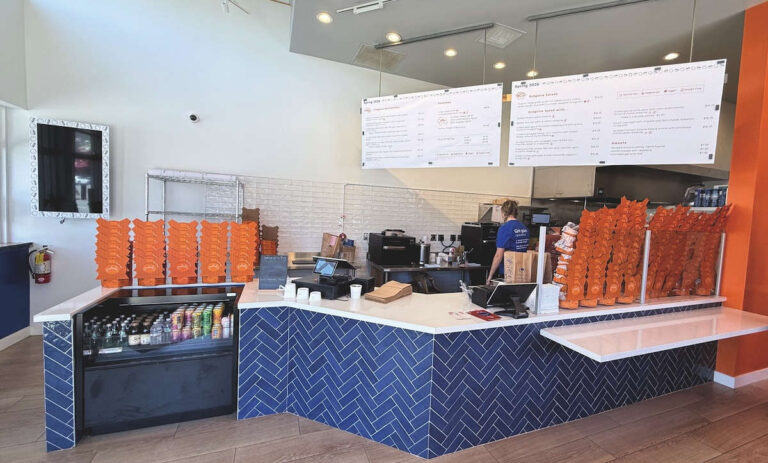
In the culinary world, the term “franchise” invariably connotes fast, unhealthy food. The idea of opening one is suspect and implies the owner lacks originality. Or that they’re reaping the benefits of an established brand not by earning credibility but by purchasing it with cold, hard cash. After two decades as a fixture on Cedar Street in Berkeley, chef Jacquet’s Grégoire has now officially entered its very own franchise phase. A small restaurant group recently opened a Grégoire in San Francisco’s Inner Sunset neighborhood. Before Jacquet embraced the idea, the chef also had his own doubts about the business model.
“By learning more about franchising, I discovered that it was more than a name,” Jacquet told me. He spent a year “creating systems” that would work within the limitations of one. Those systems included a frequently changing menu, proprietary recipes and the quality of the food. Once those systems were in place, two years ago, Jacquet opened the application process. He received around 150 franchise applicants and honed in on one.
“We talked a lot, and I fell in love with them and the way they operate and the way they think,” Jacquet said. “The group already had some experience in the restaurant business so it was just a perfect fit.” Last May, he awarded the group a franchise. Jacquet said he made the decision because of a gut feeling, mostly.
In general, he wants to partner with business-savvy franchisees. For him that means, “They care about other people, their customers, their employees and for the community.” And they’ve got to have street smarts.
Grégoire changes the menu quarterly, except for the crispy potato puffs. They’re like mashed potatoes only with a deep-fried coating. To ensure the quality of the food at a franchise is consistent with the brand, Jacquet runs a central kitchen in Emeryville where all of the ingredients are prepared. “Whatever we need to portion, we portion. Whatever we need to cook and slice, we cook and slice,” he said. At the end of the night, the San Francisco franchise orders what it needs for the next day and the products are delivered overnight.
This shared commissary provides the mother ship with specific information about how much product the satellite location is using. “We always have someone going over there,” Jacquet said. “We go on location to look at how they build their sandwiches.” The chef himself goes once a week or asks the employee delivering the food to see what products are in the refrigerator. “It’s not like we are separated from our franchisees at all,” he said. “We’re really in constant communication.”
Jacquet has ambitious plans for the business. “You create a hub here in the Bay Area that can provide for—we calculated up to 40 restaurants all the way up to Sacramento,” he said. “I’m ready for the growth here in the Bay Area.” Should this model work for the company, expanding to Los Angeles is part of the long-term plan.
Along with an actively roaming food truck, Jacquet had previously expanded the business. The chef reminded me that back in 2006 Grégoire operated a second location on Piedmont Avenue for just over a decade. When the Cedar Street location opened in 2002, he and his wife had a 3-month old. He decided to close the Oakland storefront to spend more time with his family. He recalled, “I was working too much and not cleverly enough, I guess.”
Both of his children are now college-aged, making this an ideal time to grow the business again. “All these years, I always thought that sharing this concept with other business owners would be a great thing because it’s such a personalized business,” Jacquet said. “We take care of the customers so heavily, and we care so much about the food.”
Jacquet is French, but his menu is filled with California cuisine. Dishes that are meant for lunchtime and light dinners: salmon and chicken salads, sandwiches and wraps with lamb, salami or vegetables. The chef’s standard reply about his cuisine is: “I cook food I like to eat, and I cook food I think people would like.”
Grégoire, 2109 Cedar St., Berkeley. Open Mon-Thu, 11:30am to 7pm; Fri-Sun, 11:30am to 8pm. gregoirerestaurant.com
ARIES (March 21-April 19): In the 19thcentury, Aries photographer Eadweard Muybridge (1830–1904) resolved to settle a debate about whether galloping horses ever have all four hooves off the ground. He developed a system to capture rapid sequential images, which ultimately helped lead to the invention of motion pictures. His answer to a narrow technical question opened up an entirely new art form. Moral of the story: Solving a specific problem may create unforeseen revolutions. In the coming weeks, Aries, I invite you to stay alert for how your focused efforts to address one challenge might birth even more significant breakthroughs. Don’t get so fixated on your immediate goal that you miss larger innovations emerging from your work.
TAURUS (April 20-May 20): May is Free Thinking Month for you Tauruses. It’s also Free Feeling, Free Wheeling and Free Healing Month. Wow! To observe this festive grace period, indulge in any of the following jubilant acts: 1. Declare your independence from anyone who tries to tell you how you should live your life or who you are. 2. Declare independence from your history, especially recollections that dampen your sense of possibility and old self-images that impede your yearning to explore. 3. Declare independence from groupthink and conventional wisdom. 4. Declare independence from your former conceptions of freedom so you’ll be free to arrive at fresh understandings of it.
GEMINI (May 21-June 20): The Navajo practice hózhó means “walking in beauty”: living in balance and harmony with life. But hózhó isn’t a static state you achieve once and possess forever. You must continually restore and reinvent it. I suspect you’re in a phase like that now, Gemini. Too much thinking and not enough feeling? Too much future and not enough present? I recommend you take corrective measures. Start by taking one physical action that grounds you. Have a conversation from the heart instead of the head. Spend an hour not planning the story to come, but simply loving what’s here right now. Refresh your hózhó!
CANCER (June 21-July 22): If a honeybee colony becomes too crowded, scout bees search for potential new hive sites. When they return, they perform waggle dances for their colleagues to convey specific information about different locations. Negotiations ensue. Various possibilities are offered and considered through more dancing. Eventually, the swarm collectively makes a choice and heads out to its new home. Your challenge right now, Cancerian, is to be like a scout bee who facilitates your group’s decision-making process. I invite you to carry out a reconnaissance mission and then perform your waggle dances for your people. Make your case with vigor and precision. Trust the group’s emergent wisdom to make the best decision.
LEO (July 23-Aug. 22): Like all of us, Leo, you have persistent aches from old losses, absences and wounds. They may seem like permanent burdens you will never be able to shake or transcend. But here’s some very good news: In the coming months, there’s a greater chance than usual that you’ll discover new approaches to healing them. The remedies won’t necessarily be logical or obvious. They may involve you conducting rituals, taking symbolic actions or ambushing the pain from unexpected angles. Be alert for interventions that may seem too simple or unexpected to work.
VIRGO (Aug. 23-Sept. 22): Your restlessness is building. How much longer will you pretend you don’t sense the pull of bright temptations and appealing sanctuaries? At what moment will you finally stop resisting your urge to slip past the usual boundaries and roam? The astrological omens hint that this pivot is close at hand. In the borderlands of your imagination, a daring journey is already taking shape. Where might it carry you? Here’s my guess: down into the raw, unfiltered depths of the future you secretly dream about.
LIBRA (Sept. 23-Oct. 22): In fairy tales, when heroes are rewarded for their help and kindness, their gifts are often tools of protection: a cloak that renders them invisible, a magic club that chases off foes or enchanted shoes that enable them to outrun any threat. In other stories, the reward is meant to deepen the hero’s delight in living: a genie’s lamp, a cauldron that cooks up exquisite food or a horn that calls forth marvelous companions from the fairy world. I mention this, Libra, because I believe rewards for your past and recent generosity are on their way. If you have any say in what form they take, I suggest you request something from this second, pleasure-giving category.
SCORPIO (Oct. 23-Nov. 21): Poet Marie Howe wrote, “I don’t think we can love anything more intensely than we love a secret.” Many Scorpios feel this way. You understand that mystery is often a joy to be savored. Some truths reveal themselves only to those who summon the patient intelligence to be at peace amidst the confounding riddles. Non-Scorpios may be desperate to leave nothing hidden, but you like to learn from the teasing prickles. You know that some transformations need darkness to carry on their work. Your next assignment: Decide what truth needs more time in the deep before it’s ready to surface.
SAGITTARIUS (Nov. 22-Dec. 21): Diamond is the hardest natural substance, while graphite is soft and slippery. Yet they’re both made of pure carbon. The difference is in their structure. Let’s extrapolate from this fact as we ruminate on your life, Sagittarius. I’m 97% certain that you already have everything you need. Maybe you imagine you lack key resources and powers, but from what I can tell, you are well set-up. So I propose that you simply reorganize what’s available to you now. Take the “carbon” of your life and arrange it in new patterns. Your task isn’t further accumulation but reconfiguration.
CAPRICORN (Dec. 22-Jan. 19): My Capricorn grandfather was a master artisan. He told me that the best furniture is built twice: first in the imagination, then with wood. Let’s apply that theme to you. I believe you have mostly finished the first step of visualizing what you want. Now you’re almost ready to launch the actual work. I’m eager to see the practical effects that will bloom from your detailed fantasies. The rest of the world is excited, too. These days, we all especially need your talent for turning beautiful dreams into vivid realities. You have extra power to inspire us to convert our idealistic notions into dynamic actions.
AQUARIUS (Jan. 20-Feb. 18): I invite you to imagine a time in the past when you were almost perfectly content. Visualize that magical confluence of satisfying feelings. Where were you? Who was or wasn’t there? What could you see, hear, smell and feel in your body? What made that moment so right? Next step: Make a vow to rebuild as many of those conditions as you realistically can over the next three weeks. Maybe you can’t recreate the exact scene, but you can approximate its essence.
PISCES (Feb. 19-March 20): The astrological factors now in effect are tending to generate useful and valuable cosmic jokes. I believe they may be disruptive and catalytic in helpful ways. In this spirit, I offer you the following affirmations, borrowed from internet memes: 1. “You may call me ‘melodramatic.’ I describe myself as a ‘creative problem-solver with flair and panache.’” 2. “I’m not overthinking; I’m overriding simplistic answers that hide the real truths.” 3. “You shouldn’t think of me as chaotic; the fact is that I’m generously non-linear.” 4. “I have a solid plan, but it’s always evolving to keep up with reality’s crazy insistence on ceaseless change.” 5. “Please dismantle your low expectations; I need ample room to exceed them.” 6. “I trust my instincts; they have often been wrong in interesting ways.”
People living near oceans or on islands often overlook the marine wildlife teaming below the sea’s surface. Marvelously, many scientists, explorers, environmentalists and fine art photographers dive deep and return with unforgettable images and stories of the underwater world.
In 2025, judges and curators of the prestigious, British-based Ocean Photographer of the Year competition considered over 15,000 submissions of these photographs, which arrived from around the world. Presented by Oceanographic Magazine and Blancpain, the global event in its fifth year resulted in 116 winning and finalist photographs selected for its annual exhibit celebrating achievement in ocean photography. The categories include Wildlife, Fine Art, Adventure, Conservation, Human Connection, Young Photographer of the Year, the Ocean Portfolio Award and the Female Fifty Fathoms Award, which honors excellence by women photographers.
A combination of good luck and intentional planning brings the exhibit to the United States for the first term. Opening April 24 in Hangar 41, a historic World War II airplane hangar at Alameda Point, the exhibit is hosted by West End Arts District (WEAD) and Bay Photo Lab and continues till May 17.
The immersive exhibition fills the vast industrial space with stunning, museum-quality photographs printed on aluminum. A connected gallery features “Bay Perspectives,” an interactive space shared with the Sailing Science Center that offers hands-on opportunities to engage with ocean processes such as wave formation, tides and more. A program of special events includes live storytelling, a performance by Alameda-based cellist and composer Mia Pixley, a sunset cruise—already sold out—and evenings devoted to presentations centered on coastal ecosystems in Northern California.
“The photographic exhibit is huge,” says WEAD Executive Director Tara Pilbrow. “It gives the audience many touchpoints with the ocean. The smaller Bay Perspective gallery is an ode to and a love letter to the California coastline. You get a sense of the ocean throughout the world, and then, especially for those who choose to live on the small island of Alameda to be close to the sea, Bay Perspectives shows the Pacific as more than a black, opaque surface. After that, you walk outside and you’re looking straight at the ocean.”
Pilbrow says that glimpsing beyond an occasional seal sighting to see incredible images drawn from the ocean’s ecosystem stimulates the imagination. Bringing the exhibition to the Bay Area represents for her and the rest of the team an opportunity for people to consider how they appreciate and steward the ocean.
The evening events were planned with local collaborations in mind. Six scientists from the San Francisco Estuary Institute will tell five-minute stories about their work. “They workshopped with an Alameda award-winning storyteller, JP Frary, who will be the night’s MC,” Pilbrow says.
Cellist Mia Pixley has previously written music inspired by the sea, and Pilbrow is excited by the Alameda resident’s plan to perform work from the album and other pieces inspired by the exhibition.
SHOW-WINNING IMAGE Russian photographer Yury Ivanov captures two incredibly tiny marine creatures—amphipods from the Cyproideidae family, commonly called ‘ladybugs of the sea’—resting quietly on coral. (Photo by Yury Ivanov)
Of course, the photographs are the stars of the show. From Yury Ivanov’s overall show-winning image of two amphipods that measure no more than 3mm in length to the 15 sperm whales socializing in Romain Barats’ photograph, the range from micro to macro is breathtaking. Responding to a request for comments on a limited selection of the works, Pilbrow returns repeatedly to the idea that the ocean is full of surprises, along with warnings about how much the world stands to lose if people neglect it.
Jesse Miller’s finalist photograph in the Conservation (Impact) category has a Sixgill Shark swimming past an abandoned toilet and bright orange traffic cone half-buried in the ocean floor. The lighting is a dense, eery green. Pilbrow says, “It’s not a photo I’d choose for its aesthetic value, but it’s so striking. Here’s this incredibly ancient animal and people’s refuse together at the depth of the sea. You get hit by the guttural story instantly.”
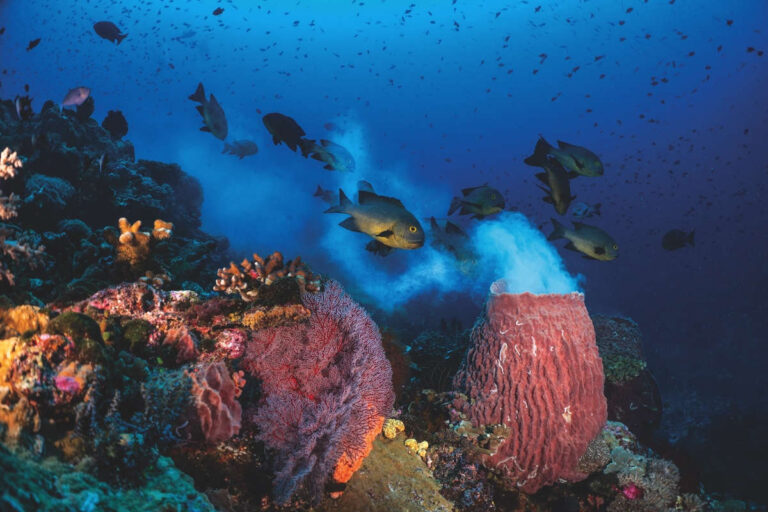
Aaron Sanders’ photo of a giant barrel sponge spewing a cloud of spawn and midnight snappers gorging on the rising plumes captures a rare moment of coordination. “All the sponges in the area do it at the same time,” Pilbrow says. “So much is volcano-ing out and these predators feast on it, but because of the volume, more of it survives. The hopefulness of that image is caught by this flourishing coral reef when so few reefs are still healthy.”
SIXGILL SHARK American photographer Jesse Miller illuminates the contrast between a 200-million-year-old prehistoric animal and the human-created trash at his local dive spot in Des Moines, Washington. (Photo by Jesse Miller)
The intense dedication and precise timing necessary to capture an image is evident in multiple photographs. The vibrant orange outline of a black juvenile pinnate batfish in Luis Arpa Toribio’s photo lasts only a few months; a yellow pigmy goby releasing newly hatched larvae illustrates Takumi Oyama’s years of dedication to one fish; Natnattcha Chaturapitamorn’s photo of fishermen harvesting seaweed in a swirl of shimmering aqua nets was taken at 5:14am.
“It’s a great reminder of communities that have daily, human-level interactions with the sea,” Pilbrow says. “Counter to massive, industrial trawlers destroying the ocean floor, it reminds us of a more holistic relationship with ocean life.”
A visitor’s greatest takeaway from the exhibit is the simple awareness, Pilbrow suggests, of how invaluable the “watery backyard” is for everyone fortunate to live on, near or surrounded by the sea.
‘Ocean Photographer of the Year,’ April 24 through May 17 at Hangar 41, 650 West Tower Ave., Alameda. Open Sat-Sun, 10am to 6pm; special events Thu-Fri. Tickets: general $25, youth/students $15, family package $60. westendartsdistrict.org/ocean-photographer-of-the-year-alameda.
Driving along Waterfront Road in Martinez, the landscape feels exactly like the industrial heart of the East Bay. Speeding cars are flanked by the towering steel drums of petrochemical refineries, the rumble of I-680 and massive oil tankers gliding under the Benicia-Martinez Bridge. It is, by most definitions, a “harsh” environment.
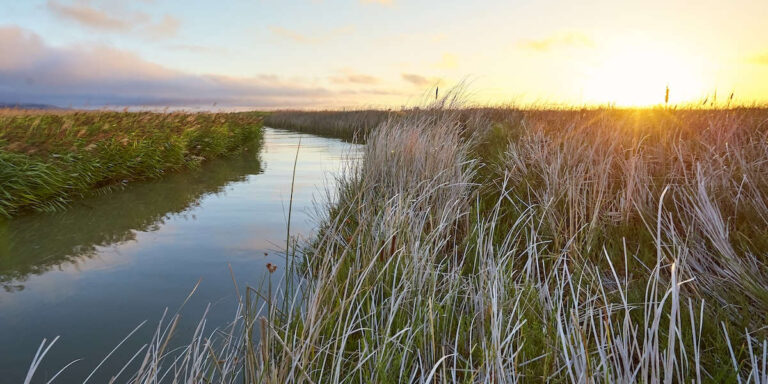
Once visitors step through the gate at Pacheco Marsh, however, the world transforms. The roar of the highway fades, replaced by the rhythmic splash of tidal currents and the high-pitched call of the California black rail. Here, where Lower Walnut Creek meets the Suisun Bay, a $25 million, two-decade-long engineering feat was recently completed and opened to the public. What was once a scarred dumping ground for dredge spoils and a proposed junkyard is now a 237-acre pristine wetland.
This massive undertaking was led by John Muir Land Trust (JMLT), a locally based nonprofit that protects the places that make the East Bay special. For over 20 years, the organization navigated a labyrinth of permits, funding and complex engineering. By spearheading a coalition of public and private partners, JMLT turned a vision of restoration into a physical reality.
The site’s history was not always so serene. For much of the 20th century, the marsh was viewed strictly through the lens of industrial utility. The prevailing philosophy at that time was to bend nature to the will of man. In an era where “progress” often meant the systematic extraction of natural resources, the land was subjected to grueling mechanical processes.
Most notably, the area served as a hub for sand-mining operations. Massive amounts of sand were dredged directly from the floor of the San Francisco Bay and pumped through a network of pipes onto the shoreline. From there, it was fed into a concrete manufacturing plant that stood where hikers now find quiet trails.
Beyond the mining, the land was treated as a convenient basin for “dredge spoils”—the thick, often contaminated silt cleared from shipping lanes to allow oil tankers passage. Diked, drained and filled with industrial debris, the marsh effectively vanished under what the JMLT website describes as “the deep scars of industrial abuse.” All of this was sold to the public as progress.
By the time the land trust and its partners began the restoration, the soil was a compacted, “sandy wasteland” that supported very little native life. At one point, a portion of the property was even slated to become a commercial towing and junkyard, which would have permanently sealed the contaminated soil under a layer of asphalt and rusted steel. The remnants of this activity surround the marsh on all sides.
That contrast is the point. JMLT calls it “ecological reconciliation.” This isn’t just a postcard of the past; it’s a functional, resilient future. Today, the marsh is designed with computer-modeled engineering to adapt to rising sea levels, providing a natural buffer for the surrounding communities while restoring a habitat that had lost 90% of its historic footprint in the San Francisco Bay Area.
“Pacheco Marsh helps remind an ever-increasing number of nearby urban dwellers to respect and cherish the nature all around us,” says Linus Eukel, executive director of JMLT. “It’s crucial to help raise children who will care for a world that sustains us all.”
RESILIENT FUTURE Pacheco Marsh is a monument to persistence and ‘ecological reconciliation.’ (Photo by Adam Weidenbach, courtesy of John Muir Land Trust)
Walking these trails, the visual juxtaposition is striking. To the left, a white egret might be perched silently in the cordgrass; to the right, the gleaming pipes of a refinery catch the afternoon sun. It’s a reminder that nature does not need a remote wilderness to thrive—it just needs an invitation to return.
For families, the marsh is a revelation. There are 2.5 miles of paths, many of them ADA-compliant, making it accessible for strollers and seniors alike. Visitors can walk across sturdy aluminum bridges that span serpentine tidal channels, offering a bird’s-eye view of a thriving ecosystem. This area is home to 10 special-status species, including the elusive salt marsh harvest mouse—a tiny creature found nowhere else on Earth but the marshes of the San Francisco Bay.
For the more adventurous, a new kayak launch supports a two-mile loop through the marsh. This water trail offers a perspective of the shoreline previously inaccessible for nearly a century. Paddling through the quiet channels, kayakers are level with the water, watching the tides move in and out—a wonderful way of getting some exercise and seeing the wildlife up close and personal.
Perhaps the most vital mission of Pacheco Marsh is its role as an outdoor classroom. The site features a low-key outdoor space with seating and 14 interpretive panels that tell the story of the land’s human and natural history. For educators and school groups, it’s a living laboratory where science moves off the chalkboard and into the mud.
Students can witness firsthand how nature heals itself when given the chance. They can see how 31,000 native plants, carefully selected and placed, and a strategically breached levee can turn a “sandy wasteland” back into a nursery for 75% of the region’s fisheries. It’s one thing to read about climate resilience in a textbook; it’s another to stand on a bridge and watch the Suisun Bay reclaim its historic home after a century of industrial exile.
“It’s an inspiring message of hope about our future,” Eukel says.
In a world where environmental news often feels heavy, Pacheco Marsh is a monument to persistence—a win the community can actually walk through. It’s a place where people stop being spectators of decline and start being participants in restoration. It proves that with enough grit, sweat and time, we can undo the damage of the past and manifest a sustainable future for the next generations.
Some events burn through a place. Others continue burning quietly inside the people who lived through them. Multimedia artist Merlin Coleman has made a work that listens to both. Her new work, DISPATCHES from the CHARCOAL FOREST, opens May 1 in the East Bay.
Part choral performance, part sound installation, part reckoning, the piece draws from interviews with cleanup workers,...
For years, California suffered from a reputation as a pizza desert. Having grown up in an East Coast family with roots in Naples, I was keenly aware of the deficit when my parents moved us West.
“It was just different out here. We still had great pizza,” says Tony Gemignani, the world pizza champion who grew up in southern Alameda...
Call it the scars of a beer bottle broken across the face of storied Black Oakland, severing the twin nerves of prosperity and progress. The freeway system that slashes through this city—from South Berkeley through Temescal to Downtown—was never meant to aid Oakland. The Oakland of the 1960s was a city on her mid-20th-century path, blazing toward the capable,...
The challenges and rewards involved in biological and cultural regeneration churn like undercurrents in the work of Alec Marin. Whether investigating the mechanisms that drive the brain’s neurorehabilitation following a stroke, teaching himself how to paint, or exploring his Chicano identity and ancient Mexica (Aztec) culture, the Oakland-based artist/neuroscientist is captivated by the discovery of connections.
These and other dimensions...
This week's calendar picks feature Novalima, Mat Muntz, Berkeley Bluegrass Festival, Party for the Workers, Everyone Asked About You, Bert Kreischer, Manic Hispanic, Jewish Arts & Bookfest, Terror, and Good Kid.
Many people are asking: What is the deal with Gavin Newsom? Since Donald Trump returned to office, the governor has gained a lot of new fans across the country for trolling Trump online, often responding to the insane president’s ravings with satirical mockery of them. He’s pretty good at it.
But at the same time, Newsom has hosted a podcast,...
In the culinary world, the term “franchise” invariably connotes fast, unhealthy food. The idea of opening one is suspect and implies the owner lacks originality. Or that they’re reaping the benefits of an established brand not by earning credibility but by purchasing it with cold, hard cash. After two decades as a fixture on Cedar Street in Berkeley, chef...
People living near oceans or on islands often overlook the marine wildlife teaming below the sea’s surface. Marvelously, many scientists, explorers, environmentalists and fine art photographers dive deep and return with unforgettable images and stories of the underwater world.
In 2025, judges and curators of the prestigious, British-based Ocean Photographer of the Year competition considered over 15,000 submissions of these...
Driving along Waterfront Road in Martinez, the landscape feels exactly like the industrial heart of the East Bay. Speeding cars are flanked by the towering steel drums of petrochemical refineries, the rumble of I-680 and massive oil tankers gliding under the Benicia-Martinez Bridge. It is, by most definitions, a “harsh” environment.
Once visitors step through the gate at Pacheco Marsh,...