

Driving along Waterfront Road in Martinez, the landscape feels exactly like the industrial heart of the East Bay. Speeding cars are flanked by the towering steel drums of petrochemical refineries, the rumble of I-680 and massive oil tankers gliding under the Benicia-Martinez Bridge. It is, by most definitions, a “harsh” environment.
Once visitors step through the gate at Pacheco Marsh, however, the world transforms. The roar of the highway fades, replaced by the rhythmic splash of tidal currents and the high-pitched call of the California black rail. Here, where Lower Walnut Creek meets the Suisun Bay, a $25 million, two-decade-long engineering feat was recently completed and opened to the public. What was once a scarred dumping ground for dredge spoils and a proposed junkyard is now a 237-acre pristine wetland.
This massive undertaking was led by John Muir Land Trust (JMLT), a locally based nonprofit that protects the places that make the East Bay special. For over 20 years, the organization navigated a labyrinth of permits, funding and complex engineering. By spearheading a coalition of public and private partners, JMLT turned a vision of restoration into a physical reality.
The site’s history was not always so serene. For much of the 20th century, the marsh was viewed strictly through the lens of industrial utility. The prevailing philosophy at that time was to bend nature to the will of man. In an era where “progress” often meant the systematic extraction of natural resources, the land was subjected to grueling mechanical processes.
Most notably, the area served as a hub for sand-mining operations. Massive amounts of sand were dredged directly from the floor of the San Francisco Bay and pumped through a network of pipes onto the shoreline. From there, it was fed into a concrete manufacturing plant that stood where hikers now find quiet trails.
Beyond the mining, the land was treated as a convenient basin for “dredge spoils”—the thick, often contaminated silt cleared from shipping lanes to allow oil tankers passage. Diked, drained and filled with industrial debris, the marsh effectively vanished under what the JMLT website describes as “the deep scars of industrial abuse.” All of this was sold to the public as progress.
By the time the land trust and its partners began the restoration, the soil was a compacted, “sandy wasteland” that supported very little native life. At one point, a portion of the property was even slated to become a commercial towing and junkyard, which would have permanently sealed the contaminated soil under a layer of asphalt and rusted steel. The remnants of this activity surround the marsh on all sides.
That contrast is the point. JMLT calls it “ecological reconciliation.” This isn’t just a postcard of the past; it’s a functional, resilient future. Today, the marsh is designed with computer-modeled engineering to adapt to rising sea levels, providing a natural buffer for the surrounding communities while restoring a habitat that had lost 90% of its historic footprint in the San Francisco Bay Area.
“Pacheco Marsh helps remind an ever-increasing number of nearby urban dwellers to respect and cherish the nature all around us,” says Linus Eukel, executive director of JMLT. “It’s crucial to help raise children who will care for a world that sustains us all.”
Walking these trails, the visual juxtaposition is striking. To the left, a white egret might be perched silently in the cordgrass; to the right, the gleaming pipes of a refinery catch the afternoon sun. It’s a reminder that nature does not need a remote wilderness to thrive—it just needs an invitation to return.
For families, the marsh is a revelation. There are 2.5 miles of paths, many of them ADA-compliant, making it accessible for strollers and seniors alike. Visitors can walk across sturdy aluminum bridges that span serpentine tidal channels, offering a bird’s-eye view of a thriving ecosystem. This area is home to 10 special-status species, including the elusive salt marsh harvest mouse—a tiny creature found nowhere else on Earth but the marshes of the San Francisco Bay.
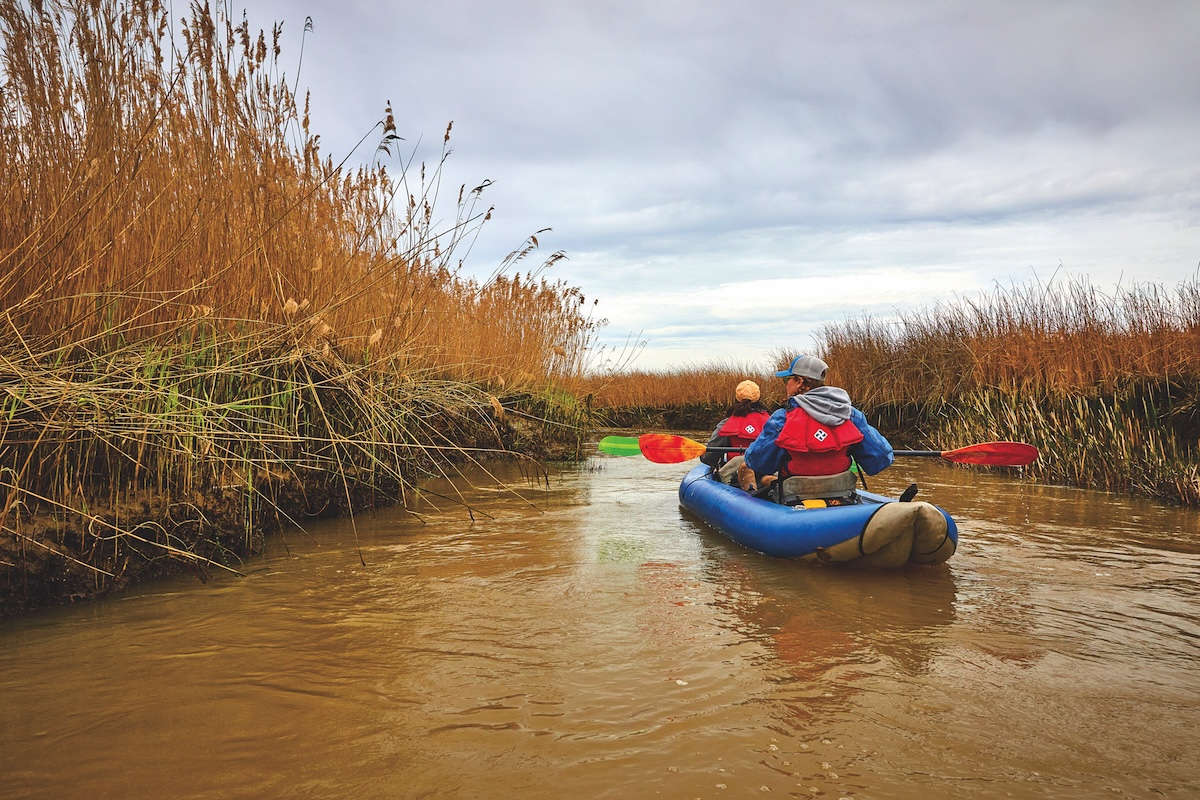
For the more adventurous, a new kayak launch supports a two-mile loop through the marsh. This water trail offers a perspective of the shoreline previously inaccessible for nearly a century. Paddling through the quiet channels, kayakers are level with the water, watching the tides move in and out—a wonderful way of getting some exercise and seeing the wildlife up close and personal.
Perhaps the most vital mission of Pacheco Marsh is its role as an outdoor classroom. The site features a low-key outdoor space with seating and 14 interpretive panels that tell the story of the land’s human and natural history. For educators and school groups, it’s a living laboratory where science moves off the chalkboard and into the mud.
Students can witness firsthand how nature heals itself when given the chance. They can see how 31,000 native plants, carefully selected and placed, and a strategically breached levee can turn a “sandy wasteland” back into a nursery for 75% of the region’s fisheries. It’s one thing to read about climate resilience in a textbook; it’s another to stand on a bridge and watch the Suisun Bay reclaim its historic home after a century of industrial exile.
“It’s an inspiring message of hope about our future,” Eukel says.
In a world where environmental news often feels heavy, Pacheco Marsh is a monument to persistence—a win the community can actually walk through. It’s a place where people stop being spectators of decline and start being participants in restoration. It proves that with enough grit, sweat and time, we can undo the damage of the past and manifest a sustainable future for the next generations.
For more info, visit jmlt.org/our-places/pacheco-marsh.