Aries (March 21-April 19): “When I discover who I am, I’ll be free,” said novelist Ralph Ellison. Would you consider making that a paramount theme in the coming weeks? Will you keep it in the forefront of your mind, and be vigilant for juicy clues that might show up in the experiences coming your way? In suggesting that you do, I’m not guaranteeing that you will gather numerous extravagant insights about your true identity and thereby achieve a blissful eruption of total liberation. But I suspect that at the very least you will understand previously hidden mysteries about your primal nature. And as they come into focus, you will indeed be led in the direction of cathartic emancipation.
Taurus (April 20-May 20): “We never know the wine we are becoming while we are being crushed like grapes,” said author Henri Nouwen. I don’t think that’s true in your case, Taurus. Any minute now, you could get a clear intuition about what wine you will ultimately turn into once the grape-crushing stage ends. So my advice is to expect that clear intuition. Once you’re in possession of it, I bet the crushing will begin to feel more like a massage — maybe even a series of strong but tender caresses.
Gemini (May 21-June 20): Your sustaining mantra for the coming weeks comes from Swedish poet Tomas Tranströmer: “I am not empty; I am open.” Say that aloud whenever you’re inclined to feel lonely or lost. “I am not empty; I am open.” Whisper it to yourself as you wonder about the things that used to be important but no longer are. “I am not empty; I am open.” Allow it to loop through your imagination like a catchy song lyric whenever you’re tempted to feel melancholy about vanished certainties or unavailable stabilizers or missing fillers. “I am not empty; I am open.”
Cancer (June 21-July 22): According to my analysis of the astrological omens, you are close to tapping into hidden powers, dormant talents, and future knowledge. Truths that have been off-limits are on the verge of catching your attention and revealing themselves. Secrets you have been concealing from yourself are ready to be plucked and transformed. And now I will tell you a trick you can use that will enable you to fully cash in on these pregnant possibilities: Don’t adopt a passive wait-and-see attitude. Don’t expect everything to happen on its own. Instead, be a willful magician who aggressively collects and activates the potential gifts.
Leo (July 23-Aug. 22): This would be a perfect moment to give yourself a new nickname like “Sugar Pepper” or “Honey Chili” or “Itchy Sweet.” It’s also a favorable time to explore the joys of running in slow motion or getting a tattoo of a fierce howling bunny or having gentle sex standing up. This phase of your cycle is most likely to unfold with maximum effectiveness if you play along with its complicated, sometimes paradoxical twists and turns. The more willing you are to celebrate life’s riddles as blessings in disguise, the more likely you’ll be to use the riddles to your advantage.
Virgo (Aug. 23-Sept. 22): Right about now you might be feeling a bit extreme, maybe even zealous or melodramatic. I wouldn’t be surprised if you were tempted to make outlandish expostulations similar to those that the poet Arthur Rimbaud articulated in one of his histrionic poems: “What beast must I worship? What sacred images should I destroy? What hearts shall I break? What lies am I supposed to believe?” I encourage you to articulate salty sentiments like these in the coming days — with the understanding that by venting your intensity you won’t need to actually act it all out in real life. In other words, allow your fantasy life and creative artistry to be boisterous outlets for emotions that shouldn’t necessarily get translated into literal behavior.
Libra (Sept. 23-Oct. 22): Adyashanti is my favorite mind-scrambling philosopher. One of his doses of crazy wisdom is just what you need to hear right now. “Whatever you resist you become,” he says. “If you resist anger, you are always angry. If you resist sadness, you are always sad. If you resist suffering, you are always suffering. If you resist confusion, you are always confused. We think that we resist certain states because they are there, but actually they are there because we resist them.” Can you wrap your imagination around Adyashanti’s counsel, Libra? I hope so, because the key to dissipating at least some of the dicey stuff that has been tweaking you lately is to stop resisting it!
Scorpio (Oct. 23-Nov. 21): During every election season, media pundits exult in criticizing candidates who have altered their opinions about important issues. This puzzles me. In my understanding, an intelligent human is always learning new information about how the world works, and is therefore constantly evolving his or her beliefs and ideas. I don’t trust people who stubbornly cling to all of their musty dogmas. I bring this to your attention, Scorpio, because the coming weeks will be an especially ripe time for you to change your mind about a few things, some of them rather important. Be alert for the cues and clues that will activate dormant aspects of your wisdom. Be eager to see further and deeper.
Sagittarius (Nov. 22-Dec. 21): Friedrich Nietzsche published his first book, The Birth of Tragedy, in 1872, when he was 28 years old. In 1886, he put out a revised edition that included a preface entitled “An Attempt at Self-Criticism.” In this unprecedented essay, he said that he now found his text “clumsy and embarrassing, its images frenzied and confused, sentimental, uneven in pace, so sure of its convictions that it is above any need for proof.” And yet he also glorified The Birth of Tragedy, praising it for its powerful impact on the world, for its “strange knack of seeking out its fellow-revelers and enticing them on to new secret paths and dancing-places.” In accordance with the astrological omens, Sagittarius, I invite you to engage in an equally brave and celebratory reevaluation of some of your earlier life and work.
Capricorn (Dec. 22-Jan. 19): “Go back to where you started and learn to love it more.” So advised Thaddeus Golas in his book The Lazy Man’s Guide to Enlightenment. I think that’s exactly what you should do right now, Capricorn. To undertake such a quest would reap long-lasting benefits. Here’s what I propose: First, identify three dreams that are important for your future. Next, brainstorm about how you could return to the roots of your relationships with them. Finally, reinvigorate your love for those dreams. Supercharge your excitement about them.
Aquarius (Jan. 20-Feb. 18): “What am I doing here in mid-air?” asks Ted Hughes in his poem “Wodwo.” Right about now you might have an urge to wonder that yourself. The challenging part of your situation is that you’re unanchored, unable to find a firm footing. The fun part is that you have an unusual amount of leeway to improvise and experiment. Here’s a suggestion: Why not focus on the fun part for now? You just may find that doing so will minimize the unsettled feelings. I suspect that as a result you will also be able to accomplish some interesting and unexpected work.
Pisces (Feb. 19-March 20): How many fireflies would you have to gather together in order to create a light as bright as the sun? Entomologist Cole Gilbert estimates the number to be 14,286,000,000. That’s probably beyond your ability to accomplish, Pisces, so I don’t recommend you attempt it. But I bet you could pull off a more modest feat with a similar theme: accumulating a lot of small influences that add up to a big effect. Now is an excellent time to capitalize on the power of gradual, incremental progress.
An oil-by-rail facility that Valero wants to build at its Benicia refinery has been stalled by opponents concerned about environmental impacts and safety issues for over three years now. But Valero and an attorney working on contract for the City of Benicia claim that the city cannot stop the project because federal railroad law preempts the city’s powers. Project opponents say this is a flawed interpretation of federal law, however, and that Valero’s new oil facility should be cancelled.
Valero’s original proposal was presented in 2013 as a simple plan to build a couple of rail spurs from the main railroad line to the company’s refinery, and the city announced its intention to approve the plan without doing an environmental impact review. A torrent of opposition greeted this announcement, however. As a result, the city was forced to conduct three environmental impact reviews and hold public hearings. Then, last February, Benicia’s planning commission unanimously reversed approval for the project. Now the oil facility is pending a final decision by the city council.
Andres Soto said Benicia shouldn’t wait on federal regulators to reject Valero’s oil-by-rail project.
Credits: Brooke Anderson
Supporters say the crude-by-rail project is necessary to preserve Valero’s — and Benicia’s — economic viability and the nation’s energy independence. Opponents say it will cause increased air pollution and environmental destruction, and that expanding oil-by-rail transportation increases the risk of catastrophic accidents like explosions and fires due to derailment.
But according to Bradley Hogin, a contract attorney advising the city, the federal government’s authority over railroads means that local governments are not allowed to make regulations that affect rail traffic — even indirectly. And when they’re deciding on a local project, cities are not allowed to consider the impact of anything that happens on a rail line, claims Hogin. The legal doctrine Hogin is referring to is called federal preemption.
But other attorneys call Hogin’s interpretation of federal laws “extreme” and say that the city has every right to block the project if it so chooses. Environmentalists have also pointed out that Hogin has represented oil companies against environmental and community groups in the past. Project opponents say Hogin is biased in favor of Valero, and is not giving the city accurate legal advice. When asked if Hogin’s previous work suggests that he could be biased, Benicia City Attorney Heather McLaughlin said no. “I think he has had great experience in the refinery industry and I think that’s been helpful for us,” she said.
Hogin’s legal argument that cities are preempted from influencing oil-by-rail projects has major national implications. As the shipment of crude oil via railroad has grown in recent years, so have the number of derailments, oil spills, fires, and explosions, including the 2013 explosion that killed forty-seven people in Lac Megantic, Quebec. As a result, communities across North America have demanded that local authorities stop rail shipments of crude oil through their towns. In addition to Benicia, San Luis Obispo County is currently in the midst of a battle over crude by rail.
“Hogin is making a case that would affect cities across the nation dealing with crude by rail,” said Marilyn Bardet, a founder of Benicians for a Safe and Healthy Community. “They [are trying] to create a legal precedent here.”
Many lawyers, including California Attorney General Kamala Harris, say the exact extent of federal preemption of local authority is still being worked out in the courts. In her legal opinion on the Valero project’s environmental review, Harris cited several cases in which local governments were allowed to implement health and safety regulations involving railroads.
Several lawyers submitted opinions and testified in Benicia City Council hearings held on April 4 and 5 challenging Hogin’s interpretation. And in one of the hearings, Berkeley City Council member Linda Maio told her Benicia counterparts that the city council has the right to make its own land-use decisions. “This is in your town and you’ve been elected to see to the health and safety of your citizens,” said Maio.
Valero and its critics have been arguing about the extent to which Benicia’s authority is preempted by federal law since last summer. After the planning commission rejected Valero’s project in February, the company showed up at the March city council meeting with a surprise request: that the council delay voting on the project until Valero has a chance to make an appeal to the federal Surface Transportation Board (STB), which regulates railroads.
That didn’t sound right to Benicia resident Andres Soto, who works for Communities for a Better Environment, an environmental group opposed to the project, so Soto called the STB and talked to staff attorney Gabriel Mayer. In a report Soto submitted to the city council, he wrote that Mayer told him that the STB is not the final authority on federal preemption, and that the state and federal courts serve that purpose.
Soto also said that the STB deals with disputes among railroads, and since Valero is not a railroad, it’s unlikely the agency would take its case. Many speakers at last week’s hearings urged the city council to deny Valero’s bid for a delay and reject the project immediately.
But project supporters emphasized the economic benefits of bringing crude oil by rail to Benicia. Berman Olbadia of the Western States Petroleum Association, an oil industry lobbying group, said that Valero creates jobs and generates tax revenue. Michael Wolf, of Ageion Energy Services, said that oil by rail reduces California’s dependence on foreign oil.
Later, however, Greg Karras, senior scientist at Communities for a Better Environment, said North American crude would create serious new problems that the environmental reviews for the Valero project did not address. Canadian tar sands produce very heavy oil with an extra load of toxic chemicals, said Karras. In addition, refining tar sands oil would dramatically increase the refinery’s emissions of carbon dioxide, the main pollutant causing global warming. The other major type of North American crude from North Dakota’s Bakken fields produces highly explosive oil. Trains carrying Bakken crude have been involved in a number of fires and explosions.
People from “uprail” communities have also turned out at Benicia hearings to oppose the Valero project. “The oil trains will pass through our downtown and pass my house,” said Frances Burke, a resident of Davis. “We will have the fumes and particulate matter from increased daily trains. I’m also a potential victim of a deadly accident, explosion, or derailment.”
Benicia resident Bardet said the project site is especially dangerous because the crude-oil-offloading tracks would be “adjacent to crude oil storage tanks and Sulphur Springs Creek, in a flood-plain zone and active fault zone, and also directly across from the industrial park along East Channel Road.” According to Bardet, derailment or fire involving flammable crude oil could have catastrophic results.
College student Jaime Gonzalez said the project would further proliferate fossil fuels, which accelerate climate change, and that future generations will bear more of the burden. “The consequences would fall on the shoulders of my generation,” he said.
Hearings will continue April 18 and 19 in Benicia, and the city council will then decide whether to wait for Valero’s federal appeal, or vote to approve or deny the project.
In Samaria’s new short film, “The Story of Right Now” — which is actually a music video for the first two tracks off her recent EP of the same title — the Oakland R&B singer cruises down the dusty road of a desert landscape. She’s dressed in all black with a bandana over her face. Her love interest is in the driver’s seat: a bad boy with neck tattoos of roses and a side-swept Skrillex haircut.
As ominous violin chords creep slowly over the beat’s rattling high-hats and sinister piano, the screen flashes with scenes showing Samaria’s character falling passionately in love. However, she quickly finds herself entrenched in her boyfriend’s dangerous lifestyle in ways that she didn’t expect: Papi told me he committed to the game but he could make time, she sings forebodingly in her soulful, smoky timbre. Moments later, we see Samaria’s character swept up in a heist that ends in tragedy. He got my heart in one hand/And my soul in the other. Her delivery poignantly conveys a combination of powerlessness in the face of temptation and frustration with herself.
Samaria’s The Story of Right Now is flush with cinematic, story-driven ballads.
Credits: Bert Johnson
When I met the nineteen-year-old artist at Café Roma in North Berkeley, just down the street from her grandmother’s house where she spent much of her youth, she looked quite different from the reckless girl she portrayed on camera. Effusive with an easy smile and goofy sense of humor, she mentally prepared for the Express photo shoot as we waited for the arrival of our photographer. “I like to call myself an awkward turtle,” she laughed nervously.
Samaria has a gift for storytelling through ballads, and The Story of Right Now is flush with nuanced, emotive songwriting that shows the singer inhabiting different characters — a talent that’s evident in her believable acting in the short film. Though her lyrics throughout the EP are from a first-person point of view, she often treats her songs like works of fiction that allow her to explore different psychological states she hasn’t necessarily experienced first-hand.
As someone who’s barely out of high school, Samaria said that she’s only been in one serious romantic relationship. But her songs demonstrate an emotional breadth that’s rare to see in a songwriter her age — a skill she said she developed by writing from the points of view of different friends and family members who have confided in her, as well as movie and TV characters.
“If you allow yourself to be emotionally wrapped up in something else, the songs will still come out great, but it’ll be different because it’s not from my own experience only,” she said. “As anybody doing something creative, it’s very important that you find inspiration in something other than personal experience, which is why a lot of the musicians and artists I look up to have traveled the world to get an album finished. Beyoncé did a whole [EP] in Spanish — that’s crazy to me.”
“Antisocial,” for instance, is one such song that Samaria said comes off as autobiographical but isn’t: She actually wrote it for a friend who deals with social anxiety. And while Samaria describes herself as a social butterfly, she used the track to explore an introvert’s headspace: Babe, I promise that I am okay/But I just be having my days where/I simply don’t have shit to say/Please, don’t take it personally. Like much of the production on The Story of Right Now, the song’s beat slowly builds tension, with jagged piano chords falling like broken glass over an undulating rhythm that evokes Aaliyah and Destiny’s Child.
The Story of Right Now is an impressively strong debut, and Samaria is already being hailed as a rising star. Being a member of Kehlani’s music collective Tsunami Mob has certainly added to her buzz (she and Kehlani, who is a year older, have been friends since middle school). The FADER, arguably today’s most influential music publication, premiered Samaria’s short film on its blog. She’s opened for prominent artists such as Washington, D.C.’s GoldLink, whose album And After That, We Didn’t Talk recently rose to popular acclaim with its savvy combination of hip-hop, funk, and go-go. And already, several labels have made Samaria offers — though she said she won’t settle on a record deal until she feels like she’s matured enough as an artist.
For now, Samaria is building a tightly-knit circle of collaborators that she can be sure have her back. She’s developed a close relationship with the producer, engineer, and trumpet player DTB, who made the majority of the beats on The Story of Right Now. DTB’s bass-heavy yet atmospheric production utilizes the rhythm structures of the Nineties and early-Aughts R&B that Samaria emulates, yet adds oceanic electronic effects that evoke experimental producers such as XXYYXX and Clams Casino. Dark string arrangements color the project throughout, underscoring Samaria’s downcast lyrics about heartbreak. One of Samaria’s ambitions is to perform with a live band, and DTB, who played the sinewy, screechy trumpet riff at the beginning of “Antisocial,” plans to accompany her on tour with his trumpet when the time comes.
Now that Samaria’s platform is growing, she finds her fans, many of whom are teenage girls, looking up to her as a role model. She said that growing up, she struggled with self-acceptance. But now that she’s older and more confident (practicing mindfulness is her secret to maintaining her buoyant, easy-going attitude, she said), she hopes to send her fans the message that there is hope beyond even the most trying experiences of adolescence.
“I was always bullied because I wasn’t afraid to be different,” she said. “So I want young girls to know it’s okay to be yourself, and whatever it is that they’re going through is only temporary. I’m very big on self-awareness and self-love.”
When Flor Crisostomo walked into Calavera restaurant last October, where she had been employed since before it opened in the summer of 2015, she didn’t expect the news she received.
“I went in and they fired me on the spot, arguing that I wasn’t doing enough for the kitchen, not fulfilling my responsibilities, and that production was slow,” Crisostomo told the Express in an interview. “They didn’t give me a two-week notice, and they were referring to a position that was not mine.”
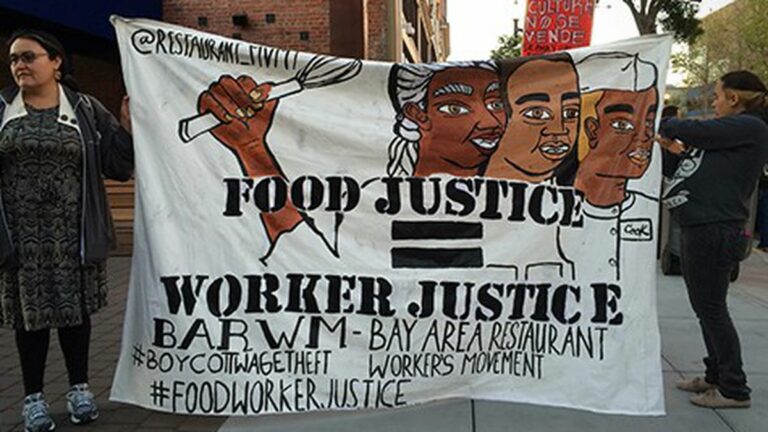
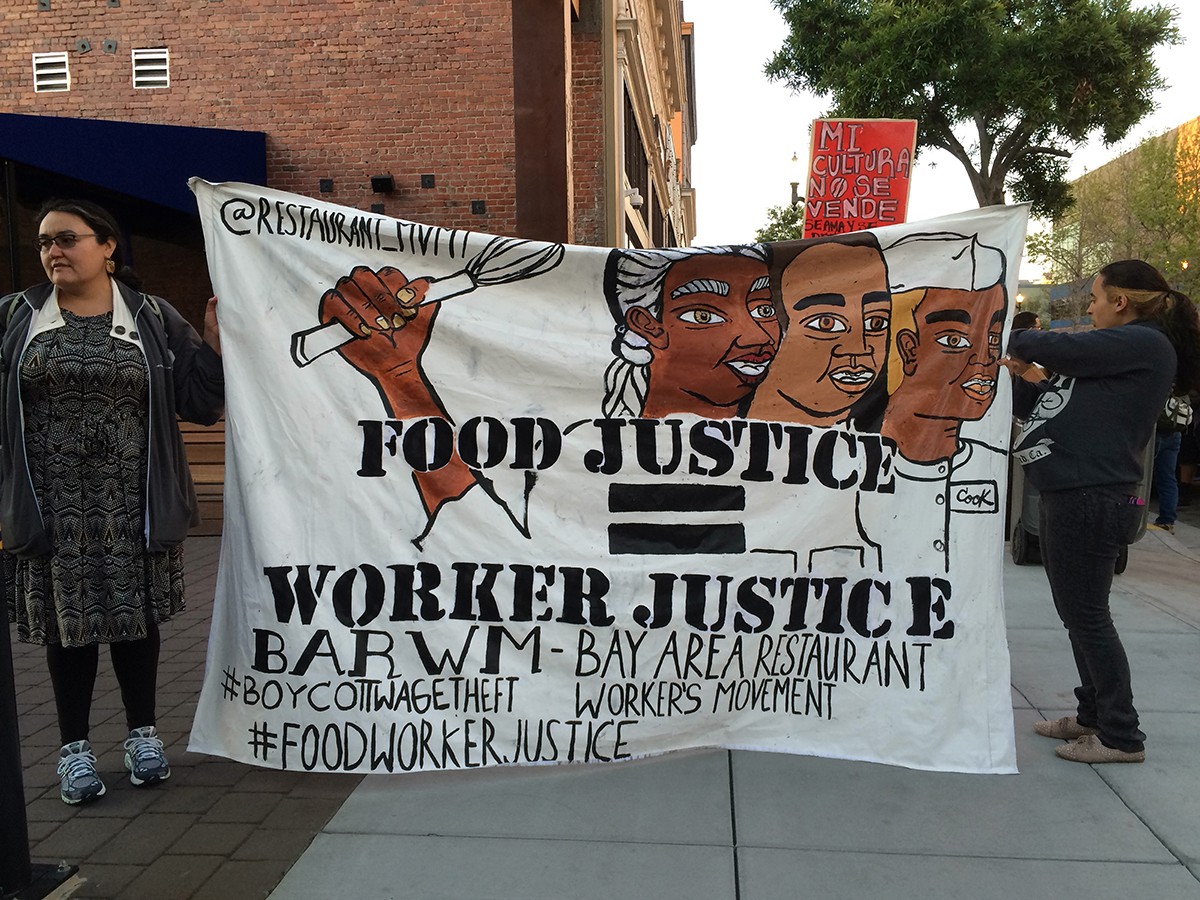
BARWM supporters hold up a banner outside of Calavera.
Credits: Jenny Huang
For Crisostomo and other workers at Calavera, this was not the first instance of what they perceived as an abuse of workers’ rights. Last month, Crisostomo and fellow former Calavera employees Sergio Esquivel and Maribel Hernandez filed a class-action lawsuit alleging that the high-end Mexican restaurant located in Uptown Oakland failed to pay workers the city’s minimum wage, did not compensate for overtime, provided inadequate time for breaks, and did not pay owed wages upon termination. The workers are also calling on the public to boycott Calavera.
The lawsuit specifically alleges that Calavera partner-owners Christopher Pastena (Lungomare, Chop Bar) and Michael Iglesias (Coqueta, Oyamel), as well as executive sous chef Adelar Rogers and opening executive chef Christian Irabien were responsible for the labor law violations. Irabien is now working at Cala in Hayes Valley, according to a San Francisco Chronicle report.
“We want to make sure that labor laws aren’t broken and that workers are treated with dignity and respect,” Crisostomo said about the lawsuit.
On April 1, during a busy First Friday street fair, the workers staged a protest outside of the restaurant, which is located in Oakland’s Hive development. Over one hundred food workers from the Bay Area Restaurant Worker’s Movement (BARWM), as well as members from the Brass Liberation Orchestra, housing, food justice and labor movements, showed up to help hold hand-painted picket signs and hand out #BoycottCalavera fliers. Dozens of patrons could be seen turning away from the restaurant due to the protest.
“With that protest and mobility, we could reach out to other restaurant workers to call out abusive owners. It was a great way for us to say that publicly and connect with other workers to let them know that it’s okay to speak up,” Crisostomo said.
Chanting “86 Calavera, Mi Cultura No Se Vende,” the protesters said that the restaurant is guilty of more than wage theft. By firing workers like Crisostomo, who is indigenous to Oaxaca, Mexico, and who over five months shared her ethno-culinary knowledge with Calavera’s owners, the workers are accusing the restaurant of stealing their culture.
“The knowledge of nixtamal — to prepare corn for tortillas — and knowing recipes that go way back to [my] roots have been taken advantage of,” Crisostomo said. “That, for me, is where cultural appropriation and culture theft begins to happen.”
The owners of Calavera declined requests to speak to the Express regarding the lawsuit. But they released the following statement saying that the workers’ claims are false: “We are a diverse group of employees and owners at Calavera with a history of fair practices and creating a healthy, supportive restaurant culture, and we take pride in being Latino, African-American and female-owned,” the statement read.
Paul Blasenheim, an original member with the BARWM, said in an interview that the organization will continue to support the fired workers as long as the boycott continues. “Even an allegation of these things is enough for us to protest,” said Blasenheim. “We believe workers when they come to us and say to us something is happening.”
The lawsuit comes at a time when numerous other high-profile Bay Area restaurants, such Coqueta in San Francisco and Bottega Ristorante in Yountville, are also facing legal action from workers. Though BARWM has not been active in those cases, Blasenheim said actions against Coqueta in particular — where two lawsuits were filed against celebrity chef Michael Chiarello and his restaurant group Gruppo Chiarello over alleged sexual harassment and labor violations — inspired the work that’s now being done in Oakland.
“The ownership is similar to those who are owning Calavera, and there is a lot of crossover within the industry,” said Blasenheim. “We were inspired by the leadership of powerful women restaurant workers who refuse to abide by the sexist and coercive status quo for women in general.”
Hector Martinez, an attorney representing the plaintiffs with the Oakland-based law firm Mallison & Martinez, said it could be up to a year until a trial happens, but that he is confident they will be successful. “We have lots of support from former workers and the records will show the violations,” said Martinez. “We are very excited about our clients being so active. This is something we don’t see that often, to have so much activism on behalf of our clients with regards to our case.”
Moving forward, Crisostomo said she was pleased to see such strong support from the Oakland community and that the boycott campaign will not stop until positive changes have been made. “We are not lying. We are addressing a problem that’s happening right now, and we are speaking on behalf of all the workers treated like this nationally — that includes those still working at Calavera right now,” said Crisostomo.
In its 59th year, the San Francisco International Film Festival is giving itself a brilliant birthday present: A brand new principal venue. Beginning next week, the bulk of the festival’s 2016 offerings — as usual, a presentation of the San Francisco Film Society — takes place at the Alamo Drafthouse Cinema in the New Mission Theater on San Francisco’s Mission Street, a five-screen garden of movie delights.
The Alamo opened in December as the latest venture of founder and CEO Tim League’s ambitious Austin, Texas-based cinema circuit, which specializes in first-run and repertory movies augmented by in-person appearances, snacks, and plenty of beer. At last count, the former mom-and-pop business had 21 locations in eight states. Alamo has a reputation as a film lover’s paradise, with an emphasis on the sensational. It’s the only national theater chain where you could ever hope to find the Disney animated kiddy-show Zootopia; Jacques Rivette’s twelve-hour 1971 cult hit Out 1, Noli Me Tangere!; a lobby video rental stand (featuring outré titles culled from the collections of Le Video and Lost Weekend Video); and a bar serving artisanal cocktails, all under one roof. It’s the kind of place that appeals to Quentin Tarantino, who famously hosted marathon screenings from his private stash at Alamo in Austin.
Sixty Six.
And when I die, I won’t stay dead
Alamo’s San Francisco operation is big on community outreach, which is where the SF Film Society comes in. Japantown’s Kabuki Theater has been the festival’s home base since the 1980s, but even though it was remodeled nine years ago under the Sundance banner — the Sundance chain was recently sold to the Texas company Carmike Cinemas — the former nightclub-turned miniplex has little of the sizzle of the sparkling new Alamo, rehabbed to the tune of $9 million in the shell of the long-defunct New Mission Theater.
The word from Bay Area film people is that the Film Society was eager to move on. The sunny Mission District, now crawling with techies and other moneyed newcomers, is in the midst of an upscale makeover — also known as gentrification. It’s the destination of choice for certain kinds of businesses. Mainline arts and entertainment orgs in the Bay Area have been trying for years to corral the elusive young hipster market, with mixed results. For the SF Film Festival, the ultra-cool Alamo may be its best shot at that goal. This election year, the SF International has already voted with its feet. It seems to be recovering its long-lost bohemian dimension as well.
Reached by phone last week, Film Society Executive Director Noah Cowan was reluctant to talk about behind-the-scenes negotiations. But it’s easy to connect the dots. Relocating to the red-hot Mission and leaving old-school Pacific Heights in the rearview mirror makes sense for a long-running local institution looking to “young up” its public image. As Cowan put it, “San Francisco’s cultural momentum has shifted south.” He also cited Alamo’s festival-friendly attitude and its cinema-fanatic concept (“We fell in love with that”). On top of that, last year’s SFIFF audience survey showed that patrons longed for better public transportation access. BART’s 24th Street Mission Station is a mere two blocks away, and Mission Street is a Muni main stem.
Then there’s the idea that the Alamo is now the most comfortable, best-equipped movie house in town. In a fit of upgrade fever, the Film Society invested in beefed-up exhibition infrastructure, including Dolby, at two of its other festival sites in the Mission, the Roxie and Victoria theaters. Won’t the Film Society’s silk-stocking supporting members feel out of place looking for parking on the funky corner of 21st and Mission? Cowan recommends nearby parking lots, Uber, or Lyft.
Longtime SFIFF exhibitor the Berkeley Art Museum and Pacific Film Archive will also show a selection of this year’s films for the first time in its eye-catching new digs in downtown Berkeley. In addition to the Alamo, Roxie, and Victoria in SF, the BAMPFA is running a well-stocked schedule of 34 features for East Bay audiences. And there are also special screenings in San Francisco at the venerable Castro Theatre, the Gray Area on Mission Street, and PROXY in Hayes Valley.
The Films
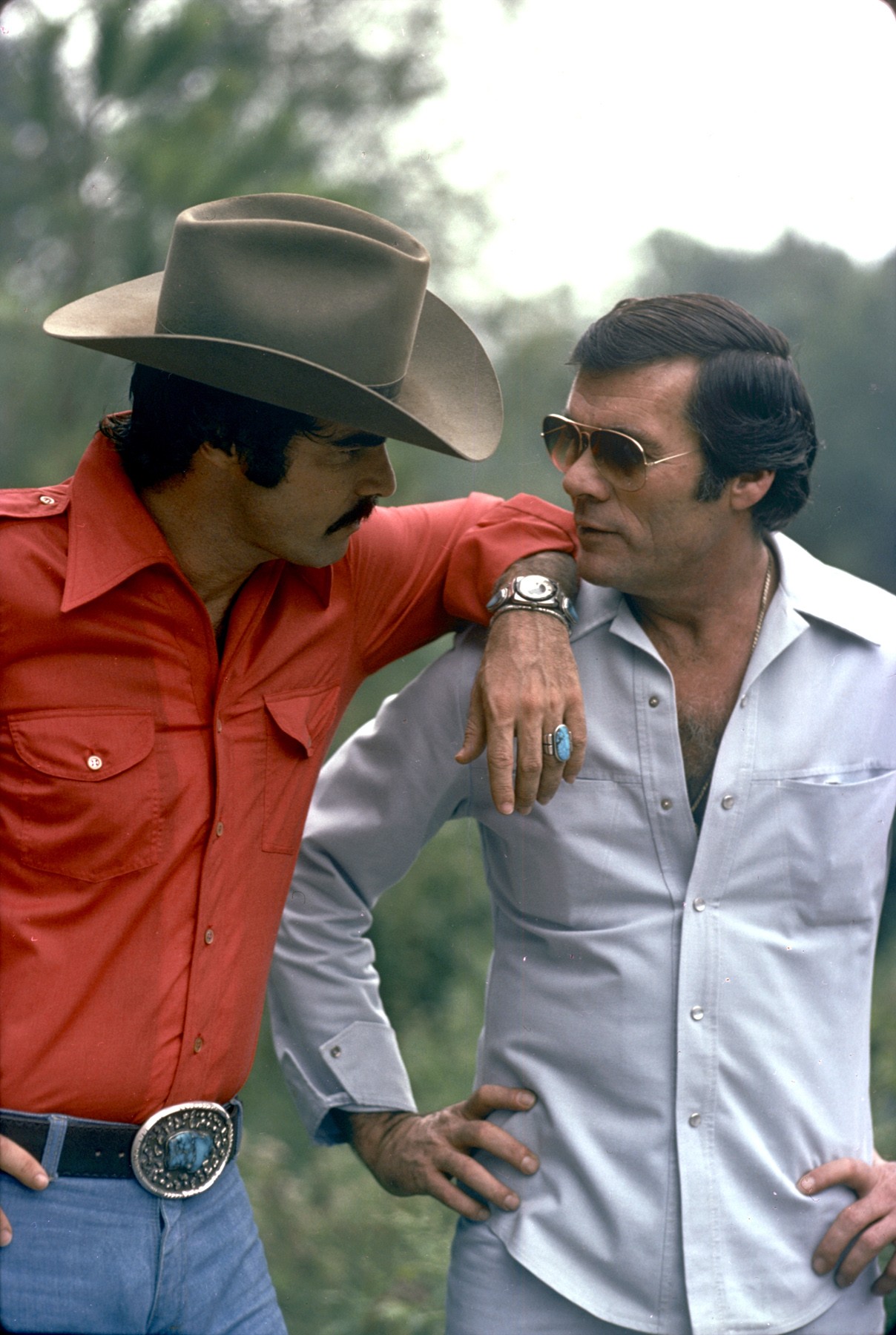
Oh yes, a film festival is about films. The 2016 SFIFF has those, too. Jesse Moss’ documentary The Bandit takes us back to Hollywood in the Seventies, when movie star Burt Reynolds and super-stuntman Hal Needham joined forces to make Smokey and the Bandit, a dumb-but-beautiful car-chase comedy that pits beer smuggler Reynolds at the wheel of his Trans-Am against Jackie Gleason as the wildly hamming county sheriff. So we get two bio-docs and a making-of in one entertaining package.
Seen on period publicity footage and in new candid interview scenes, Reynolds was at the top of his game in 1977, showing off his swingin’ bachelor pad with a mirrored ceiling. But it’s the personable Needham, an Arkansas sharecropper’s son whose expertise in falling off roofs and wrecking trucks made him an indispensable ingredient in action movies, who steals the show. Smokey was made for $4.3 million for the Southern drive-in market, but earned more than $126 million worldwide. The Bandit would fit right in with the Alamo’s trash-to-treasures sensibility, but it’s playing its festival date at the Castro (429 Castro St.) on the SFIFF’s closing night, May 5. Reason: The Alamo’s main auditorium seats 326; the Castro can hold more than 1,400.
Neon Bull may set a SFIFF record for the most human sex scenes that also have farm animals in the same shot. Writer-director Gabriel Mascaro’s Brazilian character study/eye-popper goes on the road with a tight band of scruffy rodeo wranglers as they move from dusty town to town, putting on bull-roping shows and searching for physical gratification. But it’s not without its tender, lyrical moments, revolving around Cacá (Alyne Santana), the juvenile female member of the troupe. And in the worldrealm of supporting characters, Cacá’s truck-driver mother Galega (Maeve Jinkings) gives herself an impromptu bikini depilatory in the front seat of her big rig in preparation for a date, while Iremar the hunky cowboy (Juliano Cazarré) sews outrageous fashion creations. Oh, those Brazilians. Neon Bull screens at BAMPFA (2155 Center St., Berkeley) on April 23, and the Roxie on April 25.
If you see one film at SFIFF, make it Pascale Breton’s Suite Amoricaine starring Valérie Dréville.
Billy Woodberry’s documentary And when I die, I won’t stay dead captures the mood of Beat Era San Francisco in the dazzling, impressionistic chronicle of street poet Bob Kaufman. The black-and-white location film of North Beach coffee houses and alleyways in the Fifties and Sixties should be the gold standard for documentary explorers of the past. Everybody looks ecstatic except Kaufman, the golden-voiced African-American spoken-word troubadour. As recounted by myriad talking heads, Kaufman was constantly in cop trouble over free speech and his white girlfriends, but his gorgeous poetic ode to Charlie “Bird” Parker and jazz music is what every wordsmith was, and is, looking for. This enthralling tribute to the original Black beatnik plays May 1 and 3 at the Alamo, May 4 at BAMPFA.
A pair of gentle, leisurely paced Eastern European character studies provide this year’s festival with the classic joy of people-watching. In Home Care by Czech filmmaker Slávek Horák, a selfless nurse named Vlasta (Alena Mihulová) makes house calls on her cranky, eccentric senior citizen patients, despite the cancer in her stomach. In several ways, Horák’s peripatetic drama is the epitome of the old-style film festival village picture, amiably paced and human-scaled. It shows at the Alamo (2550 Mission St.) on April 27, at BAMPFA on April 28, and May 2 at the Roxie (3117 16th St.). Meanwhile in Tbilisi, Georgia, a poised but prankish teenager named Nick (Dati Khrikadze) interacts with half the city as director Vano Burduli’s camera flits from one light-hearted situation to another. A sexy female passport official appears, then an ambling Irish photographer, then a pair of wise-cracking loafers, a street bookseller, a TV talk show hostess, and the Christmas tree man, among others. The atmosphere in The Summer of Frozen Fountains is typically Georgian — relaxed, unhurried, circumspect, “southern” in the best way, with flashes of soulful music and the ever-present promise of love. It’s the ideal film to bring a glass of wine to. Too bad the BAMPFA (May 5) and the Roxie (April 25 and 27) don’t allow alcohol.
New York’s Jem Cohen (Museum Hours, the Gravity Hill Newsreel series) has a reputation for training his camera eye on fascinatingly overlooked locations and teasing out the essence of human endeavor. In his 2015 doc Counting, Cohen basically walks around in places like Istanbul, Moscow, Cairo, St. Petersburg, Sharjah in the United Arab Emirates, New Jersey, and Porto, Portugal — and simply looks. His montage magic extends to his hometown, from wintry NYC streets to subway faces to homeless persons cowering in public spaces, as if afraid to be seen. Counting is one the finest films of any kind in this festival, and you have exactly two chances to see it: Saturday, April 23 at BAMPFA and April 24 at the Alamo.
This year, the SFIFF is paying special attention to animated work. On May 1 at the Castro, Aardman Animations co-founder Peter Lord will receive the Film Society’s Persistence of Vision Award for the company’s outstanding stop-motion comic adventures. The evening will also showcase a feature-length reel of some of Aardman’s greatest hits, including Nick Park’s short The Wrong Trousers (1993), starring audience favorites Wallace and Gromit.
And there’s more animated offerings. The French team of Jean-Loup Felicioli and Alain Gagnol, who made the delightful A Cat in Paris, combine a hint of pathos and a heap of graphic invention in Phantom Boy, the action-packed yet kind-natured tale of an ailing kid who doubles, magically, as an invisible flying hero to help a detective fight crime. But the imaginary heroics weaken him. The French are not afraid of showing a young cartoon protagonist grappling with terminal illness. It screens Sunday, April 24 at the Alamo. Then there’s Penny Lane’s NUTS! No matter how we try to describe it, Lane’s animated account of the career of “folk healer” J.R. Brinkley and his career as a seller of fake remedies in 1920s and 1930s rural America is the strangest film in this year’s fest. Also one of the most artfully produced. You’ll never see another animated movie — or any movie at all, most likely — on the concept of using goat testicles as a cure-all. NUTS! unwinds April 29 at the Alamo and April 30 at BAMPFA.
Still technically an animation, yet on another plane entirely, is collagist Lewis Klahr’s Sixty Six, a truly hypnotic anthology of twelve Pop Art-influenced shorts utilizing comic-book characters in advertising-art settings to spin out the roots of Mid-Century Malaise in a flurry of obscure montage anxiety. The found-object audio adds to the mood: soap operas, electronic burps, orchestral snippets, etc. This is the type of visual-art project every self-respecting urban film festival should try to book. You can put Leonard Cohen songs behind a montage of anything and it’ll look brilliant — here’s the proof. Don’t miss it when it hits the Roxie on April 28 or the BAMPFA on April 30.
In Under the Sun, documentarian Vitaly Mansky portrays daily life in North Korea.
If we were to embroider the impact of filmmaker Mauro Herce’s Dead Slow Ahead we might claim that it marries the poetry of machinery to the majesty of the open sea, or some such. But Herce’s doc is the very picture of industrial, a low-lit tapestry of ill-defined shapes and dim vistas as seen from the cargo ship Fair Lady, carrying grain to an unnamed destination. In the narrationless (natch) film, the glimpses of the crew’s human activity aboard the ship come as a welcome relief, even when all they’re doing is eating lunch or studying charts. Aside from occasional procedural talk and horseplay by the men, the prevailing sounds are the beeps and hums of machinery and ping-y echoes of the ship’s superstructure. The wheat-filled cargo hold looks like a desert. So much for swashbuckling adventures afloat. Seafaring in the 21st century isn’t like that, which is probably the Spanish director/camera operator Herce’s point. Still, you might want to bring a large coffee into the auditorium when Dead Slow Ahead plays the Alamo (on April 23 and 29, and May 2), just to keep yourself awake.
Young children should not wander into a screening of Canadian writer-director Philippe Lesage’s The Demons. Lesage’s understated shocker is not a horror flick, at least not in any conventional way (despite its title), but it could nevertheless make them afraid to ever be ten years old. It’s not just that Félix (Édouard Tremblay-Grenier) is bullied; it’s as if he has been selected ahead of time for some unknown dire fate. From the sinister classical music over the sequence of children’s calisthenics in the opening credits, to the odd birthday party, cruel locker-room pranks, and frightening swim instructor, the elements of Félix’s early adolescence are the stuff of sleep-disturbing urban legends. The film’s music track underscores the trepidation, with Jean Sibelius’ Finlandia Op. 26 and Robert Johnson’s “Me and the Devil” taking the lead. The Demons makes audiences sweat April 28 and May 2 at the Alamo, May 4 at the Roxie.
Who among us is not at least slightly curious about North Korea? What really goes on there? How do people live their everyday lives? Ukrainian documentarian Vitaly Mansky gamely attempts to answer some of those questions in Under the Sun, a filmed record of his visit to Pyongyang. “Attempt” is the key word. As the filmmaker embeds himself and his crew in the family of elementary school student Zin-mi, they are accompanied everywhere by a nervous apparatchik who forces everyone on camera to adhere to the government’s pre-approved script, even to the point of rehearsing their “informal” scenes (such as family dinner) again and again, so as not to embarrass the state. Yet this regimented society the camera observes — mass calisthenics in the morning, “happy” factory workers, a celebration at the Children’s Union, drill after drill — is the real Korea, or as close to it as we are likely to come. Under the Sun, a co-production of the Czech Republic, Russia, Germany, North Korea, and Latvia, shows April 30 and May 4 at the Alamo, and May 5 at BAMPFA.
Design by Roxanne Pasibe
Compared to the North Korea on view in Under the Sun, life in contemporary China, as depicted in Du Haibin’s documentary A Young Patriot, seems as carefree as life in Seattle or Santa Cruz. Our subject is a young man named Zhao Changtong from the town of Pingyao in Shanxi province. When we first meet him, he’s dressed in a vintage People’s Liberation Army uniform in the town’s shopping district, shouting his devotion to Chairman Mao — more than twenty years after the death of the Great Helmsman. Zhao’s zealous devotion to the Communist Party only takes him so far. In the five years that Du’s doc profiles him, he struggles to go to university and make a living while his contemporaries enjoy hip-hop and having a good time. Eventually, the profit motive of the new China dawns on Zhao Changtong. No one else is waving the Red Guard banner, and he is moved to observe bitterly: “Why should we care when our government doesn’t?” That’s a good question. See A Young Patriot on April 24 at BAMPFA or on May 2 at the Alamo.
If we were to suggest a film for the festivalgoer who had time to watch only one, that film would be Pascale Breton’s Suite Armoricaine, which screens April 30 at BAMPFA and May 1 at the Alamo. We hesitate to call Breton’s multi-chambered character study Proustian — critics should generally refrain from slinging around that particular modifier. But the story of a disenchanted Parisian art historian named Françoise (played by actress Valérie Dréville) and her disconsolate relocation to a teaching post at Université de Rennes in her home province of Brittany, has much of the dreamlike flavor of Proust’s homecomings, together with all the appropriate added 21st century aggravations. Kaou Langoët, Elina Löwensohn, and Laurent Sauvage costar as a few of those aggravations. Eric Duchamp’s score and the needle-drop music selections are a further plus. Writer-director Breton, a French TV veteran with few feature film releases, is nevertheless a talent to be reckoned with.
Burt Reynolds (L) and Hal Needham in The Bandit.
There are more highlights to this year’s festival than we have space to list, but here are a few further suggestions: The combo of Carl Theodor Dreyer’s 1932 gothic horror pic Vampyr, with live accompaniment by rock band Mercury Rev and Simon Raymonde of the Cocteau Twins, May 2 at the Castro. Presentation of the Mel Novikoff Award to Janus Films and the Criterion Collection, along with a screening of the Coen brothers’ Blood Simple, April 30 at the Castro. The personal appearance of Indian auteur Mira Nair, who brings along her 2001 drama Monsoon Wedding as she accepts the Irving M. Levin Directing Award, April 24, also at the Castro. The festival’s four-title “late show” shockers program, Dark Wave, now fully under the guidance of Alamo Drafthouse Creative Manager Mike Keegan and his crew, April 23 through May 1.
More recommendations: A 30th-anniversary screening of James Cameron’s Aliens, April 26 at the Alamo. On April 30, James Schamus, the producing/writing spark behind Crouching Tiger, Hidden Dragon, checks into the Victoria Theatre (2961 16th St.) with his directorial debut Indignation, a Philip Roth adaptation starring Logan Lerman and Sarah Gadon. On three separate dates at three venues (April 27 at the Victoria, April 29 at the Roxie, and at the Alamo on April 30), two episodes of Maro Chermayeff and Jeff Dupre’s PBS-TV series Soundbreaking: Stories from the Cutting Edge of Recorded Music investigate how technological advances have influenced popular music. Should be a must-see.
The festival kicks off Thursday, April 21, with Whit (Metropolitan, The Last Days of Disco) Stillman’s costumed Jane Austen adaptation Love & Friendship (Jane Austen? Is she still around?), starring Kate Beckinsale and Chloë Sevigny, at the Castro. For all the latest festive updates, plus info on personal appearances by filmmakers and talent and such, visit SFFS.org.
I’m a 49-year-old gay man. I’ve become friends with a 21-year-old straight guy. He’s really hot. He’s had to drop out of college and return home. I know he needs money, as he hasn’t found a job yet and has resorted to selling off old music equipment. I would love to have some sweaty clothes of his, namely his underwear, but I’d settle for a sweaty tank top. Is it legal to buy someone’s underwear? He’s a sweet guy, and I don’t want to freak him out by asking something so personal. How do I broach the subject?
Lustfully Obsessed Stink Seeker
It’s perfectly legal to buy and sell used underwear, LOSS, so there’s no legal risk. But you risk losing this guy as a friend if you broach the subject. You can approach it indirectly by saying something like, “So sorry to hear you’re selling off your music equipment. You’re young and hot — you could probably make more money selling used underwear or sweaty tanks.” Then follow his lead: If he’s disgusted by the suggestion, drop it. If he’s into the idea, offer to be his first customer.
I’m a 52-year-old straight guy from Australia, 29 years married. About eight years ago, I met a lady through work and we became friends, with our friendship continuing after she moved on to a different job. We meet up for coffee occasionally, and we share a love of cycling and kayaking, which we also do together on occasion. Both of us are in long-term, committed monogamous relationships. Our friendship is strictly platonic, sharing our love of riding and paddling. Neither of our partners shares our interest in these outdoor pursuits. My friend does not feel safe doing these activities alone, so often depends on my company for safety as well. The problem is that my wife gets jealous of the time we spend together and wants me to cut off contact with my friend. My wife does not trust my friend not to “take advantage” of our friendship. My relationship with my wife is the most important one in my life, so I am prepared to say good-bye to my friend. How do I say good-bye in a respectful, caring, and loving way? If she asks why we cannot be friends, I don’t want to tell her, “Because my wife doesn’t trust you not to try to get inside my pants (or cycling shorts),” as that would be hurtful. I don’t want to lie, but telling the truth would be damaging to my friend.
Paddling and Riding Terminates
Your friend is going to waste a lot of time wondering what she did wrong, PART, if you don’t tell her the real reason you can’t hang out with her anymore. And guess what? This not knowing will cause her more hurt than the truth could. So tell your friend the real reason she’s out of your life: You’re terminating your friendship because your wife is an insecure bag of slop who regards her as a threat. Your friend has a right to know she’s as blameless as you are spineless. Forgive me for being harsh, PART, but I think standing up to your wife, not dropping your friend, is the best approach to this situation.
Before I got married, I asked husband repeatedly about fantasies and kinks, so that we had full disclosure going in. It led to some fun stuff in the bedroom, but we’re both pretty low-grade kinksters. Now I realize that I do something that I have never told him about: It’s the way that I masturbate. I started when I was five or six, because it felt good. Got chided by parents and teachers for doing it in public and learned to keep it hidden. And so ever since, it’s been my secret thing. I think it has helped me orgasm in that I knew how early on, but it has also made it more difficult to come in positions that don’t mimic the masturbating position. Husband likes the idea of me coming in different positions, and I’ve managed now and again, but he doesn’t know why I’m set in my ways. We’ve been together for ten years, but I have never shared this. Should I tell him? Part of me is afraid that he will think I’m weird. But more than likely, he’ll just want to watch me do it. Still, it’s kind of nice having this one thing that belongs only to me.
Secret Masturbator Obligated Over Spanking Hotness?
You could hold this back, SMOOSH, and keep it all for yourself. But I don’t see why you would want to. As sexy secrets go, “There’s one particular position I like to masturbate in” is pretty boring. Unless you need to be positioned on top of a cadaver or under your dad or beside a life-size Ted Cruz sex doll to get off when you masturbate, there’s really no reason to keep this secret.
I am totally with your German friend, who wouldn’t do Nazi role-play “in six million years.” I’ve been in a similar position — not quite Holocaust level, but not far off. I’m a white British guy. A while back, while living in the UK, I was dating a woman from Bangalore. She revealed — after her face lit up when I dressed in a way that made me “look like a colonialist” (her words) — that her deepest fantasy was to be an Indian slave girl raped by an English imperialist. And then, living in the US a few years later, I was dating a Black woman. We got to talking about the kinks of exes. I told her about this one, and she revealed that her own fantasy was to be the slave on a 19th-century plantation, raped by her white owner. How about some advice for the human fetish objects in these scenarios, Dan? I didn’t want to stigmatize these women for their sexual desires, and I wanted to be GGG, but it was, frankly, hard (or not, as it were). Being asked to act out roles I feel guilty about, and to use the kind of racial epithets I make every effort to avoid… the guilt is a boner-killer. Any tips on how a GGG partner can get past this kind of mental block and at least act the role enthusiastically enough to fulfill the fantasy? Or was a subsequent girlfriend’s outrage about my willingness to indulge such socially regressive fantasies justified?
I Might Play Every Role I’m Asked Less Ideologically-Scrupulous Motives
Actors play Nazis in hit movies, British colonialists for prestigious BBC miniseries, and serial killers on long-running television shows. I don’t see why playing monsters in entertainments devised for millions wins Oscars (Christoph Waltz for playing a Nazi in Inglourious Basterds), BAFTAs (Tim Pigott-Smith for playing a brutal colonialist in The Jewel in the Crown), and Golden Globes (Michael C. Hall for playing a sociopathic serial killer in Dexter), but playing a monster for an audience of one should outrage “subsequent girlfriends” or anyone else.
My advice for people asked to play monsters in the bedroom mirrors my advice to a gay guy attracted to degrading “antigay” gay porn: “A person can safely explore degrading fantasies — even fantasies rooted in ‘hate ideologies’ — so long as he/she is capable of compartmentalizing this stuff. Basically, you have to build a fire wall between your fantasies and your self-esteem. (And between your fantasies and your politics.)”
If you can build a fire wall between their fantasies and your politics and beliefs, IMPERIALISM, go for it. If you can’t, don’t.
Shockingly, it was revealed this month that staff and paid advisors to California’s biggest pension fund, CalPERS, are recommending that the system reinvest in tobacco companies. If CalPERS’ board agrees, this would reverse an important fifteen-year old policy. CalPERS trustees, who include state officials John Chiang and Betty Yee, should just say no to this toxic proposal.
Tobacco kills. Over the last several decades, herculean efforts have been made by activists, medical practitioners, researchers, lawyers, and politicians to reduce deaths from tobacco. Thankfully, much progress has been made, especially in California. Wendy Max, a health economist at UC San Francisco, and the co-director of the Center for Tobacco Control Research and Education, told the Express she is “appalled” by the potential reinvestment in tobacco corporations. Research by Max and others has found that health costs for tobacco-related illnesses in California alone approach $10 billion a year — a significant drag on the economy. Money from large investors is the lifeblood of corporate activities and a pro-tobacco decision by CalPERS will be seen as support for the tobacco industry, which is currently inducing tobacco addiction in other parts of the world where public health regulations are weaker.
The ostensible reason that CalPERS staff and advisors gave for reinvesting in tobacco is to make more money for the pension system so that it can more easily pay out retirement benefits to its members — state and local public employees. But tobacco profits today come from reprehensible activities such as marketing deadly products to the youth of Asia, moves into e-cigarettes — the long-term health impacts of which we do not yet understand — and increased sales efforts in vulnerable US communities. Investing in this “spawn of the devil,” a moniker many public health champions have used to identify the tobacco industry, is not necessary for the health of CalPERS’ portfolio. Many fruitful investments exist, such as in needed societal infrastructure. And CalPERS can reduce costs, especially if the system is attentive to investment fees it pays its outside managers.
CalPERS, and the state’s other big pension system, the State Teachers Retirement System (CalSTRS), have already made many successful investments in socially beneficial enterprises. CalSTRS’ “21 Risk Factors” and CalPERS’ “Investment Beliefs” have been shining beacons for large investors around the world who want to make a positive impact on public health, the environment, and human rights. Both funds are leaders in the field of “sustainability.”
But influential forces are pushing back. The Wall Street establishment hates discussions of societal effects of investments, and powerful firms like Pension Consulting Alliance and Wilshire Consulting enforce an ideological discipline on trustees, making sure they do not stray too far from the Wall Street narrative. These two entities make millions off of California retirees and argue constantly for an end to “divestment,” whether it concern coal or tobacco. For example, just last week, a consultant from Pension Consulting Alliance counseled trustees of the City of Oakland’s police and fire pension system not to divest from fossil fuels because it might produce “suboptimal returns.”
While the term is demonized by Wall Street, “divestment” simply means choosing not to put pension fund money into the stocks or bonds of certain companies and industries whose business models or activities are harmful, and who have shown little willingness to change. Such choices are part of any kind of active stock picking, and every investor engages in some sort of “divestment.” But when the decision is made to refuse to invest in certain areas in order to protect the lives of the beneficiaries and their families — such as in the case of tobacco, guns, or fossil fuel stocks – the establishment cringes. Unfortunately, many pension fund staffers are unwilling to stand up against the Wall Street narrative.
There is another important reason for CalPERS trustees to reject tobacco investments. Financing tobacco will undermine public support for CalPERS at a time when defined benefit pensions have never been more important, or more under stress. CalPERS’ “twin,” CalSTRS, is already facing reputational damage from the dodgy use of its billions to help private equity billionaires raid companies and shutter factories (see “Financing the Destruction of American Lives,” Raising the Bar, 6-17-15). Similarly, CalSTRS and CalPERS investments in gun companies that manufacture assault weapons undermined the reputation of both pension systems as forces for economic good.
If California’s public pension funds do not more clearly consider the needs and desires of their beneficiaries, many workers will start to demand new pension plans in which they can assure that their investments don’t conflict with their beliefs or harm their families and communities. Unfortunately, such sentiments are sure to be coopted by those whose real aim is to decimate defined benefit pensions. This issue could become a problem for the proposed Secure Choice California system, an admirable fledgling effort to facilitate pensions for small business employees. Secure Choice pension investments would likely be influenced by the same consultants who are pushing for deadly tobacco and coal investments.
Whatever the motivations of CalPERS staff and consultants, trustees are the last line of defense to protect the holistic interests of their beneficiaries. CalPERS prides itself on its considerations of sustainability, yet tobacco investments are the antithesis of sustainability. If trustees do not take personal responsibility for the lives of their beneficiaries on the issue of tobacco, the health of their beneficiaries, as well as their defined benefit pensions, could suffer an irreparable blow.
Impressive article. Impressive organizing by Supernova and others. There should be no barriers to ownership or licensure in any business based on prior convictions for drug crimes. That goes for medical marijuana and the adult use of recreational marijuana, should it become legal. California and the nation have permanently disenfranchised people for selling a small amount of a commodity that another adult wanted. It’s wrong and it’s racist.
Glenn Backes, Sacramento
Social Impact
Great in-depth article. The cannabis industry really has a chance now to make a positive social impact on Oakland, rather than blindly focusing on the almighty dollar.
Businesses that seek to avoid paying for workers’ health care have a strong incentive to offer less than thirty hours of work per week to their employees. That’s the threshold of what constitutes “full time” employment with regards to the Obamacare employer mandate, which just fully kicked in this year. So, get ready for a lot of service sector jobs that offer workers 29.5 hours per week. Now, that doesn’t explain the issue with the chaotic and inconvenient scheduling, but I’m sure it is part of the reason these workers can’t get more hours, even when they want them.
Joe Mullin, Oakland
“Hotel Food for The One Percent,” Dining Review, 3/30
Appalling
As one who stayed at the Claremont many times over the years, before it became chichi, it is appalling to hear how fancy the hotel has become. I’d often look forward to quiet, excellently prepared breakfasts, even having one’s omelet made to order. The view, the quiet atmosphere, and the remarkably reasonable prices, given the setting, always made the Claremont a go-to dining experience. Too bad that the food mavens have trashed the place. Thanks for the warning!
Franklin Graham, Navarro, CA
“Why Is There a Housing Crisis?” Opinion, 3/23
Henry George’s Solution
I wonder if UC Berkeley professor Richard Walker has read Henry George’s Progress & Poverty? It is one of the most praised and glorified American books ever written. It simply solves many of the issues Walker examines. And the history of how this book revolutionized the world, but then was marginalized by ivory tower elites, also helps explain why the cost of housing is still such a problem.
Todd Pratum, Oakland
“It’s Time to Overturn the State Ban On Rent Control,” Seven Days, 3/25/2015
Supply Side Housing
I just spoke with some anti-gentrification activists at the Oakland City Council meeting last night. They told me with a straight face that they wanted to stop all luxury housing in the entire Bay Area, and only allow the building of low-income housing to stop the gentrification of the region. I asked them how they could actually stop investors from building any market rate housing and they simply asserted that they could. I asked them what it cost to build one unit of housing, and they didn’t dispute the cost of $300,000 to half a million dollars, but they said there were enough state and local funds to build low cost housing. I proposed we needed to build more housing at all income levels and they sneered I was one of those “supply side people.” One of the pair said he knew how to crash the real estate market. I asked with great interest how we could do this and he said that currently the City of Oakland pays landowners of vacant land in Oakland not to build housing in order to keep the price of real estate high. “If housing were built on the vacant land it would lower the price of housing,” he said. I jumped on the comment to say I completely agreed with him. More housing would help to lower, or “crash,” the market price. He then seemed to realize that he was also a supply sider.
Legalization efforts are alive again in Maine. On Friday, the Campaign to Regulate Marijuana Like Alcohol announced that legalization efforts have been resurrected after a Superior Court judge ruled that state officials improperly disqualified a legalization ballot measure.
Scott Anderson and David Boyer from the Campaign to Regulate Marijuana Like Alcohol.
Credits: CRMLA
Maine was percieved as one of the states most likely to legalize cannabis in the 2016 election until Secretary of State Matthew Dunlap said March 2 that the Campaign had failed to gather the required 61,123 signatures needed to qualify the measure. Dunlap said the Campaign had fallen about 10,000 signatures short after his office invalidated more than 5,000 petition forms that included over 26,000 signatures.
[jump]
Initiative supporters filed a lawsuit on March 10. Last Friday Kennebec County Superior Court judge Michaela Murphy sided with the pro-marijuana legalization plaintiffs.
“The court finds that requiring a notary to perfectly reproduce his or her commission signature in light of these realities is unduly burdensome to this absolute constitutional right to initiative,” Judge Murphy wrote in her decision.
“Justice Michaela Murphy found that state officials invalidated more than 5,000 petitions — which included more than 17,000 signatures from Maine voters that were validated by town clerks — without actually reviewing every petition in question. The Secretary of State’s Office must now review all of the disputed petitions and place the initiative on the November ballot if it determines enough valid signatures were collected,” a Campaign press release states.
“We are extremely pleased with the court’s decision to send our initiative back to the secretary of state for re-review,” said David Boyer of the Campaign to Regulate Marijuana like Alcohol. “As was the case when we submitted our signatures to the secretary of state originally, we know that a sufficient number of registered voters signed the petition to qualify for the ballot. So this re-review should now be a mere formality. Once the Secretary of State’s Office has completed its work, we look forward to launching the formal part of our campaign and educating Maine voters about the benefits of regulating marijuana like alcohol,” Boyer said.
Cousin duo Mamou Kilambi and Odilcia Balondola started their blog Nook and Kranny (NookAndKranny.com) as a way to cover Bay Area arts and music happenings from a youthful lens. Now, they’re taking their platform from URL to IRL for All Vibes, their latest music showcase. The Sunday evening show takes place on April 17 at Ashkenaz in South Berkeley and features rappers Fabes, J. Lately, Babii Cris, Clyde Shankle, Honey Gold, and Zee Will. These up-and-coming artists share a common emphasis on lyrical hip-hop, and have recently been getting buzz in the local scene. J. Lately recently finished touring to promote his album, the underdog ode Let’s Just Be Friends. Meanwhile, Clyde Shankle is a member of the hip-hop group Down 2 Earth with Dayvid Michael and Azure, and the trio is currently in the studio working on a follow-up for last year’s excellent Wildfire. Babii Cris, a versatile MC and producer, is getting ready to drop her newest project next month, as well.
Aries (March 21-April 19): "When I discover who I am, I'll be free," said novelist Ralph Ellison. Would you consider making that a paramount theme in the coming weeks? Will you keep it in the forefront of your mind, and be vigilant for juicy clues that might show up in the experiences coming your way? In suggesting that you...
An oil-by-rail facility that Valero wants to build at its Benicia refinery has been stalled by opponents concerned about environmental impacts and safety issues for over three years now. But Valero and an attorney working on contract for the City of Benicia claim that the city cannot stop the project because federal railroad law preempts the city's powers. Project...
In Samaria's new short film, "The Story of Right Now" — which is actually a music video for the first two tracks off her recent EP of the same title — the Oakland R&B singer cruises down the dusty road of a desert landscape. She's dressed in all black with a bandana over her face. Her love interest is in...
When Flor Crisostomo walked into Calavera restaurant last October, where she had been employed since before it opened in the summer of 2015, she didn't expect the news she received.
"I went in and they fired me on the spot, arguing that I wasn't doing enough for the kitchen, not fulfilling my responsibilities, and that production was slow," Crisostomo told...
In its 59th year, the San Francisco International Film Festival is giving itself a brilliant birthday present: A brand new principal venue. Beginning next week, the bulk of the festival's 2016 offerings — as usual, a presentation of the San Francisco Film Society — takes place at the Alamo Drafthouse Cinema in the New Mission Theater on...
I'm a 49-year-old gay man. I've become friends with a 21-year-old straight guy. He's really hot. He's had to drop out of college and return home. I know he needs money, as he hasn't found a job yet and has resorted to selling off old music equipment. I would love to have some sweaty clothes of his, namely his...
Shockingly, it was revealed this month that staff and paid advisors to California's biggest pension fund, CalPERS, are recommending that the system reinvest in tobacco companies. If CalPERS' board agrees, this would reverse an important fifteen-year old policy. CalPERS trustees, who include state officials John Chiang and Betty Yee, should just say no to this toxic proposal.
Tobacco kills. Over...
"Locked Out of Legal Weed," Feature, 3/30
Drug Laws Are Racist
Impressive article. Impressive organizing by Supernova and others. There should be no barriers to ownership or licensure in any business based on prior convictions for drug crimes. That goes for medical marijuana and the adult use of recreational marijuana, should it become legal. California and the nation have permanently disenfranchised...
Legalization efforts are alive again in Maine. On Friday, the Campaign to Regulate Marijuana Like Alcohol announced that legalization efforts have been resurrected after a Superior Court judge ruled that state officials improperly disqualified a legalization ballot measure.
Scott Anderson and David Boyer from the Campaign to Regulate Marijuana Like Alcohol.
Credits: CRMLA
Maine was percieved as one of the states...
Cousin duo Mamou Kilambi and Odilcia Balondola started their blog Nook and Kranny (NookAndKranny.com) as a way to cover Bay Area arts and music happenings from a youthful lens. Now, they’re taking their platform from URL to IRL for All Vibes, their latest music showcase. The Sunday evening show takes place on April 17 at Ashkenaz in South Berkeley...