Top 7 Best Sites to Buy Instagram Followers & Likes (Most Popular)

0

This article was contributed by Social Boosting

If you’re searching for the best sites to buy Instagram followers, the hardest part isn’t finding providers. It’s finding ones that won’t get your account flagged, drop followers within a week or deliver bots that tank your engagement rate. I’ve been working in social media growth strategy for years, and I’ve personally tested all seven platforms below so you don’t have to learn the hard way.

Best Sites for Instagram (Listed)

After hands-on testing, SocialBoosting and BoostMe are the only two providers I recommend without reservation. Both deliver real-looking followers with gradual drip-feed delivery, transparent refill policies and no password requirements. The remaining five providers can work for specific use cases but come with trade-offs worth knowing before you spend a dollar. 

Here’s how each provider performed in my testing. 

1. SocialBoosting—The Best Instagram Growth Service (Our #1 Pick)

SocialBoosting is the provider I recommend first, every time for buying Instagram followers. What separates it from the rest of the market isn’t one standout feature. It’s the consistency across every dimension that matters.

The platform offers three follower tiers

  • High Quality 
  • Premium
  • Exclusive/VIP 

I started with the Premium package for my test, and the difference between SocialBoosting’s “premium” and what most services call premium is immediately obvious. 

These accounts have real bios, profile photos, existing followers and post history. They are not scraped shells.

Delivery uses a genuine drip-feed system. Ordering 1,000 followers doesn’t produce a sudden spike that Instagram’s anomaly detection will flag. 

The rollout feels organic because it’s designed to look that way. Over my 30-day retention tracking period, drop-off was minimal, well under 5 percent, which is the best result I recorded across all seven services.

What I Liked

•        Three distinct quality tiers with clear, honest differentiation

•        Drip-feed delivery that mirrors organic growth patterns

•        30-day refill guarantee with a straightforward claim process

•        No password required at any stage

•        Packages start at $2.19 for 50 followers, making low-risk testing accessible

•        Apple Pay support alongside standard card options

•        24/7 support team that answered my test queries within minutes

•        Money-back guarantee with no complicated conditions

What Could Be Better

•        VIP/Exclusive pricing is a step up; not designed for budget-first buyers

•        Larger packages (50K+) take longer due to proper drip-feed pacing

Pricing

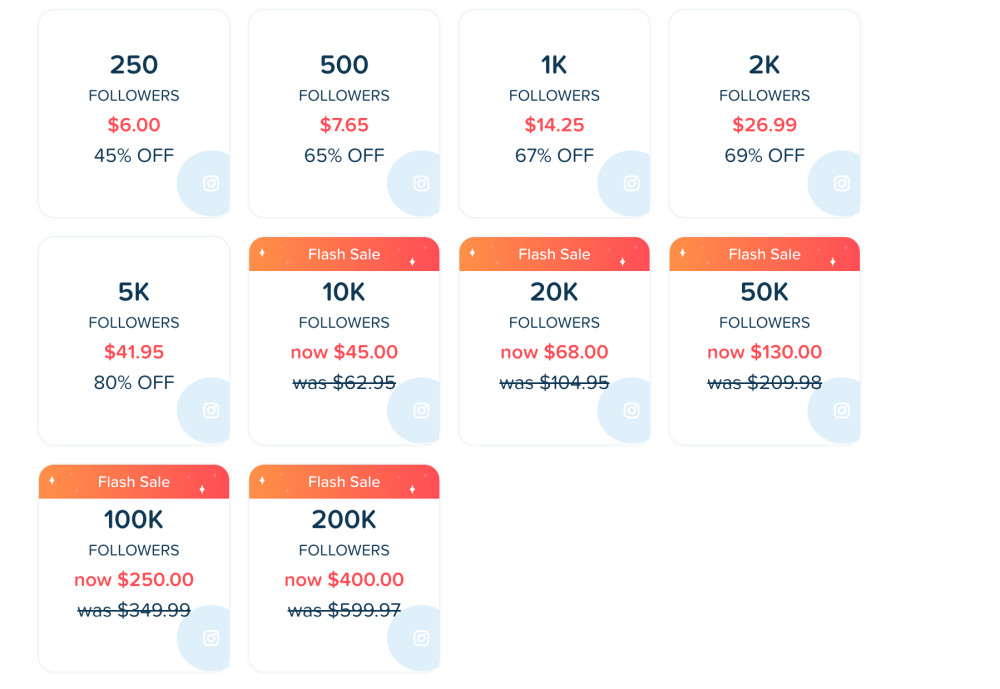
Starting at $2.19 for 50 followers, with packages running to 200,000 followers at $400 (flash sale pricing). The per-follower cost drops significantly at scale. Flash sale pricing on larger tiers makes SocialBoosting one of the most competitively priced premium services available.

Best For: Content creators, influencers, businesses, new accounts building credibility, anyone who wants a long-term result rather than a quick number.

Overall Rating: 9.8/10
socialboosting

2. BoostMe—Best for Local Brands

BoostMe’s standout differentiator is personalized support and geo-targeting capability. If you’re growing a location-based business and need followers who might actually convert, BoostMe is the service I trust second most in this space.

Their three follower tiers mirror a similar structure to SocialBoosting: High Quality, Premium and Celebrity/Influencer. 

Retention held well in my testing. The 30-day money-back guarantee is clearly stated and not buried in fine print. 

The 456 Trustpilot reviews averaging 4.7 out of 5 are consistent with what I experienced, with multiple verified buyers specifically calling out communication quality.

The main limitation is price. BoostMe’s entry point of $7.20 for 250 followers is higher than SocialBoosting. If budget is a factor, you’re getting a comparable or slightly higher quality product but paying a premium for the personalized service layer.

What I Liked

•        Human-assisted delivery with real support communication

•        Geo-targeting for location-relevant follower acquisition

•        30-day money-back guarantee

•        Strong Trustpilot presence with verified reviews

•        No password required

•        15-day refills on standard packages, 30-day on premium

What Could Be Better

•        Higher starting price than most competitors

•        Slightly slower delivery than SocialBoosting for standard packages

Pricing

Packages begin at $7.20 for 250 followers, scaling to $480 for 200,000 followers. Significant discounts apply at the 10K+ range.

Best For: Local businesses, brands targeting specific geographies, accounts where follower authenticity will face scrutiny from potential partners.

Overall Rating: 9.5/10

3. SuperViral—Best for Mid-Range Budgets

SuperViral has been around long enough to build a credible track record. My test order processed without issues, and delivery landed within the stated 24-to-72-hour window. The follower profiles I examined were a mix: most looked real enough, with some clearly lower-quality accounts in the batch.

The platform does offer a 15-day refill period, which is adequate for most purchase sizes. Customer support responded within a few hours when I reached out. The checkout is clean, no password is requested and SSL is in place.

Pros

•        Consistent delivery within stated timeframes

•        15-day refill coverage

•        Reasonable pricing for the quality tier

•        No password required

Cons

•        Profile quality is inconsistent across batches

•        Refill window shorter than top-tier competitors

Pricing: Starting around $2.99 for 100 followers.

Best For: Creators on a mid-range budget who need reliable delivery without top-of-market pricing.

Overall Rating: 8.5/10

4. Twicsy—Best for Fast Delivery on Smaller Packages

Twicsy has strong brand recognition and solid delivery speed. It’s a dependable option for quick boosts but lacks the refill depth and quality controls that SocialBoosting brings.

My test order was delivered within about 36 hours, which is fast. The follower profiles skewed toward acceptable quality, not exceptional, but not obviously fake.

Where Twicsy’s model diverges from my top picks is in the refill policy. Coverage is limited and not always clearly communicated upfront. For one-off boosts where long-term retention isn’t a priority, Twicsy works. For sustained credibility building, I’d invest in SocialBoosting’s refill guarantee instead.

Pros

•        Well-established with real customer history

•        Fast delivery speed

•        Clean checkout with no password requirement

Cons

•        Refill policy is limited and unclear

•        Profile quality doesn’t match premium tier claims consistently

Pricing: Starting at approximately $2.97 for 100 followers.

Best For: Quick visibility boosts where long-term follower retention is a secondary concern.

Overall Rating: 8.2/10

5. GetAFollower—Best Entry-Level Option for Small Accounts

GetAFollower is the most accessible starting point price-wise, but the follower quality is inconsistent enough that I wouldn’t rely on it for anything beyond a basic credibility number bump.

Their main selling point is low entry cost. At $1.49 for 50 followers, the barrier to trying the service is almost nonexistent. That affordability comes with trade-offs. In my test, the follower batch was notably mixed, with a portion of accounts showing clear inactivity markers.

Delivery was within 24 to 48 hours and retention held reasonably through the first two weeks before seeing slightly higher drop rates than the top-tier providers. 

Pros

•        Lowest entry price in this roundup

•        Decent delivery speed

•        No password required

Cons

•        Inconsistent follower quality

•        Refill is optional, not standard

•        Higher drop rates after the two-week mark

Pricing: Starting at $1.49 for 50 followers.

Best For: Brand-new accounts needing a minimal credibility baseline before investing in a premium service.

Overall Rating: 7.8/10

6. Buzzoid—Best for Instant Delivery Without a Wait

Buzzoid prioritizes speed above everything else. My test order started delivering within minutes of purchase confirmation. If you need a fast follower injection before a launch, partnership pitch or content push, Buzzoid can deliver that.

The catch is that instant delivery without drip-feed management creates a spike pattern that’s visible to Instagram’s systems.  

Pros

•        Genuinely fast delivery

•        Established brand with real customer base

•        No password required

Cons

•        No standard refill guarantee

•        Instant delivery creates unnatural spikes

•        Engagement mismatch risk on new accounts

Pricing: Starting at approximately $2.99 for 100 followers.

Best For: Established accounts needing a quick, one-time boost before a specific event or pitch.

Overall Rating: 7.6/10

7. Media Mister—Best for Multi-Platform Orders

Media Mister’s value is in its breadth, not depth. It covers more platforms than any other provider here, which is useful if you’re managing growth across multiple channels simultaneously.

If you’re managing growth on Instagram, YouTube, TikTok, Twitter and LinkedIn simultaneously, the convenience of a single vendor has real operational value.

On Instagram specifically, follower quality is more variable than SocialBoosting or BoostMe. Delivery is slower, typically two to five days, and there’s no standard refill included. 

Pros

•        Broadest platform coverage in this comparison

•        Useful for multi-channel campaigns

•        Long-standing market presence

Cons

•        Slower delivery than competitors

•        No standard refill guarantee

•        Instagram-specific quality lags behind specialist providers

Pricing: Starting at $1.49 for 10 followers.

Best For: Social media managers running multi-platform growth campaigns who prioritize vendor consolidation.

Overall Rating: 7.2/10

How to Choose the Right Instagram Follower Service

Here’s the checklist I use when evaluating any provider:

•        Gradual delivery option: Does the service offer drip-feed rather than instant dump?

•        Refill guarantee: If followers drop within 30 days, will they replace them for free?

•        No-password policy: Any service requesting your Instagram password is an immediate disqualifier.

•        SSL-secured checkout: Standard requirement; non-negotiable.

•        Visible customer reviews: Not just on-site testimonials; look for Trustpilot or third-party evidence.

•        Transparent pricing: Can you see exactly what you’re getting before checkout?

Common Mistakes When Buying Instagram Followers

Even with a quality provider, your growth strategy can be undermined if you fall into common pitfalls that signal “fake growth”. Here are some common mistakes to avoid:

•        Ordering too many at once: A jump from 200 to 20,000 followers with no corresponding post activity is a red flag to Instagram and to real visitors.

•        Choosing the cheapest provider: Saving $10 on a bot-heavy service and then spending time dealing with follower drops and potential account restrictions is not a good trade.

•        Ignoring the refill guarantee: Followers drop. Every service experiences this. If your provider doesn’t cover it, you’re absorbing that cost.

By being mindful of these common missteps, you can protect your account’s integrity while leveraging purchased followers as a strategic tool rather than a liability.

Final Take

If you’re looking for the quickest path to credible growth, SocialBoosting is the most reliable choice for its consistent, drip-feed delivery and strong refill policy. For local businesses or multi-platform needs, BoostMe and Media Mister offer valuable specialized services. Regardless of your choice, remember that purchased followers provide social proof, not actual engagement. The real work of building a loyal audience still happens through the content you create and share.

Frequently Asked Questions

Is buying Instagram followers legal?

Yes. Buying followers isn’t illegal, but it does violate Instagram’s Terms of Service and may put your account at risk if you choose a low-quality provider.

Can Instagram remove purchased followers?

Yes. Instagram regularly removes fake accounts. Choosing a provider with real-looking followers and a refill guarantee helps minimize losses.

Which provider is the safest for buying Instagram followers?

Based on my testing, SocialBoosting is the safest option, followed by BoostMe. Both offer gradual delivery, refill guarantees and never require your password.

How fast do followers get delivered?

Most providers start delivery within a few hours. For better account safety, gradual delivery over 24 to 72 hours is preferable.

Do I need to share my password to buy followers?

No. Reputable providers only require your Instagram username. Never use a service that asks for your password.

Will buying followers improve my engagement rate?

No. Followers increase social proof, but they don’t automatically increase likes or comments. You’ll still need quality content or engagement services.

How many followers should I buy to start?

Start with 500 to 1,000 followers. It’s enough to boost credibility without creating an unnatural spike.

What is a refill guarantee and why does it matter?

A refill guarantee replaces followers that drop after delivery at no extra cost, protecting your purchase.

Disclaimer: Using third-party services to increase Instagram followers carries risk, especially when they rely on purchased followers, fake accounts, bots or tactics that violate Instagram’s policies. Low-quality providers may harm your profile by weakening engagement quality, reducing account credibility, affecting visibility or or increasing the risk of issues such as follower drops, limited reach, account restrictions, bans or or even account closure.

To reduce these risks, it’s important to choose reliable providers that use safe, policy-conscious growth methods. The services mentioned here do not rely on fake followers or artificial engagement. Instead, they focus on targeted promotion, profile optimization and strategic marketing to help your account reach real users, attract genuine followers and support organic growth while staying aligned with Instagram’s guidelines.

The editorial staff of the East Bay Express was not involved in the creation of this content. The content is provided for general informational purposes only and does not constitute financial, legal, medical or professional advice from this publication. Readers should consult qualified professionals regarding their individual circumstances. The East Bay Express  disclaims any liability for any loss or damage resulting from reliance on the information contained in this content.

Resistance.ai: Putting a nonviolence advisor in every person’s pocket

It is, perhaps, the third most important book in human history. And yet it remains perfectly obscure. The drab cover doesn’t help. Clothed in a fatigues-esque olive green, the book resembles an army officer’s field manual. Make no mistake; that’s the point—it’s a field manual to wage a nonviolent campaign of peace. It is Gene Sharp’s Politics of Nonviolent Action, Part Two: The Methods of Nonviolent Action—sometimes referred to as “MLK’s Playbook.”

The Opposite of a Gun

The book names and describes 198 proven methods of nonviolent resistance. One hundred ninety eight. Most Americans couldn’t name 10. Maybe that’s why most Americans feel powerless. All are necessary; each method is suited to a different tactical situation, covering every stage of nonviolent conflict—from a one-woman stand to a general strike in which all the people withdraw their support from an oppressive regime—and victory.

The author, Gene Sharp, was doubtless a smart man—but this book is not his genius. It contains the genius of all peoples. The 198 entries cite and reference freedom movements from around the world, across all of human history. Because violence has always been with us. It is the oldest technology of oppression.

Sharp’s 198 entries roughly describe a lineage of nonviolent resistance, with each generation contributing new methods toward a single end, the end of oppression. This tool has been finished and furnished to us now, the 10,000th generation of humanity. Surely that is a signal sign of hope in these violent and oppressive times.

It had been my hope when I partnered with Jamila Rabiq, Gene Sharp’s successor at the Albert Einstein Institute, to help bring this manual back into print. If we could arm 10,000 young leaders around the world with “MLK’s Playbook,” perhaps this generation would be the generation to turn the page on history and start humanity’s second chapter—the post-violence.

Six years on, I see a problem with that plan. People just don’t read. This age is digital. And in it, physical books are outmoded tech. What’s more, Sharp’s 1973 field manual was written before computers, social media and artificial intelligence—“online” has become one of our most important political battlefronts.

The solution I ponder is whether we should now merge the digital content of Gene Sharp’s book with an AI. It’s a question. What is certain is that the violent forces of oppression are using AI against free peoples.

Big Tech

Donald Trump’s partnership with Big Tech is so close, the tech majors might even be considered part of the administration. This partnership has led to rapid adoption and heavy dependence by the administration on AI to do its “thinking” and strategy.

AI programs developed to identify and track “illegal immigrants” are being expanded to include AI surveillance of all political opposition to Trump—extending through social media, purchases, finances and location finding. This exceeds their legal authority and lacks transparency and independent oversight. The lodestone of this administration, and unprincipled Big Tech, is self preservation through wealth and power. And it is leading America down a path being blazed by China—the path of “techno-authoritarianism.”

China is currently implementing an AI system that integrates hundreds of millions of security cameras, sensors and patrol drones with billions of “smart” appliances, computers and smart phones into a single integrated system of state surveillance.

This AI system is capable of conducting continuous real-time monitoring of its citizens. Activities as innocuous as getting more gas than usual or watching “the wrong type of show” are red-flagged and entered into a comprehensive assessment of that citizen’s “political risk.” That risk rating affects a loss of privileges and rights such as access to loans, benefits, education, employment and travel.

At a certain threshold of “risk,” AI automatically triggers an arrest warrant. Make no mistake; the only crime for which the Communist Party is concerned is resistance to its authoritarian power. These AI systems are the future of oppression.

And the world’s authoritarian powers are following China’s lead. Weaponized AI is one of the reasons why oppressive governments around the globe are becoming more powerful and more resistant to protest movements. It’s time to level the battlefield.

Sharp Phone

Any modern, cloud-based AI—Gemini, ChatGPT, Claude—can be turned into a simple nonviolent resistance advisor with the prompt: “You are a nonviolent resistance advisor.” With the capacity to instantly aggregate internet search results into a single voice—which speaks 70 world languages at all reading levels—AI is a ready resistance tool. One drawback is that the information gathered by the basic internet searches that inform its advice is often shallow, opinionated and inexpert.

My proposal is to have the AI search the entirety of Gene Sharp’s book instead. 

Through AI, a thick book can become a talking book that dialogs with the user. In fact, with the book as the AI’s memory and its voice, the AI becomes a rough approximation to conferring with Gene Sharp himself. Moreover, this “AI resistance advisor” can rephrase, clarify and elaborate on any point of Sharp’s and pull additional historic examples of a tactic from the internet.

It can receive from the user a detailed and disorganized account of their protest movement’s strategic situation and present what tactical options Gene Sharp would recommend. It can even apply Gene Sharp’s principles of nonviolence to modern digital contexts—bringing the 1973 book up to date.

And here’s the kicker: The commercial AI’s—Claude Projects or Google Notebook LM—that have the capacity to upload a single book actually have the expanded capacity to upload an entire library of books.

So resistance.ai’s “memory” could include all of Gene Sharp’s 10 books, the critiques of his work, additional source works such as Nelson Mandela’s 656-page Long Walk to Freedom, and materials on special topics like digital security, organizing a movement or PTSD care for the victims of violence. Thus, the AI’s memory and voice can draw from the entire literature of resistance. It’s like having Sharp, King, Ghandi, Mandela and more in one’s corner.

Moreover, these consumer AI’s let one supplement these libraries with a set of guiding “instructions,” or principles, that are easy to write. They can be written to prioritize the security and safety of the dissidents it consults with and have the intellectual humility and deference needed to keep humans in charge of the decision making.

The addition of Starlink satellite internet reduces the risk that regimes will be able to disrupt the internet on which these cloud-based AI’s depend. The addition of VPNs reduces the risk that dissidents using this AI will be detected.

Moving the use of this AI to democratic countries where allies transfer the AI responses back to the dissidents over encrypted message services like Signal or Byrar camouflages use in places like Russia and China. Transitioning from cloud-based AI to the oncoming wave of hardware-based AI, which use no more power or water than the laptop or smartphone on which they are installed, addresses the ecological concerns of AI and reduces dependence on the internet and morally dubious tech companies.

Within a few years, 10 million young leaders could have a rounded, genius-level resistance advisor in their pockets. The cloud-based advisors are possible today.

Obsolete Violence

Whether Sharp’s nonviolent content is delivered in an AI or in a mass market paperback, the goal remains the same: to distribute tactical genius as widely as possible among the people and to lower the threshold for action, creating a vast, leaderless nonviolent movement.

“Do not mistake people’s inaction for apathy,” Jamila Rabiq said to me on a recent call to New York. “It is powerlessness.” People don’t know what to do—they don’t have tactics. I hadn’t spoken to Rabiq in six years, since the reprinting of Sharp’s tome. I was pleased to find her Albert Einstein Institute on a full, nonviolent, war footing—working closely with dozens of opposition groups around the world.

I had called her seeking her blessing for my Gene Sharp AI idea. I was pleased to find she was way out ahead of me. She had just come from a conference where she was invited to speak on the safety of resistance AI. Broadly in favor of them, Rabiq was keenly interested in the efforts of a Serbian protest group to develop a resistance AI called “GENE,” in honor of Gene Sharp. But she agreed with me that there should be a diverse ecology of resistance advisors. And so she gave her blessing to mine.

Do this: Upload this article into a chat with AI—Claude Projects and Gemini Notebook have the library capacity. It is one’s setup prompt for the construction of their own resistance AI. Digital copies of Gene Sharp’s books are available at aeinstein.org/digital-library. The authoritarians are innovating—it’s time for the resistance to innovate, too.

Learn more: Citations and resources at linktr.ee/resistance.ai.


Build Your Own Resistance Advisor 

A step-by-step companion to this article

Step 1—Get the books. Obtain digital copies of Gene Sharp’s core texts. The most essential is Politics of Nonviolent Action, Part Two: The Methods of Non-Violent Action (1973). Copies can be found at the Albert Einstein Institute website, Internet Archive (archive.org) or purchased as ebooks via Amazon.

Step 2—Choose your platform. Two free tools currently support uploading a personal library:

  • Claude Projects (claude.ai)—Anthropic’s AI
  • Google NotebookLM (notebooklm.google.com)—Google’s AI. Create a free account on either platform.

Step 3—Upload the texts. Upload your Sharp texts directly into your Project or Notebook. Both platforms will use these as the AI’s primary memory—it will draw from Sharp before anything else.

Step 4—Paste your setup prompt. Start your first conversation with the following:

You are a nonviolent resistance advisor. Your primary source of knowledge is the uploaded works of Gene Sharp. Always prioritize the safety and security of the people you are advising. Offer tactical options clearly, but defer all final decisions to the human. Apply Sharp’s principles to modern digital contexts where relevant.

Step 5—Protect yourself. Before using your advisor, enable a VPN on your device. Consider using a secure messaging app like Signal to share its guidance with others.

Step 6—Begin. Describe your situation. Your advisor is ready.

Jack London Square adds hopscotch murals that turn sidewalks into public art

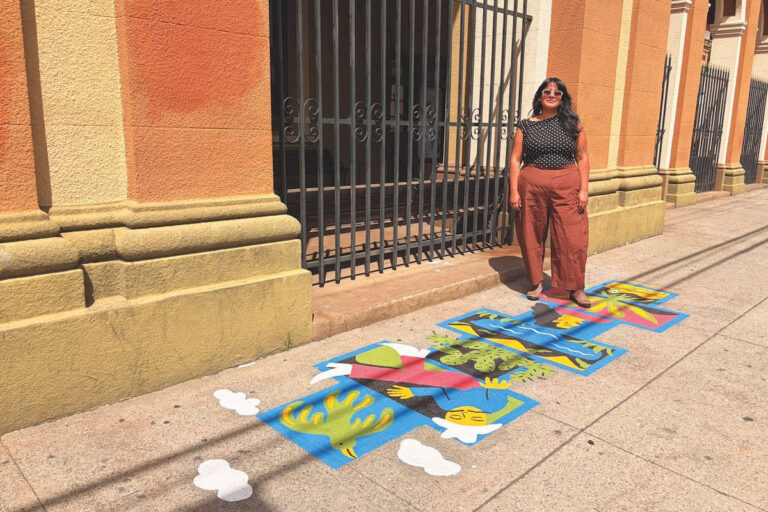
A woman talks on the phone as she walks along Jack London Square’s Third Street. Suddenly she looks down, then up again, then down. She starts hopping. One foot, then two, then one and two, until she returns to her call.

The hopscotch she used is part of the Jack London Hopscotch Tour, an installation of 11 hopscotch murals dispersed around the area by the Jack London Improvement District (JLID). Each mural was created by a local artist with full creative control of their design. The result: a mix of colors, concepts and inspirations now adorns the concrete sidewalks of Jack London Square. Ten of the murals are currently on display, with the 11th to come later this summer.

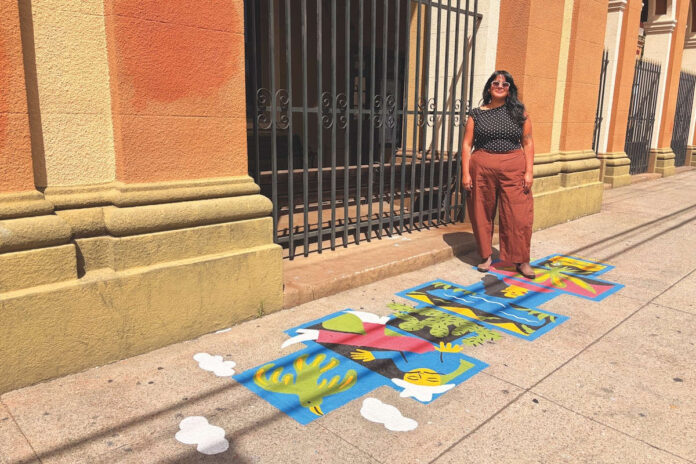
Ivana Pinto, a graphic designer for Nido’s Backyard in Oakland, created the hopscotch pattern on Third Street. Originally from Peru, Pinto has lived in the Bay Area for the past 20 years. Her design, marked by green agave and cacti surrounded by deep blues and reds, is inspired by Latino folk art.  

For Pinto, one of the harder things about moving to the United States was the feeling of not having a home like the one her parents and grandparents had. One full of the color, quirkiness and mysticality she associates with Peru.

“To me there’s nothing more beautiful than walking into a space that’s just colorful, and I think that represents a lot about being Latina,” she said. “I always felt inspired by migration and longing and the kind of feeling of wanting to create a space, even though we are in the United States, to make it our own.”

Her hopscotch mural sits right outside the Oakland branch of the Immigration Institute of the Bay Area. Richie Flores, also of Latine heritage, told Pinto he thought this was something she might like. Flores spearheaded the hopscotch project as public space manager at the JLID. 

He wanted to fill the space in Jack London with interactive art, something he hadn’t seen before. Most of the mural locations were intentionally chosen to be near local businesses in order to bring people in to enjoy both the art and the establishments that surround it.

Danny Pirello, owner of the oyster bar The Salty Pearl, says he sees kids playing on the hopscotch outside his restaurant all the time. As someone who appreciates the arts scene in the Square—most of the art displayed in his restaurant comes from the neighboring art studio, The Grand Gallery—Pirello says he wants to see more projects like this one.

The hopscotch outside of The Salty Pearl uses each square to highlight an East Bay wildflower. Creator Jeni Paltiel, a graphic designer and gardener, wanted to draw attention to plants around the city that might otherwise be overlooked. Most people see them, but don’t think about them or know their names.

“My hope is that people will come away from this and maybe next time they see one of these flowers they’ll go, ‘Oh, that’s a tidy tips!’” she said.

Outside Alta Vina, a wine bar celebrating its one-year anniversary, Cookie Lockhart and her four-year-old daughter, Libberti Stewart, stop to play on a hopscotch mural. Lockhart says Stewart constantly draws her own with chalk she finds on their walks through Eastmont Hills in Oakland.

Stewart can’t get enough. She finishes hopping in one direction, then immediately turns around to repeat the process. After a couple of minutes, Lockhart tells her daughter they should start heading inside.

“Let me do one more,” Stewart says, completing a last round before running to meet her mom.

The mural she leaves behind is illustrator Kaeli McLeod’s homage to Jack London’s vibrant and diverse history as an industrial waterfront. Originally from Southern California, McLeod moved to the Bay Area five years ago. When living in San Francisco, she took the ferry to Jack London Square nearly every week to visit her partner in the East Bay.

“A lot of these were things I was passively observing, but maybe not at the forefront of my mind,” she said. “So when I had the opportunity to work with Richie on this project to create a hopscotch design, a few of these images immediately came back.”

At its center is a man playing the saxophone, a reference to Oakland and Jack London’s legacy as a western jazz hub. McLeod also wanted to depict hidden gems like Plank, the bowling alley that has stood in Jack London Square for 12 years and is set to permanently close this August.

Second Street is quiet and calm on a Sunday morning. April Garland, 53, brings a bit of excitement to that tranquility by taking a moment to hop on the mural outside Cafe Da Fonk.

“It brought me back; you don’t see them very often,” she says as she laughs and recounts stories of throwing rocks at hopscotch squares in the schoolyard.  

The Jack London Improvement District will host an official celebration of the murals this July 11.

It’s still about all that jazz

0

In its 42-year history, the organization now known as Living Jazz has had only three executive directors: co-founder Stacey Hoffman, who served from 1984 until 2023; Lyz Luke, who left in 2025 to become the cultural affairs manager for the City of Oakland; and now Mary Lins, appointed in May.

Lins, who spent seven and a half years as the executive director of the Berkeley Playhouse, continues the organization’s lineage of female executive directors, something that remains unusual in the jazz world.

In a phone interview, she said she plans to take time to get to fully know the institution, its mission, its staff, the teaching artists and the people it serves, before proposing any changes. “I am still learning so much,” she said—especially about the various programs. They include RootED, a tuition-free music, dance and performance program serving TK–12 students in under-resourced public schools; Jazz Camp West and Jam Camp West; and the popular annual community event, the “In the Name of Love Dr. Martin Luther King Tribute” at the Paramount Theatre.

Under Luke, RootED expanded from four schools served to 21, and the nonprofit’s operating budget more than doubled. Living Jazz has gone through multiple changes over the years, including a name change in 2011 from “Rhythmic Concepts,” introducing the Oakland Interfaith Choir in 1986 and the choir’s success allowing it to become its own nonprofit in 1991.

Lins’ extensive music background includes training in music and theater at Penn State and decades of experience as a singer/songwriter, in addition to her administrative resume. Before her appointment at Living Jazz, she was aware of the organization’s commitment to arts in the schools, one of her own passions.

“Children today live in a complex world,” she said. “The arts teach empathy and compassion … they are such a great place to process.” With federal funding currently drying up, resources like RootEd are even more essential, she emphasized. “The genre of jazz enhances the quality of [the participants’] lives.”

The Jazz Camps, which remain an essential part of Living Jazz’s programming, are another special interest for Lins. Jam Camp West is a seven-day overnight music, dance and vocal program for ages 10-17 and all skill levels, held in the redwoods of Loma Mar in San Mateo County. Jazz Camp West is an eight-day jazz overnight immersive experience for adults and teens of all skill levels, held in the redwoods in La Honda, also in San Mateo County.

For many of the kids and young adults participating in the camps, it’s not only an immersive experience in jazz, but their first extended foray into a non-urban environment. Living Jazz continues its commitment to the Trailblazers of Hope Quasi-Endowment, created under Luke and designed to support the long-term sustainability of camp scholarships.

“Living Jazz’s camps and fellowships draw participants from across the country and around the world, and the organization’s next chapter is being shaped by a belief that the arts thrive through collaboration, connection and community impact—not in silos,” the nonprofit’s materials state.

“Jazz is an American art form, and we have the Black community to thank for it,” Lins said. “The heart of jazz is a space of welcoming.” Jazz, she said, “creates a culture where we can take risks. This goes hand-in-hand with the spirit of the Bay Area.”

Lins expects to bring her outreach and fundraising expertise to Living Jazz. At Berkeley Playhouse, according to Living Jazz materials, “she led a period of sustained fiscal health, expanded access and scholarship programs, and strengthened the organization’s role as both a producing theater and a hub for arts education.”

Lins said, “I welcome more Bay Area [companies and organizations] to become familiar with Living Jazz and become partners.” As the nonprofit moves forward, it is building for the next 42 years—and rededicating itself to both community service and an art form that remains an American treasure.

For more information about Living Jazz and its programs, visit livingjazz.org.

Social Eyes: Week of July 2-8

THU 7/2

BLUEGRASS

JACOB JOLLIFF BAND

There is just something really special about the mandolin. It’s a difficult instrument to master, requiring not only super-strong, callused fingers, but the agility to manipulate its high string tension and tightly spaced frets. But, oh, what gorgeous music results when someone like Jacob Jolliff plays it. In 2012, Jolliff won the U.S.A. National Mandolin Championship, and he’s just gotten better from there. He’s collaborated with many top bluegrass artists, but now focuses on his own Jacob Jolliff Band, described as “cutting-edge progressive bluegrass,” incorporating pop covers and improvisation. OK, one of his originals is titled, “The Perils of Macrame.” Say no more. JANIS HASHE

INFO: Thu, 8pm, The Freight, 2020 Addison St., Berkeley. $44-$49. 510.644.2020.

FRI 7/3

ROCK

KELSY KARTER AND THE HEROINES

Kelsy Karter and the Heroines, fronted by Australian-born firebrand Kelsy Karter and backed by a trio of lifelong friends from Derby, England, pull their wild energy from glam-rock, punk, power-pop and arena-sized theatrics. Their latest album, Love Made Me Do It, turns heartbreak and self-destruction into a swaggering rock opera with a few showtune-y nods to Karter’s theater-kid origins. Onstage, Karter has the reckless charisma and unfiltered attitude of a true rockstar, leading a band with real chemistry and big personalities earned through years of friendship and touring. SONYA BENNETT-BRANDT

INFO: Fri, 8:30pm, Cornerstone, 2367 Shattuck Ave., Berkeley. $28. 510.214.8600.

FRI 7/3

JAZZ

BENNY AMÓN & THE NEW ORLEANS PEARLS

Benny Amón grew up in Davis, but his musical identity was forged in New Orleans, where he spent more than a decade soaking up musical knowledge on stages with some of the scene’s most prodigious players. Versed in more than a century of Crescent City idioms, the drummer brings a second-line powered combo to the Sound Room. Since moving to the Bay Area in 2021, he’s kept company with some of the finest musicians steeped in trad jazz, building on the region’s longstanding love of New Orleans culture. Working steadily with more than a half-dozen bandleaders, Amón is also a savvy leader in his own right. ANDREW GILBERT

INFO: Fri, 7:30pm, The Sound Room, 3022 Broadway, Oakland. $32. 510.708.9691.

SAT 7/4

PUNK

GENERACIÓN SUICIDA

Despite what the powers-that-be want us to believe, America is a melting pot. It’s a brilliant, diverse mix of people, nationalities and cultures. So, this Independence Day, what’s more American than celebrating with some good ol’ fashioned Latin punk rock? Generación Suicida started as a side-project in a garage in 2010 but quickly became the main course as this L.A. punk group has earned the love and respect of the community over the last decade and a half. The music is catchy and authentic, with a dark twang that edges on post-punk with a big middle finger sticking from the center of its corazón. MAT WEIR

INFO: Sat, 8pm, Thee Stork Club, 2330 Telegraph Ave., Oakland. $15-$20. 510.859.8709. 

SUN 7/5 –> SHOW CANCELLED

EDM

MORILLO

If one could capture the sounds of nature and turn them into a dance beat, it would probably sound like Morillo’s music. Since the age of 7 this producer and drummer has made infectious grooves and heavy beats combining an array of various genres of music like pop, rock, bass and dub. He’s taken his music around the world, playing live with acts like Childish Gambino and Groundation, playing festivals such as Haiti’s One Love Fest, Spain’s Rototom Sunsplash Reggae Fest and Ultra Music Fest in Miami. Last year this Los Angelino released two albums—and a remix of one of those. This night promises good vibes and mystical realities. – MW

INFO: Sun, 8pm, Cornerstone, 2367 Shattuck Ave., Berkeley. $28. 510.214.8600.

SUN 7/5

FOLK

ORQO TAKI

A new folkloric duo brings together veteran Peruvian guitarist Héctor García with Kitan García (no relation), a Bay Area multi-instrumentalist specializing in the Andean end-blown bamboo flute (quena) and the diminutive, 10-string charango. As Orqo Taki (Mountain Songs), they explore a transnational array of Indigenous and mestizo idioms from the Andes Mountains. Héctor, a native of Cusco, is a renowned soloist featured with symphony orchestras. Kitan is part of Comunidad Anqari, a collective dedicated to preserving and teaching the Indigenous music of the Altiplano. Together, they have developed contemporary arrangements of songs gleaned from Andean folk traditions of southern Perú, Ecuador, Bolivia and Argentina. – AG

INFO: Sun, 7pm, The Back Room, 1984 Bonita Ave., Berkeley. $15-$20. 510.654.3808.

MON 7/6

POP

ROSALÍA

Every now and then an artist rises to a spectacular, singular vision. And then does it again and again. Rosalía is arguably one of these rare birds. Possessing a vocal gift that is glorious, vulnerable, acrobatic and more, this tour of her newest album, Lux, also brings fantastic production elements to the arena. Divided into four acts, the concert is part ballet, partly an orchestral and electronic symphony and, throughout, an operatic journey. The sum total is physically fierce, then frolicsome, then fantastical, fun and scaled to exceed expectations. The only thing bigger than Rosalía’s reach appears to be her imagination. LOU FANCHER

INFO: Mon, 8:30pm, Oakland Arena, 7000 Coliseum Way, Oakland. $250-$529. 510.569.2121.

TUE 7/7

THEATER

‘SCABMUGGERS’

“Sometimes,” says the playwright of Scabmuggers, Yvonne Martinez, “you have to break shit up to get things done.” She should know. The work-in-progress play, from her novel of the same name, is based on her experiences in 1994 at the Harvard Trade Union Program. Her stage surrogate, Ana, begins the course and is harassed by a Black classmate who’s been set up by a white, homophobic, racist classmate. The cohort splits into camps supporting and against her, mirroring the conflicted history of the labor movement and starkly illuminating issues of misogyny, race, homophobia and class that continue to resonate today. A “scabmugger,” BTW, was an early 20th-century female striker who fought back against scabs. – JH

INFO: Tue, 7pm, The Freight, 2020 Addison St., Berkeley. $20-$30. 510.644.2020.

TUE 7/7

BLUES

MARCUS KING BAND

Marcus King’s guitar playing gets headlines, but his songwriting has also grown increasingly adventurous. Since stepping away from the Marcus King Band for a series of solo albums, the South Carolina musician has explored everything from orchestral soul to country-rock confessionals. 2025’s Darling Blue marks a return to the band format and to the musical legacy of the Carolinas: Southern rock, blues, gospel and country. Backed by a road-tested ensemble and armed with a voice that sounds seasoned beyond his 30 years, King circles back to emotional directness and roadhouse grit. – SBB

INFO: Tue, 8pm, Fox Theater, 1807 Telegraph Ave., Oakland. $56-156. 510.302.2250.

WED 7/8

COMEDY

ALLISON O’CONOR

As the co-host of Decadence, a podcast about glamor, the Brooklyn-based queer comedian is fearless. No topic—men giving birth, rock-star parking, redeeming a $5 reward at Walmart, the versatility of pizza—is too trivial or too taboo to touch upon. O’Conor’s “Aspiring Icon” show ventures into more personal places she encountered during her coming-out journey. Featured recently in the New York Comedy Festival and intensely relaxed on stage or in front of a camera, O’Conor makes audiences laugh, cry, groan, giggle and look at themselves and the world with new, fun-loving eyes. Life is hard, but made so much easier with jokes. – LF

INFO: Wed, 8pm, Eli’s Mile High Club, 3629 Martin Luther King Jr. Way, Oakland. $15-$20. 510.808.7565.

New citizenship test challenges immigrants preparing for naturalization

0

On Sept. 17, 2025, U.S. Citizenship and Immigration Services (USCIS) posted a Federal Register notice announcing the implementation of the 2025 naturalization civics test. The new test, made effective Oct. 10, now contains double the number of questions and draws from a 128-question bank rather than the previous 100.

The update represents the most substantial overhaul to the U.S. naturalization test in years, and now requires individuals seeking naturalization to earn 12 correct answers instead of the previous six.

Green card holders who filed for citizenship after Oct. 20 will be required to prove their knowledge of U.S. civics, history and government with a wider question pool featuring more open-ended questions. For example, the previous test asked prospective citizens, “The idea of self-government is in the first three words of the Constitution. What are these three words?” The new test asks, “The U.S. Constitution starts with the words, ‘We the People.’ What does ‘We the People’ mean?”

As the updated exam rolls out, local organizations have implemented new preparation models for prospective citizens—including English-language practice, mock interviews and guidance sessions. In Richmond, the West Contra Costa (WCC) Adult Education program offers free in-person and online learning models that advertise interview coaching, test preparation, citizenship application guidance and document counseling. 

In the wake of these changes, Richmond educators, lawyers and hopeful citizens have had to adapt their methods of preparation. 

Kenneth Ryan, one of the WCC Adult Education instructors, said that class registration has doubled in the past year, and he expects the numbers to keep climbing. “Trump’s a great recruiter for citizenship class,” he said, “because people are like, ‘What can I do to protect myself and my family?’” 

A student of WCC Adult Education and a hopeful citizen, who requested anonymity to protect herself and her family, said she had to stop working and start taking classes four times a week to prepare for the citizenship exam. She takes two morning classes and two night classes per week. The pressure, she said, is the hardest part of preparation. Her husband is a citizen, so she feels stress both at home and as part of a constantly evolving political landscape.

“As an immigrant you feel like if you don’t do it you’re gonna have consequences, or suddenly they’re gonna change something, then you’re out,” she said. “Or that’s the fear, right?”

Nearly 15 students, many of whom have limited English-speaking abilities, attend the Thursday morning class at Serra Adult Center in Richmond. Much of the class is spent defining difficult English words like “amendments,” “electoral” or “allegiance.” Students practiced enunciating the words phonetically, then used fragments of English and Spanish phrases to remember their definitions.

Despite the language barrier, many students are quick to respond to being quizzed. “How long does a U.S. presidency term last?” asked morning instructor Ryan, to which students snapped, “Four years!”

“Solo dos años más,” one student whispered. Only two more years

Another student, who also requested anonymity, said she is also taking time off work to focus on classes full-time. “I have a kid here and I have my husband here, and I want to stay here,” she said. “I have to do the best I can to stay legally or more secure.”

Ryan described to students how many of the question changes are intentionally confusing or ideological. For example, while many straightforward questions like, “How old do citizens have to be to vote for President?” were removed, new questions have been added, such as, “Why did the United States enter the Persian Gulf War?” The answer is “to force the Iraqi military from Kuwait.”

Aside from the increase in the number and rigor of questions, prospective citizens will also need to prove to an immigration officer that they are of “good moral character.” Previous to October 2025, the absence of a criminal record was sufficient for this requirement. The new test requires evidence of “positive contributions to American society.” Discretion will be given to the immigration officer administering the exam.

USCIS spokesperson Matthew Tragesser said, “American citizenship is the most sacred citizenship in the world and should only be reserved for aliens who will fully embrace our values and principles as a nation.” According to the Department of Homeland Security (DHS) website, “The agency is also resuming neighborhood investigations to ensure that aliens meet statutory requirements and are worthy of U.S. citizenship.”

While the DHS has not released pass/fail data since 2023, Ryan is confident he can still prepare students to be successful. “90% of my students pass,” he said.

Umami Mart bottles a taste of Japan

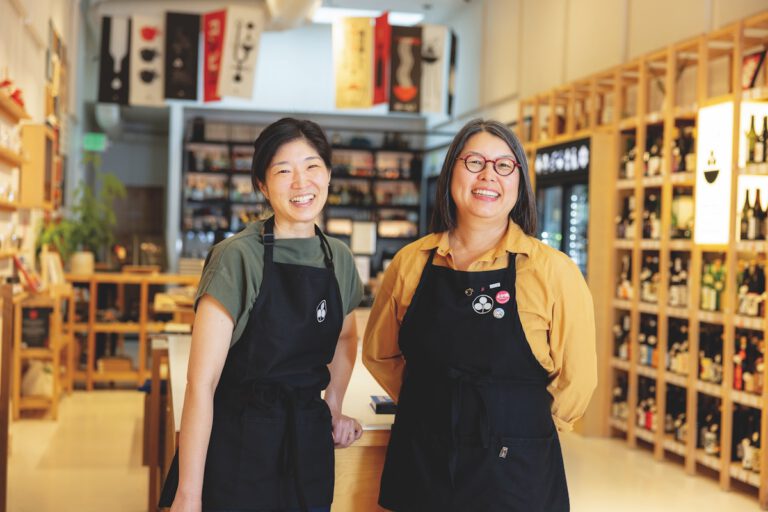
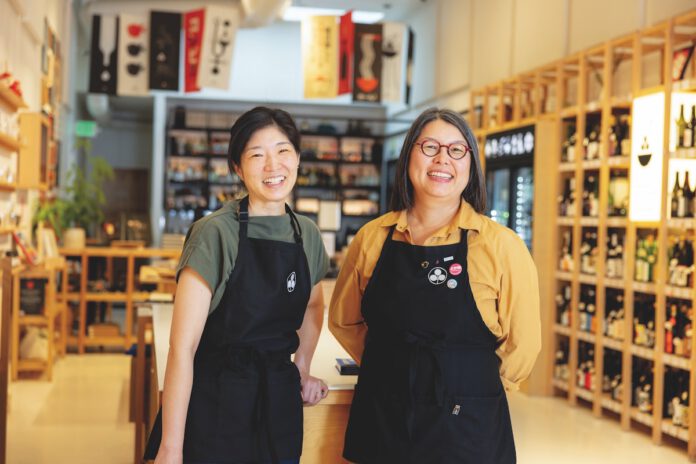
Umami Mart started as a blog and then materialized IRL as a pop-up in Oakland before expanding into its current incarnation as a specialty market and sake bar. Friends since childhood, Kayoko Akabori and Yoko Kumano were living in different cities when they decided to start that foundational blog together in 2007. It was a way for them to keep in touch when blog culture was a brand new trend. They were in their 20s living in two big metropolitan areas—Brooklyn and Tokyo. The content they developed was based around food.

“We invited other writers from around the world—Copenhagen, Brazil, L.A.—so it became a community food blog,” Akabori, who was the main editor, recalled. It was also a way to introduce the concept of umami to a broader audience, a couple of years before anyone had heard of the restaurant chain Umami Burger. When Akabori and Kumano decided to open a brick-and-mortar, it made sense to name the store after the blog. 

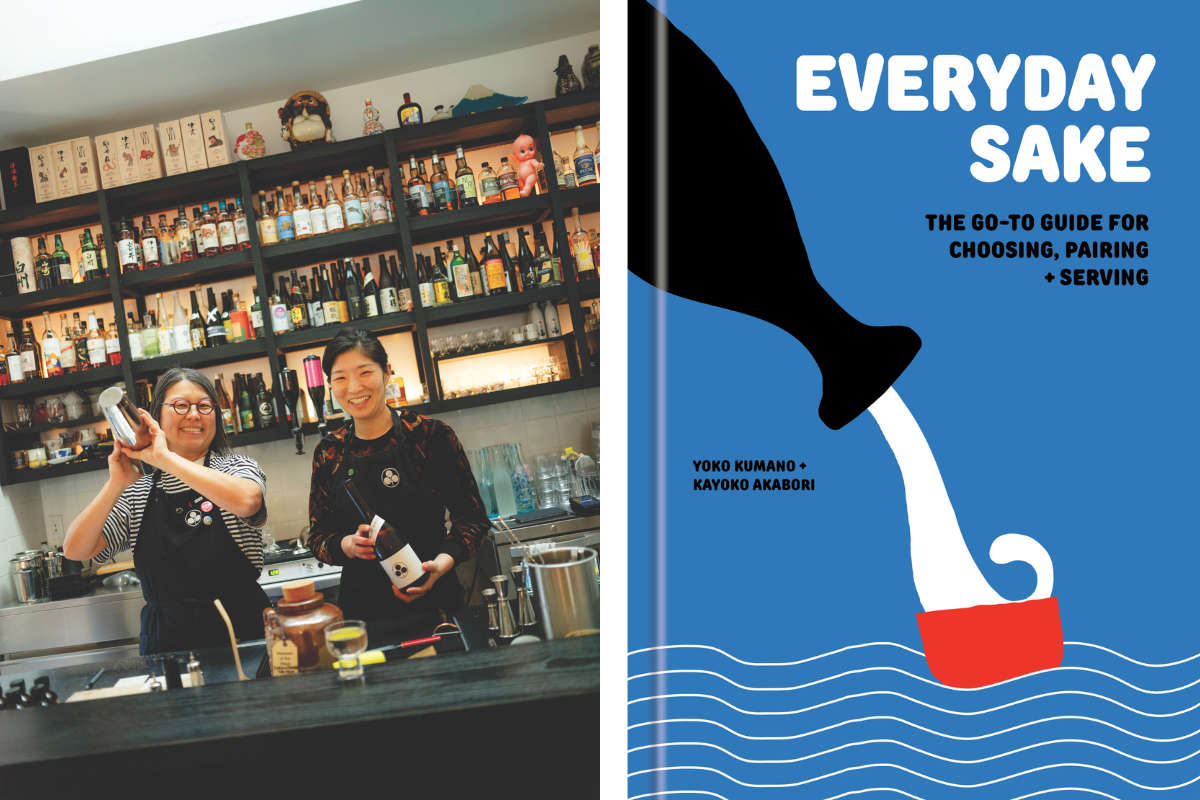
In their comprehensive and charming new book, Everyday Sake: The Go-To Guide To Choosing, Pairing + Serving, the glossary includes a definition of umami: “The ‘fifth taste,’ after sweet, salty, bitter, and sour. The term refers to savory, nutty, meaty flavors detected in foods and drinks that are high in glutamates and nucleotides.”

I’ve always thought of that fifth taste as providing an extra bit of oomph to a dish. Akabori described the flavor as the difference in taste between a fresh tomato and one that’s sun-dried. Both of her parents are chefs so it was always a familiar word. Kumano added that the glutamates and amino acids in miso soup, red wine and sake are the key building blocks that register umami on our palates.

UMAMI MART founders Kayoko Akabori and Yoko Kumano released a new book, ‘Everyday Sake: The Go-To Guide To Choosing, Pairing + Serving.’ (Photo on left by Cayce Clifford; both photos courtesy of Clarkson Potter Publishers, Penguin Random House)

When Akabori and Kumano both moved back to the Bay Area, they wanted to turn the blog into a business. They started out by importing barware from Japan which, Akabori explained, became popular with the rise of the bespoke classic cocktail movement. Tools such as strainers, muddlers, jiggers and long bar spoons. The American equivalents, aesthetically speaking, weren’t as nice as the ones made in Japan. “That’s why Japanese cocktail barware became a huge hit, because it’s high quality. It’s beautiful,” Akabori said.

The Japanese concept of mottainai is alien to this American life. If the TV, mattress or spouse you share it with is flawed, we’re all empowered to replace them with the latest model. When Akabori heard her parents use the term, she understood that being wasteful wasn’t a good thing. But the concept goes beyond the act of cooking every part of an animal or a vegetable. Mottainai encompasses much broader ideas about preserving one’s heritage and culture. 

“If you travel to Japan,” Akabori said, “you notice how well they preserve things.” That sustained history of artisanal craft in Japan has since vanished in the United States. Kumano described that approach as “the care of craftsmanship,” adding, “If you go to a coffee bar in Japan the furniture is the same from the 1950s because they’ve kept it so clean and they preserve everything so well.”

Umami Mart’s shelves and display tables are filled with barware, plateware and arty knickknacks. But there’s also an enormous cabinet stocked with bottles of sake and shochu that stretches toward the bar at the back of the store. Kumano is the sake director; she used to work at Takara Sake in Berkeley. Akabori looks after the shochu program. And Katrina, their bartender, tends to the cocktail program.

“I love sake because it’s such a great food-pairing beverage,” Kumano said. “It’s also casual, more in the spirit of beer than wine.” She likes to drink it both cold and hot. Sake is a fermented beverage whereas shochu is a brewed spirit. Akabori said she drinks it with a soda mixer as a highball. “My favorite is the sweet potato shochu,” she said. “It just has a nice earthiness.” She regularly drinks it at mealtime. 

Whether it’s made with the flavors of sweet potato, barley, green tea or sesame, shochu tastes very different from sake. “Some people get mixed up and they have shochu thinking they’re having sake—and the shochu tastes really strong,” Kumano said. “Umami is the biggest thing about sake, but it’s sweeter and lower in alcohol.” 

Umami Mart, 4027 Broadway, Oakland. Open Tue-Sun, 11am to 7pm. ‘Everyday Sake’ is available for purchase in-store and at umamimart.com.

Free Will Astrology: Week of July 1

0

ARIES (March 21-April 19): Archaeologists studying ancient wells have discovered that some weren’t finished in a single effort. Communities might dig to the current water table, use the well for years, then probe further down when water levels dropped or needs increased. This is a useful metaphor for you, Aries. As of yet, you don’t have the ability or tools to reach the deepest layers you aspire to reach. My counsel is to go as far as you can now and gather what you find there. Later, when you’re readier, you will build on what has come before.

TAURUS (April 20-May 20): The doom‑and‑gloom wing of astrology is exhausting. The superstition that Mercury retrograde causes scrambled messages and dire mix‑ups is dull and misguided. The planet’s apparent backward motion, which is happening right now, shows up about three times every year like clockwork. It’s perfectly normal! In my view, Mercury retrograde isn’t threatening unless you obsess on the idea that it is, in which case yes, your payment might go astray and a friend may misunderstand you. But if cultivating relaxed clarity is more fun and productive for you than coping with fearful tension, treat the time between now and July 23 as a rich opportunity to refine, deepen and upgrade how you communicate.

GEMINI (May 21-June 20): You Gemini readers have decreed that I must halt all musings about maddening, riddle-drenched ambiguity. You’ve delivered the message to me that you’re tired of wrestling with enigmas wrapped in paradoxes. Straightforward, plainspoken factualness is what you want. Well, OK. (Please remember that I don’t make this stuff up; I simply channel cosmic omens.) Maybe I’ll start obeying your orders next time. But first, I will advise you: 1. Unexpected gifts are coming from people and situations in transition. 2. Tough but friendly interventions will nudge you toward healthy course corrections. 3. Mysterious assistance is on its way.

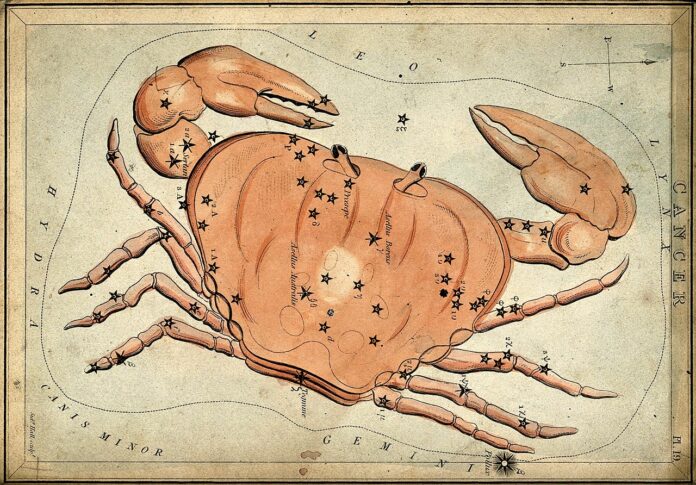
CANCER (June 21-July 22): There are phases when the cosmic energies and I urge you to put others first—even tend to their pain before you tend to your own. But this isn’t one of those times. Right now, sacrificing yourself for the sake of others would obstruct the flow of righteous grace into your life. So then what is the most soul‑honoring path available? Here’s what I think: Summon your inventive brilliance and use it to imagine generous ways to care for yourself. Shower yourself with gifts, treats and blessings that delight you. Take the loving care you so deftly pour into other people and lavish it wholeheartedly on yourself.

LEO (July 23-Aug. 22): Most fields of human endeavor work like this: A few people are truly brilliant, a handful are actively harmful, and the majority fall somewhere between “not great” and “pretty good.” That’s true whether you’re talking about engineers, doctors, poets or astrologers. So it’s inadvisable to assume a physician is wise about your well-being just because they’ve logged 15 years on the job, or to trust your life direction to the first astrologer whose promotion catches your eye. In the coming weeks, dear Leo, discernment like this matters even more than usual. Let your natural hopefulness be balanced by sharp, thoughtful judgment. Don’t just challenge obvious authority. Put every so-called fact, spin, assumption and official line under your own clear-eyed review.

VIRGO (Aug. 23-Sept. 22): Architects designing spaces for collective use try to balance two human needs: to see expansively and also have safe places to retreat. Too much exposure creates anxiety; too much enclosure brings claustrophobia. The ideal is to provide both shelter and spaciousness. Let’s use this theme as a metaphor for your life during the coming months. You’ll be wise to create an equilibrium between engagement and privacy, between vastness and protection. Make it easy for yourself to observe the larger scene and also withdraw when needed.

LIBRA (Sept. 23-Oct. 22): Self-proclaimed “skeptics” love to sneer at astrologers, as if pondering what lies ahead were a violation of scientific purity. And yet economists, sports analysts, trend watchers and political commentators churn out shaky predictions every day. Honestly, those professionals of probability often create more confusion than those of us who read the heavens. Take weather forecasters, for instance: From Europe to Japan, their models routinely miss sudden floods and twisters, and trigger more than a few false alarms. But do the debunkers brand them as charlatans? Of course not. Forgive the outburst, but I’m building to a key foresight: Every forecast, projection or vision that crosses your path over the next month will miss the mark—except for this one. So free yourself of their meddling.

SCORPIO (Oct. 23-Nov. 21): Ethnobotanists describe how certain Indigenous traditions work with “teacher plants.” These are flora that offer not only physical benefits but spiritual instruction. They include psychoactive substances, but also ordinary plants approached with extraordinary attention. In the spirit of reinventing your education, Scorpio, I invite you to expand your understanding of who and what your teachers are. What ordinary elements of your daily life might offer wisdom if you engage them with deep respect? What situations at the edges of your awareness could bring lessons that enrich your perspectives? Now is an excellent time to seek new apprenticeships.

SAGITTARIUS (Nov. 22-Dec. 21): Western science and Western religions may disagree about how the universe began, but both place its birth in the distant past. Tantra and other spiritual paths, by contrast, propose that the universe is born afresh in every instant through the sacred, erotic interplay of God and Goddess. When humans approach love-making as an experimental sacrament, these traditions suggest, we can tune in to the union of those primordial forces and, in a sense, take part in the continual creation of existence. So, are you ready for a bit of world-making erotic play? The current astrological indicators say yes, you are.​

CAPRICORN (Dec. 22-Jan. 19): A common obstacle to healthy intimacy is the belief that a beloved ally should automatically know what you need, without you saying a word. I used to suffer from this delusion myself and worked hard to dissolve it. I no longer unconsciously assume that my companions are so attuned to me that they can always intuit my desires. But I know this bad idea feels romantic to many people, even though it can sabotage even the most promising bond. In the weeks ahead, Capricorn, I invite you to starve this fantasy. Your intimate world is ripe for a fresh infusion of lucid, straightforward honesty.

AQUARIUS (Jan. 20-Feb. 18): Your next few weeks will be sponsored by CoffeeBeer, the paradoxical elixir that both pumps up your energy and decompresses your defenses. You will be an exemplary role model for this innovative product because you will epitomize what occurs when a sensitive soul gets excited and mellows out at the same time. I also expect you will soon be exploring intriguing opportunities that become available to you because of your supercharged calm. Fortunately, you don’t need to drink actual coffee and beer together to make this happen. The cosmic forces will be conspiring to help you.

PISCES (Feb. 19-March 20): Finish this sentence, Pisces: “The one thing that really keeps me from being myself is _______.” Is it someone’s opinion, an old story about who you are, a fear of loss, a habit of over-pleasing, a secret shame, or a belief that you’re “too much” or “not enough”? Whatever first pops into your mind is probably closest to the truth. Here’s your next step: Loosen the grip of this stressor by even just 20%. I bet your real self will feel relaxed enough to bloom more fully.

Homework: We’re halfway through 2026. How are your big projects progressing? tinyurl.com/zzz333xxx333

Oakland archivists protect Black queer history from disappearing

0

The pilgrimage purifies. It counts sacrifice in footsteps and heat stroke—a journey only for the traveler interested in overstanding how the humble get made. If one takes AC Transit and attempts the walk from the bus stop, the vertical gives even the most hardened Northern Californian pause. On a hot day, the smart stop for provisions at the corner store at the foot of the climb. The sure hydrated fully the morning prior. The steady wear their good shoes. The wise drive, catch a ride or call a Lyft.

But the bipedal pilgrim, halfway up the first block, begins to bargain with themself. If I make it to the top of this street, I’ll rest. They know they are lying. They know their calves will lock the second they stop moving. They make the bargain anyway.

This is the Eastmont Hills—far-off ridges, sharp curves, impossible verticals. On a good day Sutro Tower is visible clear across the bay. The housing stock is split-levels and 1950s ranch houses settled into narrow, snaking streets.

Every major religion has its holy sites. So does every culture in exile. For queers, the holy sites are third spaces—those temples of acceptance: bars, cafes, bookstores, archives. On June 13, 2026, a house in the Eastmont Hills was activated as one. Inside, in acid-free sleeves and Hollinger boxes, the relics waited: a black-and-white photograph of a 1976 march down Market Street, a button from a softball league, a flyer for a poetry reading at a cafe that’s now a parking lot. This was Black Queer Folks Community Archiving Day, and the reliquary it gathered around was the Bay Area Lesbian Archives (BALA).

The renaissance that began with a refusal

It started with one woman who refused to stop collecting. Lenn Keller came west from Evanston on Chicago’s North Shore the year before, one of four Black students in a graduating class of 1,200. She landed inside a lesbian renaissance already gathering force—bars with easy names: Ollie’s on Telegraph, where she bartended and the poet Pat Parker drank. The Bacchanal. The Driftwood. Brick Hut. Camilla’s and the legendary Jubilee. La Peña on Shattuck, where Aché threw parties that filled the place to the sidewalks.

Her 1993 short film, Ifé, the first by a Black woman to premiere at Frameline, opens on a line that doubles as the house’s whole thesis—“My name is Ifé, I came here from Paris one year ago and heard San Francisco is a very gay city.” It lands on another: “Here everyone belongs to a tribe, and they want to be recognized and noticed.” 

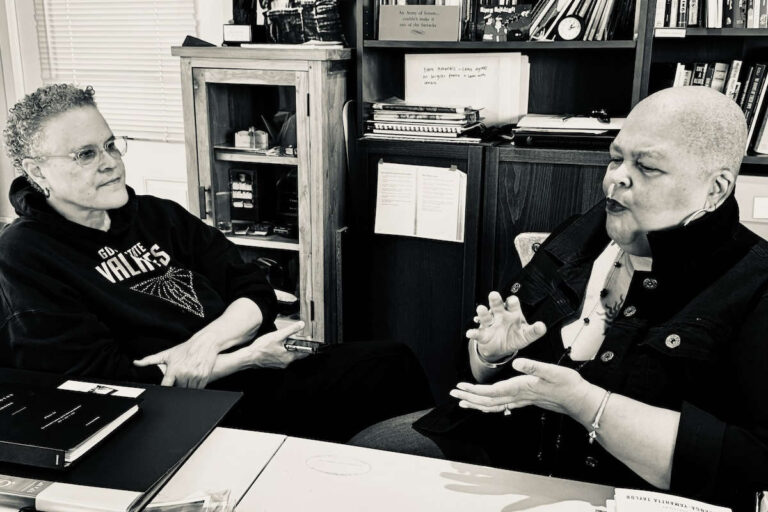
As Dr. Kerby Lynch, the archive’s current director, put it: “She started this archive because she had kept all of the ephemera from that time period, every poster, every photograph from that time period.” The boxes moved with her through apartments and stretches with no fixed address, and still she would not let go. It was Keller who started this, dragging 30 boxes of her people’s memory through the East Bay because no one else would tell that story the way she could. And what she guaranteed, in the end, was its survival.

That survival is a house with an open door. “All sorts, all sorts of lesbians—cis, trans, gender expansive,” said Aubrey Pandori, they/them, a community archivist at Eastside Arts Alliance who’s volunteered at BALA every Monday since 2023. “If you’re a lesbian, you’re a dyke. You could be here. And if you’re an ally, too.”

In 2024, that openness took the shape of “Sister Hold On: Reclaiming Third World Lesbian Imaginaries,” a yearlong collaboration between Eastside and BALA.

“That was a very beautiful experience,” Pandori said. “It was like a whole year of planning. We had filled out the gallery and the theater, every single space—the walls were covered in lesbian art and lesbian herstory. And we commissioned [Malaya Tuyay and Shreya Shankar] to do some original art.”

The work, Pandori said, built something else too: “I’ve been volunteering at BALA since then, since 2023, and I’m here every Monday. And I built such a close relationship with the people here.”

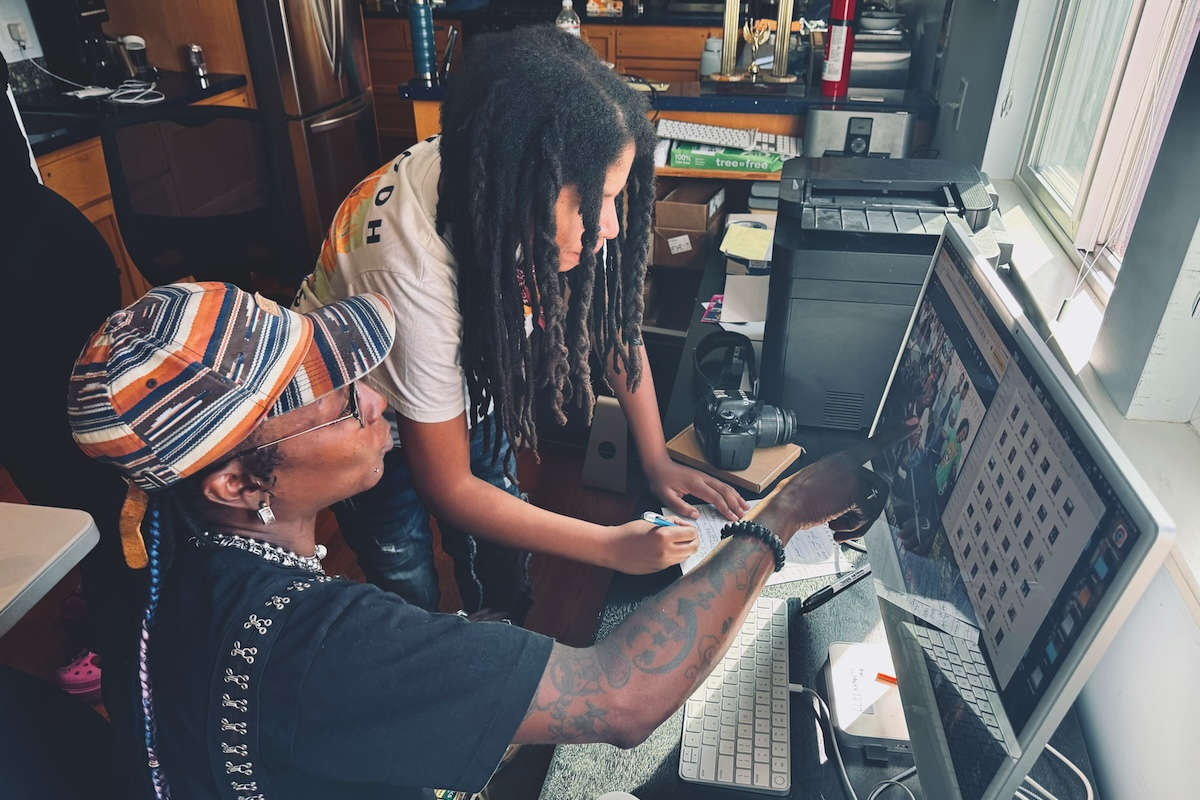
ARCHIVAL PRESERVATION From right, Dr. Kerby Lynch, the archive’s current director, assists photographer/dancer Toshia Christal to digitize documents and encase the originals in acid-free plastic. (Photo by A.V. Benford)

The memory keepers who came before

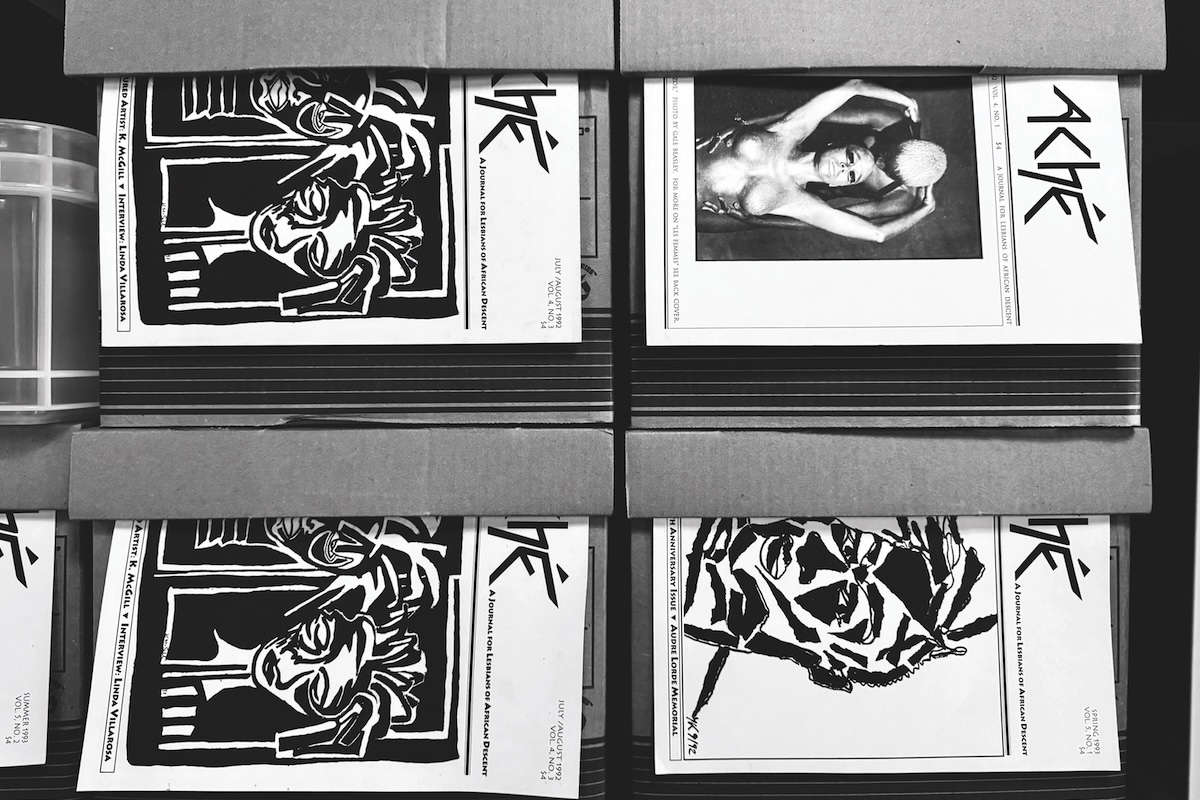
Keller was not alone in this work. Lisbet Tellefsen, an Oakland-based archivist and curator, has spent three decades gathering one of the country’s most significant private collections of late-20th-century African Americana, which includes the Black Panther Party, Angela Davis, Black LGBT culture and political graphics. She co-founded Aché: A Black Lesbian Journal in 1989; her papers now live at Yale, with pieces of her collection hung at the Smithsonian, SFMOMA and the Oakland Museum. 

Tellefsen and Keller are two versions of the same devotion—one moved into the nation’s great institutions while the other stayed in a grassroots house in the Eastmont Hills, which answers to no one but its own people. Both insisted this history was not optional to keep.

The relics previously gathered feed into “Directory of Dreams: Bay Area Lesbian Economies and Radical Care, 1970–1995,” BALA’s own exhibition on the grassroots networks of mutual aid and self-determination Bay Area lesbians built for one another when no one else would.

What the renaissance left behind, and what’s replacing it

The Bay Area that gave rise to Keller’s lesbian renaissance has largely disappeared. But the East Bay kept creating new third spaces even as the old ones closed. Club Q, a house photographer’s vision, captured every patron against a white backdrop, a yearbook of the eternally ethereal. The Golden Ratio, a Black-lesbian-owned bar at 15th and Franklin, gathers today’s archivists and queer community leaders. B. Tourmaline, a sex-positive crew founded in Oakland on June 13, 2023, builds Black/queer/trans/kink education spaces where the youngest attendees are 21 and the oldest past 60—Keller’s intergenerational thread, still holding.

That thread is the entire point of June 13. The day paired BALA with Eastside Arts Alliance’s Community Archival Resource Project (CARP) and Artist as First Responder, the organization founded by cultural strategist Ashara Ekundayo, on the second installment of a series built around Black queer families in Oakland and the wider Bay Area.

People came up that punishing hill carrying shoeboxes and photo albums, hard drives full of photos and Pride parades, and snapshots from the Nia Collective—a nonprofit built to provide kinship, friendship and networking for lesbians of African descent. Dawn Rudd, a photographer and longtime fixture of the Bay’s Black feminist scene, brought images from Nia’s earliest days, recalling the time with the specific ache of having lived inside a golden age without fully knowing it was one.

“Everyone was so intelligent and so driven and so alive,” Rudd said, flipping through pictures of herself and her friends in their 20s and 30s. “It was a rich time. I’m so glad I was a part of it.”

BACK ISSUES Tellefsen co-founded ‘Aché: A Black Lesbian Journal’ in 1989. (Photo by A.V. Benford)

Toshia Christal—photographer, fashion designer, dancer—arrived with decades of her work compressed onto SD cards and old USB drives. She spent a year meticulously consolidating it all into one comprehensive collection: photographs and flyers from the Bench Bar, the East Bay party scene’s legendary venue, whose first location sat right across from the Oakland Museum on a one-way street.

She fondly recalled DJ Black, a renowned Bay Area artist, and the Old Venture Bar, where she had some of her first shows—those were fun, exciting party days. She also brought photographs of the Sexual Minority Alliance of Alameda County (SMAAC) Youth Center and flyers from DJ Black herself, known across California as the “Mother of DJs,” a 30-year fixture of the state’s music and LGBTQ+ nightlife scenes.

The archivists don’t merely accept what’s offered. They digitize, encase the originals in acid-free plastic and return them to donors who wish to keep them—preservation as a gift returned, not a resource extracted. The archive now houses over 150 collections, partly funded by a recent Mellon Foundation grant meant to complete the inventorying process—figuring out exactly what they have, and making it digital and accessible to researchers and community members. The work falls mainly to community volunteers—but also to interns, summer by summer, mostly from Mount Holyoke, who are paid a stipend to live in a region that’s grown unaffordable for the very people whose history fills these boxes.

For Lynch, the work is explicitly generational. “For our young Black lesbians, when viewing the collection I like for them to go from Black Lesbian Newsletter to Onyx, because all of these women were all in community,” she said. The Onyx: Black Lesbian Newsletter, originally titled the Black Lesbian Newsletter, was a pioneering bimonthly founded in 1982 by Laverne Gagehabib, A.C. Barber and Vivienne Walker-Crawford. Based out of Berkeley and the wider Bay, it provided a vital forum for African American lesbian women excluded from both mainstream media and predominantly white feminist space. 

“It’s just multiple generations of different women,” Lynch continued. “So you’ll get to see how through time, a ’70s Black lesbian is going to be different than the ’80s Black lesbian going to be different than the ’90s. Black lesbian thought has definitely evolved.”

The goal isn’t simply preservation. It’s population—the deliberate, stubborn work of making this history visible enough and loud enough that it cannot be quietly disappeared the way it nearly was. Every photograph scanned this month becomes part of three different archives at once: BALA’s permanent collection, Eastside’s CARP hub and a new AfroPortals Digital Archive built so a teenager in 2046 can type “Black lesbian Oakland 1985” into a search bar and find an actual answer, instead of the silence Keller grew up inside.

That’s the whole pilgrimage, really. One climbs the hill not to escape the city but to find the part of it the city forgot to keep. One hands over the box they’ve been protecting for 40 years. One lets someone with acid-free sleeves and steady hands turn their shoebox into scripture. And somewhere in that house, in a place full of memories held by a woman who refused to let her people’s herstories disappear, the torch keeps moving—from hand to hand, from box to box, holy in the most literal sense: kept whole.

The Bay Area Lesbian Archives is located in Oakland’s Eastmont Hills. It is not open to the public. Visits are by appointment. Learn more at bayarealesbianarchives.org.

Mylo Cardona uses theater to build queer community and resistance

To Oakland’s Mylo Cardona, theater is a space of community and belonging. For them, artistic expression is an extension of both the personal and the political—creation as an act of resistance against hierarchical structures of the status quo.

They became interested in theater in high school, seeking refuge and reprieve from a world that felt harsh and unwelcoming. Being a young queer person meant feeling excluded from spaces around them. Theater offered them an opportunity to step into other people’s experiences and connect with other LGBTQ+ youth.

Like any art form, theater can come with creative slumps. To get themselves out of it, Cardona says, perspective is everything. Sometimes that means taking a step back from their project, or prioritizing rest. “If that doesn’t work,” Cardona says, “I will talk to elders who have been in creative slumps before me, artists that I trust, other theater community members [and ask], ‘What do you think?’” They say that theater is all about figuring things out in community, and leaning on each other for resources and ideas. 

Cardona is realizing their passions for theater and community organizing by directing The Fre, written by Taylor Mac and hosted by the Oakland Theater Project. The play takes place in a ball pit, with the main character speaking in iambic pentameter while a mob of dirty “fre” prepare to eat him.

Cardona says, “While preparing for this play and thinking about the revolution, I [thought], we can’t abandon the ‘fre’ in this new world, no matter what we think of them.”

Humor and subversion, they explain, are key elements that can be useful in understanding people different from us. Instead of resisting the “enemy,” Cardona believes in finding common ground. Clowns, in this case, serve as the perfect metaphor.

“The clown’s ability to reflect ourselves back and satirize the failures of our society places this low-status character at an incredibly influential and powerful position,” they say. “Unlike traditional activism, the clown’s approach uses humor and vulnerability to disarm defenses and reveal deeper truths without getting oneself killed.”

Cardona also believes that uplifting queer art begins with dismantling hierarchical structures. While theater can be a very top-down system of creation, with the director placed at the top, they believe in allowing queer people to collaborate and contribute wherever possible, creating a free flow of ideas and support. “It’s a better way for me,” says Cardona, “and so finding ways that each queer artist can feel like whatever it is that they’re working on is theirs, too, giving them the freedom to insert themselves in whatever way that looks like, is what’s important.”

To Cardona, pride is the opposite of shame, which is what performance is all about. It’s a verb and a profound act of resistance.

“Pride is not just visibility and a celebration of queerness,” Cardona says, “but also a reminder of the fact that all of our rights and the ways that we’re able to be free now is because of the ways our ancestors and our transcestors fought for that. And it’s our responsibility to continue that fight, because the fight is simply not over—in fact, there are so many.”

Cardona makes it clear where they stand on the state of the world, and believes queer art is an important facet for resisting oppression.

“Spread of misinformation, continuous gutting of education funding, relentless attacking of teachers and professors, systemic creation of underserved communities that are quite frankly too busy working three jobs to survive to think about intellectualism—to ponder is a privilege in a world governed and overrun by corruption, division and the denial of our humanity,” Cardona says. “What better way to return us to ourselves and remind us what we are fighting for than the art of play? Thank you, Fre, for teaching me that.”

‘The Fre’ by Taylor Mac, directed by Mylo Cardona, now through June 28 at Oakland Theater Project. Tickets at 510.646.1126 or bo*******@*******************ct.org; oaklandtheaterproject.org.

Top 7 Best Sites to Buy Instagram Followers & Likes (Most Popular)

Best Sites to Buy Instagram Followers & Likes
This article was contributed by Social Boosting If you're searching for the best sites to buy Instagram followers, the hardest part isn't finding providers. It's finding ones that won't get your account flagged, drop followers within a week or deliver bots that tank your engagement rate. I've been working in social media growth strategy for years, and I've personally tested...

Resistance.ai: Putting a nonviolence advisor in every person’s pocket

Resistance.ai: Putting a nonviolence advisor in every person’s pocket
It is, perhaps, the third most important book in human history. And yet it remains perfectly obscure. The drab cover doesn’t help. Clothed in a fatigues-esque olive green, the book resembles an army officer’s field manual. Make no mistake; that’s the point—it’s a field manual to wage a nonviolent campaign of peace. It is Gene Sharp’s Politics of Nonviolent...

Jack London Square adds hopscotch murals that turn sidewalks into public art

Jack London Square adds hopscotch murals that turn sidewalks into public art
A woman talks on the phone as she walks along Jack London Square’s Third Street. Suddenly she looks down, then up again, then down. She starts hopping. One foot, then two, then one and two, until she returns to her call. The hopscotch she used is part of the Jack London Hopscotch Tour, an installation of 11 hopscotch murals dispersed...

It’s still about all that jazz

It’s still about all that jazz
In its 42-year history, the organization now known as Living Jazz has had only three executive directors: co-founder Stacey Hoffman, who served from 1984 until 2023; Lyz Luke, who left in 2025 to become the cultural affairs manager for the City of Oakland; and now Mary Lins, appointed in May. Lins, who spent seven and a half years as the...

Social Eyes: Week of July 2-8

Social Eyes: Week of July 2-8
This week's calendar picks feature Jacob Jolliff Band, Kelsy Karter and the Heroines, Benny Amón & The New Orleans Pearls, Generación Suicida, Morillo, Orqo Taki, Rosalía, 'Scabmuggers,' Marcus King Band, and Allison O’Conor.

New citizenship test challenges immigrants preparing for naturalization

New citizenship test challenges immigrants preparing for naturalization
On Sept. 17, 2025, U.S. Citizenship and Immigration Services (USCIS) posted a Federal Register notice announcing the implementation of the 2025 naturalization civics test. The new test, made effective Oct. 10, now contains double the number of questions and draws from a 128-question bank rather than the previous 100. The update represents the most substantial overhaul to the U.S. naturalization...

Umami Mart bottles a taste of Japan

Umami Mart bottles a taste of Japan
Umami Mart started as a blog and then materialized IRL as a pop-up in Oakland before expanding into its current incarnation as a specialty market and sake bar. Friends since childhood, Kayoko Akabori and Yoko Kumano were living in different cities when they decided to start that foundational blog together in 2007. It was a way for them to...

Free Will Astrology: Week of July 1

Free Will Astrology: Week of July 8
We’re halfway through 2026. How are your big projects progressing?

Oakland archivists protect Black queer history from disappearing

Oakland archivists protect Black queer history from disappearing
The pilgrimage purifies. It counts sacrifice in footsteps and heat stroke—a journey only for the traveler interested in overstanding how the humble get made. If one takes AC Transit and attempts the walk from the bus stop, the vertical gives even the most hardened Northern Californian pause. On a hot day, the smart stop for provisions at the corner...

Mylo Cardona uses theater to build queer community and resistance

Mylo Cardona uses theater to build queer community and resistance
To Oakland’s Mylo Cardona, theater is a space of community and belonging. For them, artistic expression is an extension of both the personal and the political—creation as an act of resistance against hierarchical structures of the status quo. They became interested in theater in high school, seeking refuge and reprieve from a world that felt harsh and unwelcoming. Being a...
19,045FansLike
17,709FollowersFollow
61,790FollowersFollow