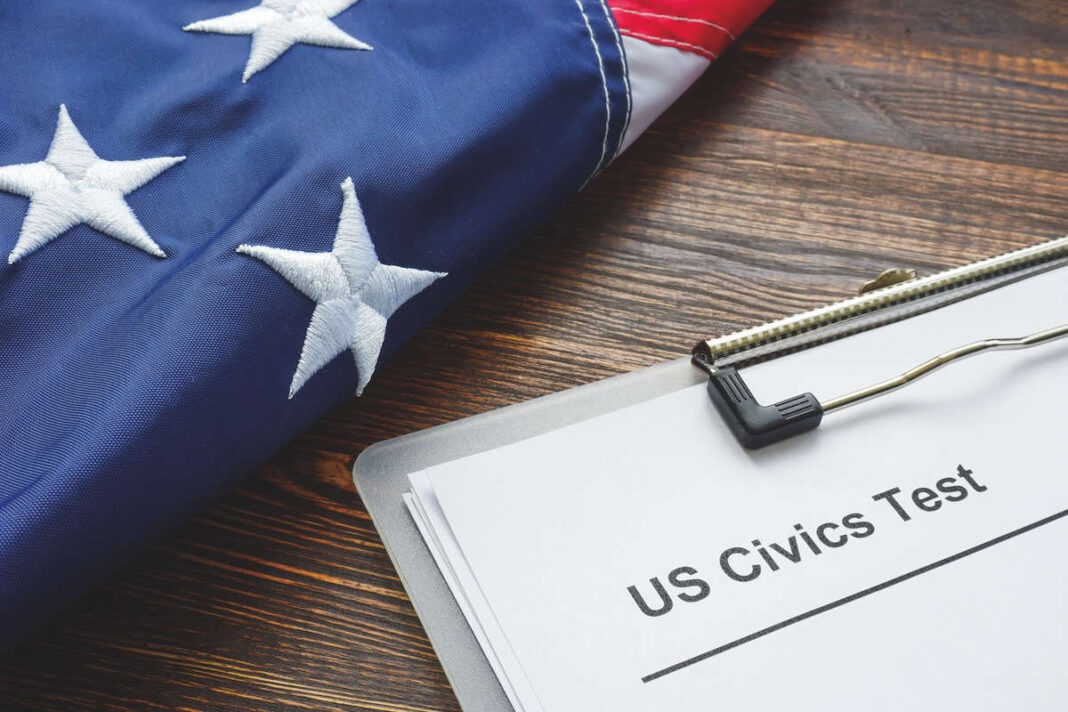
On Sept. 17, 2025, U.S. Citizenship and Immigration Services (USCIS) posted a Federal Register notice announcing the implementation of the 2025 naturalization civics test. The new test, made effective Oct. 10, now contains double the number of questions and draws from a 128-question bank rather than the previous 100.
The update represents the most substantial overhaul to the U.S. naturalization test in years, and now requires individuals seeking naturalization to earn 12 correct answers instead of the previous six.
Green card holders who filed for citizenship after Oct. 20 will be required to prove their knowledge of U.S. civics, history and government with a wider question pool featuring more open-ended questions. For example, the previous test asked prospective citizens, “The idea of self-government is in the first three words of the Constitution. What are these three words?” The new test asks, “The U.S. Constitution starts with the words, ‘We the People.’ What does ‘We the People’ mean?”
As the updated exam rolls out, local organizations have implemented new preparation models for prospective citizens—including English-language practice, mock interviews and guidance sessions. In Richmond, the West Contra Costa (WCC) Adult Education program offers free in-person and online learning models that advertise interview coaching, test preparation, citizenship application guidance and document counseling.
In the wake of these changes, Richmond educators, lawyers and hopeful citizens have had to adapt their methods of preparation.
Kenneth Ryan, one of the WCC Adult Education instructors, said that class registration has doubled in the past year, and he expects the numbers to keep climbing. “Trump’s a great recruiter for citizenship class,” he said, “because people are like, ‘What can I do to protect myself and my family?’”
A student of WCC Adult Education and a hopeful citizen, who requested anonymity to protect herself and her family, said she had to stop working and start taking classes four times a week to prepare for the citizenship exam. She takes two morning classes and two night classes per week. The pressure, she said, is the hardest part of preparation. Her husband is a citizen, so she feels stress both at home and as part of a constantly evolving political landscape.
“As an immigrant you feel like if you don’t do it you’re gonna have consequences, or suddenly they’re gonna change something, then you’re out,” she said. “Or that’s the fear, right?”
Nearly 15 students, many of whom have limited English-speaking abilities, attend the Thursday morning class at Serra Adult Center in Richmond. Much of the class is spent defining difficult English words like “amendments,” “electoral” or “allegiance.” Students practiced enunciating the words phonetically, then used fragments of English and Spanish phrases to remember their definitions.
Despite the language barrier, many students are quick to respond to being quizzed. “How long does a U.S. presidency term last?” asked morning instructor Ryan, to which students snapped, “Four years!”
“Solo dos años más,” one student whispered. Only two more years.
Another student, who also requested anonymity, said she is also taking time off work to focus on classes full-time. “I have a kid here and I have my husband here, and I want to stay here,” she said. “I have to do the best I can to stay legally or more secure.”
Ryan described to students how many of the question changes are intentionally confusing or ideological. For example, while many straightforward questions like, “How old do citizens have to be to vote for President?” were removed, new questions have been added, such as, “Why did the United States enter the Persian Gulf War?” The answer is “to force the Iraqi military from Kuwait.”
Aside from the increase in the number and rigor of questions, prospective citizens will also need to prove to an immigration officer that they are of “good moral character.” Previous to October 2025, the absence of a criminal record was sufficient for this requirement. The new test requires evidence of “positive contributions to American society.” Discretion will be given to the immigration officer administering the exam.
USCIS spokesperson Matthew Tragesser said, “American citizenship is the most sacred citizenship in the world and should only be reserved for aliens who will fully embrace our values and principles as a nation.” According to the Department of Homeland Security (DHS) website, “The agency is also resuming neighborhood investigations to ensure that aliens meet statutory requirements and are worthy of U.S. citizenship.”
While the DHS has not released pass/fail data since 2023, Ryan is confident he can still prepare students to be successful. “90% of my students pass,” he said.