
The pilgrimage purifies. It counts sacrifice in footsteps and heat stroke—a journey only for the traveler interested in overstanding how the humble get made. If one takes AC Transit and attempts the walk from the bus stop, the vertical gives even the most hardened Northern Californian pause. On a hot day, the smart stop for provisions at the corner store at the foot of the climb. The sure hydrated fully the morning prior. The steady wear their good shoes. The wise drive, catch a ride or call a Lyft.
But the bipedal pilgrim, halfway up the first block, begins to bargain with themself. If I make it to the top of this street, I’ll rest. They know they are lying. They know their calves will lock the second they stop moving. They make the bargain anyway.
This is the Eastmont Hills—far-off ridges, sharp curves, impossible verticals. On a good day Sutro Tower is visible clear across the bay. The housing stock is split-levels and 1950s ranch houses settled into narrow, snaking streets.
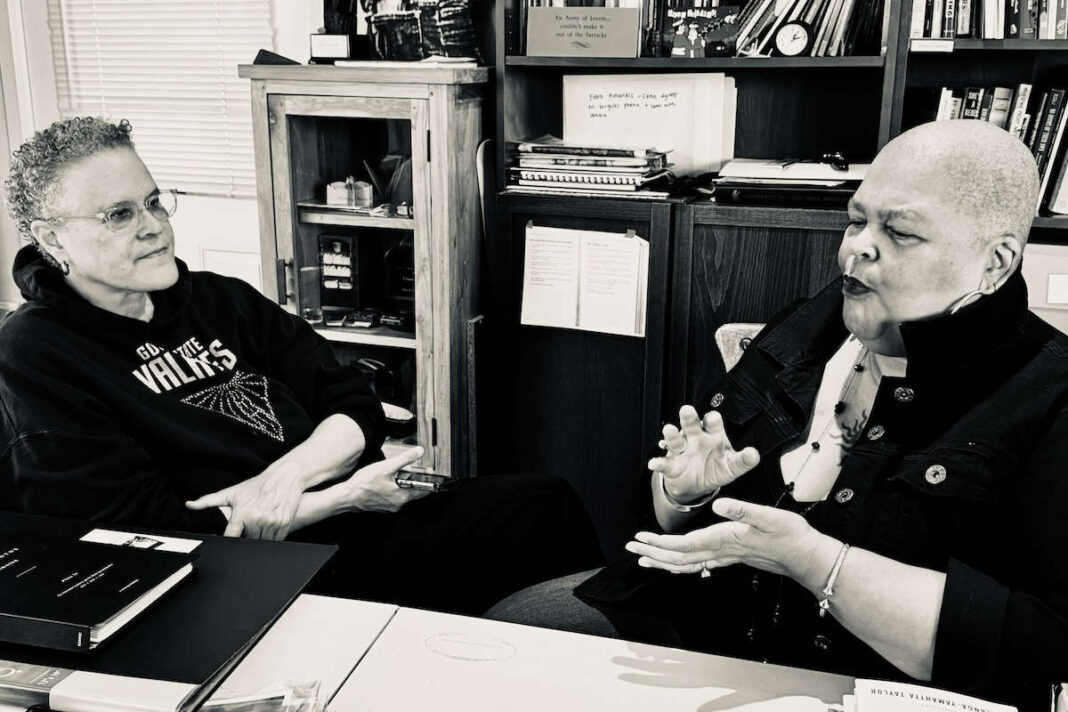
Every major religion has its holy sites. So does every culture in exile. For queers, the holy sites are third spaces—those temples of acceptance: bars, cafes, bookstores, archives. On June 13, 2026, a house in the Eastmont Hills was activated as one. Inside, in acid-free sleeves and Hollinger boxes, the relics waited: a black-and-white photograph of a 1976 march down Market Street, a button from a softball league, a flyer for a poetry reading at a cafe that’s now a parking lot. This was Black Queer Folks Community Archiving Day, and the reliquary it gathered around was the Bay Area Lesbian Archives (BALA).
The renaissance that began with a refusal
It started with one woman who refused to stop collecting. Lenn Keller came west from Evanston on Chicago’s North Shore the year before, one of four Black students in a graduating class of 1,200. She landed inside a lesbian renaissance already gathering force—bars with easy names: Ollie’s on Telegraph, where she bartended and the poet Pat Parker drank. The Bacchanal. The Driftwood. Brick Hut. Camilla’s and the legendary Jubilee. La Peña on Shattuck, where Aché threw parties that filled the place to the sidewalks.
Her 1993 short film, Ifé, the first by a Black woman to premiere at Frameline, opens on a line that doubles as the house’s whole thesis—“My name is Ifé, I came here from Paris one year ago and heard San Francisco is a very gay city.” It lands on another: “Here everyone belongs to a tribe, and they want to be recognized and noticed.”
As Dr. Kerby Lynch, the archive’s current director, put it: “She started this archive because she had kept all of the ephemera from that time period, every poster, every photograph from that time period.” The boxes moved with her through apartments and stretches with no fixed address, and still she would not let go. It was Keller who started this, dragging 30 boxes of her people’s memory through the East Bay because no one else would tell that story the way she could. And what she guaranteed, in the end, was its survival.
That survival is a house with an open door. “All sorts, all sorts of lesbians—cis, trans, gender expansive,” said Aubrey Pandori, they/them, a community archivist at Eastside Arts Alliance who’s volunteered at BALA every Monday since 2023. “If you’re a lesbian, you’re a dyke. You could be here. And if you’re an ally, too.”
In 2024, that openness took the shape of “Sister Hold On: Reclaiming Third World Lesbian Imaginaries,” a yearlong collaboration between Eastside and BALA.
“That was a very beautiful experience,” Pandori said. “It was like a whole year of planning. We had filled out the gallery and the theater, every single space—the walls were covered in lesbian art and lesbian herstory. And we commissioned [Malaya Tuyay and Shreya Shankar] to do some original art.”
The work, Pandori said, built something else too: “I’ve been volunteering at BALA since then, since 2023, and I’m here every Monday. And I built such a close relationship with the people here.”
The memory keepers who came before
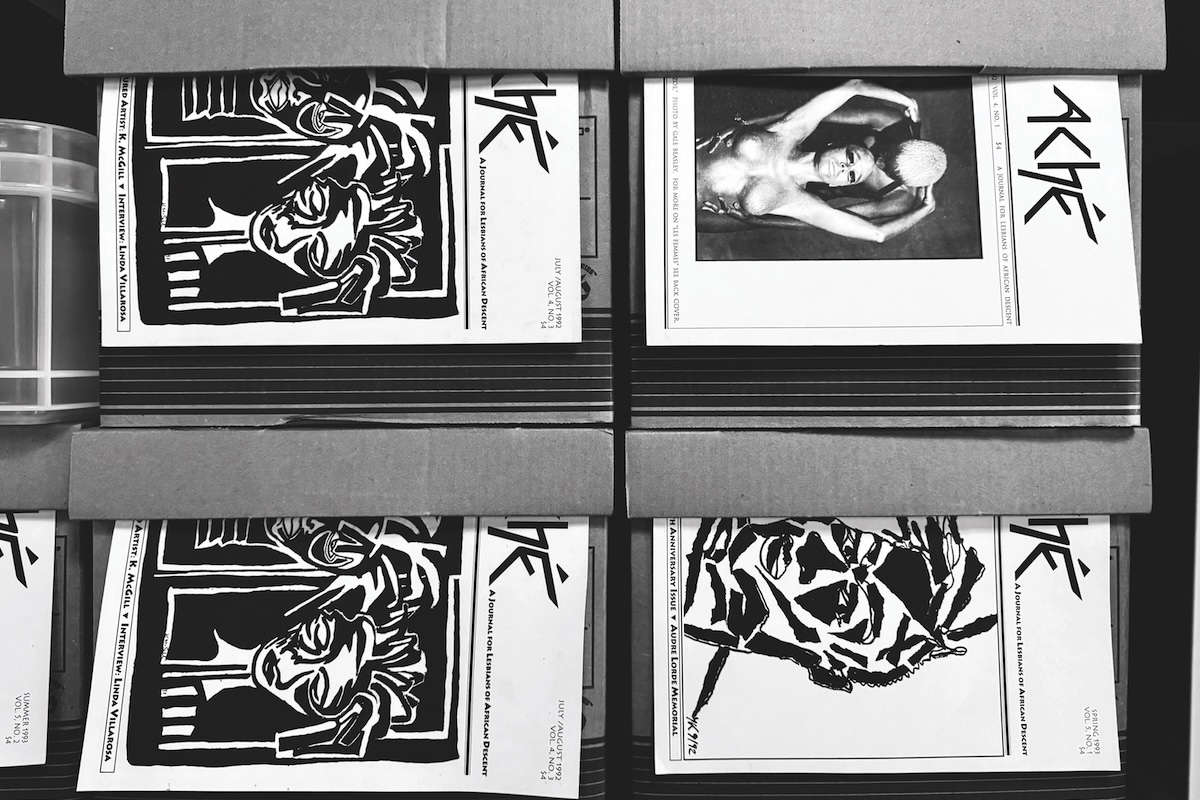
Keller was not alone in this work. Lisbet Tellefsen, an Oakland-based archivist and curator, has spent three decades gathering one of the country’s most significant private collections of late-20th-century African Americana, which includes the Black Panther Party, Angela Davis, Black LGBT culture and political graphics. She co-founded Aché: A Black Lesbian Journal in 1989; her papers now live at Yale, with pieces of her collection hung at the Smithsonian, SFMOMA and the Oakland Museum.
Tellefsen and Keller are two versions of the same devotion—one moved into the nation’s great institutions while the other stayed in a grassroots house in the Eastmont Hills, which answers to no one but its own people. Both insisted this history was not optional to keep.
The relics previously gathered feed into “Directory of Dreams: Bay Area Lesbian Economies and Radical Care, 1970–1995,” BALA’s own exhibition on the grassroots networks of mutual aid and self-determination Bay Area lesbians built for one another when no one else would.
What the renaissance left behind, and what’s replacing it
The Bay Area that gave rise to Keller’s lesbian renaissance has largely disappeared. But the East Bay kept creating new third spaces even as the old ones closed. Club Q, a house photographer’s vision, captured every patron against a white backdrop, a yearbook of the eternally ethereal. The Golden Ratio, a Black-lesbian-owned bar at 15th and Franklin, gathers today’s archivists and queer community leaders. B. Tourmaline, a sex-positive crew founded in Oakland on June 13, 2023, builds Black/queer/trans/kink education spaces where the youngest attendees are 21 and the oldest past 60—Keller’s intergenerational thread, still holding.
That thread is the entire point of June 13. The day paired BALA with Eastside Arts Alliance’s Community Archival Resource Project (CARP) and Artist as First Responder, the organization founded by cultural strategist Ashara Ekundayo, on the second installment of a series built around Black queer families in Oakland and the wider Bay Area.
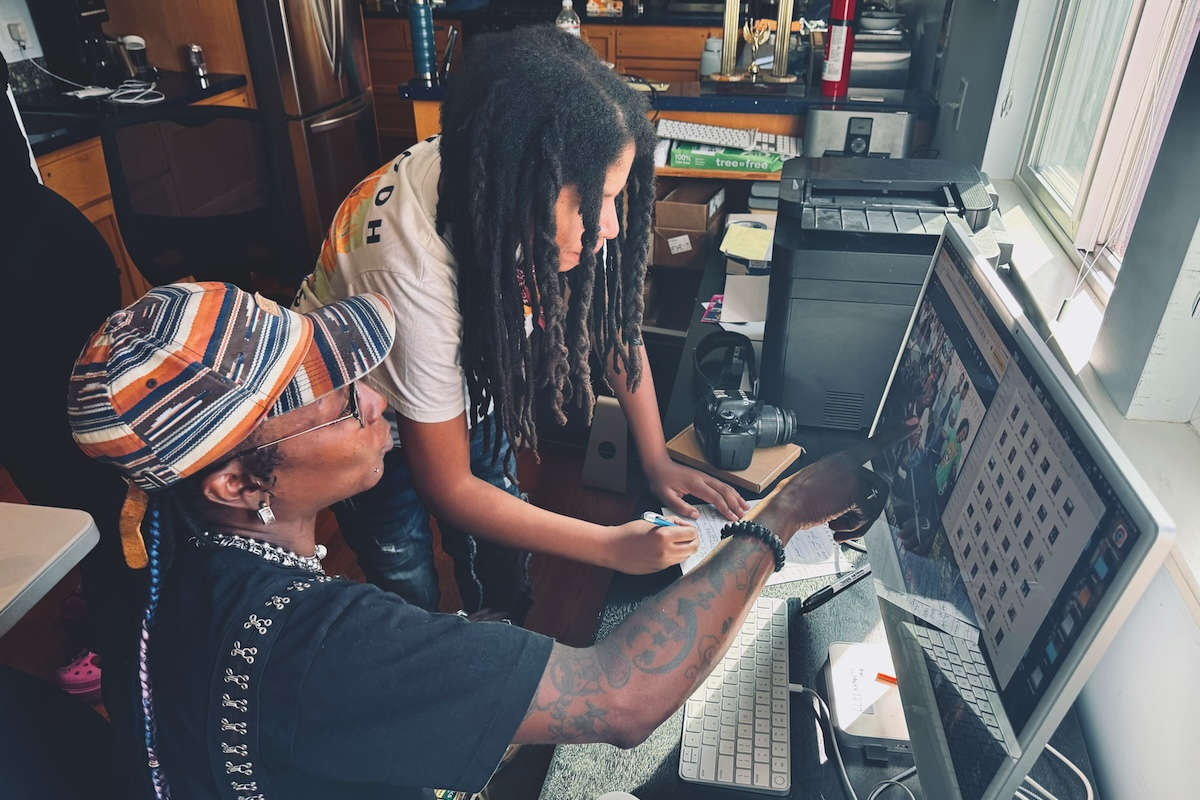
People came up that punishing hill carrying shoeboxes and photo albums, hard drives full of photos and Pride parades, and snapshots from the Nia Collective—a nonprofit built to provide kinship, friendship and networking for lesbians of African descent. Dawn Rudd, a photographer and longtime fixture of the Bay’s Black feminist scene, brought images from Nia’s earliest days, recalling the time with the specific ache of having lived inside a golden age without fully knowing it was one.
“Everyone was so intelligent and so driven and so alive,” Rudd said, flipping through pictures of herself and her friends in their 20s and 30s. “It was a rich time. I’m so glad I was a part of it.”
Toshia Christal—photographer, fashion designer, dancer—arrived with decades of her work compressed onto SD cards and old USB drives. She spent a year meticulously consolidating it all into one comprehensive collection: photographs and flyers from the Bench Bar, the East Bay party scene’s legendary venue, whose first location sat right across from the Oakland Museum on a one-way street.
She fondly recalled DJ Black, a renowned Bay Area artist, and the Old Venture Bar, where she had some of her first shows—those were fun, exciting party days. She also brought photographs of the Sexual Minority Alliance of Alameda County (SMAAC) Youth Center and flyers from DJ Black herself, known across California as the “Mother of DJs,” a 30-year fixture of the state’s music and LGBTQ+ nightlife scenes.
The archivists don’t merely accept what’s offered. They digitize, encase the originals in acid-free plastic and return them to donors who wish to keep them—preservation as a gift returned, not a resource extracted. The archive now houses over 150 collections, partly funded by a recent Mellon Foundation grant meant to complete the inventorying process—figuring out exactly what they have, and making it digital and accessible to researchers and community members. The work falls mainly to community volunteers—but also to interns, summer by summer, mostly from Mount Holyoke, who are paid a stipend to live in a region that’s grown unaffordable for the very people whose history fills these boxes.
For Lynch, the work is explicitly generational. “For our young Black lesbians, when viewing the collection I like for them to go from Black Lesbian Newsletter to Onyx, because all of these women were all in community,” she said. The Onyx: Black Lesbian Newsletter, originally titled the Black Lesbian Newsletter, was a pioneering bimonthly founded in 1982 by Laverne Gagehabib, A.C. Barber and Vivienne Walker-Crawford. Based out of Berkeley and the wider Bay, it provided a vital forum for African American lesbian women excluded from both mainstream media and predominantly white feminist space.
“It’s just multiple generations of different women,” Lynch continued. “So you’ll get to see how through time, a ’70s Black lesbian is going to be different than the ’80s Black lesbian going to be different than the ’90s. Black lesbian thought has definitely evolved.”
The goal isn’t simply preservation. It’s population—the deliberate, stubborn work of making this history visible enough and loud enough that it cannot be quietly disappeared the way it nearly was. Every photograph scanned this month becomes part of three different archives at once: BALA’s permanent collection, Eastside’s CARP hub and a new AfroPortals Digital Archive built so a teenager in 2046 can type “Black lesbian Oakland 1985” into a search bar and find an actual answer, instead of the silence Keller grew up inside.
That’s the whole pilgrimage, really. One climbs the hill not to escape the city but to find the part of it the city forgot to keep. One hands over the box they’ve been protecting for 40 years. One lets someone with acid-free sleeves and steady hands turn their shoebox into scripture. And somewhere in that house, in a place full of memories held by a woman who refused to let her people’s herstories disappear, the torch keeps moving—from hand to hand, from box to box, holy in the most literal sense: kept whole.
The Bay Area Lesbian Archives is located in Oakland’s Eastmont Hills. It is not open to the public. Visits are by appointment. Learn more at bayarealesbianarchives.org.






Thanks, A.V. Benford for writing on rich living cultural history with such sensitivity and literary finesse.