It began with a single riser, draped in black, on a half-lit stage.
Atop it sat a desk chair with plain blue cushions, such as you might
find in a library or school lab. Surrounding the chair were a laptop
computer, an audio processor, and a large black concert accordion. As
audience members filed in, the arrangement awaited Mills College
composer-in-residence Pauline Oliveros, an internationally acclaimed
composer and performer of contemporary music who was set to play the
inaugural note in Mills’ newly renovated concert hall.
To celebrate the grand reopening of the 450-seat venue and showcase
the achievements of its renowned music department, Mills organized
Giving Free Play to the Imagination, a six-concert series
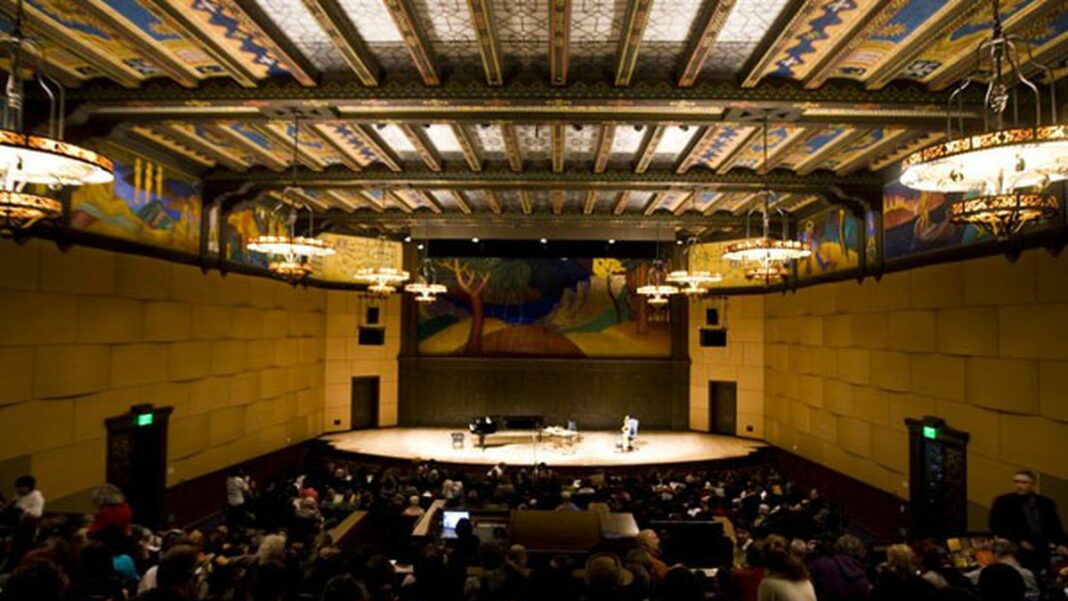
spanning February, March, and April. Built in 1928, the Spanish
Colonial-style concert hall features include a vibrant, multicolored
mural above the stage (a natural landscape on six panels that fold away
to reveal a choir loft), mythological frescoes around the room
depicting various stages of life, and hand-painted geometric ceiling
tiles. Dark wood throughout and chandeliers of wrought-iron and mica,
dispersing a burnt orange glow, complete the visual array.

Credits: Ali Thanawalla
Credits: Pietr Kers
An eighteen-month, $11 million renovation and restoration process
removed eighty years of dirt and grime from the artwork, including
repair where necessary. It also installed new and improved acoustic
panels along the walls, a state-of-the art sound system, a larger
stage, and new seating, all while accounting for both seismic and
accessibility retrofitting.
“Isn’t this an amazing space?” exclaimed college president Janet
Holmgren from the lone lectern that now shared the stage with Oliveros’
still-patient accordion. Well-mannered but enthusiastic applause
answered from a full house of faculty, staff, students, and music
lovers both local and visiting. Tickets for opening night had sold out
a month before, leaving eager parties in recent weeks clamoring for
tickets or even a spot on the waiting list. The occasion also motivated
many to arrive in formal attire: suits, gowns, and designer hats were
more rule than exception.
Of course, the unveiling of the music department’s stunning
structural centerpiece — newly named the Jeannik Méquet
Littlefield Concert Hall after the alumna and Bay Area arts patron, who
contributed $4 million to the cause — was only half the appeal of
the opening night gala. Going back to the 1930s, Mills has a rich
tradition in the realms of experimental, avant-garde, and
improvisational music — often collectively referred to as
contemporary or new music — and counts many leading innovators
among its extended family, including John Cage, Dave Brubeck, Phil
Lesh, the Kronos Quartet, Fred Frith, Laurie Anderson, Joanna Newsom,
Steve Reich, and Deerhoof’s Greg Saunier. As the work of these pioneers
in their various fields has resounded far beyond its source, Mills has
developed an international reputation as an incubator of contemporary
music — a sort of ground zero for musical open-mindedness. The
evening’s program was designed to showcase some of that breadth of
vision.
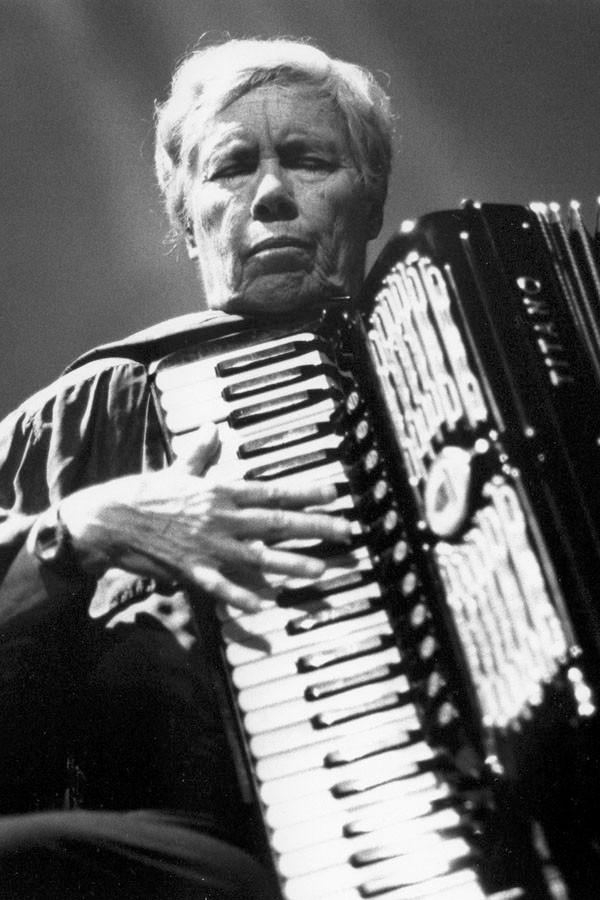
When the lights finally went down and Oliveros commenced her
performance, it became clear that the concert was less a new beginning
than the continuation of a long and storied history. The sharp notes
and sound clusters wrestled from the body of her accordion and
gracefully flung through the room were not isolated or alone, as new
and adventurous as they seemed, but intimately tied to past works like
Desert Ambulance, an experimental piece composed for Oliveros by
Ramon Sender in 1964. She would revive it in her distinct
improvisational and exploratory style on the same stage with the same
accordion the very next afternoon.
Oliveros’ 25-minute performance was paired with illustrations by
pioneering visual composer Tony Martin, projected onto a huge screen
(also new) hanging behind her. Next, the stage was set for a
performance by concert pianist Joseph Kubera. His piece — daring,
challenging, and full of contrast; shaped by extreme time signatures
like eleven-eight and seventeen-eight; and full of split-second shifts
between quiet and loud and crashing and quiet again — sounded
utterly contemporary. But it was again rooted in a rich, inescapable
past. The work, titled 8/8/88, was written by legendary composer
Roscoe Mitchell, who has been at the forefront of international
contemporary music and avant-garde jazz for four decades and would be
featured in the Mills Music Festival’s February 27 concert. Since 2007,
Mitchell has taught composition, performance, and improvisation at the
college.
A brief intermission was followed by the night’s most anticipated
performance: a world premiere, written for the occasion and dedicated
to Margaret Lyon, chair of the Mills Music Department from 1955 to
1979. The man responsible was revolutionary musician and composer Terry
Riley, who has been credited with launching the minimalist movement
through his 1964 work In C. Compared to Kubera’s piece, For
Margaret was more sonorous and sustaining, a melodic and harmonic
piece built upon repeated phrasing and subtle improvisation. The effect
was as organic and natural as it was mechanistic and ordered, like a
well-tuned hive of bees.
The final two performances came from former Kronos Quartet cellist
Joan Jeanrenaud, who realized an ageless drive toward innovation
through contemporary tools. She used pedals and switches to capture,
loop, and layer certain sections, then generated delays and echoes of
sounds she’d produced by bowing and plucking the strings. The solemn
timbre of her cello interacted with the precise, cold effects of the
electronics to create an elegant image of cutting-edge music.
These five pieces illuminated the entirety of Mills’ place in
American experimental music: past, present, and even future. By design,
each step along the way, each phase and iteration, is new and
different, but it is also a conversation with an earlier innovation.
“It’s like putting a ball on an incline plane and giving it a little
push and it just starts to snowball,” said former department head and
current faculty member David Bernstein, who helped to organize the
festival. As much as it may outwardly spurn tradition, experimental
music exists in a continuum where limits are continually pushed forward
and outcomes are as contextual as they are unpredictable. “The stuff
that was thought of as being really experimental isn’t being considered
as outrageous as it was forty years ago,” said Bernstein.
Future concerts in the series, such as the next day’s more
left-field program celebrating Mills’ electronics-based Center for
Contemporary Music, would provide the very contrast experimental music
requires to define itself. This, in a sense, is Mills’ mission: to
constantly reassess what “new music” means. Those who choose to accept
it must challenge preconceived notions of music, noise, and the vast
ground between them. This charge to explore the outer limits of
personal expression binds current faculty and students with icons of
the past. “That’s how Mills is,” said Bernstein. “The goal is to let
the imagination fly.” Imagination soared at the festival’s opening
night, and it should continue to long into the invisible, fertile
future.