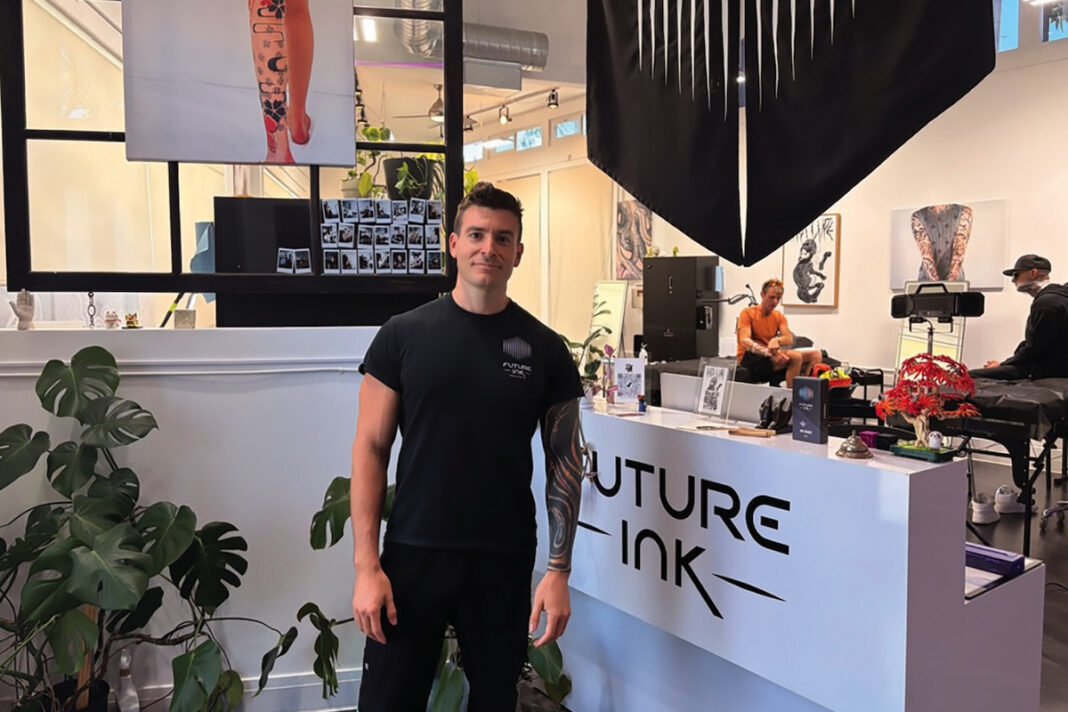
At Future Ink on Broadway in Oakland, a man with both arms completely blacked out stands at a mirror photographing his latest tattoo.
He goes by Nero and came to this tattoo shop because Kevin Ligabue, founder of Future Ink, seemed like the only local artist up to the task. Blackouts require considerable skill, and people often fly to other states to reach artists who specialize in the technique.
Believed to have originated in the 1980s as a way to cover up unwanted tattoos, blackout tattoos have become their own sought-after style. They take a lot of time and are often done in multiple sessions so that one layer can heal before the next is applied, until the desired opacity is reached.
Nero blacked out both of his arms to cover old tattoos that no longer reflected his motivation for having tattoos in the first place.
“I kind of realized that I’d rather look different,” he said. “I’d rather have more of a tattoo style that not everybody on the streets walks around with. It’s also a much more simple, more bold and aesthetic look.”
Ligabue says that this is common for his customers, but that blackouts don’t always have to be for coverups. Like Nero, many enjoy their minimalism, which offers a way to be tattooed in a large area without requiring a complex design. Others get blackouts to then put color or white ink on top of them, creating an almost inverse tattoo.
Originally from Italy, Ligabue came to the Bay Area five years ago and started Future Ink around two years back. Blackout tattoos are his specialty, something he learned from Dekalcomanu, a blackout tattoo artist in France who Ligabue calls a real leader in the industry.
“The blackout is a counterintuitive technique, because it looks easy,” Ligabue said. “It’s all black, no design. Everybody can do it, right? But truthfully, it’s not.”
For a blackout tattoo to come out looking even and smooth, artists have to be very careful to not overwork the skin as these types of tattoos can be especially traumatic for it. The technique Dekalcomanu taught Ligabue requires old-school mechanical coil machines. Though he doesn’t use this technique as strictly anymore, at the time it required specific tools that were hard to find in the U.S. Not only are there few tattoo artists in the U.S. who Ligabue considers qualified—less than 10 to be exact—there are also few distributors of traditional needles on bars in the sizes recommended for blackout tattoos.
In response, Future Ink manufactured its own, along with grips to hold them and special, reusable drape sheets that can withstand the long-hour sessions required for blackouts. Future Ink is also an official U.S. distributor of Panthera, an Italian ink brand that’s created a niche in the ink industry by focusing on its black ink, making sure that it stays opaque and doesn’t have any blue or green undertones. That’s usually not so much of an issue, but when the black ink must cover an entire leg, one might notice if the ink leans green.
Ligabue says that blackout tattoos have become massively popular in the last couple of years, with an influx of customers who drive long distances and even fly to see him. In addition to blackout tattoos, Ligabue also specializes in Japanese-inspired geometric designs that are influenced by his favorite tattoo artist in the world.
Nissaco, the Japanese artist who did both of Ligabue’s legs, creates intricate pieces that read almost like an optical illusion, with elements of Japanese aesthetic design and motifs at their core. Ligabue says Nissaco was the first to develop that type of design, something he now implements into his work at Future Ink.
“Obviously not a copy,” he said, “but inspired.”
Ligabue isn’t the only artist at Future Ink drawing from Japanese aesthetics. Essie Bloom, another artist at the shop, specializes in naturalist themes, specifically large, colorful floral designs that also take influence from Japanese art. Her great-grandmother, an English teacher in Japan, constantly brought back small wooden dolls and items of clothing that first introduced her to different styles of floral drawing. She now visits Japan regularly, sometimes for a month at a time, for inspiration.
“One time I went and watched how they made a kimono, and it’s all hand-done,” Bloom said. “The artistry that they have in Japan is very focused on craftsmanship and not just producing quantity.”
She, like most artists at Future Ink, gravitates towards larger tattoos partly because of her background in graphic design.
“The body is kind of like packaging design,” Bloom said, “and if you only put something small in a tiny corner, it’s not addressing the rest of the package.”
Techno house music plays from a speaker in the corner. It fills a sleek, white room with multiple tattoo tables lining its walls, each outfitted with Future Ink’s custom drape sheets. Bloom appreciates the cyberpunk feel of the place, which creates the perfect environment for the unique geometric and blackout designs Future Ink specializes in.
Future Ink, 5251 Broadway, Oakland. 510.200.8065. futureink.co