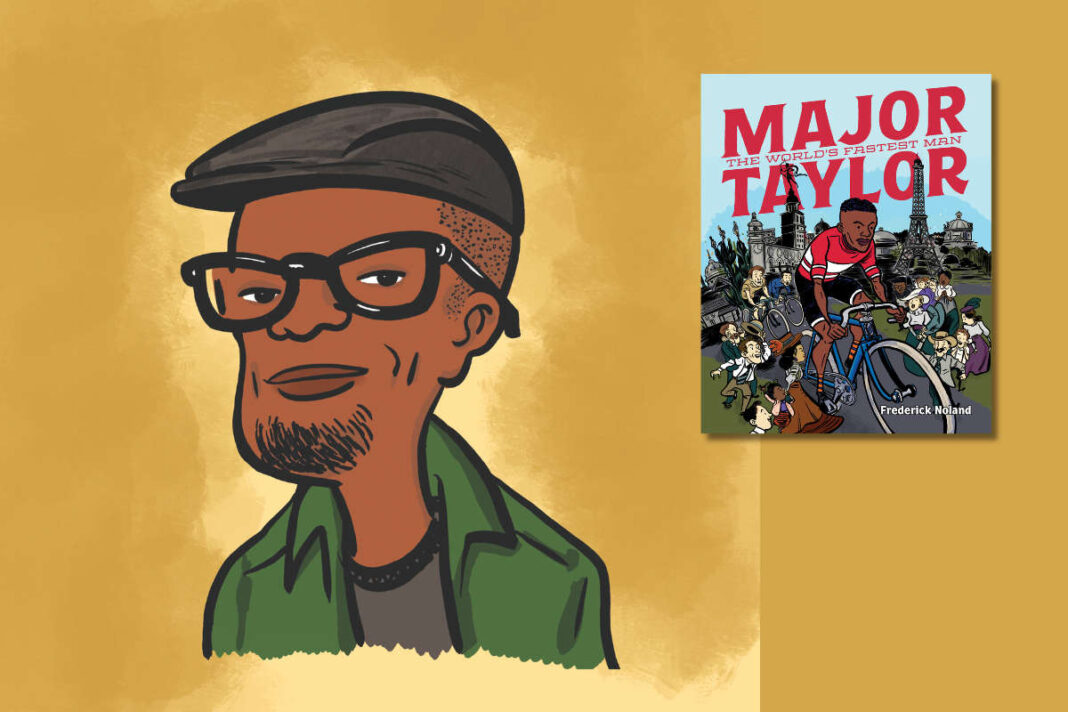
Frederick Noland is the unofficial oracle of lesser-known stories about Black people in America, and especially in the Bay Area. As an Oakland-based visual storyteller, the New Yorker cartoonist and California College of the Arts adjunct professor creates graphic biographies, mini-comics, animation, public art and illustrations.
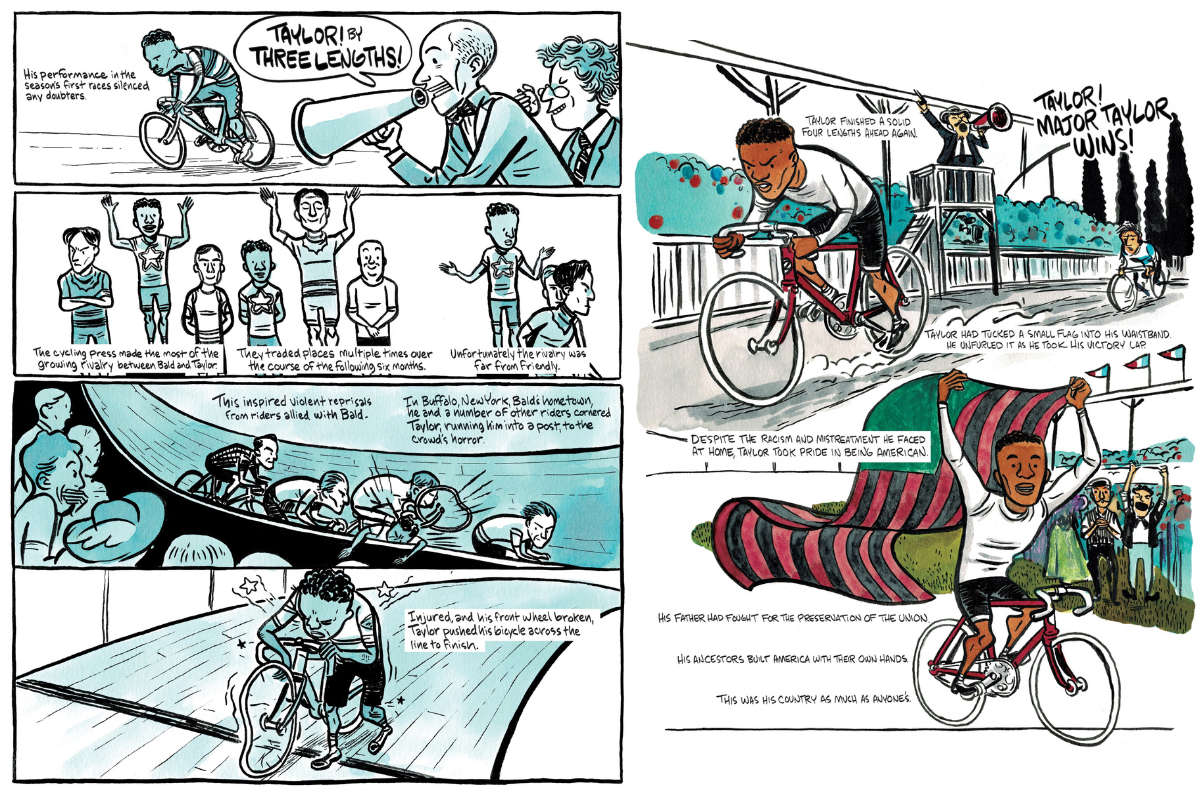
Noland’s most recent endeavor is a new graphic biography, Major Taylor. The 400-page book tells of America’s first Black world-cycling champion. Marshall Walter “Major” Taylor, born in 1878 in Indianapolis, acquired an enormous fan base in North America, Europe and Australia. Throughout his racing career, Taylor faced segregation at tour venues, exclusion from “whites only” accommodations, physical injuries caused by competitors, and exploitation by handlers, sponsors and others.
Despite these obstacles, Taylor was a devout Christian who, as a companion to a white boy during childhood, received a first-class early education and rose to become a highly skilled cyclist. Clever, industrious and very competitive, Taylor navigated a white man’s world by picking his battles, choosing confrontation only when acquiescence would compromise his pursuit of the sport he loved.
With marvelous illustrations and streamlined text, Noland’s fast-paced biography reads with all the thrill and suspense of a world-class bike race. Simultaneously delivering a deeply researched historical record of cycling, the narrative avoids long, weighty details. Instead, the facts zip by, providing essential insight into the societal revolution caused by the invention of bikes.
Originally created to replace horses, bikes became a major means of transportation that improved access to jobs for the lower and middle classes and gave women suffragists good reason to begin wearing pants. The popularity of racing led to massive crowds at velodrome events and laid groundwork for improvements in the U.S. highway system.
In an interview, Noland said he is a devoted biker, but not a racing fanatic. His interest in Taylor lies where it does in other hidden stories: paying tribute to important, overlooked historical Black Americans whose experiences in San Francisco and the world mirror Noland’s own.
Like Taylor, Noland grew up in a Christian household. His father was a minister, and Noland attributes his work-ethic principles in large part to his mother. Although not claiming Christianity in the way Taylor did, Noland lives according to similar ideas about equity and justice.
While working on the book, Noland realized how unchanged the world of today is from Taylor’s time. Things then seemed to be shifting in a progressive direction, but as Black people acquired wealth and won elections, a white-supremacist, “how can we stop this” mentality mounted. Nolan offers recent history as an example that the same racism continues.
“It’s the same as it ever was,” Noland said. “San Leandro and Piedmont were sundown towns and still have vestiges of redlining. Like gates people don’t know about that meant, ‘When the sun goes down, Black people get the fuck out of town.’ That hasn’t changed a lot in 100 years.”
He recounted a personal story about riding his bike from the Walnut Creek BART station to his corporate job in the city’s downtown. “I was dressed in business clothes and accidentally grabbed the front brakes and ended up in the street,” Noland said. “All I hear as I’m reorienting, picking myself up, are car doors locking: click, click, click. How did I go from being a businessman to ninja-ing everybody out of their cars and stealing their stuff?”
On the other hand, Noland said he is always treated well at cartoon and comic trade shows and author/illustrator appearances in the East Bay. “They’re happy to hear Oakland stories and to see a Black guy who’s still living in Oakland, because that’s becoming less true,” he said.
Noland’s writing habits are feverish. “I work nonstop, late into the night,” he said. “I’m anarchistic. I don’t have a script-then-layouts production style. It’s more organic, loose. I make discoveries on the page.”
Largely self-taught, he works hard to make sure his foundational skills remain solid. Years of obsessing over comics and old Japanese manga taught him to be efficient with dialogue and rely on art and precise framing to establish pace. “An indulgent splash page or double spread gets the reader to slow down,” Noland said. “Inset panels can set a rhythm. Color can be black-and-white, indicating something in the past, lightly tinged for interstitial action, or full-color to warrant eyes lingering on a page.”
Noland expressed excitement about the way graphic art books, comics and cartoons have caught on. Effectively used as tools for biography, he named March: Book One and Book Two, about the late Congressman John Lewis’ life, and Persepolis, by Marjane Satrapi, as examples of specific stories that offer universal appeal.
“I love how indie comics have broken out,” he said. “The huge variance is something I love, along with how ethnic and queer they’ve become.”
Ultimate kudos, he suggested, goes to the librarians who form the bulwarks against a tide of mis- and dis-information. “They’re so clever about getting books out there and getting people to the books,” he said. “They’re mild-mannered, but they’re champions and they’re out there taking the hits.”
Noland’s next four books are already planned. He withheld details, but said stories about “a handful of Black men and women” are definitely in the lineup.
Frederick Noland will appear in conversation with JF Frankel on Tuesday, Sept. 22, at 7pm at Pegasus Books, 2349 Shattuck Ave., Berkeley. drawnandquarterly.com