
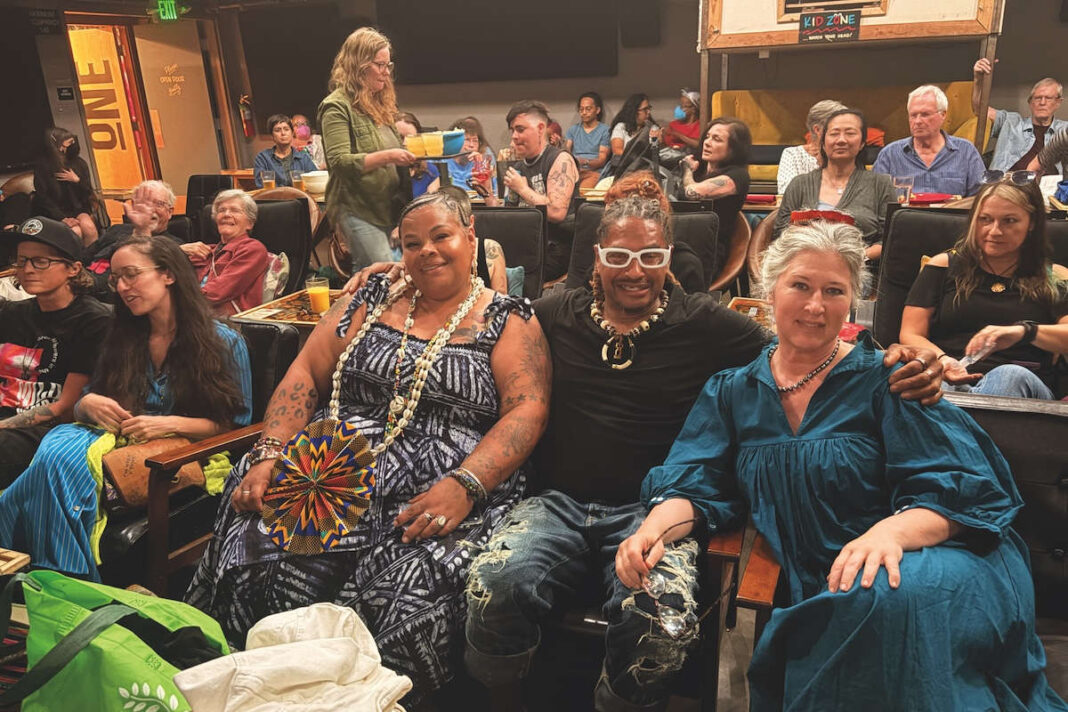
A crowd gathered under the multicolored bulbs of Oakland’s historic Grand Lake Theatre on July 15 for the sold-out red carpet premiere of Wood Street, a feature-length documentary portraying the eviction of what was once the largest homeless encampment in Northern California.
John Janosko, the film’s main protagonist, was decked out for the carpet in a plaid purple suit and large, white-rimmed glasses. His smile was infectious as he greeted the crowd and took pictures with fellow members of Wood Street Commons and people coming to see the film.
A day earlier, a smaller—also sold-out—premiere was held at the New Parkway Theater, in partnership with the Berkeley Film Foundation, which partially funded the film. Wood Street premiered in the Bay Area back in May, but director Caron Creighton’s goal was always to show the documentary in Oakland.
“It’s the hometown screening. It’s definitely really important to show it to city officials,” Creighton said.
Carroll Fife, in attendance at the Grand Lake showing, spoke to members of Wood Street Commons about meeting with them to debrief after the documentary.
“Let’s acknowledge that this is bigger than any one of us,” she said, before former Wood Street Commons member and current organizer LeaJay Harper took her by the hand and brought her into the theater.
LaMonte Ford, another prominent figure in the film, hoped showing it in Oakland would incite change in the community. Every member of Wood Street fears and rallies against the eviction of the encampment throughout the film, but LaMonte’s sense of indignation is particularly palpable. He wants more empathy for people suffering from homelessness.
“Give us our dignity, and bring us to the table,” he said.
Wood Street was swept in 2023. According to a recent UC Berkeley study published in the American Journal of Public Health, sweeps in Oakland have only increased, with the average areas swept becoming larger. These increases came following the 2024 Supreme Court decision on Grants Pass v. Johnson, which ruled that local governments can enforce anti-camping bans without violating the Eighth Amendment’s Cruel and Unusual Punishments Clause.
“This is the place that we wanted people to be able to see it,” Janosko said of the premiere in Oakland. “Especially city officials to be able to see a lot of the … trauma that they’ve been causing through their policies and procedures and these evictions.”
Despite the difficult moments that undercut a majority of the film, what truly stands out is the organization and partnership exhibited by members of the Commons. Creighton focuses a lot of the screen time on the various meetings, most with Janosko at their center, that leaders at the encampment conducted to try any method of delaying the eviction. These included a restraining order against the California Department of Transportation, protests at City Hall, attempts to communicate with city officials and, at moments of desperation, discussions about simply refusing to leave once the time came.
The documentary is very much situated in place, with shots of Oakland’s iconic murals used as B-roll throughout its length, reminding viewers in the city that while homelessness is experienced everywhere, this is what it looks like outside the four walls of the theater.
Members of the community showed up for the film. At the New Parkway, tickets sold out five hours after the screening, when the subsequent panel was announced. On the day of the premiere, people even came to sign up for a waitlist in hopes a spot might open up. Many felt it was important to support Wood Street as friends and allies of the cause. Others went in with pure curiosity.
“I’ve lived in Oakland for the last 10 years, and I used to drive by the Wood Street encampment all the time. I’ve been following it,” said Dana Jantz, an audience member at Tuesday’s screening. “I wanna know what happened to those folks.”
The Wood Street sweep has been on Charlotte Ione’s radar for a long time, and after meeting some of the people involved in the commons, she wanted to see the vision of Wood Street before it was swept.
In the portion of the film that shows the sweep, officers are seen demolishing the handmade shelters that members once gathered around to cook for each other, celebrate holidays and assist one another through their hardest moments.
Today Janosko, along with other members of the Commons, works to keep that sense of community alive, despite people being separated. They host weekly outreach events on Sundays to feed encampments across Oakland. The crowd was invited to donate and volunteer at what has now become a nonprofit organization that goes by the same name as the former encampment. For more information, visit woodstreetcommons.org.