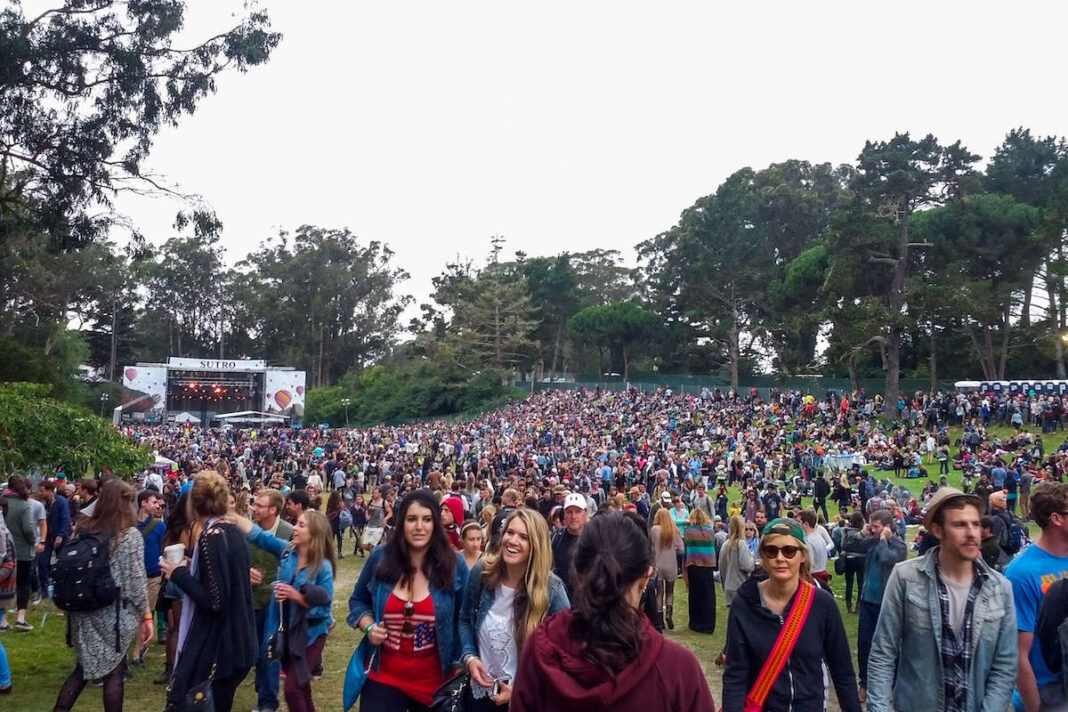
Ah, Outside Lands. Three days of music, art, gridlocked traffic, price-surging Ubers, inexplicably freezing temperatures, attendees from all over the world and, of course, so much discourse.
Boasting headliners Charli XCX, The Strokes, RÜFÜS DU SOL and PinkPantheress, it’s no surprise that this year’s sold-out festival drew 75,000 attendees per day. With three-day passes priced at $499 face value and reselling for upwards of $1,000, it’s safe to say that the festival drew a particular kind of crowd: one eager about this year’s acts and able to foot such a bill despite harsh economic conditions nationwide.
In an age of Instagram celebrities with feeds full of festival ‘fit pics, corporate patronage ranging from Amazon Music to Chase Bank, and ominously touted “Golden Gate Club” tickets priced at more than $5,000, one can easily begin to wonder if the music festival has become less of a celebration of music and community and more of a spectacle of opulence and mainstream status.
While the concept of the music festival has been around for thousands of years, the Newport Jazz Festival in 1954 launched what many recognize as the modern-day festival. By the mid-’60s, festivals had grown in popularity and international acts began taking the stage at multiple-day events. Famously, the 1969 Woodstock Music and Art Festival drew a crowd of more than 450,000 people for “three days of peace and music.” The festival was associated with the anti-war movement, hippie culture and acts like Jimi Hendrix, the Who, Janis Joplin and the Grateful Dead. These artists served as a medium of opposition to both musical and social homogeneity, and cemented sonic and visual identities associated with hippie subculture.
These early examples point to the notion that music festivals have always wrestled with ideas of authenticity versus expansion, activism through the arts and how to best portray cultural events through media coverage. There seems to be a very human urge to document these unique experiences and display proximity to causes and subcultures that one feels most aligned with.
That notion became even more pervasive in the ’70s and ’80s as festival circuits expanded to cater to specific genres, with jazz, reggae, punk and electronic music lending themselves to community building around subculture. Musical genres were strictly socially enforced, as committing to a particular “scene” meant adopting its aesthetics, values and community. Acting outside of social norms could lead to targeting and violence, and committing to a subculture meant embracing all of its visual cues. In this way, the concept of the subculture becomes contradictory: Resisting norms comes with a strict set of regulations and social pressures to abide by. If you were a punk, you couldn’t sit with hippies at lunch. If you were a metalhead, you couldn’t also be into hip-hop. There was nothing worse than being deemed a “poser,” and gatekeeping kept scenes tightly knit.
In 1993, Pearl Jam performed at the Empire Polo Club to protest Ticketmaster-controlled venues. The grounds proved viable, and 1999 was the year Coachella debuted with Beck, Tool and Rage Against the Machine as headliners. Tickets cost $50 per day, and the festival lost nearly $1 million on opening weekend. Goldenvoice took a year off to recover funds, and the festival returned for good in 2001. It has obviously since become a cultural staple, now one of the largest, loudest, most expensive and most profitable festivals in the world.
The inflection point at which Coachella became “mainstream” is hotly debated, but it’s difficult to ignore how the festival has become associated with wealth, status, social media and corporate sponsorship. As social media took rapid control of, well, everything in the 2010s and “influencing” became more widespread, the festival became abstracted into optics, brand partnerships and content. From livestreams to street interviews, Coachella fashion guides to TikTok recaps, mass corporate sponsorships and celebrity cameos, it’s hard to remember that Coachella’s roots actually lay in boycotting a major ticketing company.
So, where does Outside Lands fit in with all of this?
Well, promoters and bookers around the world borrowed from Coachella’s concept, adding regional flair to market to more specific audiences. The first Outside Lands took place in 2008, with Radiohead, Tom Petty and Jack Johnson headlining. Passes started at a steep $225, and the bill boasted artists of all genres across five stages in Golden Gate Park. Another Planet Entertainment and Superfly were the weekend’s commercial promoters.
Arguably, this could be seen as a fairly mainstream start. Three commercially popular artists playing an expensive festival in an expensive city does not inherently foster any form of subculture. Early organizers did have the correct instinct to tap into San Francisco’s wealth of food, wine and art cultures. Restaurant sponsorships, wine and cannabis pop-ups, and installations by local artists did slightly set the gala apart from its Southern California counterpart.
Still, Outside Lands has always been a far cry from the counterculture and activist movements of its historical predecessors. The 2026 affair was no exception. While determining if there were any shreds of subculture left at this year’s event, interesting questions emerged about the relationship between the mainstream and the underground. Festivalgoers and performers weighed in, as did Redditors (of course).
Reddit user u/undeadsinatra compiled a meticulous spreadsheet of every performer, genre category, subgenre and even related artists per day. Day 1 was perhaps the festival’s most “alternative” affair, with rock, punk and indie acts dominating the main four stages.
Sonically, there was some interesting stuff going on. Die Spitz does a fresh and femme take on hardcore, metal and punk conventions, all while donning babydoll dresses with Doc Martens à la ’90s Courtney Love. Geese, while pretty much the epicenter of nepo-baby-industry-plant-marketing-psyop discourse, seem to be handling their newfound ubiquity by just playing their instruments pretty well and making fun rock music. Turnstile, often described as the first hardcore band to go “mainstream,” did not feel particularly sonically abrasive yet still managed to produce a mosh pit at every PA stand at the Sutro Stage. Modest Mouse were a fan favorite of the day, which is no surprise as they practically wrote the blueprint for early-to-mid-aughts indie rock. Charli XCX delivered arguably one of the most exciting sets of the weekend, dancing across her decade of discography in all her hard-earned pop-star panache.
Culturally, the day was a lot of what you might expect: $25 canned cocktails, distinct sections for GA, GA+, VIP and “Golden Gate Club” (the exact meaning of this remains unclear), man-on-the-street interviews left and right, brand booths, talking through sets and iPhones recording, well … everything.
Frank Woods, a San Francisco native, said that cost of attendance is likely what cements these behaviors and demographics. The cost of the ticket alone is steep, he explained, but food, alcohol and Ubers also add up.
“(Outside Lands) is borderline unaffordable, and I think that definitely contributes to the energy in there being very much mainstream. It’s not really countercultural. I wouldn’t say that. There’s definitely people who go and want to have that vibe, but then you look at like the bill that adds up through the weekend, and it’s tough,” he said.
Day 2 proved to be a pop-lover’s soirée, with Audrey Hobert, Malcolm Todd, Djo and PinkPantheress reigning over the day’s festivities. Indie and electronic acts were woven in, with Lucy Dacus and Ethel Cain holding down the former. Snow Strippers and It’s Murph were the electronic powerhouses, but Yard Act and Automatic delivered some of the day’s most countercultural sounds.
Automatic does spaced-out, synthy and isolated meditations on an increasingly lonely world under capitalism, forgoing guitar for synth, drums and a fretless bass. Yard Act has historically wrestled with the mundanities of corporate life, inevitable mortality and the concept of the self’s role in society over a post-punk backdrop.
In conversation about their upcoming set, newly released album and thoughts on the Outside Lands experience, frontman James Smith explained how genre titles and labels can actually hinder free expression and countercultural ideas.
“I think that it’s a product of consumerism that is penetrating the music community on a wider level. You’re kind of collecting genres like they’re your own personal histories. I think it’s kind of a chess sort of stance to be like ‘I know where this has come from because I know about music, and to me it sounds like x.'”
Smith agrees that the age of the internet and reduced barriers to access to scenes have impacted the way subculture works in society. He paints an example of a young teen getting into sludge metal.
“I would have to know somebody that knew what sludge metal was. Otherwise, there’d be no way I could access it, and then I would have to buy a specialist magazine. I’d have to go somewhere to go and get it, and then I’d have to then order these records because there wouldn’t be any of the shops that were available to me. And by that time, I’ve put so much investment in that scene that I’ve changed the way that I dress, and I’m kind of a bit more of an exclusive listener, and I’m listening to other things because I’ve staked my claim on this one culture.”
Now, with social media, that process is much simpler. Access exists at our fingertips to audio and video from every genre of every era. If you want a specific jacket, an original pressing of your favorite record, a fanzine from 1978, a pair of Doc Martens or anything else you could dream of, you can order it from your phone in minutes. The rigid gatekeeping of the ’70s and ’80s scenesters is in the past, or at least from a consumer standpoint. Social media gives people the opportunity to brand themselves and display association with clear reference points.
“I think the way that Instagram presented itself to millennials, especially, was kind of like your own personal billboard for your style, your beliefs, your thoughts, your dress sense. It kind of sold you in a way you can curate yourself to seem like a certain individual, but at the same time you don’t want to stand out too much because you can be brought down standing out, and I think that’s creating a space of modern musing where anything goes, but everything’s hard to grab onto,” Smith explained.
As The Strokes took the stage to close out Night 2, one couldn’t help but notice the sea of iPhones recording the once-young NYC rockstars, with some audience members actually watching the set through the screen rather than with their own eyes.
Jean Baudrillard’s Simulacra and Simulation argues that modern society has replaced real experiences with abstracted images and symbols. Because these images and symbols are so pervasive and convincing, the copy feels more real than the original itself. This concept permeates modern society through products, advertisements, experiences and, crucially, screens.
Imagine a perfectly curated ‘fit pic at Outside Lands, where the subject is smiling or laughing, maybe holding a beer or a joint, likely surrounded by friends. The lighting is perfect, all the levels are edited to maximize saturation and minimize shadows. The subject can curate a specific moment to highlight, perhaps while their favorite band is playing or just ringing out in the background, and mirror the experience of the festival to their trusted followers and friends. The image becomes an abstraction of an experience, a simulation of a joyful moment. Thus, even if the subject were truly happy or enjoying themselves at the festival, or were partaking in subculture, this photo could have flattened and cheapened that experience.
Proximity to coolness or culture is something that becomes more valuable than the actual culture itself.
In the case of festivals, musical subculture has long created symbols and images as reference points for affiliation. Tie-dye shirts with “Peace, Love and Music” factory-printed, heart-shaped sunglasses, tired maxi skirts and suede vests are easily identifiable symbols connected to the hippie movement. Studded leather jackets, tartan skirts, buckled boots and spiked hair are emblematic of punk. Once a subculture or scene can be easily recognized, it can be bought and sold as an image, and quickly become a caricature of the real values the scene may represent. Coachella influencers and Outside Lands brand representatives may seem like extreme examples, but they pretty much fall into the same category as all other simulacra.
Now, the important question becomes: Does it matter?
Harry Davis, a 77-year-old San Francisco native at his sixth Outside Lands, didn’t seem to think so. He said that if festivals give young people the opportunity to experience musical community and discover new artists, then it’s a net positive.
“(Outside Lands) is important because it shows the face of the generation that would follow such an event. Rock concerts and music festivals are normally something that young people do. Now I’m 77, but I’ve been doing this since the 1960s. So for me, it’s still important and it has meaning,” he said.
It almost seems like creating rigid definitions of “mainstream” and “subculture” can be limiting in itself, as many of the weekend’s musical performances subverted genre and scene conventions in their sets. Charli XCX is a beloved star whose new album critiques consumer culture and meditates on alienation. Audrey Hobert, who delivers addictive pop hooks and Instagram-worthy hits, encouraged her audience to put their phones down during her most popular single. Turnstile introduced a friend to Black Flag. Local DJs drew crowds to the tiniest stages, and the all-ages fest booked artists across every genre.
So, what if someone wants to record their favorite band or make a TikTok about everything they ate at Outside Lands? Certainly that seems less insidious than, well, plenty of other things you could be doing. It probably doesn’t contribute positively to the state of subculture or anything, but it’s also OK to enjoy oneself at a music festival and share those memories with others. Life is hard, gas is nearly $6 a gallon, one-bedroom apartments are $4,000 in San Francisco right now, and most people aren’t thinking about a dead guy named Baudrillard on their hard-earned weekends. That’s OK!
Plus, as is often the case, big corporations and rich guys in suits are the ones who benefit the most from the commercialization of culture. Turning real artistry, creativity and community into dollar signs is something those rich guys have been doing forever. This does not mean we are powerless as individuals, but it’s certainly worth noting that the people who hold the most capital are probably more sinister than teenagers on Instagram Live.
So, Outside Lands is probably not countercultural these days, if it ever was at all. However, there are certainly elements of the festivities that celebrate art and culture and may give people the opportunity to become interested in new music. Also, sometimes it’s OK to not have to be “cool” or “different” and enjoy things that are widely popular. Creating rigid boundaries may end up isolating people from seeking out subculture, or just reinforcing social boundaries that warranted the desire for counterculture in the first place.
The state of counterculture as a whole remains unclear. Maybe it’s dead because Instagram killed it. Maybe if everyone is different, then no one is. Maybe reducing barriers to entry is a good thing that will get young people excited about resisting norms. If one thing’s for certain, though, it’s that music can and should bring joy to people regardless of its popularity.
Aptly put by Davis, “This banging that we’re hearing …” he trailed off, gesturing toward the boosted bass erupting from the Polo Field. “Whether we understand it or not, it is art.”