
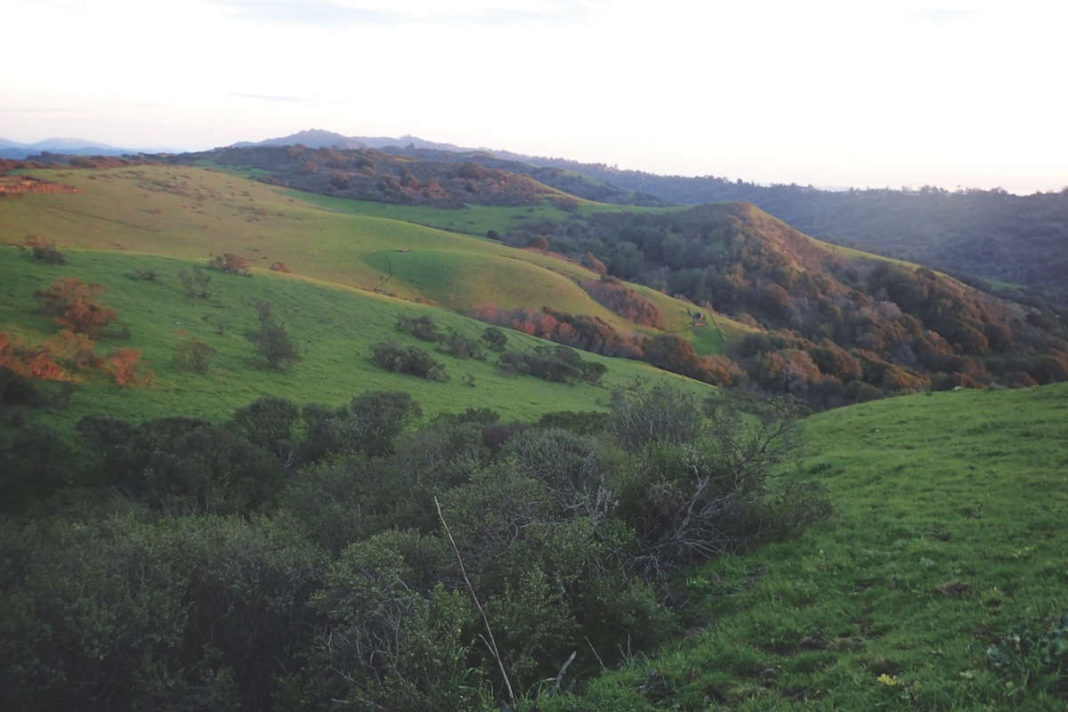
A new visitor to the wild and peaceful vistas of Wildcat Canyon Regional Park in El Sobrante would likely have no idea about the current controversy surrounding a proposed 1.4-mile mountain bike trail. Disagreements over the recreational use of publicly owned lands aren’t new, but details have emerged in this case involving the East Bay Regional Park District (EBRPD), private biking supporters with a million-dollar pledge and accusations by environmental groups of being shut out of the planning discussion, which make this disagreement out of the ordinary.
The idea for the trail was broached years ago, and emails between supporters and EBRPD staff flew back and forth, shown in documents released under a Public Records Act (PRA) request by groups opposing the trail. By June 21, 2023, a joint letter was sent under the letterhead of the Golden Gate Audubon Society, the Sierra Club and the Sustainability, Parks, Recycling and Wildlife Defense Fund (SPRAWLDEF), headed: “Re: Bias in planning Wildcat Flow Trail and Loss of Trust in the Park District Planning Process.”
An excerpt states: “The documents reveal how the park district staff have been pretending to be inclusive and equitable in creating its trail policy but have actually been planning this new trail in secret with only one user group, mountain bikers, for two years.”
Email responses from EBRPD acting General Manager Max Korten state that, “The idea for this trail came from community interest from middle school and high school mountain bike teams who practice in Wildcat and Tilden regional parks looking for a trail that was purpose-built for mountain biking.”
The park district’s public plan for the park, available online, includes this: “In 2020, the Northern California chapter of the National Interscholastic Cycling Association (NICA), approached the Park District to share that the high school and middle school mountain bike teams in the area including Berkeley, El Cerrito, Albany, and Richmond are growing in parallel with the increasing popularity of mountain biking nationwide.”
However, in a phone interview, Norman La Force, president of SPRAWLDEF and a leader of the group Friends of Wildcat Canyon, said that emails retrieved as part of the PRA request show a years-long pattern of interchanges between members of the adult mountain biking community and EBRPD staff.
Not included in these interchanges and discussions, he said, was the park district’s self-created Trail Users Working Group. The 2023 letter states, “Park district staff ignored this open, transparent process and the park district’s very own legally mandated requirements of enacting a land use plan amendment for this park in order to establish a new trail. Instead, park staff began meeting privately with and sharing internal staff discussions and analyses with mountain bike advocates, while telling the other park users that this same information cannot be made public.”
Korten’s email response to a question about this criticism was as follows: “The Park District has been committed to leading a transparent, inclusive process and continues to seek additional opportunities for public input as planning moves forward. Project information has been presented at several public meetings, where we have received hundreds of comments—both supportive and critical. This feedback is valuable and directly informs our work to ensure we best serve the community.”
Why Wildcat Canyon?
The park district’s position is that the current site was chosen because it was “accessible to local teams” and would have the least impact on the natural environment.
Stated Korten’s email: “Mountain bikers, including these youth teams, have regularly advocated for dedicated single-track designed specifically for mountain biking to achieve technical features (switchbacks, berms, rock gardens) that riders enjoy; reduced congestion compared with multi-use trails where hikers, runners, and horses share the path; and sustainable design that balances resource protection with recreational opportunities.”
La Force contends that the site was chosen at least partly because of the million-dollar “gift” offer from the two Kensington-based donors, and that adult mountain bikers want a trail in Wildcat Canyon. The proposed trail’s route is through an area designated as a “Natural Area” in 1989, he said, but the EBRPD now says this designation was a “vision document that provides guidance.” La Force and critics believe a formal land use plan amendment is needed to change the 1989 designation.
Information acquired through the PRA, he said, includes no documentation that other sites within Wildcat Canyon were considered for the flow trail.
Racetrack? and the next steps
Other concerns about the trail include the lack of parking at Wildcat Canyon, the possible use of the track for mountain bike racing and the permanent disruption of the area’s tranquillity.
The park district denies that the trail will ever be used as a race course, but La Force pointed out the design would accommodate exactly that. He speculates that in a few years after the trail is built, the issue would arise and be accommodated by EBRPD.
The next step in the plan to build the trail is preparation of an Environmental Impact Report (EIR). This, according to Korten, will provide more opportunities for public input. “We anticipate issuing a Notice of Preparation for the EIR in January, followed by a public comment period and scoping meeting. A second comment period and another public meeting are expected in 2026 when the draft EIR is released,” his email stated.
Under the state’s California Environmental Quality Act, the EIR will be required to include potential impacts on increased traffic and additional air pollution caused by that traffic. La Force reiterated that the Sierra Club, the California Native Plants Society and the Golden Gate Audubon Society, along with SPRAWLDEF, have already expressed concerns about the impacts on wildlife and natural vegetation. He added that the EIR will not address the issue of lost serenity and solitude the park now provides.
The park district will pay an outside consultant to prepare the EIR. “Interested community members can sign up on our website to receive project updates and notifications about participation opportunities,” Korten’s email states.
La Force noted that if environmental groups are not satisfied that the EIR correctly identifies potential impacts and remediations, a lawsuit may be filed. In any case, he remains concerned about the lack of transparency in the flow trail’s planning process.










Part of the EBRPD mission is to offer recreation opportunities to a broad user base. These needs can change over time. In the case of mountain biking, I know it’s better to separate bikers from hikers and horseback riders just for safety and conflict reduction. The particular area for this relatively short trail isn’t “precious” in the manner being presented by opponents. This is former ranch land with substantial slope instability, always moving, dominated by low quality invasive grasses, disturbed vegetation. Mr. LaForce has a long multi-decades history of advocating for what I’ll characterize as an elitist, narrow user group—able-bodied walkers, preferably limiting open space access for the public, so I’m not surprised at his opposition. I’m pleased to see East Bay Regional Parks is considering a broader base of park users, especially young users, as well as expanding trails in Wildcat Regional Park.
The Park District prepared a Land Use Plan for Wildcat Park that designated this area as a Natural Area precisely because of its habitat and wildlife values. It located recreational uses at the two ends of the park. Endangered bird species have been sighted in the location of the trail, and the area is listed as habitat for other endangered species. It is not “low quality” habitat. But the Park District has not followed its own legally required process for amending the land use plan which would have required it to give public notice years ago. Instead, this flow/thrill trail was planned without real public input. Ms. Saarni actually makes a statement that supports my and others concerns about this site. She says it is “ranch land with substantial slope instability.” What she doesn’t tell you is that this trail is not “just a trail,” but a manufactured trail with jumps and ramps and cuts into the slopes for thrill riding. Google “flow trail” and check out what they really look like. The proposed flow/thrill trail will actually cut right into active landslides. This is not a site for this kind of trail with the slope instability Ms. Saarni admits is there. Moreover, this trail is not just for high schoolers. The mountain bike interests have made it clear that it can be and will be used by many other mountain bikers that would number in the thousands. The two entrance points for this trail are at Rifle Range Road and Inspiration point. Rifle Range Road has virtually no parking now. Just imagine even just tens of cars trying to park there let alone hundreds of mountain bikers. Inspiration Point parking in the Park District is already often maxed out. This flow/thrill trail at this location is due to two wealthy donors who made it clear that they would only give the district $1 Million for the trail conditioned on the Park District building this trail at this location even if there were adverse impacts to wildlife habitat. A condition of the donation is that the Board of Directors must certify the EIR regardless of what damage is done to wildlife and habitat. This is just an example of the wealthy buying access to our parks. Finally, I have advocated and campaigned for parks and trails for everyone. I was one of the attorneys in the lawsuit that enabled the Park District to save Point Molate as a regional park. I just finished writing comments supporting active recreation at the North Basin Strip in the McLaughlin Eastshore Park which is zoned for active recreation. I worked to create the Tom Bates sports fields on the Berkeley shoreline. There is also a place for active recreation where such activities are suitable. A flow/thrill trail in the Natural area of Wildcat Canyon Park is not such a location.
My being against this proposed trail in Wildcat is not opposition to mountain biking as an activity, which is something the pro-bikers have advanced as a critique. So let me say at the outset: biking is fun and a wonderful activity!
I am, however, opposed to both the secrecy with which the Parks have advanced this proposal and the introduction of a highly developed trail into this area of Wildcat, where it is neither safe nor consistent with long-standing Land Use designations reserving the space for passive use by hikers, equestrians, and service vehicles.
Safety concerns are already happening, not hypothetical. I have seen multiple instances of bikers riding at high speed through pedestrian areas where they are required to yield, forcing hikers, elders, families with children, and dogs to literally jump off the path. This is occurring even without a sanctioned thrill-flow trail.
Establishing a formal bike route in a narrow, unstable corridor will increase these conflicts, not reduce them, especially because bikers must enter and exit through limited access points, resulting in exponentially more high-speed traffic and conflict with those on foot or horseback.
It has also become clear through the two recent MAC meetings and the general approach to this proposal that, although the cyclists advocating for this trail are not responsible for including local residents, they did work with the Parks in ways that effectively excluded them. Their strategy of arriving in large numbers and delivering coordinated, highly performative presentations is part of a broader advocacy playbook designed to dominate public meetings. These orchestrated efforts are meant to overshadow the voices of the people who will truly experience the impact of this project.
I also see this proposal as part of a larger coordinated effort. Mountain biking advocacy groups have carried out a well-funded strategy across Bay Area park systems to open quiet natural areas to high-speed recreation. Max Korten did the very same thing with the biking community in Marin during his tenure there. Secrecy, performative crowds showing up at meetings — the pattern is identical. Wildcat fits squarely into this regional push.
The East Bay Express article highlighted another concern: key discussions about this proposal took place behind closed doors while a million-dollar donation was quietly offered to the Park District as an incentive. County Supervisors, Municipal Advisory Council members, and residents most affected were left out entirely. Posting flyers at trailheads or quietly placing information on a website does not constitute meaningful public outreach.
It is also misleading to say the land in question is “not precious.” Those of us who visit regularly know that, besides being a sanctuary for people and animals, the slopes are unstable, emergency access is extremely limited, and the area is home to wildlife — their only home. This area is part of a fragile and diverse wildlife corridor and serves as one of the few remaining quiet natural refuges in the region. Introducing high-speed recreation here, even without the threat of organized competitions, will affect the entire surrounding ecosystem and visitor experience, not just a 1.5-mile trail segment. And let’s be honest: animals will get caught in fences, and they will be struck and killed by riders moving too fast to see them.
A previous commenter described local opposition as “elitist,” which could not be further from my experience. Wildcat is used by one of the most racially and economically diverse communities in the East Bay. Walkers include elders, multigenerational families, long-time residents, people with mobility limitations, dog walkers, and individuals across a wide range of incomes. This part of the park is one of the few places where such a broad cross-section of the community coexists peacefully.
By contrast, mountain biking as promoted by these advocacy groups requires expensive bikes, specialized gear, regular maintenance, and the ability to transport that equipment to the park. It is accessible to a much narrower and more economically privileged group. Calling the existing community “elitist,” while promoting a sport that requires thousands of dollars in equipment, reverses the truth of who is included and who is excluded.
There is also a fiscal concern. After private donors pay to construct the trail, taxpayers will bear the cost of ongoing maintenance for a high-impact recreational facility used by a small subset of visitors. This is especially concerning given that the Park District already allocates very little funding to environmental stewardship. In the proposed 2026 budget of $376 million, only 2.6 percent is dedicated to natural resource protection. Of $66 million in proposed capital projects, only about 1 percent supports stewardship. It is difficult to justify taking on new obligations for a niche activity while core environmental needs remain underfunded.
For me, protecting passive-use areas like Wildcat is not about excluding mountain bikers. It is about safeguarding a fragile landscape, maintaining equitable access for the multiracial and economically diverse community that already relies on this park, and ensuring that wildlife corridors, ecological health, and public safety are not compromised. Not every recreational activity belongs in every park. High-speed recreation has appropriate places, but this sensitive corridor is not one of them.
If the mountain biking community wants more trail options or simply a more convenient location than driving to existing destinations, as their advocates have repeatedly stated at recent MAC meetings, they should pursue private or better-suited public land rather than attempting to reshape one of the last quiet natural refuges into a multi-use corridor. This is not anti-bike; it is pro-community, pro-environment, and pro-transparency in public decision-making.
Another well written piece by Janis Hashe! It serves us (the public) well that Hashe continues to report with clarity and I can only hope she does not decide that our society does not devote enough resources and respect to the magnificent work of great reporters. About the issues of mountain bikes, there must be a proper and inclusive way to discuss and plan a separated trail for mountain bikers that will not compromise critical habitat. People of good intent need to be brought together by the EBRPD to review, discuss, argue over, design, agree upon and accomplish creating a mountain bike trail. Separating trails such that hikers and mountain bikers are not forced to share the same trail is simple safety and should be a priority. If the process to date has not been inclusive enough there is still plenty of time to revisit and correct that. And please, although we may have differences, to paraphrase one of the most forgiving comments to ever arise from a travesty of justice, how about we all just get along during these planning processes.
I’m writing to express my deep concern about the proposed mountain bike flow trail in Wildcat Canyon Regional Park. As someone who treasures this landscape, I feel compelled to speak up for what makes this place irreplaceable.
Wildcat Canyon offers something increasingly rare in our crowded Bay Area: genuine solitude and the chance to experience nature on its own terms. When I walk these trails, I’m surrounded by native grasslands, oak woodlands, and the kind of quiet that allows you to hear birdsong, wind in the grass, and your own thoughts. This isn’t just pleasant – it’s essential habitat for wildlife that needs undisturbed corridors to thrive.
The proposed trail would fundamentally change the character of an area designated as a Natural Area for over 35 years. While I support youth recreation, I question whether this particular site – with its ecological sensitivity and existing designation – is the right location. The lack of transparent planning and consideration of alternative sites troubles me deeply.
Our regional parks serve many purposes, but some landscapes should remain sanctuaries where the priority is conservation and quiet recreation. Wildcat Canyon is one of those rare places. Its wildness and quiet are gifts we should not casually give away.
Thanks to the Express and Janis Hashe for raising the profile of this important issue. It is especially important because, by the Park District’s own census of trail users, some 85% of users at Wildcat and other parks are hikers. By definition, this vast majority of park users are diffuse and NOT politically organized, while mountain bikers are very connected and politically active, as evidenced by their backers who met secretly with Park District staff to hatch this “thrill trail” plan, including the $1 million conditional donation that has now been revealed.
Critics of this imbalanced power play recognize that trails for mountain bikes can and should be researched across all parks in the district in a truly balanced and open process, but NOT by using cloak and dagger tactics and trampling upon well-established precedent that has long designated Wildcat Canyon as a “Natural Area”. Perhaps you have noticed while hiking in Wildcat or Tilden or other regional parks the vast number of “rogue” bike trails that are not on your park map, but run for hundreds of miles in various parks, disturbing and destroying wild habitat. These trails were built by a subset of the constituency that now wants a high speed, highly engineered mountain bike flow trail in Wildcat Canyon. Their line of talk is that if they get their special “thrill trail”, they’ll stop ravaging the parks with rogue trails. Given the tactics they have used thus far, I say that this would reward bad behavior that should be repaired before any new toys are provided.
There are time-tested tools available to the District staff and board that are designed to evaluate multiple alternatives for such a project, and which provide real transparency and debate for changing trails and activities in the park. But that is not what has happened to date, as the article chronicles. Please share this story with your friends who use the parks, and encourage them to plug into the environmental review process, which begins in January. These are YOUR public lands, and the regional parks board is spending YOUR tax dollars to determine how to manage wild lands in the future.
This article does not quote park users that would benefit from this trail. There are so many positive aspects. For example, it gets our youth outdoors and exercising. It allows for transportation alternatives where cyclists will not be killed by motorists. It increases pollution while on bikes? It reduces pollution because people can ride instead of drive to work or to the place they recreate. Other of the “negatives” in the article are absurd. Many cyclists in Tilden ride from their homes to the park so parking is not even necessary.
Don’t You Think Our Youth Deserve a Little Outdoor Space?
While there are legitimate concerns about the Wildcat Flow Trail (WFT) there have also been a lot of misconceptions which we would we’d like to dispel.
Many riders of WFT would be kids from local youth mountain biking teams in nearby areas. For these kids, the trail would be more than just a place to ride – it would give them a sense of belonging and freedom. Mountain biking helps kids build confidence, stay active, and gets them off of their screens and outdoors. Building WFT would show that the community supports healthy, outdoor activities for youth.
Some have called WFT a “downhill jump course” or a “race track,” but these are exaggerations at best. Due to the nature of the trail, involving lots of turns, it is impossible to maintain high speeds. Looking at another flow trail nearby in Marin, we see average speeds of around 9 miles per hour, which is much less than most of the existing trails open to bikes in Wildcat Canyon park.
For years, cyclists have been accused of having very little regard for environmental consequences, which isn’t a fair accusation. Most bike riders care deeply for the environment, and many engage in trail restoration projects. In addition, mountain bikers, by nature of the sport, choose to surround themselves with the outdoors, which engenders a respect and appreciation for both plants and animals.
Some have said that the trail would create disruptions for other users. However, it would have the exact opposite effect. The trail would attract bikers from other areas of the park, reducing user conflict. Because it is biker-only, other users wouldn’t even notice the relocated bikers.
Many hikers, runners, and equestrians are worried about an increase of mountain bikers on heavily used trails like Nimitz, but there would be four good routes to get to the head of the flow trail. In addition, there are many hiker-only trails in the area for people who desire a more solitary experience. Furthermore, if the WFT were to be approved, the hiking community would also gain a trail. Leonards, a trail next to WFT, would become hiker-only if mountain bikers are given the proposed flow trail.
Some residents of the East Bay have also expressed concern that the trail would impact local parking. However, a recent EBRPD survey showed that the vast majority of cyclists get to Tilden on their bikes. As for the cyclists who would be driving, there are many different available parking areas.
In addition, critics have cited an outdated land use plan from EBRPD in 1985 to argue that bikes should not be allowed in Wildcat Canyon park. However, this plan has been superseded by revisions such as in 1997 and 2013 that allow bikes. Indeed bikers have been legally riding in Wildcat for decades.
The truth is, mountain biking isn’t just a sport, it’s a growing community. One that’s filled with people of all ages and skill levels who share a passion for getting on their bikes and appreciating the outdoors. It’s also a source of joy and peace for about 300 youth (3rd-12th grade) in the Tilden area, who ride with local teams multiple times a week. They would love having a trail like the WFT to practice skills and have fun on. Support for the WFT, especially from non-bikers, sends a message to the kids that their desires are recognized and respected. It shows them the power of advocating for what they want, and isn’t it essential that the voices of the youth are listened to?
To get the real facts on the Wildcat Flow Trail visit: http://www.wildcatflowtrail.org/
This comment was written by Ania and Andy, two high schoolers who mountain bike for local teams.
As a mountain biker, hiker, and East Bay native my entire life — these elitist, NIMBY (and mostly Boomer, let’s be real) people against the trail project are being selfish. Ya’ll already effectively ‘own’ the vast majority of public trails and will continue to own them – you need to share a small fraction, even if it causes some inconveniences. Anything less is selfish. Just own it rather than make BS arguments about environmental impacts.
NIMBY’S need to accept the times are changing and they do not have any inherent rights to this land use, mountain bikers are people just like them, and honestly there are more of us than hikers and we have nowhere to go, while there are thousands of miles of accessible trails for hiking. Bikers will still be accessing a hugely disproportionate amount of land relative to the size of the constituency.
As far as these concerns about endangered species, etc. – give me a break this is .0001% of the land in the East Bay. These are no sensitive endangered species in this extremely small area that are going to be meaningfully disturbed by this bike trail.
I could go on forever about how beneficial mountain biking is to the youth and to the public in general. These youth are not going to go out hiking together into the great outdoor outdoors.
The people who are against this really need to reflect on why they feel so entitled to controlling every square foot of public land, and are unwilling to share.
I do not oppose mountain biking or creating a new trail specifically for the mountain bike community. I do oppose bulldozing an area that has been set aside for conservation and has been a home to wildlife, including endangered species. There are few grasslands left for our wildlife and birds. This is not a barren ranchland; there are sensitive species that rely on this grassland. Grassland birds are declining at a rapid rate because of development. This area was set aside by EBRPD and not supposed to be used for high intensity recreation.
I also oppose wealthy donors being able to buy the rights to our public lands for a small special interest group. This process has not been transparent, probably due to the fact that it is so controversial. There needs to be a solution that does not include destroying this area. I guess I do not understand why mountain bikers, who supposedly love nature, would even want to destroy an area set aside for conservation!
Thank you to Janis Hashe for her excellent and important exposé. The East Bay Regional Park District seems to have lost its way. The District’s mission is to be guided by an environmental ethic in all its activities and yet it is trying to install high-intensity recreation at the expense of nature. We teach children to follow the rules and yet, EBRPD is going against its own “Natural Area” designation of Wildcat Canyon Park. To call it a mere “vision document” is a travesty.
One thing I learned from birding is if you stand still for a few minutes you start to notice the sights and sounds of wildlife. I saw my first Grasshopper Sparrow in Wildcat Canyon and learned that it is a Species of Special Concern in California due to a significant population decline. They, like the California Quail, Red-tailed Hawk, Western Bluebird, American Robin and Lazuli Bunting all breed in the park. Their habitat would be irreparably harmed by a proposed course that not only runs 1.4 miles downhill but on the connecting uphill trails as well, including beautiful Havey Canyon Trail where I heard and saw- foraging in the trees and on the ground- over 25 bird species on a recent 1 hour walk. Bobcats and their kittens, foxes, deer, coyote and countless other animals also call Wildcat their home.
Walk along Wildcat Canyon Creek and you will catch a Park District sign stating that special precautions must be taken to protect native rainbow trout and California newts, additional populations that are struggling. Just imagine the erosion and soil that could wash into the creek from the trail construction and use!
Hundreds of thousands of dollars have already been spent trying to fit an intense activity into the wrong location. The Park District should stop wasting valuable taxpayer-supported resources by going back to the drawing board, following clear guidelines that adhere to the District’s mission, and giving priority to environmental protection while sincerely soliciting input from ALL parties- not just a single minority interest group.
This article and many of the comments are full of so much misinformation, it’s hard to know where to start. It seems the reporter built on the severely distorted article in the Alameda Post from last summer. Sadly this is not really journalism as the reporter never bothered to interview anyone from the bicycling community and instead relying on “facts” generated by the small minority of self-appointed guardians of the local park lands – that is the very small group of people who have used the local chapters of the Sierra Club, Native Plant Society and Audubon Society to fight every attempt to increase public access within the East Bay Regional Park system. (A good example of “elitists” and NIMBYs if ever there was one) But to hit some of the low points: there were no “secret” meetings between cycling advocates and park district staff. User groups have every right to talk to staff and attend board meetings, as the aforementioned “environmentalists” have done for decades. Also, EBRPD does a good job of protecting critical habitat and in fact has many properties, thousands of acres, where public access is completely prohibited. The District, which has already spent many thousands of dollars studying the ecology of the trail alignment and is about to spend more on more studies. The area in question is a former and current cattle ranch with low biodiversity and moderate to high public use. Bicycling and hiking is already allowed in the area, and the proposed trail would simply divert some bicycle use off the poorly constructed ranch roads and create a much needed recreational asset. Really, this is not that scary. Let’s build it and see how it turns out. If it turns out to be a horrible experiment, then we’ll just let the cows stomp it back to dust.
Thank you to EBX and Janis Hashe for the article, and to everyone engaging in this civic debate. I am happy that youth are writing in on this topic. I hope they will also read all the comments.
We are in an era of species extinction. Wildlife should be defended everywhere in our local parks, especially in these times where public lands are being sold off and CEQA protections are being dismantled. Wildcat Canyon is home to many animals, from the grasshopper sparrow (species of concern per US Fish and Wildlife) to hawks, owls, coyote, fox and bobcat. For every large predator there is a working ecosystem, aka “dinner” to support these animals, all the way down to the plants and insects that support them. This is a wild space that should be protected.
Do we want to open every wild space to intense recreation that disturbs wildlife? There is an environmental cost to recreational development beyond the initial investment, maintenance and dedication of skilled staff. We need to start measuring the biodiversity we are giving up every time we replace a natural environment with a built one. Once common species are now rare. For some time we have relied on mitigation, i.e., “save something over there so that we can build this here”. Maybe its time to save what’s here.
A downhill bike course in Wildcat Canyon would be very popular. Please look up the Park District’s “Conceptual Design” for details. The plan is not just for a dedicated trail but a manufactured-downhill-challenges course loaded with features that will draw riders from Bay Area counties and beyond. One bike proponent called it a “world class trail”. The Conceptual Design says some features are “for NICA or similar types of races”. How will riders get to the top of the downhill run? They will increase rider use on every other trail in the Park. A recent presentation by Max Korten at the El Sobrante MAC meeting stated they would make Leonard Trail off limits to bikes as part of this plan. What about the narrow, shaded, leafy Havey Canyon Trail that is already being damaged by bike use? What do you think it will look like when bike rides are increased ten-fold? Check out Joaquin Miller Park in Oakland where bike use and bootleg trail making has completely changed the character of that park. How do you think the animals respond to bikes zipping in every direction? What is the Park District doing to enforce current trail use regulations?
We should meet the growing demand for mountain bike trails with serious consideration of their placement in locations that serve everyone, with access to public transportation, in areas that do not disturb wildlife. Decisions about intense recreational development should be part of a publicly open and comprehensive analysis of where best to put them. Let’s have a public-input trails commission that recommends how to best serve all users: riders and walkers and equestrian trail users, people walking with children and elders and people with all kinds of personal challenges. Some of us look to these trails as a place for cycling and others go into natural areas to observe nature and for quiet reflection.
When there is a conflict between walkers and bikers on a trail, its usually the walker who gets to step to the side to let the bike pass. There are increasing reports of walkers who feel unsafe when bikes approach quickly with no bell and no shout-out. The bike community offers the idea that more dedicated single direction trails will reduce pressure on other trails, and that given a dedicated trail in a park, they will stop creating bootleg trails. All of these issues would be served by an advisory trails commission in a truly open forum.
I don’t think that the entire community of East Bay youth want us to be putting this kind of activity in a place that is home to so much wildlife. The next step is to help inform our community and our youth about the wildlife that calls this place home. A good place to start to understand what’s happening with biodiversity in our East Bay Parks, is the excellent Regional Parks Foundation’s 4-part webinar series “Wild Within Reach”.
I am a boomer, and even a member of one of the environmental groups mentioned, but I am totally in favor of this project even though it is highly unlikely that I personally will ever use it. Hooray if it brings more youth into parks for recreational uses! That is a win in my view.
I am tired of the old conservation organizations with NIMBY attitudes who try to throw red tape into any new project. If someone wants to enjoy the park in a way different than hikers there seems to be so much negative judgement. As if there is only one correct way to enjoy the outdoors. There is enough room for this project, and trails for hikers are already abundant. We need to share the resources much better. To the youth involved: Keep fighting. Many of us are on your side.
It is journalistic malpractice to publish what’s basically a press release from a self-appointed opposition leader with an axe to grind. This project has broad support (though you didn’t manage to find any supporters to speak to), and will improve environmental conditions and reduce user conflicts compared to the existing condition, which is a gullied out, over-steep fire road in a cow pasture.
The way the term NIMBY is being thrown around here reveals more about rhetoric than reality. NIMBYism has always referred to privileged groups blocking essential housing. Yet in this debate, the development pressure is coming from those pushing for a new high-speed recreational trail in a protected canyon, while those speaking up for the land, the wildlife, and long-standing land-use protections are being labeled as obstructionist. It’s a misuse of language that flattens nuance and avoids responsibility.
And layered on top of that is the idea that youth can only experience nature through mountain biking. This erases the countless ways young people already connect with the outdoors in Wildcat Canyon: walking, exploring, sketching, watching birds, studying plants, finding quiet spaces to breathe. As a birdwatcher beautifully described, it is in slowing down that the symphony of life reveals itself: in the subtle movements, the songs, the relationships of an intact ecosystem. These are experiences that speed simply cannot offer.
Misusing NIMBY and reducing nature to a single recreational activity both obscure what this place truly offers. Wildcat Canyon is one of the last places in the area where people can encounter nature on its own terms. Protecting that isn’t NIMBYism. It is guardianship.
The park district is not trying to install high intensity recreation at the expense of nature. It is not going against it’s own ‘natural area’ or natural unit designation for much of Wildcat Canyon Regional Park. The park district refers to Natural Areas as Natural Units in the 2013 Master Plan. The following activities are appropriate in Natural Units – ‘Improvements permitted within a Natural Unit include narrow trails and wider multi-use trails to serve walking, hiking, riding, bicycling and other trail users;’. The proposed trail falls into this category. The district stewardship staff have been involved from early discussions of the concept of this trail and suggested changes to the trail corridor location. Multiple field surveys were conducted to get current information on the species in the area. These items were discussed at the initial public meeting and information posted on the district project website.
Regarding high intensity recreation. Biking is defined as a form of passive recreation. If mountain bikers were interested in truly high intensity, high speed recreation, they could just bomb down the steep fire roads at speeds far beyond what would be possible on the proposed trail. This is not the experience most mountain bikers are looking for. Is mountain biking higher intensity than hiking and trail running? It generally depends on conditions but not in all cases. Is it as impactful on the land as equestrian use? Generally it’s not. And we don’t hear calls to get rid of equestrians and we shouldn’t. We’d like those that ride horses on soft trails and roads to be a little more respectful, just as we do with mountain bikers who ride when it’s too wet.
What about the impact of humans hiking on the existing roads & trails in the area with similar if not more sensitive biology? If there’s actually a valid argument regarding adding a new trail in the area, why aren’t we hearing anybody suggest Mezue, Leonards, or Havey Canyon should be closed to regular human access? It doesn’t seem like there really is a valid argument being applied to all trail user impacts. The CEQA study is being done to determine the level of impact. Wildlife are also affected by hikers but we don’t hear much about that. Different species are affected differently depending on the type of the trail user. The residence time of a hiker is much higher than for a bike. For some species this would be a higher impact than the shorter duration but higher speed of a bike. If zero impact is the only tolerable level then all human access should be curtailed. But that’s not the case and there’s a balance to be found.
There ought to be ‘world class trails’ in most of the EBRPD. Instead the ‘trails’ are typically adopted ranch or fire roads that weren’t designed for recreation or sustainability. The negative impact on the watershed by over grade and poorly maintained fire roads will far exceed the impact of a modern sustainably designed trail for hikers, mountain bikers, or equestrians. Much of the narrow trail system are historic legacy trails, created by users, that are not sustainable. EBRPD now has their Small Trails Crew up and running and a much needed backlog of narrow trail maintenance is getting more attention. ‘World class trails’ also means modern sustainable design with less environmental impact and lower maintenance.
Volunteer trail work days hosted by EBRPD are heavily attended by mountain bikers. BTCEB mountain bike volunteers have been doing trail maintenance at Crockett Hills for over a decade and at Joaquin Miller Park for much longer. The Stewards of Briones mountain bikers have been logging thousands of volunteer trail stewardship hours since the start of the Briones Pilot Project. Area middle and high schools can’t find enough volunteer trail stewardship opportunities in the East Bay and many go to China Camp State Park to volunteer. Mt. Diablo Trails Alliance has been holding large trail work days for several years now and pulls in a broader mix of mountain bikers, trail runners, and hikers. Mountain bikers are the majority of their volunteer base including local high school mountain bike teams.
As far as this project being a reward for bad behavior it’s far from that. The advocates for this project are people working inside the park planning system and not building rogue trails. By working in the system it has the stewardship experts involved and making determinations. Working through the proper process is neither a reward nor easy. It would be much quicker to build a rogue trail but these advocates have respect for the natural resources. The CEQA process will determine if the project is acceptable or not from a natural resources perspective.
The area is graded by full sized road graders annually. It’s essentially an annual bulldozing. You may want to advocate for road grading changes which the mountain bike community is advocating for. Instead of mainly filling in ruts from the last season of erosion we’d like to see more effective and functional drainage features created that would prevent and reduce erosion. How about advocating for conversion of 12 foot or wider roads down to singletrack and re-routing steep erosive roads to sustainable designs to reduce impact of the existing ‘trails’? The conversion of one road from the ridge to the valley to singletrack would likely meet or exceed the reduction in vegetation from a new trail.
Regarding Joaquin Miller Park bike use being so high that is driven by the lack of legal bike access to singletrack in the EBRPD parks. If there was more legal singletrack access in EBRPD parks the number of bikes at Joaquin Miller would drop.
The project is going through all the required steps and then some. CEQA will provide a thorough analysis of the project impact. Other park districts in the region (Marin & Sonoma) have built sustainable trails in situations with similar biological resources. This is not a project moving at warp speed without public participation opportunities. Watch for the next public meeting and participate.
I live in Wildcat Canyon, I’m cyclist for transportation, a parent of a former Berkeley High Mountain Bike Team member and a daily user of Wildcat Canyon Regional Park. Walking and hiking in the Park is therapeutic and a life soother, countering the busy-ness of our urban lives. Hearing and seeing wildlife, wildflowers, learning about our native plants and animals is a big part of life in this Park. The park supports wonderful wildness, and the solitude soothes the soul. It came as a surprise to me and my Wildcat Canyon neighbors several months ago, that East Bay Regional Park District wants to disrupt this preserved natural area by constructing what’s called a “flow trail” for mountain biking. I now worry what will be come of the wild, natural and solitary open space preserved for decades for all residents to enjoy. I know there are native plants and animals that thrive in the natural area around Mezue trail, where this trail is proposed to be built. I, we have all heard and learned about the decimation of natural areas and the great loss of flora and fauna already suffered at the hand of humans. Millions of speciea already decimated. Will we lose yet more open space to development? I hope not. I hope the Park District finds a way to avoid destroying this natural area, saving the flora and fauna, and humans that call it home.
I live next to Wildcat Canyon. EBRPD did not notify anyone in the area of their discussions regarding this project. A grave omission that will backfire as the backstory to this project becomes known. A wealthy donor couple from Kensington, and the bike clubs behind them, offering a Million Dollar donation for building a mountain bike (potential race) trail at a very particular location, at this particular park?? The most glaring example of wealth money trying to influence public policy that I’ve seen! We will not stand for it! Wildcat Canyon is not for sale!
As an East Bay Regional Park District Volunteer Trail Safety Patroller (and mountain biker), I have encountered innumerable mt bike bootleg trails throughout my 7 years of patrolling in over 40 parks.
Mt bikers have used tools to cut through fencing in order to access trails and they’ve cut down trees in order to build trails (both I’ve personally witnessed), they’ve removed “No Bikes” signs, have dug out soil and stacked up logs and branches to erect berms and jumps, and have created interconnected, snaking trails in designated forest “Resource Protection Areas,” resulting in them effectively becoming “Resource Destruction Areas!”
I’ve not seen a single group of Park users–including hikers/runners and equestrians–do so much damage to our very limited and precious natural resources, despite the fact that bikers are far less a percentage of Park users than hikers/runners.
Believing that a flow trail is going to stop this widespread activity throughout the Park system is far-fetched, especially since trail advocates themselves state that the flow trail will mainly draw people from the immediate area. Bootlegging elsewhere and even in Wildcat will continue unless there is strict enforcement.
Before the District considers giving mountain bikers their own designated flow trail, the biking community offering to help with maintenance should first repair and remediate the extensive damage and erosion caused by the hundreds of miles of bootleg trails over the years. Otherwise, they’re just rewarding bad behavior.
On Wildcat Canyon and Flow Trail, my home is in the Canyon near Alvarado Park so the trail head is right there.
For 60 years I’ve hiked cross country through the landscape, mainly biked to cover territory including with Marin’s Davey Simon so I get flow trails.
I once rode horses in the Canyon and across its ridges.
On mixed use I am aware of the hike – bike issues especially on Havey (once Nike trail) and Laurel as a short loop compared to Canyon Meadows, well, ride on the weekdays and be respectful.
Flow trail where proposed proximate Mezue is the wrong spot for a bike course on the cow and calf operation, unsightliness, and across the top of that slide area.
West Mezue itself is a downhill albeit a dangerous one and Subject horses, aware of 2-year-olds trained abreast across the width of fire trails wherever you might encounter them especially coming up fast from behind on a bike.
West Mezue for a Mountain Bike training course please send that too Point Richmond proximate East Bay and Marin bike community.
The ideal spot for an organic downhill bike trail is from Nimitz at Havey to Wildcat Creek Trail down the old east side trail of Havey Creek watershed leaving Havey to hikers albeit I think all fire trails should mixed use and regraded to support fire trucks with an appropriate bridge put over the aquifer that once drained from the Nike sewage treatment plant.
Bikers have inferred there are no or few trails in Tilden but what about Canyon Meadows which is about as premiere a downhill as you’re going to get in the Canyon after Conlon and the East side trail to Clark Road down from the stock pen.
For those riding in from Inspiration point parking lot, down ‘a new’ Havey East side trail where there once was a fire road coming up from the Rifle Range earth works on that East side would need to be restored. Then to Wildcat Creek Trail and back to Tilden is organically the right spot for such a trail. The only organic option is East Side of Havey which I have hiked, and the contour is perfect for a downhill bike trail. On the animal life, don’t ride at night.
Ultimately, Riffle Range Road needs to be restored, city water returned, 3rd day camp maybe even the 2nd and 1st restored. My own priority would not be a training camp but to regrade and restore as many fire roads as possible which certainly make for good bike use with a new Havey East Side downhill bike trail.
Any Mountain Bike training course best in Point Richmond.
mb
The headline for Janis Hashe’s mountain bike article is extremely misleading and biased. I demand an apology to the public for writing a hit piece about the proposed mountain bike trail by Wildcat Canyon.
The article really angered me as a person who has been using Tilden Park for the last 50 years. Ms. Hashe failed to interview any mountain bike users. She used the propaganda put forward by Mr. La Force, a paid attorney for a small group of NIMBYS and naysayers and stated his opinions as if they were facts. Not so. He represents a group who basically are telling youth, “This is our park and you don’t belong here”. Let’s find out how much he is being paid and who is paying him.
Previous comments outline the need and reason for a dedicated bike trail for our young mountain bikers who otherwise have to travel miles by car to a trail. Most mountain bike teams travel to Tilden by bike, another fallacy put forward by Mr. La Force and his minions, about parking.
It is a worthwhile and important effort to include young people as stewards of our parks. They will be the ones guarding our natural resources in the future. Generous donors are willing to cover many costs and wish to guarantee equal and fair access to the park. Mountain bikers volunteer and repair trails throughout the park for everyone.
This topic has been discussed openly and is not a SECRET.
Let’s stay on track and make the EBRPD a welcoming and safe place for everyone. I am in favor of the dedicated mountain bike trail in Tilden and support the 300 young mountain bikers, their families and supporters.
Okay, I get why some folks resort to hyperbole and misinformation to support their points of view but these comments are mostly, well, ridiculous. For a region that supposedly embraces science and scientific analysis, I find it plainly absurd that opponents consistently ignore the studies and research involved in moving this project forward.In addition, the stated mission of EBRPD in balancing conservation and recreation is also discounted by these opponents. We live in a highly urbanised area and to believe that our parklands should be limited to the activities of a single group is selfish and sets a terrible example for our youth. There is no sacred right to the status quo.
There has been plenty of public notice and if you are just learning about this project, well, that’s on you. Please take time to learn and understand rather than just react. As we all know, it is pretty easy to get people up in arms with propaganda and mis-information. The smear campaign against kids and adults experiencing nature by enjoying trails on bikes is a prime example.
I have to say, this reads as very one-sided. Why was there no interview or quote from any local bike advocate? It sounds almost like a sponsored post or editorial.
There are also several repeated misconceptions here, with no counter-point offered. As several commenters point out, you cannot “race” at high speed down a technical flow trail, a lot of control of your bike is required. Drawing in cyclists from other counties or hosting large race events based on one trail is extraordinarily unlikely. This is a 1.4 mile trail, aka about a 10-15 minute ride, and anyone putting their bike in their car for a full day of riding is going to places like Briones or China Camp.
This trail would primarily be used by locals, especially middle and high school students, and the vast majority would get to the park ON their bikes, as they already do. This would be a trail for local kids to practice on after school, not some enormous destination that would draw in cyclists from far away.
For the argument that the construction would be too disruptive or it would be too damaging to have a trail in this area–there is already yearly construction work on the hiking trails and fire roads throughout the parks, as well as plenty of vehicle use on those trails to serve various park needs. This idea of park experience purity and that hikers and the infrastructure that serves them has no impact on wildlife, while a single bike trail would drive all birds and rare flowers away, is absurd.
There is also no great controversy with a donor offering funds for a specific project or desired use, or approaching the park with their basic idea before it becomes developed enough to open to public comment. This happens in the park district all the time and is not a sign of “corruption”.
For the record, I am a road cyclist and have never mountain biked, and I am highly active in native plant restoration. But this staunch animosity toward mountain biking from the local native plant community is deeply disappointing to me. Mountain bike hatred seems unique to the Bay area. Mountain bikers are recognized as fellow and valuable advocates for protecting open space and wildlife habitat in other areas of the US, and even other parts of California. I’m not proud to see this openly hostile attitude towards young people who just want to take their bike outside and have some fun, and who are gaining appreciation for the natural world in the process.
I have seen illegally constructed bike trails and I definitely want that practice stopped and all illegal trails closed (check out the back side of Sibley, just past the park boundary–it’s pretty horrifying). I would much rather see professionally built and maintained trails with meaningful EIRs, as well as a commitment from the younger mountain bike community to stay involved in trail and park maintenance. To me, this trail would be a great step in that direction.
Anytime Davey Simon Marin Flow in Tamarancho the designer wants to contact me a worthy good crew on my Express 27 and fellow Mountain Biker albeit well above my bike grade it works both ways, can contact me where the Best Flow trail in Wildcat Canyon is I have articulated and we can confer on the terrain and counter maps. The Park District so informed heading down the wrong trail must b stopped now until Simon and I confer. mb
I contacted Davey Simon by email and will follow through with what is the organic downhill in Wildcat Canyon central specific Havey old East trail that Havey south or West Mezue Ridge that most don’t know that West Mezue said on Flow course no longer exists as West Mezue to the end of Wildcat Road on the fork to day camp 3. mb
I would love to see more mountain bike trails in our area; they would be a great benefit to young people (and some of us not so young). The term ‘racetrack’ is incorrect and seems provocative because, in my experience, these single-track courses are technical and require more care than speed. But, yes! Please build the mountain bike trails. I have been hiking and biking in Wildcat Canyon for 40 years and I am very much in favor of the MTB single-track trails.
For many years we visited Vollmer or Claremont Canyon at the end of day. And each time we visited, we encountered at least one and sometimes groups of mountain bikers on trails in which it was clearly prohibited. “No Bicycle” signs were crossed out or levered out of the trail signs with one prominent sign dug out and tossed in the nearby shrubs.
While passing on prohibited single tracks, we stopped a few and were cursed or flipped off. When not cursed, we received a friendly smile and polite greeting that seemed rehearsed in a nothing-to-see-here way.
We stopped hiking in Vollmer in the evening to avoid the issue. More recently we visited in the early morning and we were surprised to see the same issue at daybreak – group riding on prohibited trails.
We’ve visited most of the EBRPD parks in the last 10 years. In all the parks, we’ve seen mountain bikers on prohibited single tracks. In three parks we’ve watched mountain bikers lift their cycles over fences into and out of land bank areas.
If bike groups helped enforce the rules I might have more faith.
I enjoy mountain biking but am disturbed by the proliferation of the lawless and rules-don’t-apply-to- me behavior of many mountain bikers we’ve encountered.
Many comments of proponents refer to “young people” as users, but what “young people” exactly are they talking about? I see only bike club pictures of El Cerrito High and I see mention of Albany High and Berkeley High, none of which are close to the proposed project. I see pictures of mostly privileged white kids, and privileged donors. Where are the black and brown kids of Richmond, El Sobrante, San Pablo who live next to the park? The proponents do not represent the demographics of the youth of this area, so please don’t make it sound as if you do.
As a resident of the neighborhood immediately adjacent to the park, and a long time Wildcat Canyon user (hiking, dog walking, and biking), I support this proposal, as do my kids and many of my neighbors. This article tries to stir up some false narrative about secrecy to divide the community. Whereas the reality is, this proposal has been out there for years — sorry if you weren’t paying attention. Quoting Normal La Force is incredibly biased, given that he has basically dedicated his entire grumpy existence to trying to shoot down every single outdoor recreation activity for young people ever proposed in the East Bay (be it on land or water). Why would anyone try to reach out to him to debate a trail design, we know he’s against any and all bike trails everywhere. We – the neighbors and taxpayers – want to be able to use our local open space for healthy activities that get our kids off of phones. The trail is literally right next to a fire road, so it’s hard to imagine any “environmental impact” that would occur from a single track trail that is any more impactful than the fire road itself. That’s nonsense. This is not some untouched pristine land, it’s basically a large grazing field covered with cow patties with park ranger vehicles driving by on the road regularly.
I applaud EBRP for trying to address the changing interests of the communities they serve and for their efforts to provide our youth with engaging outdoor activities to get them off their devices and outdoors.
The pushback to this trail is not about this specific location. It’s a coordinated effort to keep people on bikes out of ALL of the parks. Whenever any bike access proposal arisises, you’ll see the same people treating it like it’s the most precious land the park district manages out of the 125,000 acres they oversee.
To put this into perspective. EBRP manages 126,800 acres. A 1.4 mile trail that’s 4′ wide is 0.000528% of the park district. It’s a drop in a very large bucket.
They chose this location because it was non-native grasslands, had distance from wetland areas and was a decent distance away from park entry and exit points that may have more foot traffic, as to prevent user conflicts.
During one of the meetings, with dozens of kids in attendance, the folks that are always opposing any form of bike acces were tasked with one question: If not here, where? To which they offered ZERO alternative locations..
It’s not about the location, it’s not about the environment, it’s not about pollution, it’s about gatekeeping to keep kids on bikes out of our parks and it’s a shame.
You can thank the people that oppose bike access for the “illegal bike trails” that are built without any oversight, because they’ve weaponized CEQA to prevent any trails from being built that would have such oversight, just as they’re trying to do again here.
If it was about the environment, people would support thoughtful construction like the park is trying their best to do here, but it’s not about the environment.
I concede that the public may fear bicycle encounters because of the old policy of keeping bikes fire roads, where downhill cyclists were forced into uphill foot traffic. That’s not good for anyone.. But if you look the success of the Briones MTB pilot, where bikes have 4 downhill, bike-only trails to go down, you’ll see that user conflicts have been reduced, while the usage has gone up dramatically.
Let’s give the kids something worth getting outside for. Let’s help them learn to be active. Let’s help them develop a healthy active lifestyle for improved physical and mental health that they can carry on through their life, and let’s do that IN OUR COMMUNITY, so it’s easy for them to access.. Kids don’t drive, families are busy and don’t have the time to travel long distances to go ride a bike on a fun trail away from the dangers of distracted drivers.
Let’s support this trail for the health of our community and realize it’s a tiny fraction of land that the park manages and the park has done a great job in their efforts to mitigate any disruption to our natural habitat. Our youth and our communities need improved access out our outdoors, not more barriers. We’ve already seen where that gets us.
For safety reasons, people don’t post pictures of minors. Yes, a lot of advocates are adults, because my 10 yr old and his buddies aren’t very skilled at changing public policy.
I am so upset to read this. Who speaks on behalf of the yellow-throated flooptattler? Well, I do.
With these wayward youths rampaging over our treasured public lands, no flooptattler will be safe, nor will the one-eyed thrack, which is an endangered species. Only two are known to remain in existence!
My late husband, Commodore Fenwick, would not have stood for this tomfoolery. He would have shaken his walking stick at these renegades and smartly scolded them: “Not in my name!”
I am authorized to say that I speak for the following groups, which for many years now have safeguarded our lovely East Bay Cattle Pasture District hillsides against any activity that postdates the nineteenth century:
SANCTIMONY: Sour And Negative Curmudgeons Totally Indignant re Multitudes of Noisy Youth
NOSE: Naysayers Opposing Strenuous Exercise
AHAB: Apoplectics Hating All Bicyclists
HOHA: Hateful Old Hikers Association
SLACK: Sedulous Luddites Against Cavorting Kids
NOPE: Neighbors Opposing Progress Everywhere
It’s hard to be a kid these days, between social media stealing your attention span, AI offering all sorts of confusion and the world overall being a pretty dark and scary place.
Having places to be in nature and recreate with a fun and healthy hobby helps keep you grounded. Makes you spend time outdoors with friends. All the good things that makes one want to be a part of a bigger community.
Every time I read these anti-trail advocates, they always say things along the lines of, this is great, but not here. They never commit to answering where, just “not here”.
Why is it that every time a proposal for outdoor recreation trails is advanced in the bay area, there’s always miles of red tape and lawsuits. We’re not talking about creating a flow trail thru Muir Woods here, this is reclaimed farmland that was protected for public use. I say, let the public use it.