
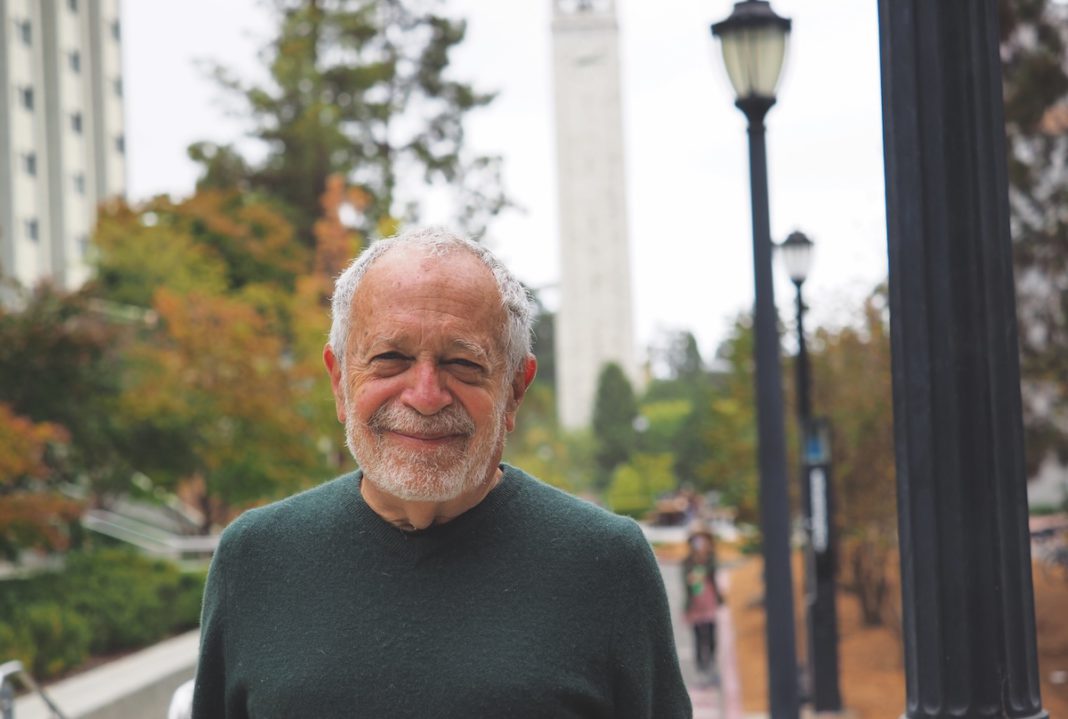
Most people at age 79 do not become film stars or cause the words “vigor” and “buoyant” to spring to mind. Robert Reich is not most people. Throughout his almost eight decades of life, the former U.S. Secretary of Labor and now professor of public policy emeritus at the University of California, Berkeley, has energetically championed the rights, causes, education, beliefs and ideas regarding liberty and democracy held by many people.
Reich, in addition to serving as labor secretary in the Clinton administration, was an economic advisor in 2008 on Barack Obama’s transition board and has written 18 books—The System, The Common Good, Saving Capitalism and more. His most recent book, Coming Up Short, chronicles his march through time, from his birth nine months after World War II to the present day.
Coinciding with the book is the film, The Last Class, which has catapulted him into greater visibility. Reich, during his years at UC Berkeley, has taught the immensely popular course “Wealth and Poverty.” On the cusp of retirement, a word he only grudgingly accepts, the film follows Reich through his last days as a regular figure on the UC campus.
For Reich, who is accustomed to cameras and is an astonishingly well-known public figure worldwide—he has been asked to autograph shoes and complete strangers on campus often holler, “Hey, Professor Reich”—the new cinematic role is a happy surprise.
In a late October 2025 interview, Reich said, “The best thing about all of this is the enthusiasm the movie has created. It’s a wonderful testament to what I try to leave with my students. I was amazed it played for eight weeks at the Rialto Cinema in Elmwood.”
Reich admitted he had doubts about the project when approached by the filmmakers: executive producer Heather Kinlaw Lofthouse, director Elliot Kirschner and editor/producer Josh Melrod.
“Education is not reading books or hearing lectures,” Reich said. “This is why I’m so thrilled the film emphasizes all the aspects of what education should be. I was skeptical initially that a film would help educators understand in a deeper, more fundamental way what they were trying to do or should try to do. When it’s talked about at the abstract level it sounds theoretical and diffuse, but they managed it beautifully.
“I didn’t expect it to be a feature film,” he added. “I thought it would be a short video. So I was surprised and delighted when it became a full-length feature and even more delighted by its success.”
The principles of good teaching, in Reich’s playbook, are most often related to social equality and involve students overcoming cynicism to actively engage as participants in democracy. Education is not exclusive to academia, and Reich insists people can participate at varying scales and in multiple forums—social, cultural, political and economic.
“People are participating all over,” Reich said during his interview last month. “Food stamps are likely to be unavailable, starting next week. There’s an opportunity to participate in communities in terms of food banks, pantries, and volunteering and offering time or money. Every community has its own needs and character. There’s no reason we can’t all be involved. Same thing for places of work: They can be either uplifting, exciting or fun, or deathly dull, horribly cynical and sharp-elbowed.
“We can contribute to improving quality of life wherever we are,” he continued. “These are actions not often called or understood as aspects of morality. I use my class mostly to help students at vulnerable points in growing up to have license, freedom and permission to explore their own values. To ask themselves hard questions, maybe change prior assumptions.”
The questions he asks and the actions he suggests show up not only in the classroom but in articles written for The New York Times, The Washington Post, The Wall Street Journal, The New Yorker and The Atlantic. Inequality Media, the organization Reich co-founded in 2015 with Emmy Award-winning filmmaker Jacob Kornbluth, reaches more than 22 million people, among them 10 million followers on various social media platforms. Complex topics such as the racial wealth gap, student debt crisis, free trade and Medicare are explained in short videos that inform and educate rather than direct people to follow specific courses of action.
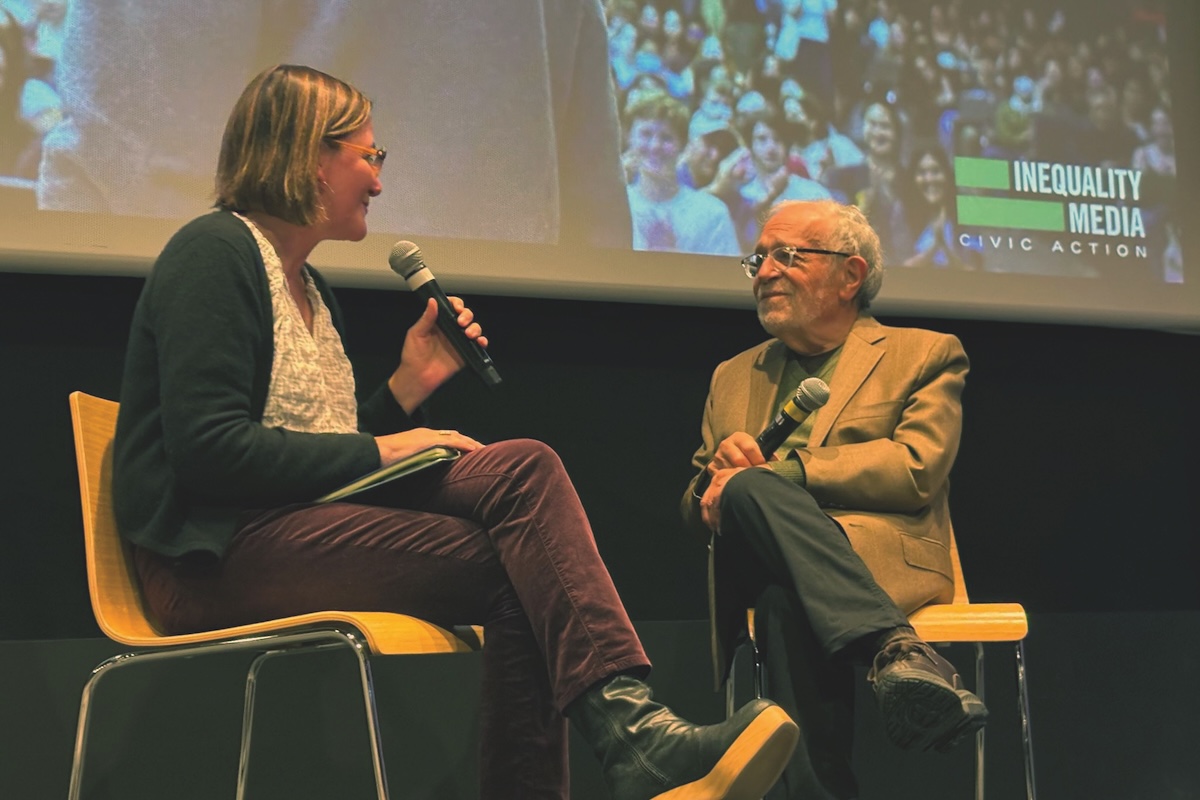
Reich himself proved he’s not done learning, saying, “yes, yes, yes,” when asked if writing Coming Up Short led to discoveries no prior book had revealed.
“[I saw] how heartbreaking so much of the last 79 years have been,” Reich said. “The story is not sad, but it’s tragic that we ended up with an authoritarian [in the White House]… and we have record levels of inequality and corruption. I was [observing] from the standpoint of my own experience, starting with being bullied as a little kid and extending through bullying most Americans now feel.
“Job growth has almost stalled. Most people’s wages have not gone anywhere. There’s fear in the country around escalating prices,” Reich continued. “People ask, ‘How did we ever get here, with government that’s dysfunctional and an economy not working for most people?’ They throw up their hands. In writing that book, I saw step-by-step what happened. I was involved in some of it, which is even more heartbreaking.”
Reich arrived in Berkeley, where he still lives, in 1968. The political climate was incendiary. Many of the issues then are mirrored by and found in news headlines in 2025.
“The differences aren’t nearly as large as we like to think,” Reich said. “Martin Luther King Jr. was assassinated. Robert F. Kennedy was assassinated. Our cities were aflame. Millions of Vietnamese and tens of thousands of young Americans were being killed. And then Richard Nixon became president. It was a perfectly awful year, as this year is turning out to be.
“There are slightly different [factors],” Reich continued, “the big one being Donald Trump as president is usurping the powers of the government, violating constitutional rights of individuals inside and outside the United States. He’s asserting authority or power no person was ever supposed to have. That has understandably imposed a pall over the entire country. In 1968, I was 22 years old. I was afraid America was going down the sinkhole. Ideals were disappearing. In 2025, I have many of the same feelings.”
Reich said the cacophony of voices expressing opinions as facts or misleading the public by failing to make sense of society, science, history, politics and the economy leaves him searching for voices of reason. Presented with a few people he might consider trustworthy and asked if the problem is actually people’s failure to listen well, Reich said the answer is both, not either/or.
“Nobody is listening well to anybody,” Reich said. “The dominant voices are Donald Trump and the loud voices of people using the media to amplify Trump’s authoritarianism. This is not a time in America where the public is being taught, with obvious leaders pointing the way to the future, guiding people. We don’t have, although we definitely need, an Edward R. Murrow, Walter Cronkite and civic leaders, university presidents or even public philosophers. We are adrift without the leading voices we need.”
The advent of social media and its tendency to skew toward loud, extremist voices that create a firestorm presents a nearly impossible battlefront. Reich said Trump has been “sucking oxygen out of the air since 2016” and has learned a great deal about the use of social media in the intervening years. He advises people feeling overwhelmed to find time and quiet space to think about what is happening in the United States and the world.

Lessons he hopes are most remembered and practiced by his students include the value of critical thinking and the importance of thinking for oneself, talking with people who disagree with them and taking a 30,000-foot, high-level view to avoid becoming caught up in the events or problems of the day. The velocity and intensity of the forces entering our ears, eyes, bodies and minds must be actively managed, Reich insisted.
Among Reich’s list of favorite questions is, “What’s the point of the national experiment that is the United States?” Another is a three-parter: “What is a good society, how do we get there and how do we recognize the elements of a good society?” Reich said his answers are not the most important. “As a teacher, my biggest responsibility is to come up with good questions, not good answers,” he noted.
But some answers he offers willingly, like what makes it possible for him to avoid becoming discouraged by the country’s continuing wage inequality, current media ecosystem and lack of ethically responsible leadership?
“I’m optimistic, for everything I’ve said. I see young people today, and I’m very pleased with what I see. My students give me optimism. The young people I work with at Inequality Media Civic Action give me great optimism,” he said. “They will be responsible for the future. The future is in good hands.”
And then, this vigorous, buoyant 79-year-old fellow set out to do everything and anything but retire. The world has become Reich’s new classroom.







Amen job well done by this gentleman … enjoy it.
Amen