It’s Friday night and the tiny venue is packed. People of all ages—mostly punk or punk-adjacent—crowd the bar, shouting drink orders over the blaring sound system. Others mill about, buzzing with anticipation.
She walks toward the stage, her heart racing, a bead of sweat forming on her upper lip. Stepping onto the platform, she takes a breath, grabs the mic, nods at the guitarist, then the drummer. The crowd leans in—faces expectant, willing her to begin. She feels jittery, slightly nauseous and totally alive.
And here’s the thing: She’s not in the band.
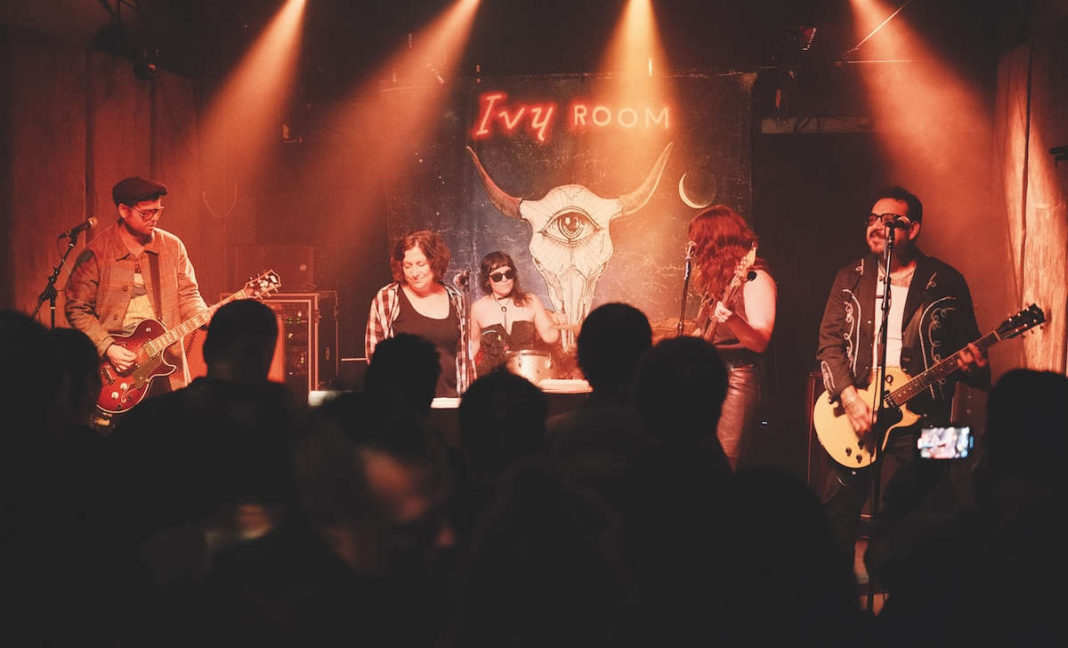
In fact, she’s never been in a band. What she is about to do is sing karaoke—backed not by a machine or a YouTube instrumental, but by a fully rehearsed, four-piece punk band playing live behind her. This is Punk Band Karaoke, an East Bay project that makes it possible for anyone—literally anyone—to live out a long-buried rock-star fantasy for three chaotic, glorious minutes.
The idea first sparked three years ago, when Julio Palacios managed music programming at the then-new Little Hill Lounge in El Cerrito. People kept asking for karaoke. “If we did karaoke,” Palacios recalls saying, “I’d want to do it with a real band. Like a Punk Rock Karaoke.”
He was thinking of the SoCal band from the late ’90s that functioned as something of an Orange County punk supergroup. That rotating lineup included Steve Soto of the Adolescents and Agent Orange, Derek O’Brien of Social Distortion, Greg Hetson of Circle Jerks and Bad Religion, and even Bob Mothersbaugh of Devo. It was equal parts reverent and ridiculous—punk mythology brought to life by letting regular people scream into the void.
Palacios, a guitarist, plays in Sweetwater Black, an Oakland band that formed about a decade ago. But as members started families and moved across the Bay, the band began playing less frequently. Still, Palacios couldn’t shake the karaoke-with-a-live-band idea.
Around that time, he befriended Berkeley drummer Gracie Malley, who was immediately on board. Malley plays in Rip Room, a “weird, slightly technical” art-punk trio based in San Francisco, as well as the Greasy Gills, an instrumental surf-rock band. She’s also been filling in on drums for the Wind-Ups, a garage-punk band connected to Oakland’s Dandy Boy Records.
“Genre-wise it’s a bit different,” Malley says. “But drumming style-wise I’m pretty much just ripping fast tempos, which is a zone I’m comfortable in. If I ever have to play under 130 BPM I feel naked and scared.”
Mack Narragan was DJing at Little Hill around the same time, and also signed on. He plays in the Oakland power-pop psych-rock band CVCC—pronounced “civic”—and records solo material under the name Dum1, where he plays all the instruments himself.
“It’s kind of jangle-poppy,” he says. “I love ’60s baroque pop, ’70s glam. It kind of runs the gamut from smarter stuff to dumb ’70s ‘Saturday Night’ Bay City Rollers and anywhere in between.”
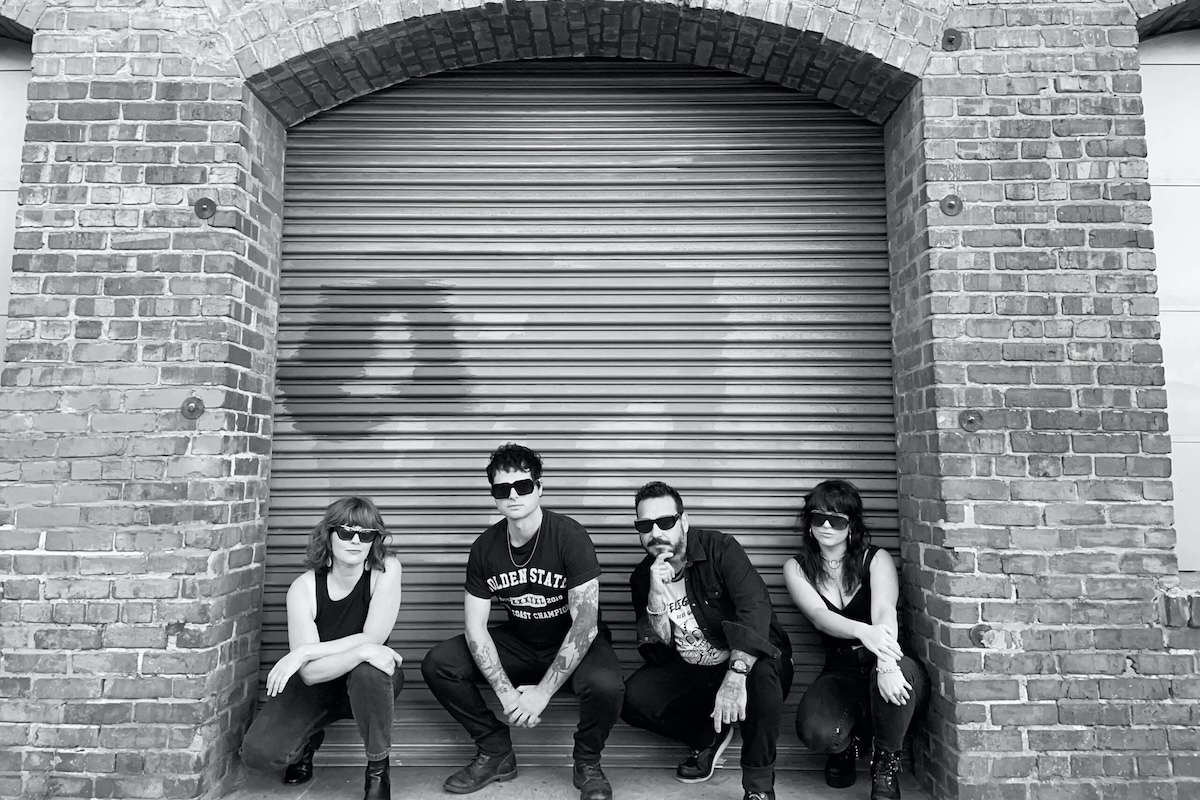
Punk Band Karaoke became official when bassist-vocalist Sarah McKinney joined in the summer of 2023. McKinney also plays in Rip Room with Malley, and the two share a deep musical shorthand forged over eight years of playing together. In spring 2024, Oakland DJ Cristy Nelson—a.k.a. DJ Cristy Bubbles—came on board to warm up the crowd at every show. While not technically in the band, she’s widely considered its unofficial fifth member.
“I view myself as a cheerleader for the band,” Nelson says. “I think they respect my knowledge of rock ’n’ roll and punk history so I try to bring out the obscure, popular and tracks from local bands.”
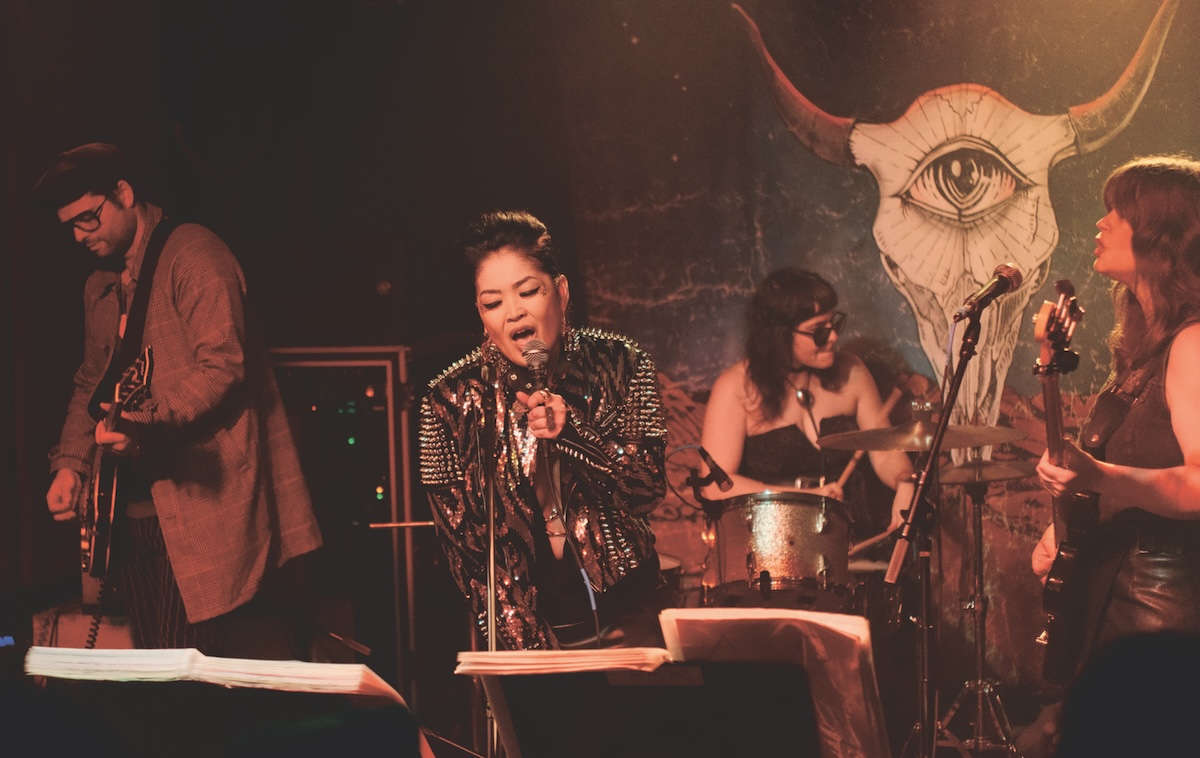
With Palacios on lead guitar and Narragan mostly on rhythm, Punk Band Karaoke (PBK) played its first show on Oct. 13, 2023, during Little Hill Lounge’s one-year anniversary. The initial setlist was 25 songs—each band member picked four.
“It’s cool because everybody’s taste within the band is a little different,” Palacios says. “We all pick different things so that keeps it pretty diverse.”
“We all grew up listening to punk,” McKinney says.
Over time, the song list grew organically. First came written request sheets at shows. Then another Rip Room bandmate, guitarist-songwriter John Reed, built a PBK website so people could request songs online. Those requests went into an Excel spreadsheet, where the band would choose which songs to learn before the next gig. They’re now up to 107 songs.
“When we first started doing this, it was me, Gracie and Mack,” Palacios says. “In those days, we were kind of trash.”
Narragan agrees. “Sarah and Gracie play in Rip Room, where it is so technical, so much virtuosity in that band. Me and Julio—we’re the loosey-goosey rock ’n’ roll boys. They school us. It’s definitely upped our game. Having them as the rhythm section is just an insane cheat code.”
All that practice means anyone can sing with the band, regardless of skill level or experience. That accessibility is the whole point.
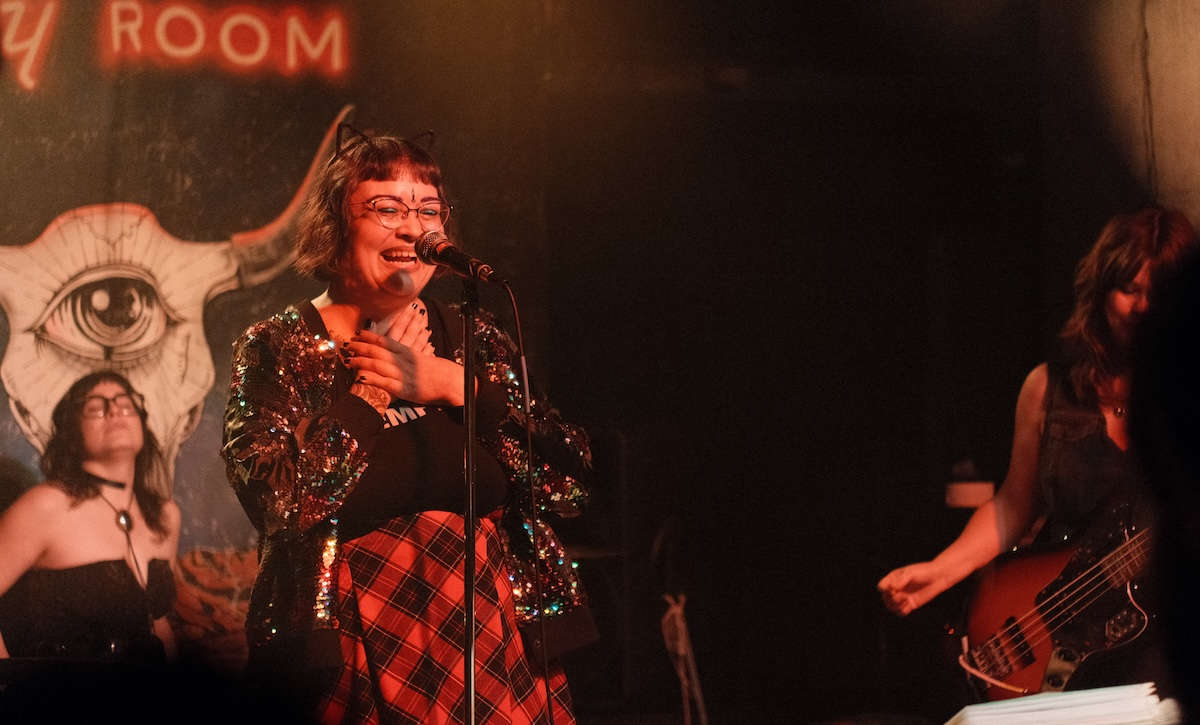
Sezín Devi Koehler, a local author and editor, found PBK soon after moving to the Bay Area last year. She finally attended a show on Nov. 22 at the Ivy Room in Albany.
“The moment I heard that you could sing karaoke with a live band I was sold,” Koehler says. “I’m a trained actor so the stage doesn’t scare me. But secretly, I’ve always wanted to be a singer.”
She chose “Sheena Is a Punk Rocker” by the Ramones—partly because it has relatively few lyrics, and partly in honor of a friend who introduced her to the band years earlier. She practiced by listening to the song on repeat, figuring that if she messed up at least the chorus would carry her through. She needn’t have worried.
“It was one of the best moments of my life!” Koehler says. “Performing with the band was one of the most magical things I’ve experienced. I’ve always wanted to sing with a punk band, but not being a singer has understandably put a wrench in those plans. Until Punk Band Karaoke, that is, making my lifelong dream come true.”
She’s now considering voice lessons. Not because she needs them, exactly—but because she wants to do it again.
“I love being on stage,” she says, “and feeling like part of an actual band was next-level enchantment.”
That transformation—from nervous curiosity to full-body exhilaration—is something the band sees every show. But it doesn’t happen by accident. When PBK was first getting started the members enlisted a friend to come sing during practice to help them figure out how to support future performers.
“[That first show] was sort of a trial by fire,” McKinney says. “It’s a bar so there are varying levels of sobriety.”
“People think they know the song, but then they don’t,” Palacios adds.
Lyrics are displayed on a monitor for singers, complete with cues for guitar solos and breaks. If someone gets lost, the band steps in—sometimes with a look, sometimes with a pointed finger, sometimes by singing along loudly enough to guide them back.
“I think a lot of bands kind of rely on the singer,” McKinney says. “There’s cues that you listen for when you’re playing a song. When you can’t rely on that with karaoke, we have to be the ones that are like, ‘We’re here.’”
“Sarah’s my cue,” Palacios says. “Sarah knows the songs and I just watch her.”
When things go wrong—and they occasionally do—they tend to go wrong gloriously. One night, a singer bailed on a Sex Pistols song moments before it was supposed to start.
“So I asked the crowd, “Does anybody want to do ‘Bodies’?’” Palacios says. “This guy came up out of nowhere, sang it perfectly without looking at the words, crushed it—[and then] just walked off.”
Another night, a man stumbled while getting onto the stage to perform Talking Heads’ “Psycho Killer.”
“But the audience all knew the words,” McKinney says. “Everybody was singing and it was just like, OK, we all know where we’re at here.”
Those moments—when the room collectively steps in—are what keep the band coming back.
“That’s the biggest surprise to me, show after show,” Narragan says, “is the way that people support each other. It’s way cooler to see somebody come up, belt their life out on the stage and then that’s the person sweeping the floor at the end of the night when you’re loading out. Average people get to play these shows, where people are so engaged with them and positive.”
For Malley, the emotional impact is unmistakable.
“People say things like, ‘I was at the first show and thought I’d never sing on stage but after talking to my therapist about it, she said I should, so fuck it here I am,’” she says. “And then they’d dive into ‘Rebel Girl’ [by Bikini Kill].”
It’s also unexpectedly healing.
For people who insist they “can’t sing,” Punk Band Karaoke offers something rare: teamwork. Singers aren’t alone up there. The band sings with them. The crowd sings with them. The pressure dissolves.
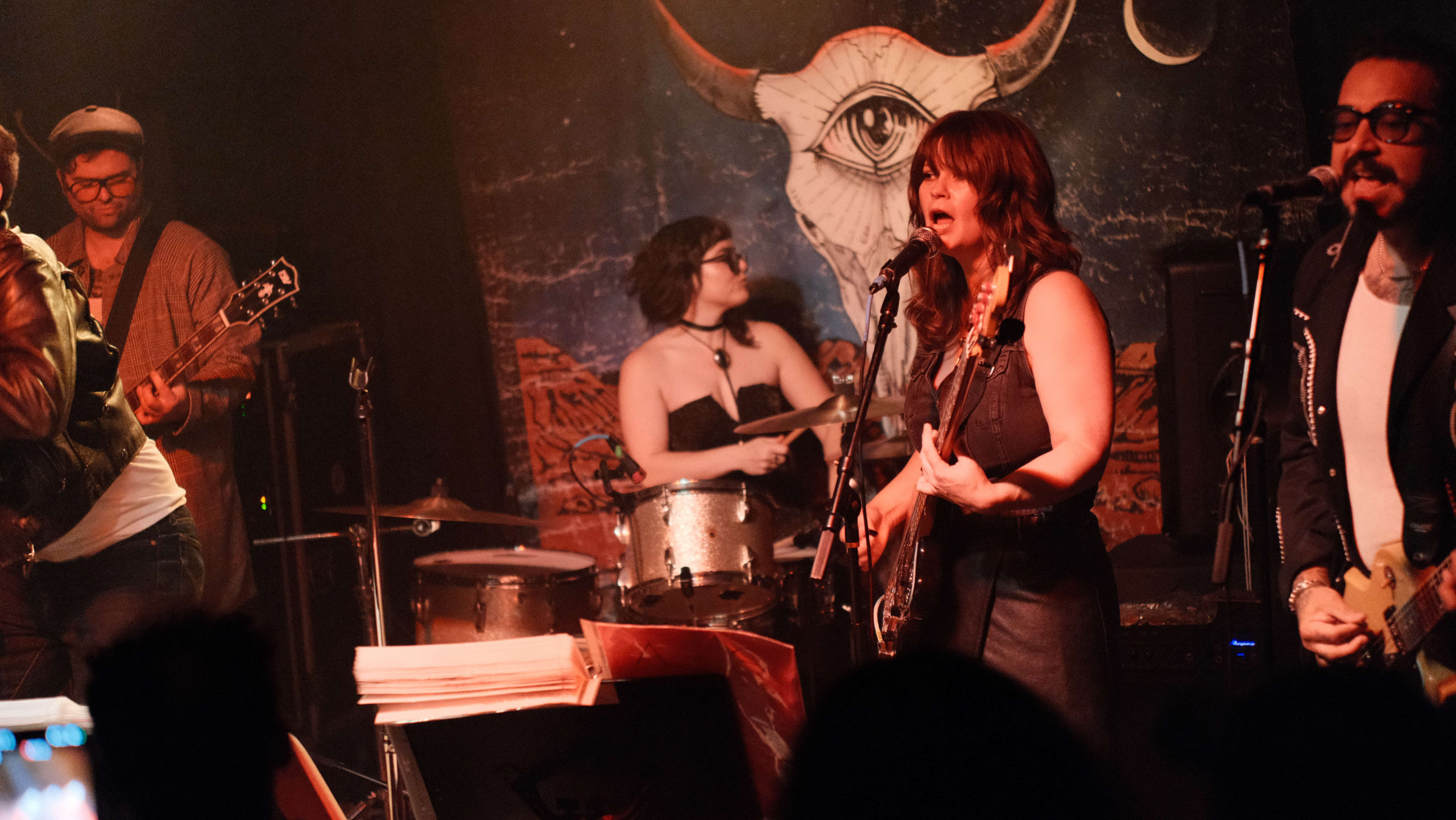
“It’s not like you’re just going up there alone like karaoke,” Palacios says. “There’s the four of us, we’re going to be right there with you. We’re going to sing when you don’t sing. We’ll sing with you. We’ve got the chorus. Just come up, you can do it.”
McKinney adds, “It does feel like you’re in a band. It’s really an exciting feeling if you haven’t experienced that.”
Narragan puts it more philosophically. “[It] democratizes the musical landscape,” he says. “Everyone talks about punk as if it’s this monolith where there’s this connection with the crowd. But there’s still this blockism. And [with PBK] that wall is torn down, yet it’s still in this great show environment.
“And on top of that, we’re not being overly earnest about it. We’re gonna create a fun environment. We’re gonna support you. It’s a give and take. Fortunately for us, it’s just been incredible,” he adds.
“People have talked about it like it’s church for them,” Malley says. “I’ve played hundreds of shows in my life and there’s something different about the energy in the room at a PBK show. The way the audience is way more visibly appreciative of both what you’re doing but also what their peers are doing on stage. It’s really wholesome. Pretty classic that the punk crowd is just a bunch of sweethearts.”
In a scene often defined by coolness and detachment, Punk Band Karaoke is radically sincere. It’s messy, generous, occasionally off-key—and deeply human.
“In a lot of ways it feels more like providing a service in the community but by being in a band,” Malley says. “I love it.”
On any given Friday night, that service looks like someone conquering a fear, honoring a friend or remembering—just for a moment—what it feels like to be brave, loud and alive.
Punk Band Karaoke plays Friday, Dec. 19 at Bar 355, Oakland; and Jan. 9 at Thee Stork Club. More info: punkbandkaraoke.com.