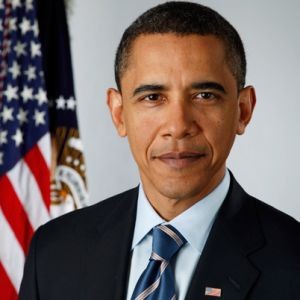
Addiction specialists often say admitting a problem is the first step toward recovery. Well, VICE magazine, in conjunction with HBO, released on Monday for free an hour-long bombshell documentary that depicts the US criminal justice system hitting rock bottom, with both President Obama and former Attorney General Eric Holder saying the system is broken.
The president says it could be anyone’s family that can be shattered by this system, which Senator Cory Booker says is set up to “crush” low-income Americans. The criminal justice system is institutionally biased according to race, “particularly when you think about non-violent drug offenses,” Holder says. “It’s not normal.”
In related news, the FBI released new data yesterday showing US marijuana arrests rose to more than 700,000 in 2014. Almost 90 percent of those arrests were for simple possession. One person will be arrested for marijuana about every minute, which means while you read this, someone just got cuffed. Blacks are up to thirty times more likely as whites to be arrested for pot in the United States, despite similar usage rates.
[jump]
[embed-1]
As VICE documents, one out of every three black children born in the United States today will go to jail at least once in their lives. VICE features a former federal judge who says mandatory minimum sentencing laws enacted by Congress in the Eighties and Clinton in the Nineties are wildly unjust. Sex offenders and rapists get far less time than fathers and sons with non-violent drug offenses.
Folks are pleading guilty and serving fifteen years in federal prison rather than face potentially life for “ghost dope” — conspiracy charges based on hearsay evidence. Mandatory minimums are so terrifying, the federal system has a 97 percent guilty plea rate. It is prosecutors, not judges, who now decide time served.
America is also dealing with the generational consequences of fifty years of mass incarceration. The nation has families in which three generations of males have done time. There are 1.1 million fathers behind bars. There are more Black folks in state custody than there were slaves in 1850.
When convicts get out, they’re barred from getting a job, credit, food stamps, college loans, and housing. States are also releasing citizens with huge debts and re-arresting them when they can’t pay them. With no diploma and a record, it’s no wonder 50 percent reoffend within one year. It’s barbaric.
A bipartisan effort is underway in Congress to reform the entire system, due to both its immense fiscal and human costs. We’re spending $80 billion a year on “corrections” systems that do not correct anyone.
But as the documentary shows, the single biggest challenge of America in the 21st century will be repenting for five decades of silence and inaction.
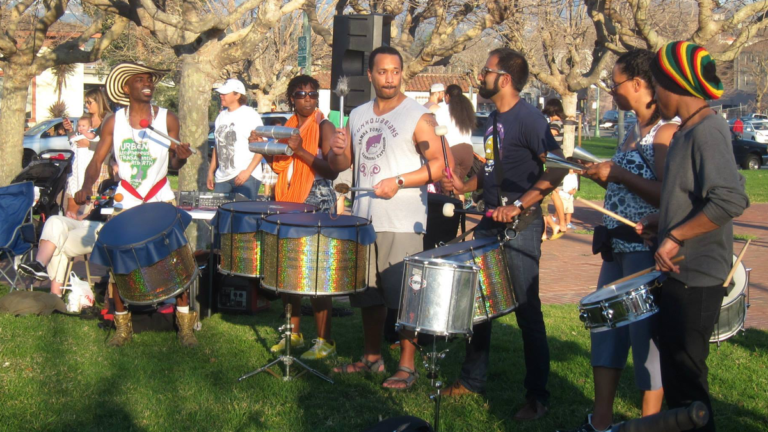
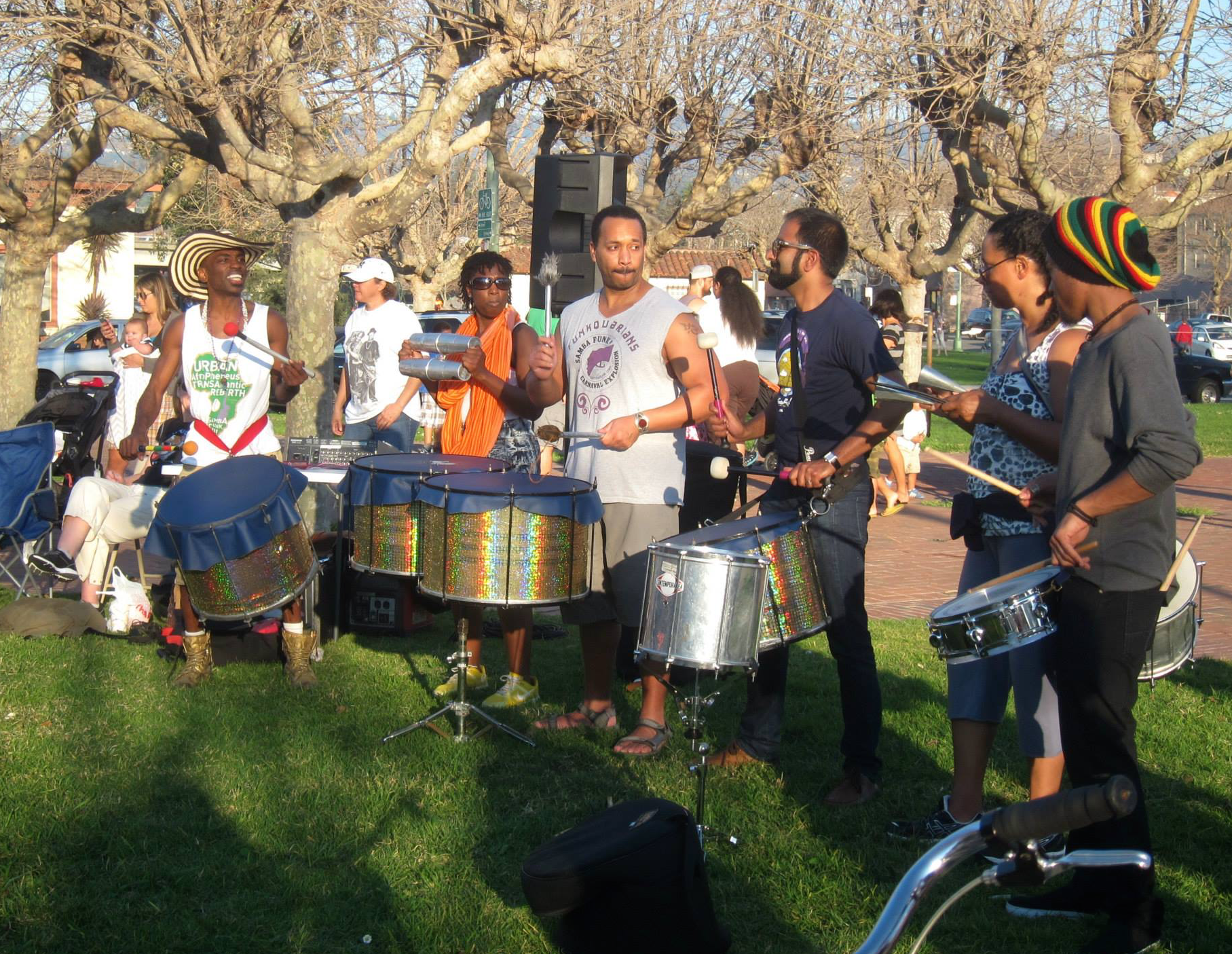
SambaFunk! drummers at a different Lake Merritt event.
Credits: Elise Evans / Courtesy of SambaFunk!
On Sunday night, a white Oakland resident called the Oakland Police Department on a small group of Black and Latino drummers by Lake Merritt, resulting in multiple citations and sparking extensive debates online about racial profiling, biased policing, and gentrification. The story has since gone viral on social media with a Facebook post from local radio journalist Davey D Cook who argued that this case is just the latest example of white residents who are newer to Oakland and the Lake Merritt area complaining about the activities of longtime residents of color — leading to unnecessarily aggressive responses from police.
I spoke by phone this morning with Theo Williams, the artistic director of local group SambaFunk!, who was part of the drum circle on Sunday and had also posted an account of the incident on his Facebook page. Williams, who is Black and grew up in Oakland, said that roughly a dozen OPD officers ultimately responded to the call and that he felt many of the officers had not treated him or his fellow drummers fairly and were clearly biased toward the caller, who is a white man who apparently lives nearby.
An OPD spokesperson told me via email that officers responded to a call at 9:51 p.m. to the 100 block of Lake Merritt Boulevard (the south side of the lake at the Lake Merritt Amphitheater) after receiving a “report of a noise disturbance and an assault.” The officers issued multiple citations related to the assault allegations and will have to appear in court before a judge, according to the spokesperson, who did not respond to my requests for additional information.
Williams said that he and about six others — all people of color — started drumming just after 7 p.m. in time for the rare lunar eclipse happening that night. He said they played for about ninety minutes, at which point the white man showed up and allegedly started shouting at them.
“He is screaming and yelling, ‘What are you guys doing in the park?! … Do you have a permit?'” Williams recalled. “I’m looking at him and I’m like, ‘Who are you?'” Soon after, according to Williams’ account, the man lunged at Williams, grabbed his wrists, and pulled his drumsticks out of his hands. “I said, ‘You cannot start grabbing on people and trying to take their personal property.’ … I couldn’t believe this was actually happening. … He said, ‘If you don’t stop drumming, I’m calling the police,'” Williams said. The man shortly thereafter did call the police on the drummers, and by the time four OPD officers arrived around 10 p.m., the group had already ended the drum circle — not because of the man’s demands, but because they were done for the night, according to Williams.
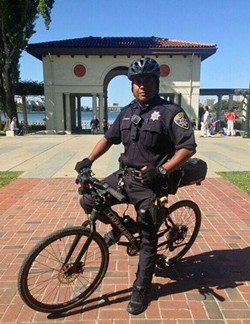
But even though the drumming was over, the conflict only escalated after the police arrived. “The police, of course, didn’t hear any drumming,” Williams said. “But they immediately began to take the side of this gentleman.” Williams said police were hostile toward him from the start: “They shine a light in my face and scream, ‘Get back, stay where you are!’ … They immediately assumed because I’m Black, that I’m the perpetrator. … They just assumed that we had done something wrong.” An Oakland police officer patrolling Lake Merritt.
Credits: oakland police department
The man who called the police informed the officer that he wanted to press charges against Williams and several others for assault, according to Williams. At that point, Williams said he told the officer that he wanted to press charges against the man who had called police, since that man had clearly attacked him when he grabbed his wrists and drumsticks. “He’s the one that came here and assaulted me,” Williams said. The other drummers that the man was accusing of assault had not even had any physical interactions with the man, according to Williams. Eventually, at least six more officers and a sergeant showed up to the scene, he said.
After much discussion, the man who had called police apparently agreed not to press charges against Williams, but still pressed charges against several others, Williams said. An officer subsequently tried to encourage Williams not to press charges against the man, which Williams said was frustrating. “Are you working for him or are you just out here to find out what’s going on?” he said. “He’s coming here and flexing his white privilege and you guys are supporting that with the way you’re responding.”
The situation escalated further when one of the drummers accused of assault didn’t have his ID on him, Williams said. The whole ordeal lasted until 1:15 a.m. and apparently resulted in citations against multiple people who were in the drum circle and the man who had originally called police. I have not yet been able to confirm the identity of the man who called the police or reach him for comment.
Williams — who lives in downtown Oakland and also runs Caribelinq, a group that does local arts consulting and events — said that he and others are now organizing to speak out about the incident at the Oakland City Council tonight. He said he does not believe police treated him and the other drummers fairly. “It looks like another one of these cases where anybody who is white and calls the police and says anything about any person of color, that person is guilty until proven innocent.”
In his Facebook post, Cook said that police have been more aggressively patrolling and policing people of color at Lake Merritt for harmless activities, such as amplified sound and barbecuing. As my colleague Darwin BondGraham wrote in May, police started putting up electronic billboards on the eastern side of the lake threatening to cite people for drinking or barbecuing. Those threats also prompted lengthy discussions about gentrification and profiling, with some arguing that police were clearly targeting Black residents through the crackdown on partying.
The drum circle protest is scheduled for 5:30 p.m. tonight outside Oakland City Hall.
Update, October 2, 12:10 p.m.: An individual named Sean McDonald, who said he was the person who had called police on the drummers, has posted a statement in the comments offering his side of the story. His account is below.
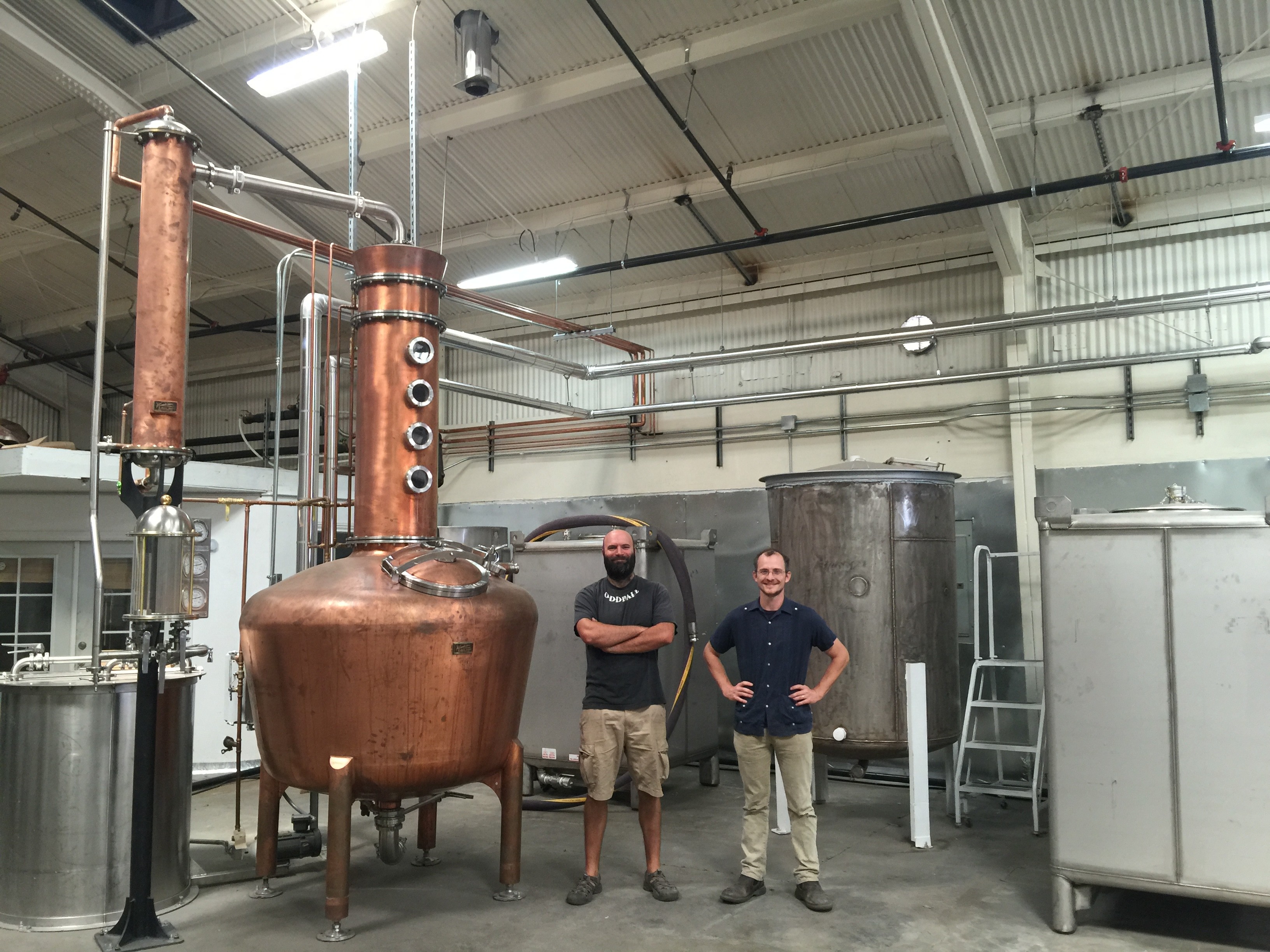
Daniel Wright (left) and Earl Brown in their West Oakland facility.
Credits: Sara Hare
It’s sweltering hot inside this nondescript warehouse building in West Oakland, and for the fifth or sixth time in the past twenty minutes, Daniel Wright hands me a glass tumbler full of freshly distilled brandy and asks me what I think. What I’m thinking about, really, is how to take as tiny a sip as possible so my throat doesn’t burn too badly, and I don’t have another coughing fit and lose face in front of this burly, thickly bearded tugboat-captain-turned-distiller-of-craft-spirits.
Also, as the afternoon wears on: that this brandy doesn’t taste half bad.
[jump]
Later, I was told the liquor I took progressively tinier sips of had historic significance: It was what Wright and business partner Earl Brown believe to be the very first batch of brandy — or any craft spirit, for that matter — to be legally distilled in Oakland since the onset of Prohibition.
The two entrepreneurs are childhood friends who grew up in the same remote section of Humboldt County, and they’re the proprietors of Wright & Brown Distilling, a new distillery that they say is the first one to open in Oakland in nearly a century. Even though their still was producing brandy — a relatively low-risk product to make while Wright, the head distiller, is getting a feel for his equipment, because all that’s required is a supply of inexpensive wine — during my visit, their plan is to primarily manufacture whiskeys.
The centerpiece of their West Oakland facility is an old-fashioned copper still that was hand-built by Vendome, a one-hundred-plus-year-old company based in Louisville, Kentucky. It’s a gorgeous piece of machinery, all burnished metal, analog dials, and ancient-looking little portals, like some gadget out of a Jules Verne novel. And that’s fitting because Wright and Brown talk about wanting to produce craft spirits in a decidedly old-school way.
Credits: Wright & Brown Distilling
Brown said he remembers a trip, years ago, when he and Wright visited the Jim Beam factory in Kentucky and saw the company’s 65-foot-tall still, with every possible variable monitored via computer screens in an air-conditioned control room. At Wright & Brown, distilling brandy or whiskey appears to be as much art as science. Wright can manipulate the temperature of the brandy he’s distilling, but ultimately, he said, his palate is his most important piece of equipment. Hence, the constant tasting and re-tasting of each batch.
“When you make something good, it is art,” he said.
According to Brown and Wright, the reason that Oakland has yet to develop a vibrant craft-distilling scene, despite a steady proliferation of craft breweries and boutique urban wineries, mostly has to do with the challenging regulatory environment throughout California. Generally speaking, it’s very difficult to even learn how to distill whiskey and other spirits in the United States, because, unlike with winemaking or beer brewing, it isn’t something that amateurs can experiment with, legally, in their garage or basement, unless they obtain the same kind of federal and state permits that a gigantic company like Jim Beam has. That’s a costly and time-consuming process — Brown said they waited about a year and a half — that basically makes it impossible for a hobbyist to dabble.
What’s more, California’s strict restrictions on the sale of spirits set up a three-tier system that makes it difficult for a small-scale operator to profit. A company such as Wright & Brown has to go through a wholesale distributor, who then sells the product to restaurants and liquor stores, who, in turn, finally sell that bottle or shot of whiskey to the customer. A bill that Governor Jerry Brown signed into law in 2013 allows distilleries to sell small samples to customers onsite — a modest concession that Wright and Brown hope to take advantage of once they set up a licensed tasting room. But the ability to do direct sales of entire bottles, which would be the real game-changer, remains off-limits.
Added to this is the fact that distilling spirits is the ultimate in “slow food,” with a barrel of craft whiskey typically needing to age at least three years — if not five or ten — before it becomes a viable product. “I always think of it as literally putting time in a bottle,” Wright said, describing the near-magical process by which a grain, fruit, or nut gets distilled down to its essence. That said, he expects that, by working in tiny batches, Wright & Brown will be able to start selling bottles of whiskey, brandy, and rum in as little as six months.
But Brown believes that while they’ve tentatively laid claim on the title of “first,” there certainly will other distilleries coming to Oakland. Earlier this summer, the Uptown Oakland winery Two Mile Wines announced plans to launch a gin distillery, and Brown said that with the interest in locally produced craft foods and beverages higher than ever, it’s only a matter of time before even more distillers set up shop — regulatory challenges be damned.
Barley from the Mattole Valley.
Credits: Luke Tsai
Brown, for his part, already talks the talk of a slow food veteran. He said he’s buying barley from a farm in the Mattole Valley, in the same Northern California small town where he grew up, and wants to use it to create a single-malt, “single origin” whiskey — to use the nomenclature of the third-wave coffee movement. He also wants to work with local wineries to make special-label brandies that feature their respective wines.
Walking me out, Brown gestured toward the surrounding neighborhood, with its vacant lots and barbed-wire fences, pointing out that this industrial stretch of West Oakland has increasingly become a kind of secret foodie neighborhood: Hodo Soy and OCHO Chocolate both have their manufacturing facilities nearby, and the folks at FuseBOX, the scrappy Korean restaurant down the street, are busy making dozens of varieties of kimchi at any given time.
Like all of those enterprises, the Wright & Brown Distilling warehouse doesn’t look like much from the outside. But its proprietors are hoping that a year or so from now, Bay Area whiskey connoisseurs will be awfully glad they’re around.
1. The median home price in Berkeley topped $1 million for the first time ever at the end of the second quarter of 2015, SFGate reports, citing a Red Oak Realty analysis published on Berkeleyside.com. The median price for a single-family home was $1.05 million in Berkeley, where homes are selling for an average of 19.9 percent over the asking price. The median home price in San Francisco is $1.425 million. In Alameda County, only 18 percent of the population can afford to pay the median home price.
2. Governor Jerry Brown’s much-touted prison realignment plan has had few impacts since it was implemented in 2011 — other than relieving overcrowding in the state’s prisons, the SacBee$ reports, citing a new analysis by the nonpartisan Public Policy Institute of California. Realignment, which transferred nonviolent inmates from prison to county jails, has failed to save any money and has had no effect on recidivism — as Brown and other proponents had claimed it would. It also has not led to any increases in crime, as opponents had claimed.
[jump]
3. Anti-vaccination groups turned in signatures yesterday on a petition to put California’s new mandatory vaccine law on the November 2016 statewide ballot, the LA Times$ reports. However, it looks as if the anti-vaxxers, which depended on an all-volunteer effort, may have failed to gather the necessary 365,000 signatures.
4. Scientists discovered a colony of Africanized honeybees, better known as “killer bees,” in the Bay Area for the first time in Reliez Valley, a section of Lafayette near Briones Regional Park in Contra Costa County, the CoCo Times$ reports. Killer bees have the ability to swarm and kill animals and are known to wipe out other bee colonies.
Brontez PurnellYounger Lovers
Brontez Purnell, frontman of garage rock band the Younger Lovers, is a locally renowned musician, dancer, choreographer, and writer. But perhaps most fascinating of all is that, although mainstream museums and publications have championed his work, Purnell’s approach to his art has been adamantly DIY. Originally from rural Alabama, Purnell came to Oakland in the early Aughts and quickly immersed himself in its punk and queer scenes. His electro-punk band Gravy Train!!!! became well known locally for its uninhibited live shows and, as the band’s singer and hype man, Purnell gained a reputation for his flamboyant stage persona. Though the group dissolved in the late-2000s, Purnell continued to make waves with his other creative ventures. He started the Brontez Purnell Dance Company and published his first book, The Cruising Diaries, an illustrated memoir he adapted from his earlier zines chronicling his sexual exploits. Simply put, Purnell is a force of nature. His current music project, the Younger Lovers, performs at Eli’s Mile High Club with LA rockers Contrafang and Oakland DJ collective Trill Team 6 this Saturday. — Nastia Voynovskaya
Sat., Oct. 3, 8 p.m. $TBA. ElisMileHigh.com
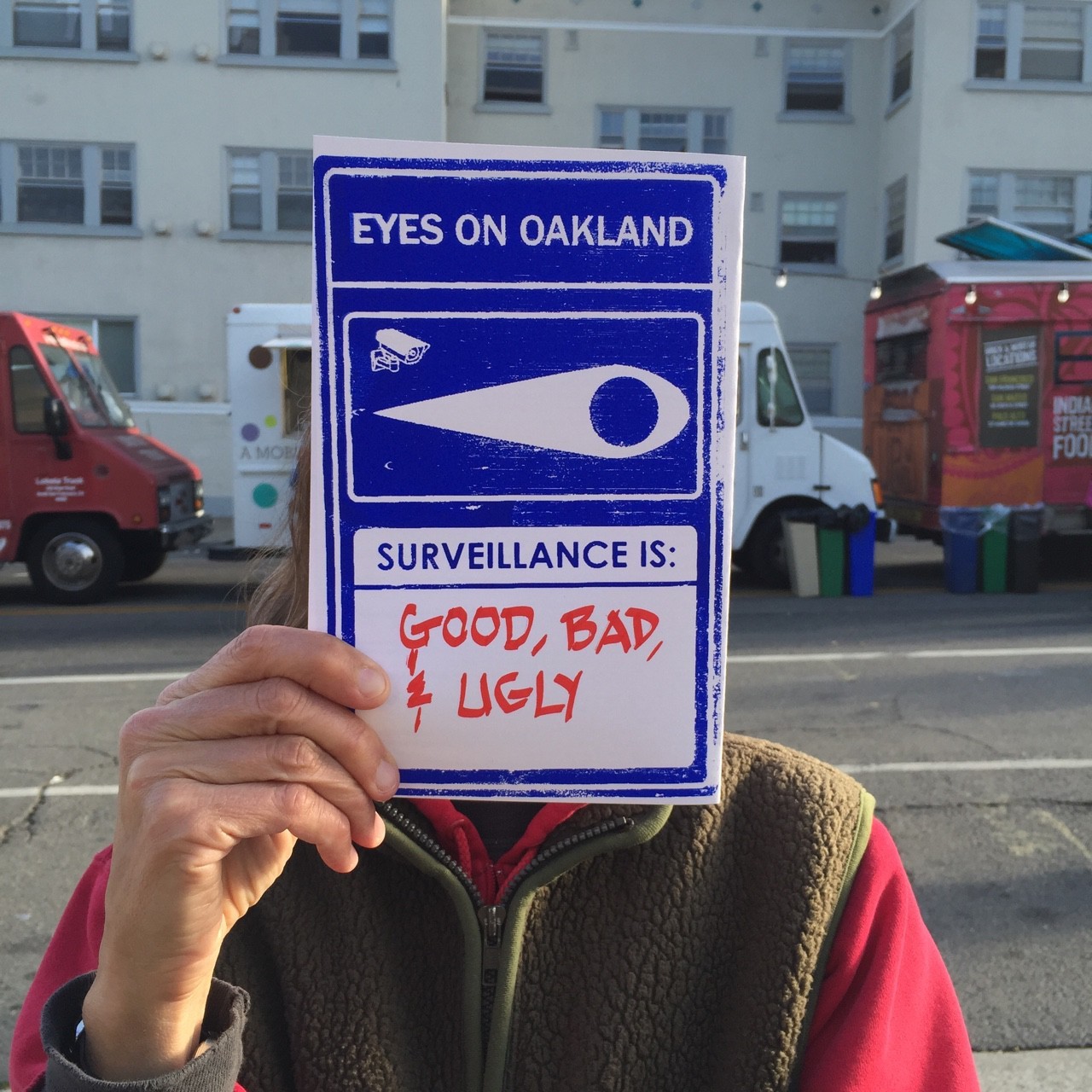
Credits: Courtesy Eyes on OaklandEyes on Oakland
You may have seen the Eyes on Oakland project roving around Oakland in a Ford Falcon van retrofitted as a mobile newsroom. Or, it may have seen you. Eyes on Oakland is a hybrid journalism and interactive art project that aims to inform Oakland residents about the various types of surveillance used by police and give them the opportunity to share thoughts and concerns on camera. The project is an ongoing collaboration between Mobile Arts Platform and the Center for Investigative Reporting that was part of the Oakland Museum of California’s Who is Oakland? exhibit — through which many citizens’ reflections were shared, and more were gathered. So far, the project’s leaders have collected hundreds of opinions by popping up around The Town, and have staged many conversations regarding how to maintain balance between privacy and public safety. On October 2, from 5–8 p.m., Eyes on Oakland will be sharing its footage on The Great Wall of Oakland, a huge wall on West Grand Avenue, between Valley Street and Broadway. The screening is public and free, but bring something to sit on if you plan to stay a while. — Sarah Burke
Fri., Oct. 2, 5-10 p.m. Free. GreatWallofOakland.org
Boorma, a not-so-distant cousin to Middle Eastern baklava.63rd Annual Armenian Food Festival and Bazaar
The fact that the East Bay doesn’t have a proper Armenian restaurant makes this food festival — the biggest event that the St. Vartan Armenian Church (650 Spruce St., Oakland) hosts each year — all the more attractive. Where else can a person who has a taste for well-spiced lamb and buttery phyllo dough go to get his or her fix? Specialties to target at the two-day feast include koofta (a kind of stuffed lamb meatball), boereg (meat- or cheese-filled phyllo pastries), and an assortment of breads and pastries, including cigar-shaped boorma, a not-so-distant cousin to Middle Eastern baklava. Most of the food has been prepared by members of the congregation, with a la carte items priced at $3–$6 apiece. Taste something you love? Frozen versions of many dishes will be available for purchase at the popup khanoot, or country store, along with a variety of Armenian pantry staples. — Luke Tsai
Fri., Oct. 2, 5:30 p.m. $1, $3. StVartanOakland.org
The planetarium at Chabot Science Center.Lost in Space
Why would you drink beer at a bar when you could drink beer while on a mission to Mars? Once a month, the Chabot Space and Science Center (10000 Skyline Blvd., Oakland) gives guests the opportunity to do the latter — kind of — through its “Lost in Space” simulated space mission. While the center regularly hosts daytime mini missions to Mars that are for astronauts ten years old and up, “Lost in Space” missions take place during more adult hours (from 7–9 p.m.) and are partially fueled by beer and wine. Normally, participants land on the red planet and are tasked with constructing a probe to send to one of the moons of Mars. But for Chabot’s special “Spooky Halloween Lost in Space,” which takes place on October 3, things are likely to go wrong. There’s a good chance that Martians will be involved, but there’s no way of knowing whether they’ll be friendly. — S.B.
Sat., Oct. 3, 7-9 p.m. $30. ChabotSpace.org
Queens D. Lite.Ships in the Night
Ships in the Night is one of the East Bay’s most widely attended, monthly queer parties, so much so that the event’s organizers faced controversy last year for publishing an open letter that suggested that only LGBTQ people — and not straight allies — should attend. While some found this approach alienating, others agreed that a safe space for queer people, especially queer people of color, is paramount in the East Bay as gentrification progresses. With that said, this month’s Ships will be a good one: DJs Durt, Mutie, Minh La, and Rumorosa will spin party jams on the New Parish’s two dance floors. Local rapper Queens D.Light — who recently returned from an extended stay in New York City, where she worked on her forthcoming EP — will perform. While Queens’ last album, California Wildflower, featured down-tempo beats and lyrics that reflected on her Yoruba faith, her recent live shows have foregrounded unreleased tracks with more danceable production. The party’s proceeds will benefit El/La Para Trans Latinas, a nonprofit that provides a community space and Spanish-language health and counseling services to trans Latinas in the Bay Area. — N.V.
First Saturday of every month, 9 p.m. $5. TheNewParish.com
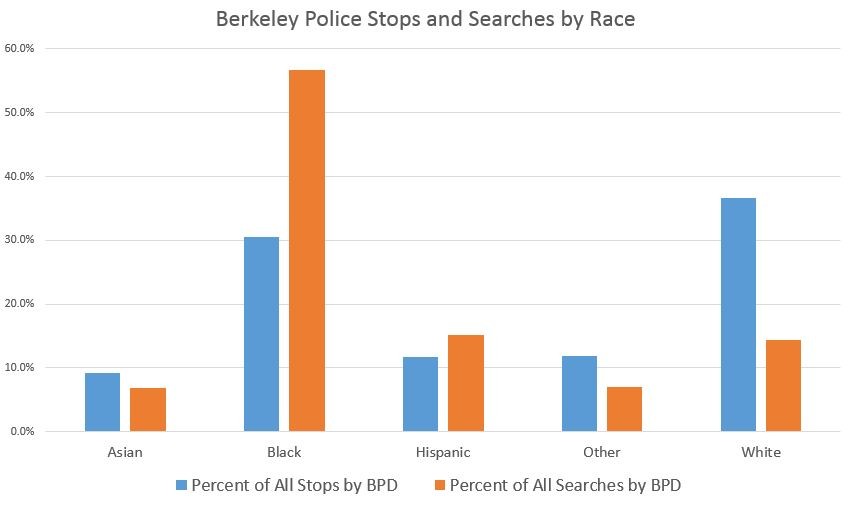
Despite being only 8.4 percent of Berkeley’s population, Black people accounted for 30 percent of all traffic stops by the Berkeley Police. They were 56.6 percent of all searches.
Credits: Darwin BondGraham
Recently obtained data tracking Berkeley police stops and searches appears to show racial bias among officers. A coalition of groups including the Berkeley NAACP; UC Berkeley Black Student Union; Berkeley Copwatch; the ACLU of Berkeley; and the National Lawyers Guild, San Francisco Bay Area Chapter obtained the data set through a public records request. They shared the data set with the Express.
“We have long suspected that there was racial profiling happening,” said Anrdrea Prichett, a founding member of Berkeley Copwatch who wrote the records request. “We’ve tried to get some data that would verify that, but for the longest time BPD said they didn’t collect this kind of information.”
Last year, the city began requiring its police to collect stop data including the race, gender, and age of each person stopped, whether a search was conducted, and if the stop resulted in an arrest, citation, or a warning.
The Berkeley police stop data set tracks 4,659 traffic stops conducted by Berkeley police officers between January 24, 2015 and August 12, 2015. While Blacks only account for 8.4 percent of Berkeley’s total population, they represented 30.5 percent of all stops by Berkeley police officers. White people, on the other hand, who account for 56 percent of Berkeley’s total population, were only 36.7 percent of those stopped by the police.
[jump]
Searches were conducted in similarly disproportionate numbers. About 1 in every 5 Black people stopped by the Berkeley police were searched, whereas less than 1 in every 20 white people stopped was searched.
Civil rights attorney Jim Chanin said the data shows classic signs of racial profiling. Chanin pointed specifically to the rate at which stops of each racial group resulted in a citation or arrest, or releasing the person with only a warning.
According to the data set, even though Blacks are much more likely than whites to be stopped and searched by Berkeley cops, they are actually no more likely to be arrested, and much less likely to be cited for any kind of infraction. In other words, Berkeley cops appear to be stopping and searching Black people at higher rates than other racial groups, but they are finding no reasons to justify the stops.
“The African American percentage released without arrest or citation should be same as whites if there no profiling,” said Chanin. Chanin said the lower “hit rate” at which a stop and search of a Black person led to an arrestable or cite-able offense shows that some Berkeley cops are pulling people over simply for being Black or Latino.
The coalition of groups that obtained the data are holding a press conference tomorrow at 11 am in the Berkeley City Administration Building where they will release more information.
The Berkeley Police Department did not respond to a phone call seeking comment.
Nas performed songs from his classic album, Illmatic, on the second day of Bay Area Vibez.
Credits: Erin Baldassari
The Bay Area Vibez festival landed at the Port of Oakland this past weekend, bringing world-renowned reggae, electronic, and hip-hop artists to Middle Harbor Shoreline Park — a vast, open space that overlooks the San Francisco skyline. In its first year, the event arrived with a seemingly enormous budget and star-studded lineup that included living legends Stephen Marley, Damian Marley, and Nas.
But despite the festival’s grandiosity, the event ultimately felt like a way to capitalize on people’s nostalgia for bygone eras, prioritizing artists who haven’t released new material in years or are descendants of celebrated musicians. And though the name of the event suggested otherwise, the vibes were not very Bay Area at all, with the majority of the musicians coming from other parts of the country and the Caribbean. That in itself is not a problem — but the name of the event came off as empty lip service to hometown pride. This seemed somewhat disingenuous because the event competed directly with Oakland Music Festival, which primarily showcased local talent and took place during the same weekend.
However, if you weren’t looking for innovative sounds or up-and-coming, local artists and just wanted feel-good music, Bay Area Vibez certainly was the place. Middle Harbor Shoreline Park provided a gorgeous setting for the event, with the sun setting over the foggy San Francisco skyline on Saturday to a soundtrack of mostly roots reggae.
[jump]
[slideshow-1]
Morgan Heritage, a band composed of five siblings whose father, Denroy Morgan, was a popular reggae artist in the 1980s, performed tracks from its new album, Strictly Roots. The release mostly follows a traditional, roots reggae template, but occasionally pushes its mellow sound in new directions with the addition of dancehall and R&B vocals. Morgan Heritage’s live set, however, focused on easy listening rather than spontaneity. The musicians are undeniably skilled and delivered produced-sounding, studio-quality versions of their tracks, but their set flatlined at an even tempo and prominently featured smooth jazz saxophone that easily faded into the background.
As clouds of weed smoke filled the sky, Saturday ended with sets by Stephen Marley and Damian Marley. Stephen Marley is a talented vocalist — with a soft yet raspy voice and a wide range — and six-time Grammy winner. But he hasn’t released new material in four years and filled his performance with Bob Marley covers, leaving original songs wanting. One of his set’s stand-out moments was when he brought out Skip Marley, his nephew and Bob Marley’s grandson, to the stage. Skip Marley played his single “Cry to Me,” a slow, somber reggae song with a sparse beat that works well with his warm, emotive timbre and sentimental lyrics. His brief performance demonstrated his ability to carve out his own lane while continuing family tradition.
While Stephen Marley’s set focused on his father’s legacy, Damian Marley, who closed out the day’s performances, proved to be more forward-thinking in his approach. He energized the crowd with his rapid-fire vocals, which fuse roots reggae and dancehall singing with flows that often evoke hip-hop. Though it was somewhat disappointing that Damian Marley did not play with Nas — his one-time collaborator who headlined the next day — Stephen Marley joined him on stage for several heartwarming duets.
Sunday’s lineup departed from Saturday’s more traditional offerings, with a heavier emphasis on dubstep and hip-hop — but especially dubstep. While the first day of the festival attracted a more diverse and inter-generational crowd, the second day drew mostly Burning Man types. Cultural appropriation was rampant, and there were frequent sightings of white people sporting dreadlocks, bindis, Navajo print, etc.
Unfortunately, some of Sunday’s most memorable, yet lesser-known artists were relegated to the festival’s smaller stage and their set times competed with more famous acts, so they didn’t get their proper shine. Kev Choice Ensemble, a group led by the local rapper and virtuosic pianist, dazzled a small, enthusiastic crowd with its skilled musicianship. Choice rhymed while playing complex keyboard melodies, occasionally drifting off into elaborate solos that showcased his classical training. He brought out guest artists such as singer Jennifer Johns, whose breathy, soulful vocals were impressive, and San Francisco rapper Sellassie. Their show ended with an improvised cypher that attested to the musicians’ synergy. Meanwhile, most festivalgoers were dancing to dubstep producer Z-Trip — whose barrage of bass emanated from the other side of the field — and missed the show.
Meshell Ndegeocello, a talented bassist and bandleader with dynamic vocal ability, didn’t get her due recognition either because, as her set began on the smaller stage, Nas started to perform on the main one. Ndegeocello was one of the only female musicians in the lineup and was a major influence on the neo-soul movement of the late Nineties and early Aughts. She opened her set with a sparse, bass-driven cover of Ready for the World’s Eighties R&B hit “Love You Down,” which highlighted her smooth, husky vocals. But it became difficult to hold the audience’s attention when Nas, one of the only Nineties New York rap legends who still performs today, began his set when she was only a few songs in.
Nas rapped with impeccable dexterity and his performance, much like that of the Marleys the night before, invited the audience to time travel to his heyday. The majority of his set list came from his 1994 album Illmatic, which is still considered one of the all-time greatest hip-hop albums. Illmatic’s success overshadowed Nas’ subsequent releases in the late Nineties and early Aughts, and though Nas has performed its songs hundreds of times over at this point, he still delivered an invigorated performance that attested to the record’s timelessness.
Bassnectar closed out Sunday night’s show, and it was somewhat surprising that festival organizers prioritized the veteran DJ and producer over Nas in the set time hierarchy. Bassnectar synced up his blaring, wobbly dubstep beats with frenetic video projections that made for a dizzying audio-visual experience. However, after about twenty minutes of his lengthy set, his pattern of slow-paced breakdowns, build-ups, and massive bass drops became predictable. Watching the lunar eclipse taking place that night from the park’s marshy beach proved to be a welcome respite from the sensory overload taking place on stage.
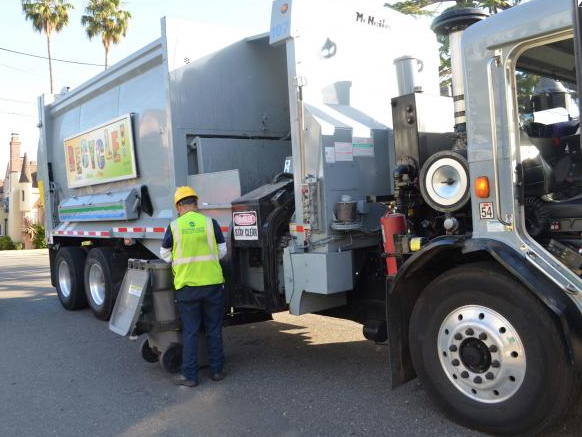
While much of the recent controversy around Oakland’s new garbage contract has centered on the exorbitant rate increases for commercial composting, the City of Oakland has quietly put forward a new proposal to increase the recycling rates for all residents beyond the fees that officials negotiated and approved last year. On the agenda of the Oakland City Council tomorrow is a proposal from the city’s Public Works Agency to raise recycling rates by more than 10 percent to resolve a dispute with the private contractor California Waste Solutions (CWS). The proposed hike would enable CWS to increase its annual revenue by roughly $800,000, according to the report.
CWS — a West Oakland-based firm that took over citywide residential recycling services in the new franchise agreement that began in July — said that city officials had originally provided the company with incorrect information on the total number of households it would be serving, according to the report. Joel Corona, chief operations officer for CWS, said in an interview today that the city initially told CWS that the company would be serving roughly 165,000 customers — which the company used to determine its rates. But according to Corona, that was an overestimate and the company is now only serving roughly 155,000.
It’s unclear why the city overestimated the number of households that CWS would be serving under the new contract. The report states that the city used “raw data” from Waste Management (the other Oakland private contractor that previously did half of the city’s residential recycling services), but that this number “proved to be incorrect.” Sean Maher, spokesperson for the city’s Zero Waste Program, declined to comment today. According to the city’s report, CWS has claimed that the difference equates to annual losses of roughly $800,000.
[jump]
It’s also unclear why California Waste Solutions is not cutting its own costs rather than demanding that Oakland residents pay for them. Corona contended that the company has fixed costs that it previously calculated based on the 165,000 estimate and that it now needs to raise rates to make up the difference.
This issue, which has received no attention or scrutiny so far, led the city to negotiate a clause into the final contract adopted earlier this year that said the city and CWS could at a later date negotiate additional increases to rates based on the “differential between the number of households assumed by CWS in their cost proposal and the number of households actually served by CWS.” The subsequent negotiations have resulted in the proposed rate increases that the council will consider tomorrow. If approved, residents’ rates would increase by roughly one dollar per household per month starting in July of 2016. The increases beyond the fees initially approved would continue through 2021, according to the city’s report. CWS has a twenty-year contract for recycling.
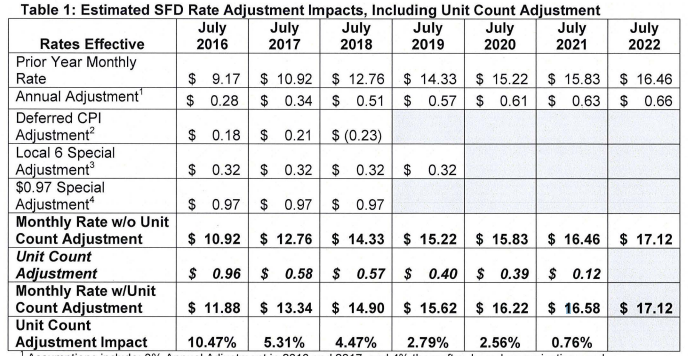
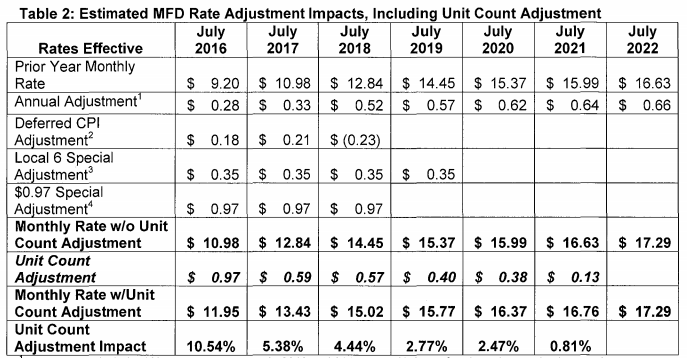
The recycling rates would increase by smaller amounts each year. For single-family homes, the rates would increase by 10.47 percent in 2016 — from $10.92 per month initially approved in the contract to $11.88 per month under the new rates. The single-family home rate increase would be 5.31 percent in 2017; 4.47 percent in 2018; 2.79 percent in 2019; 2.56 percent in 2020; and 0.76 percent in 2021. Those hikes are in addition to the annual increases already approved in the contract for consumer price index increases and union wage increases. The proposed additional rate increases for multi-family dwellings are slightly higher than the single-family home hikes.
These two charts from the city’s report (pages 3-4) detail the proposed hikes for single-family units and multi-family dwellings. The “unit count adjustment” row in italics shows the actual proposed price increase to resolve the dispute and the “monthly rate w/ unit count adjustment” shows what the new rates would be:
According to the report, the city could propose additional rate increases in subsequent years based on the number of customers CWS serves. The report states that starting in 2016, the city will conduct a review each year to establish the actual number of households billed and compare it to the unit count used by CWS in its original calculations and rate proposal. “The results of the review will be used to determine whether CWS has experienced a revenue shortfall in the previous contract year. Any shortfall would be corrected by increasing the rates of the residential customers billed the following year,” the report states.
It remains to be seen whether this proposal will spark additional controversy at the council. Since the new franchise launched this summer, most of the backlash has focused on the rates of Waste Management, the Texas-based corporation that sued the city last year to win back the contract and now is responsible for trash and composting services for Oakland residents and businesses. Both restaurants and homeowners have criticized the city and Waste Management for not transparently disclosing massive increases that were also environmentally questionable.
On the business side, the city had approved composting rates that were significantly higher than trash rates, incentivizing business to throw food waste in the trash instead of composting. The city and Waste Management have since re-negotiated this part of the contract, and the council is considering a proposal to lower business composting rates tomorrow. On the residential side, homes with the smallest trash bins (meaning residents who produce the least waste) have faced disproportionately high rate increases. There are no efforts underway to change that portion of the contract
The city council will debate both waste contract proposals tomorrow, September 29 at a special meeting starting at 6 p.m.
Update, 7 p.m: Maher, city spokesperson, emailed me a statement about the discrepancy in residential recycling customers: “The City received raw data from Waste Management of Alameda County, Inc., listing all residential Oakland customers and their service levels. This information was robust and accurate, and the City provided it to all proposers along with direction that they perform their own due diligence analysis of the data. The City’s own analysis, also provided to proposers, included a number of customers who were listed for multiple services and whom the City counted more than once, resulting in the 165,000 household total figure.”
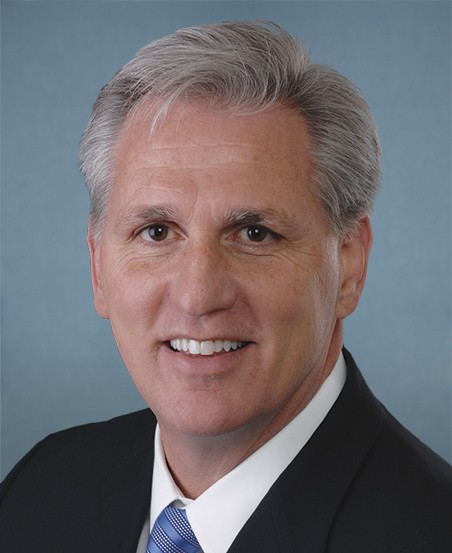
Kevin McCarthy.
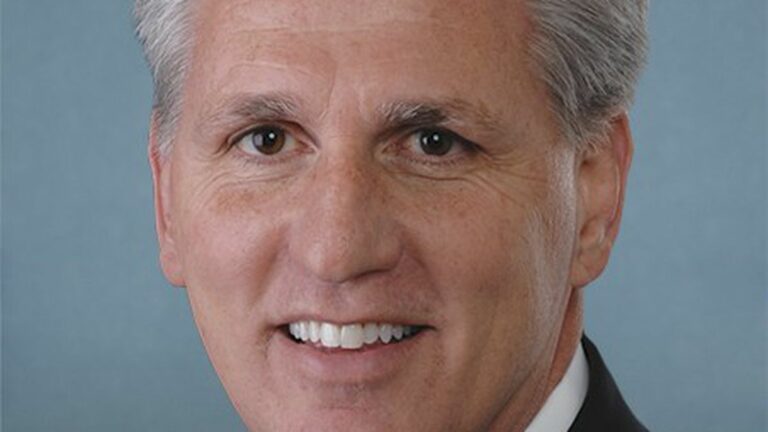
1. After John Boehner’s surprise resignation announcement on Friday, California Republican Congressman Kevin McCarthy is now the favorite to become the next speaker of the US House of Representatives — a development that would be a boon to Big Ag and bad news for the environment, the LA Times$ reports. The conservative McCarthy, of Bakersfield, has pushed to gut environmental protections of the Sacramento-San Joaquin River Delta in order to ship more water to agricultural interests in the south. He also opposes air pollution rules — even though his district has some of the worst air pollution in the nation.
2. A new comprehensive study confirms earlier research that found that foreign-born people in the United States are far less likely to commit crime than native born residents — a fact that blows a hole in GOP presidential frontrunner Donald Trump’s claims about immigrants, the Times of San Diego reports (h/t Rough & Tumble). The new study by the National Academy of Sciences found that “men aged 18–39 are jailed at only one-fourth the rate of native-born American men of the same age.”
[jump]
3. Flywheel, a company that provides ride apps for the taxicab industry, has sued the state in federal court, alleging that on-demand ride service competitors Uber, Lyft, and Sidecar have an unfair advantage in the marketplace, the Chron reports. Flywheel notes that Uber and Lyft drivers don’t undergo strict background checks and that those companies don’t have to comply with city and county rules that mandate workers’ comp coverage for drivers, fuel-efficient cars, and providing access to disabled people. Flywheel wants cities and counties to regulate Uber, Lyft, and Sidecar like taxicabs.
4. Airbnb has pumped $8 million into a campaign to defeat a November ballot measure in San Francisco that would tighten regulations of Airbnb and other on-demand hotel companies, the Chron reports. Prop F would cap vacation rentals at 75 nights per year and impose strict penalties on scofflaws.
Stan Dobbs.
Four members of the Hayward school board publicly acknowledged at a special meeting Thursday night that Superintendent Stan “Data” Dobbs allegedly berated and cursed the board in a closed session meeting on September 16 and then made physical contact with at least one of the boardmembers. The board, however, following a two-hour closed session meeting Thursday night, made no decision on Dobbs’ future with the school district.
Two members of the board, Luis Reynoso and William McGee, filed incident reports with the Hayward Police Department following the confrontation. Reynoso said he plans to press charges against Dobbs, while McGee Is awaiting findings from an investigation by the school district before making a decision.
According to Reynoso and McGee’s account given to police, which was backed up by their board colleague’s comments Thursday, Dobbs, who was hired as superintendent in 2013, began cursing the entire board during the September 16 closed door meeting. When McGee asked Dobbs to calm down, Dobbs approached him and stood over McGee. Dobbs again began yelling profanities at McGee. Among the comments made by Dobbs was: “I have to deal with motherfucking punks like you all day,” according to both Reynoso and McGee.
[jump]
Later, Reynoso, too, asked Dobbs to relax, according to Reynoso’s statement to police. “Mr. Dobbs turned his fury turned towards me. I too was seated and he came at me in a threatening and aggressive manner which made me fear for my personal safety. He was screaming shouting expletives and behaving in a[n] aggressive physical manner. I continued to tell Mr. Dobbs to calm down at the same time ordering him to stay away from me. However, he continued to approach until his chest was shoved against my shoulder and face. I made every effort to get up from my seated position but I could not because he was blocking me from rising from my chair and moving to a safe place in a room.”
Luis Reynoso.
McGee, who has been mostly silent over the incident other than acknowledging it took place, said Thursday night, “When we look at our school district we hope that we can cultivate a culture of no bullying and no workplace violence, so one of the reasons why this board met tonight was because there was that experience in closed session.”
Although no resolution to the matter came Thursday night, Reynoso, McGee, and two other school boardmembers Lisa Brunner and Annette Walker acknowledged last week’s incident during a board comment period. School boardmember John Taylor did not comment on the incident but later suggested to Reynoso that he understood Reynoso’s reticence about being in the same room with Dobbs.
Brunner said she was upset and embarrassed by the event last week and lamented news of the incident is overshadowing the start of the new school year. “It was very unprofessional what happened September 16 and it should not have happened,” Brunner said. “It was wrong.”
Walker added, “There is always two sides of the story. There was an unfortunate incident that did occur that evening that was unpleasant for the board,” as Dobbs entered the room just after 10 p.m. “We need to say that there was extenuating circumstances for perhaps why we saw a different side of our superintendent that evening I would say is sincerely warranted, not that it is excusable.”
Nearly a dozen public speakers, including Hayward Councilmember Sara Lamnin, Alameda County Board of Education Trustee Marlon McWilson, Hayward Education Association Union President Mercedes Faraj, and a representative from the Hayward Chamber of Commerce voiced support for Dobbs. Lamnin told the board Dobbs has made “great gains” for the school district over the past two years. “A new superintendent is the worst option,” urged Lamnin. Others consistently lauded Dobbs’ efforts in Hayward, while at the same time labeling the board as dysfunctional.
Later, Reynoso lashed out at the public speakers who mostly avoided any mention of the confrontation or Dobbs’ role in it. “This type of behavior — they would not allow in their own organizations — and they’re all here supporting him. I’m very, very disappointed.
“If we allow this individual to get by with just a slap on the hand, we’re sending the wrong message,” Reynoso added. “You do not make physical contact with the board. We are public employees. We represent the community.”
Reynoso said in an interview that he will continue to push for police officers at future school board meetings. About an hour into their closed session meeting Thursday, a security guard was summoned to the meeting following a request by Reynoso, he said.
In addition, based on the school board’s public comments, some members asserted that Reynoso and McGee’s disclosure of the September 16 closed session confrontation with Dobbs violated the Brown Act. Reynoso strongly disagreed and added, “Closed session does not support crime.”
Addiction specialists often say admitting a problem is the first step toward recovery. Well, VICE magazine, in conjunction with HBO, released on Monday for free an hour-long bombshell documentary that depicts the US criminal justice system hitting rock bottom, with both President Obama and former Attorney General Eric Holder saying the system is broken.
The president says it could...
SambaFunk! drummers at a different Lake Merritt event.
Credits: Elise Evans / Courtesy of SambaFunk!
On Sunday night, a white Oakland resident called the Oakland Police Department on a small group of Black and Latino drummers by Lake Merritt, resulting in multiple citations and sparking extensive debates online about racial profiling, biased policing, and gentrification. The story has since gone viral...
Daniel Wright (left) and Earl Brown in their West Oakland facility.
Credits: Sara Hare
It’s sweltering hot inside this nondescript warehouse building in West Oakland, and for the fifth or sixth time in the past twenty minutes, Daniel Wright hands me a glass tumbler full of freshly distilled brandy and asks me what I think. What I’m thinking about, really, is...
Stories you shouldn’t miss:
1. The median home price in Berkeley topped $1 million for the first time ever at the end of the second quarter of 2015, SFGate reports, citing a Red Oak Realty analysis published on Berkeleyside.com. The median price for a single-family home was $1.05 million in Berkeley, where homes are selling for an average of 19.9 percent...
Younger Lovers
Brontez Purnell, frontman of garage rock band the Younger Lovers, is a locally renowned musician, dancer, choreographer, and writer. But perhaps most fascinating of all is that, although mainstream museums and publications have championed his work, Purnell’s approach to his art has been adamantly DIY. Originally from rural Alabama, Purnell came to Oakland in the early Aughts...
Despite being only 8.4 percent of Berkeley's population, Black people accounted for 30 percent of all traffic stops by the Berkeley Police. They were 56.6 percent of all searches.
Credits: Darwin BondGraham
Recently obtained data tracking Berkeley police stops and searches appears to show racial bias among officers. A coalition of groups including the Berkeley NAACP; UC Berkeley Black Student Union;...
Nas performed songs from his classic album, Illmatic, on the second day of Bay Area Vibez.
Credits: Erin Baldassari
The Bay Area Vibez festival landed at the Port of Oakland this past weekend, bringing world-renowned reggae, electronic, and hip-hop artists to Middle Harbor Shoreline Park — a vast, open space that overlooks the San Francisco skyline. In its first...
While much of the recent controversy around Oakland's new garbage contract has centered on the exorbitant rate increases for commercial composting, the City of Oakland has quietly put forward a new proposal to increase the recycling rates for all residents beyond the fees that officials negotiated and approved last year. On the agenda of the Oakland City Council tomorrow is...
Stories you shouldn’t miss:
1. After John Boehner’s surprise resignation announcement on Friday, California Republican Congressman Kevin McCarthy is now the favorite to become the next speaker of the US House of Representatives — a development that would be a boon to Big Ag and bad news for the environment, the LA Times$ reports. The conservative McCarthy, of Bakersfield, has pushed...
Four members of the Hayward school board publicly acknowledged at a special meeting Thursday night that Superintendent Stan “Data” Dobbs allegedly berated and cursed the board in a closed session meeting on September 16 and then made physical contact with at least one of the boardmembers. The board, however, following a two-hour closed session meeting Thursday night, made no...