
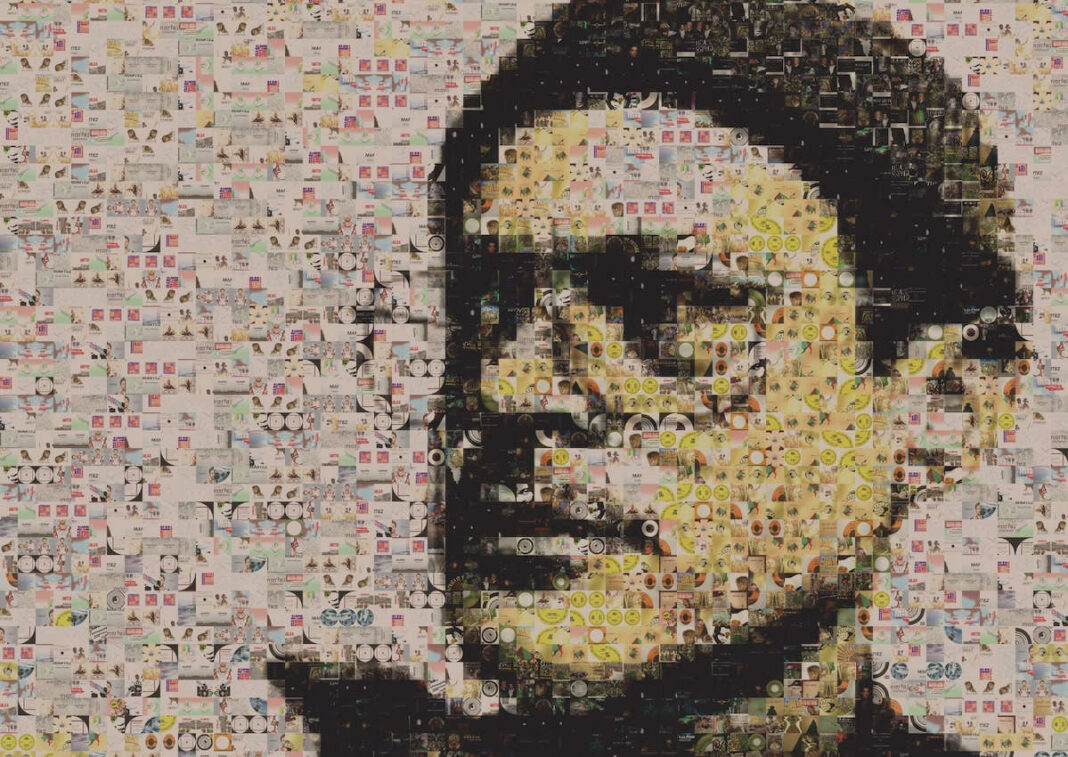
He started as an alto. Not a baritone, not a tenor. An alto. In the chorus of a Philadelphia elementary school, singing parts he was told to sing, performing repertoire he found corny and sometimes worse. He liked music. He did not like what they were doing with it.
That tension—between the love of sound and the refusal to settle for lesser versions of it—has motivated Martín Perna for 51 years.
There’s a word that lives at the intersection of music and grace: facilitation. Not performance. Not command. The act of making possible what would have never happened alone. Perna has spent three decades mastering the role of lead enabler. That is the work. That is the long game.
He and Gabriel Roth—sonic architect and co-founder of Daptone Records—met at NYU in the early 1990s. They became roommates, fellow travelers. Always with an electric piano; always with a shared record collection. They were always building something. By 1995 they were forming the Soul Providers on the Lower East Side with drummer Philippe Lehman, renting studio space above a storefront and laying the foundation for everything that followed.
Perna nudged. Perna ushered. Perna cleared the road so the driver could drive.
Out of Jojo Kuo’s rhythm came the Daktaris, recorded around ’96-’97—seeds of Afrobeat before Afrobeat had a name in that room. Out of the Daktaris came Antibalas, founded in New York City in ’97-’98, their first gig at St. Nick’s Pub on 149th St. in Harlem, with Olu Dara in the crowd, listening with full attention. Twenty-nine years of music followed—longer than Fela Kuti did it. That shadow falls over everything in this music like no other shadow in any other genre. Fela had the bravado. He named it. He claimed it. But the music was bigger than any one person’s ownership of it. Perna knew this. He built a band that owned nothing and served everything.
Tony Allen—Fela’s own drummer—came and sat in around ’98-’99, when Perna found himself at the Jazz Cafe in London and brought his horn on a dare. Said: “This is how it’s supposed to sound.” That was the credential. That was the green light.
But before any of that—before the records, before Daptone, before the world caught up—there was Spain. In the summer of 2001, the newly formed Dap-Kings secured a four-week, 20-show engagement at La Boite, a club in Barcelona. A few hundred copies of what would become their debut LP—Dap Dippin’ with Sharon Jones and the Dap-Kings—were pressed specifically so that sales during the residency could offset what would have otherwise been a financially ruinous trip.
Night after night in the low light of La Boite, set after set, Sharon Jones burning. Perna holding the architecture around her, learning in real-time what it meant to serve a voice that large. One doesn’t come out of something like that unchanged. One comes out knowing exactly what facilitation costs.
The Big Band and the Overhead
“Our expenses exceeded our income by $30,000,” Perna says of Antibalas. Every horn player flew in from California. Every set of drums was hauled across a time zone. The overhead is what kills a band, not lack of talent, not lack of love. The overhead. “We’re not broke. It just means after taxes we are starting the year with $10,000 in the bank,” Perna adds.
And so he contracts. Eleven becomes seven, maybe eight—enough to hold the sound while the overhead recedes to a manageable grief. He knows what to let go of so that the essentials survive.
But here is what does not contract—the space inside the music itself. A larger ensemble fills every niche of sound, he explains, but there’s something equally powerful in having space. Space on stage. Space in the audio sense. Space as a felt presence, not an absence. The music breathes. The listener leans in.
When Duke Amayo departed in 2021—acrimoniously, with lawyers, with claims on the name Antibalas itself—the band breathed out. Some losses arrive as relief.
The Stages, the Halls
Perna has served as musical director at Carnegie Hall three times: for Paul Simon in 2014, David Byrne and Talking Heads in 2015, and Aretha Franklin in 2017. The same year as Aretha, he directed the music of Billie Holiday at the Apollo Theater. He scored the PBS American Masters documentary on Roberta Flack. He collaborated with Angélique Kidjo at the CIAMO Arts Academy in Benin, West Africa.
He contributed to Mark Ronson’s Uptown Special, to Beck’s The Information, to Toro y Moi’s Mahal, to the Tune-Yards. He brought his horn to London and played inside Tony Allen’s pocket. He brought it to Prospect Park and played inside a crowd of thousands. He brought it everywhere the music needed someone to hold the architecture up.
These are not detours. They are the work in different rooms. The facilitator changes rooms. The work does not change.
The Bay, the Root System
In 2019 Perna relocated to Berkeley. He co-founded Keys to the City in Oakland. He launched MARTEZ—solo flute and woodwind, psychedelic jazz, a space where his own voice could move without holding anyone else’s architecture together. He joined a Sufi choir, learning a new alphabet and new scales, keeping himself open the way a musician must when the temptation is to stop learning. In late 2024 he co-founded the Suns of Mothers trio with Tommy Guerrero and Nino Moschella, debuting at Little Hill Lounge in El Cerrito, a room with the right kind of low light.
In 2026 he began teaching popular music theory at UC Berkeley, bringing 10 years of Sunday shekere study—every polyrhythm absorbed under Madeline Yayodele Nelson in a room at Westbeth—directly to his students. Most recently that included “Testify”—a ritual reading for James Baldwin at UC Berkeley on March 31, 2026, co-conducted with his partner Courtney Desiree Morris, where artists, scholars and spiritual workers gathered into something that defied categorization: Readers performing as a choir. Grief named. Ancestors called. The audience not passive, but bearing witness. The same skill. A different vehicle. Still clearing the road.
“Music has been making me for 30 years,” he says. Not the other way around. The inversion is not accidental. It is the whole philosophy: One does not impose on the sound. One serves it. One creates the conditions. One steps aside.
The facilitator does not take the bow.
The facilitator ensures the bow is possible.










Martín Perna harasses women.
Great musician, not a great dude.