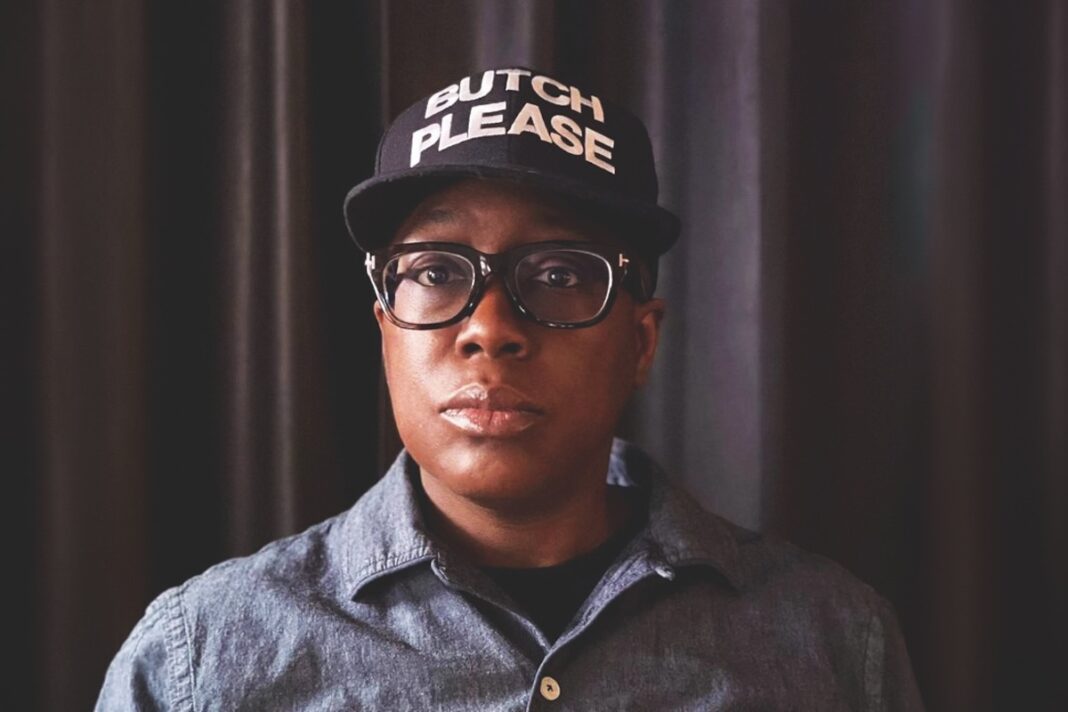
Cheryl Dunye, an Oakland-based Liberian-American filmmaker, director and producer, says telling stories about Black queer identity, history and culture is energizing.
“I’ve always worked in the space where identity gets complicated,” she says. “That’s not new for me. What’s new is the scale of it.”
Dunye, who continues to tip the scales, is one of the Kenneth Rainin Foundation’s 2026 Rainin Arts Fellowship recipients. The annual awards since 2021 recognize four artists whose work is grounded in the Bay Area, emphasizes community and pushes beyond expected boundaries in the arts field. The unrestricted $100,000 grant comes with additional marketing, legal and financial planning support. Fellows are nominated by Bay Area artists; the winners selected by national reviewers and a panel of four local jurors. In 2026, in addition to Dunye, the recipients are Cece Carpio (Public Space), Sarah Crowell (Dance) and Danny Duncan (Theater).
Dunye, who was born in Monrovia and grew up in Philadelphia, holds a bachelor’s from Temple University and received her MFA from Rutgers University’s Mason Gross School of Art. With her work centered on race, gender and sexuality, Dunye quickly received attention as part of a “Queer New Wave” of young filmmakers in the early 1990s. Her first feature film, Watermelon Woman, earned considerable critical acclaim, including winning the Teddy Award for Best Feature at the 1996 Berlin International Film Festival.
After springing out of the gate early in her career, Dunye’s forward momentum accelerated. This resulted in awards, fellowships, residencies and having her work presented in the 1993 Biennial Exhibition at the Whitney Museum of American Art and at subsequent festivals in San Francisco, New York, Melbourne and Berlin. In addition to several independent films, Dunye has directed episodes of television series such as Queen Sugar, Dear White People, Bridgerton, Lovecraft Country and The Hunting Wives.
In 2018, Dunye established Jingletown Films, a production company specializing in cinematic storytelling and focused on serving underrepresented filmmakers. The cultural, political and artistic legacy of Oakland is foremost; undergirding the company are philosophies anchored in Dunye’s recognizable, signature filmmaking style. Sometimes appearing “as herself,” other characters in a film might make comments on the film itself. The films invite unusual combinations to coexist on the screen—Watermelon Woman’s rom-com narrative dangles on a sturdy exploration of Black and queer women in Hollywood, an example from early in her career.
A later, short film made in 2014, Black is Blue, sets up a Black trans man in near-future Oakland whose life becomes enmeshed with a Black trans woman. As two working professionals in AI tech, the dystopian sci-fi film’s characters introduce and query why stories of trans people in the field are seldom told. Issues such as power—who holds it, who does not and how it is sought—add gravity without becoming burdensome.
Dunye says Black is Blue is the first film to which she will apply the Rainin funds. “The short has been waiting to grow into the feature it was always meant to be, and now it can,” she says.
She continues, “The Rainin matters because of what I’m building, not just what I’ve already made. Jingletown Films was never just a production company. It’s meant to be a home, a fixture in queer cinema where I’m seen not only as a maker but as a producer creating infrastructure for other people’s work. This fellowship sees that full picture. At this point in my career that means a lot.”
Dunye insists a high priority is ensuring the next generation of filmmakers has the right tools in place. Speaking about her core philosophies, she says, “I am an Audre Lorde-ian. The master’s tools will never dismantle the master’s house. You cannot do this alone. Community is the practice, not the outcome. The two things that keep me moving are collaboration and documentation. I build with other people because that is the only way the work survives, and I keep the record because if we don’t, nobody will.”
Beyond that, she believes in taking what’s given, even if it is not meant for oneself, and creating something that never existed before. The structural barriers as a Black queer artist are not new, but have not and never will intimidate Dunye. “What’s changed is me,” she said. “I’ve stopped waiting for the structures to move before I do.”