No one can trust this review. I mean everything that follows, but one should know up front I’m a devotee of the work of writer/director Martin McDonagh from the marrow in my bones to the metabolic waste in my brain, so nothing here is objective.
I think McDonagh and Sam Shepard are the two greatest playwrights of my lifetime—and it’s not even close. I’ve directed one of McDonagh’s plays (The Plowman) and seen another (A Behanding in Spokane) on Broadway, while living with the belief that if I don’t get to act in or direct either The Lieutenant of Inishmore or A Skull in Connemara before I croak, I will have wasted the decades I’ve spent in theater. So, no pressure.
As much as I think he’s a brilliant filmmaker, I still don’t think we’ve seen McDonagh’s masterpiece yet. From the pitch-black tragicomic absurdity of In Bruges to the violent Hollywood satire of Seven Psychopaths and the social deconstruction of small-town America in Three Billboards Outside Ebbing, Missouri or the heartbreaking tenderness of The Banshees of Inisherin, McDonagh is working with a palate much larger, yet more specific than many filmmakers alive today.
I’ve always connected deeply with films that walk a very specific, microscopic line between a bottomless well of existential sadness and dry laughter at the absurdity of being a human being. Filmmakers like McDonagh, Wes Anderson and the Coen Brothers capture some essential flaw at the heart of the human condition, where we’re all essentially committed to the Sisyphean task of waking up each day, existing uncynically and trying to keep our hearts open.
Anderson’s characters become the best versions of themselves when they let go of their solipsism. The Coens mock the self-serving and the nihilists while celebrating the romantics. McDonagh though, as cynical as he can sometimes be, believes nothing is more important than love, both platonic and otherwise, and that without it life loses its flavor and texture.
Mild spoilers follow:
McDonagh’s new film, Wild Horse Nine, follows some of the same themes and structures as his earlier films, and manages to sit comfortably with his previous work. Yet it is more overtly political and righteously angry, with a brutally funny central message and a gently moving final button.
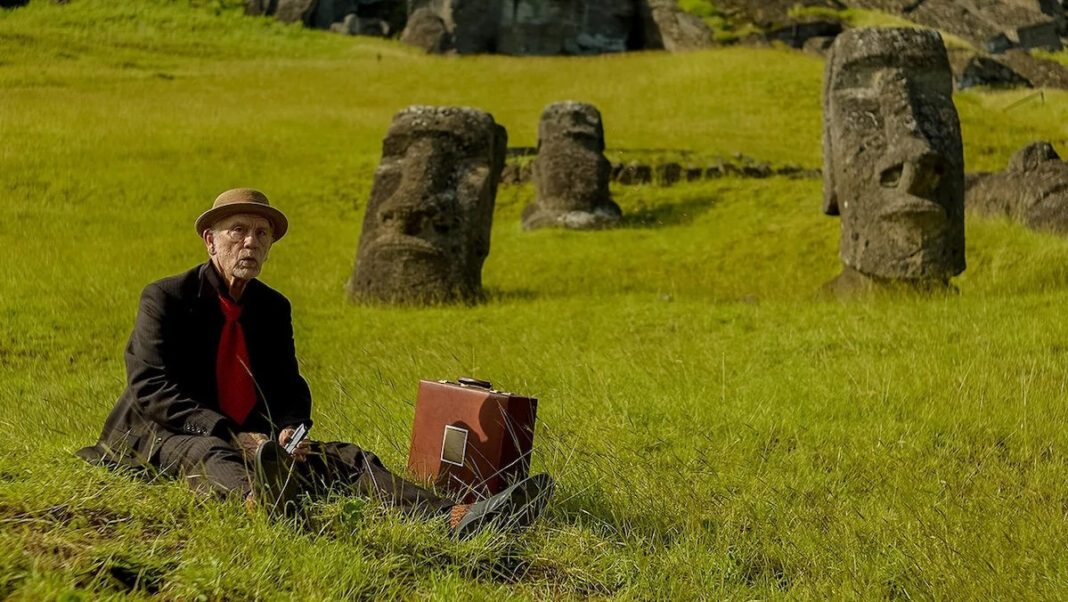
John Malkovich and Sam Rockwell star as Chris and Lee, two CIA agents in 1973 who have just assisted a coup d’etat in Chile and are headed to Rapa Nui (Easter Island) for some R&R. This isn’t actually a vacation, though. Chris only has a short time to live due to cancer and is losing his memories. So the CIA section chief—played by Steve Buscemi at his wormiest—wants Lee to make sure Chris doesn’t let any of their desperately held, bloody national secrets out of the bag, and that he doesn’t leave Rapa Nui alive.
End spoilers.
The trope of bickering bag men wandering around a picturesque location like tourists is one McDonagh also explored with In Bruges. But Wild Horse Nine focuses less on the witty banter and tough-guy posturing, instead mixing a regret-fueled character study with a rage-fueled macro look at how United States foreign policy destroys the lives of innocent people all over the world.
Malkovich has always been a remarkable actor, but he finds depths to Chris I didn’t know he had and layers of pain he has never unpacked in front of the camera before. Armed with a never-retreating tremor in his voice and a glint of weary, wild fatigue in his eyes, Malkovich moves to the front of the current Best Actor race. Rockwell weaponizes his bottomless charisma to craft Lee into a wild card capable of limitless violence, both dangerous and charming. It’s a perfect two-hander.
McDonagh remains a remarkable writer with the precision of a poet with his dialogue. Words are given to every member of the cast that are so achingly beautiful that I’m reminded of the stark magnificence of his mind. Wild Horse Nine might initially seem like the most cynical of his films, but it really isn’t. In Bruges has a streak of futility that keeps the film heartbreaking even through the laughs.
Instead of total cynicism, Wild Horse Nine stands behind Chris, 10 toes down. As his short-term memories evaporate, all that remains for him are the crushing regrets of his violent life and his quiet dream of a good death. Chris doesn’t fear it in the slightest, but introspectively hopes he’s not going to hell. In fact, when asked for advice by a young student, he basically says to end every fascist you see, that the only way to fight back against a system that uses most of us as grist for the mill is to kill anyone who looks like him. It’s a heartbreaking, serene level of self-disgust made elegiacally breathtaking by Malkovich’s tremulous voice and McDonagh’s poetry of language.
Wild Horse Nine might not reach the emotional peaks and valleys of Banshees, but it feels like a work McDonagh could have only done this far into his career. There are observations on human nature that could only be made by someone who has spent a lifetime with his/her eyes open. It’s a major work disguised as a buddy comedy, disguised as a CIA thriller. The fact that cinema continues to be such a vital, fearless form of art, protest and passion is, for lack of a better word, wild.
Grade: A-