
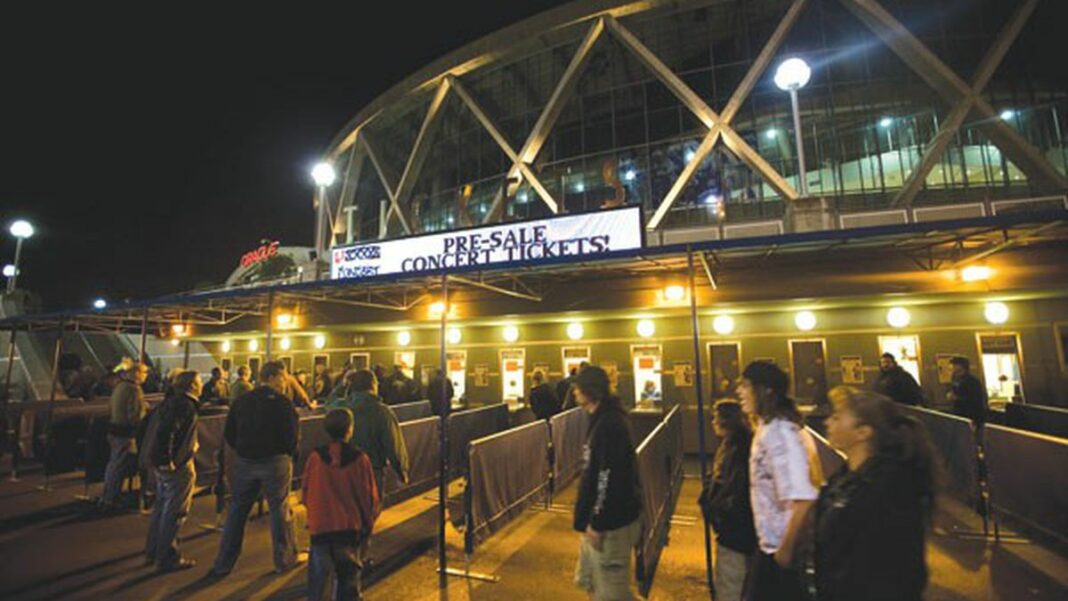
Last week’s sold-out AC/DC concerts at Oracle Arena in Oakland felt
more like 1978 or 1988 than 2008. After the deafening heavy metal music
began sending shock waves over the crowd, the smell of marijuana
quickly filled the air. An army of screaming, adoring head-bangers
swayed back and forth as one, wearing glow-in-the-dark red devil horns,
and shouting the lyrics to “Back in Black.” It was like the good old
days, a time when the Oakland arena was the place to see a
concert in the Bay Area.
But the ’70s and ’80s are long gone. Sold-out rock concerts just
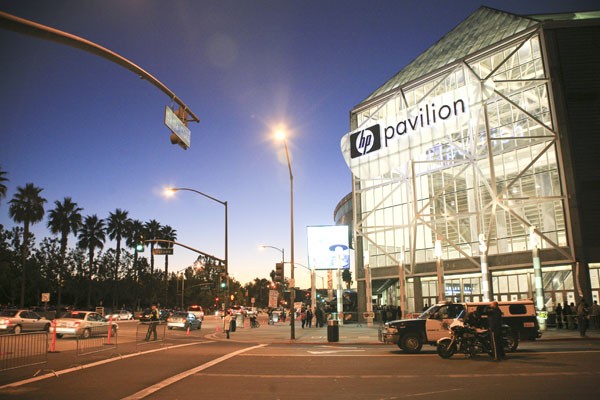
haven’t occurred as often since the HP Pavilion opened in 1993. The San
Jose arena, better known as the Shark Tank, immediately supplanted
Oakland as the premier concert venue in Northern California. And Oracle
Arena has never really recovered, even after Oakland and Alameda County
taxpayers floated $140 million in bonds for a major renovation in
1996.
Credits: Tim Wagner
Credits: Tim Wagner
Credits: Tim Wagner

Credits: Tim Wagner
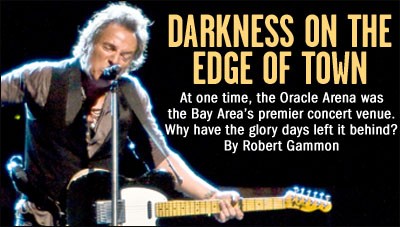
In fact, according to a hard-hitting recent audit obtained by the
Express, Oracle Arena remains an “underutilized” and
“underperforming” public facility that falls short of expectations for
a major event center in the middle of the nation’s fourth-largest
market. “The arena should be a ‘must-play’ by promoters of touring
shows, including concerts, family shows, and special entertainment
events,” the audit stated. The arena also has fallen short of
expectations in terms of offsetting the $20 million public subsidy that
Oakland and Alameda County give to the arena and coliseum complex each
year to keep it afloat.
According to the audit, which was requested by the Golden State
Warriors and completed last month, Oracle Arena has averaged just 99
events a year over the past three years, including 43 basketball games
annually. By contrast, HP Pavilion drew 169 events last year alone,
including San Jose Sharks hockey games. According to Pollstar, a
concert industry publication, HP Pavilion ranked sixth in the world in
2007 among indoor arenas with 666,587 concert tickets sold. Oracle
Arena ranked thirtieth, selling just about half as many tickets —
343,584 — even though it’s slightly larger. “Until HP came along,
the arena was the place to play in the Bay Area,” Pollstar
Editor in Chief Gary Bongiovanni said in an interview. “The only other
option was the Cow Palace, and very few people wanted to play in the
Cow Palace.”
The audit, conducted by Stafford Sports, a New Jersey-based firm
that consults to numerous sports complexes and franchises around the
country, blamed Oracle Arena’s disappointing performance on several
factors. These included the facility’s private operator, SMG, which the
audit said has not been aggressive enough in attracting events since it
took over the complex a decade ago. The audit also said the high costs
of putting on a show in Oakland, including a 5 percent tax on ticket
sales and above-average wages paid to union stagehands, dissuade
concert promoters from booking events. The lack of shows and concerts,
in turn, has hurt the Warriors’ bottom line because the team shares
proceeds from non-basketball events. “The limitations on these revenues
will have a lasting negative effect on the Warriors’ ability to compete
with other teams in the NBA,” the audit stated.
But SMG’s Mark Kaufmann, general manager of the arena, believes the
audit is unfair, and doesn’t paint a full picture of the facility’s
challenges. He acknowledged the high costs of putting on a show at the
arena, but said the presence of the Oakland Raiders and A’s at the
adjacent Oakland-Alameda County Coliseum also makes it tough to
schedule events. The arena is contractually prohibited from hosting
non-basketball events during ten Raiders’ home games and six A’s home
games a year. “It’s easy to say we could be more aggressive,” Kaufmann
said. “We could all be armchair quarterbacks.”
At least one major concert promoter agrees that SMG is not entirely
to blame. Greg Perloff, head of Berkeley-based Another Planet
Entertainment, which put on the AC/DC concerts, said the arena
operator has done a much better job in the past couple of years. “SMG
has been very aggressive in getting shows and working with promoters to
meet their needs,” he said. The audit appears to back up that
assertion. It notes that the arena went from 16 concerts in 2005 to 23
in 2007 — a 44 percent increase.
However, it still trailed HP Pavilion, which hosted 32 concerts last
year. Moreover, the managers of the Shark Tank also have to deal with
roughly comparable scheduling challenges, not only because of hockey,
but because the facility also hosts the San Jose SaberCats Arena
football team. Plus, it wouldn’t be too smart for Perloff to openly
criticize SMG because he has to work with Kaufmann and his employees to
book concerts at the arena.
Still, Perloff said that concert promoters, agents, and artists
prefer HP Pavilion because it’s cheaper to put on a show there. As a
result, they all make more profit. The 5 percent ticket fee is
especially tough for the top acts to swallow, because this can cost
them almost $100,000 per show. Consequently, performers who can’t sell
enough tickets to justify booking shows in both San Jose and Oakland
tend to choose San Jose. And even if they can sell out two shows,
they’ll sometimes schedule both at the Shark Tank. “There’s no doubt
that HP has benefitted from not having the tax and having lower
stagehand costs,” Perloff said.
The audit’s origins date to 2004. It stems from a settlement over a
lawsuit between the Warriors and the Oakland-Alameda County Coliseum
Authority, a joint panel made up of Oakland city council members,
county supervisors, and their designees. The authority officially owns
and oversees both the coliseum and the arena and employs SMG. The
lawsuit concerned the Warriors’ refusal to pay about $20 million in
back rent and other fees to the authority. The Warriors pay about $7
million to $8 million annually to help defray the costs of the $140
million renovation bonds, according to authority documents. But after a
series of setbacks in court, the team ultimately agreed to settle the
case four years ago and pay the overdue rent in exchange for a few
concessions, including a management audit of the arena. The audit cost
$60,000 and the Warriors are to pay half of it.
The team has made rumblings over the years about wanting the
authority to fire SMG so that it can manage the arena itself. The team
and SMG have had a rocky relationship for some time. Warriors President
Robert Rowell did not return two phone calls seeking comment for this
story, but according to three well-placed sources familiar with the
situation, team officials have been angry about the lack of
non-basketball events at the arena.
The scarcity of concerts and family shows damages the team
financially in several ways, including making luxury suite sales less
attractive. The Warriors get all luxury box revenues at the arena, and
luxury suite buyers are less inclined to purchase boxes, let alone pay
top dollar, if the arena hosts a small number of non-basketball events.
As a result, the luxury suite prices at the arena, according to the
audit, are considerably lower than many of the team’s smaller-market
competitors, including the Portland Trailblazers, the Sacramento Kings,
and the Utah Jazz. The team also can’t sell as many corporate
sponsorship packages because they’re typically based on the total
number of attendees at the arena each year. “With the modest attendance
at the arena and an underperforming event calendar, the ability to
maximize the asking price for these packages is limited,” the audit
states.
Most significantly, an underutilized arena hurts taxpayers. Along
with the 5 percent ticket fee, the coliseum authority receives revenue
from parking and concessions. According to authority documents, the
ticket tax on non-basketball events at the arena generates about
$700,000 annually, and the authority’s share of parking and concession
revenue from arena events totaled close to $1.5 million last year.
Those numbers would increase dramatically if the arena were to attract
as many shows as HP Pavilion does now.
But can it? According to the audit and Perloff, it may prove
difficult because of the tax itself and the cost of union stagehands.
The tax, which is referred to as the facility fee, has been around
since the late 1990s as a way to help pay back the $140 million
renovation bonds. Originally, the Warriors proposed to pay off the
bonds through the sale of personal seat licenses. But after the
Raiders’ debacle with personal seat licenses, the Warriors chose to
help finance the bonds with the ticket tax and by sharing revenues with
the authority in the form of rent.
Consequently, the authority would be hard pressed to eliminate the
ticket tax, especially considering the $20 million annual subsidy that
taxpayers continue to provide to the coliseum and arena. The city and
county split the subsidy by each paying about $10 million from their
general funds. The payments have been especially painful at a time when
both public agencies have had to make severe cuts in services because
of the recession and housing collapse. According to the authority
documents, the total public subsidy has amounted to more than $240
million on the two facilities since they were both renovated in the
mid-1990s.
Most of that money, however, has gone to pay off the bonds on the
coliseum and not the arena. That’s because the authority’s deal with
the Warriors is much better than its deal with either the Raiders or
A’s, who essentially pay no rent at all. Besides the public subsidies,
the revenues generated by the Warriors’ rent payments, the arena ticket
tax, naming rights, concessions, and parking make up the lion’s share
of the authority’s revenues. So to kill the ticket tax would mean
eliminating one of the few ways that the complex actually produces
money. Moreover, if the authority were to do away with the tax, budget
documents indicate that the arena might have to double the number of
concerts and non-basketball events just to compensate.
The issue of union costs appears to be no less problematic.
According to the audit, it costs at least $15,000 more to put on a show
at the arena than the HP Pavilion, and the arena has among the highest
costs in the nation. The Shark Tank also uses union stagehands, but the
contract in Oakland is a much better contract for workers. In a
pro-union town like Oakland, there is little likelihood that this will
change any time soon. Stagehands at the arena have a much older
contract than the one in San Jose, and according to several authority
members, convincing the union to take a pay cut would not be realistic.
“There’s really nothing we can do about the labor costs — not in
Alameda County; no way,” said Gail Steele, a county supervisor and
longtime authority member. “This is a strong union area — not
that there is anything wrong with that, but there are side
effects.”
So is Oakland forever doomed to take a backseat to San Jose?
Authority members said they plan to talk about the audit at their
upcoming meeting this Friday. But even though it strongly criticizes
SMG, it doesn’t appear to provide sufficient cause to fire the company
or evidence that the Warriors could do a better job of managing the
facility. After all, the Warriors aren’t exactly a model sports
franchise. The team hasn’t won a championship in 34 years and appears
headed for another disappointing season.
Oakland City Council President Ignacio De La Fuente, who has been an
authority member since its inception in 1995 and is currently it’s vice
chair, said the audit has some good recommendations and valuable
findings, but he refused to blame SMG for the arena’s shortcomings. He
also said he wouldn’t be interested in handing the arena over to the
Warriors unless they bought it and assumed all debt payments on the
bonds. “I’m open to anyone taking it over, if they’re willing to pay
the bills,” he said.
Meanwhile, authority Chairman and County Supervisor Scott Haggerty
said the panel should look at possibly capping the ticket tax or
adopting a sliding-scale fee to make the arena more attractive to
high-profile acts. But he also appears satisfied with SMG’s
performance, especially over the past couple of years.
To be fair, even the audit acknowledges that SMG has done a better
job of attracting concerts and other events in recent years. For
example, the Madonna concert earlier this year was a huge money maker.
Moreover, SMG’s Kaufman said he does not believe the ticket tax hurts
the arena, and the complaints by promoters, agents, and artists are
simply about the bottom line. “Let’s face it,” he said, “they grumble
because they want every dollar they can get their hands on.”
Still, the HP Pavilion continues to outperform Oracle Arena, as it
has for the past fifteen years. And according to the audit, the
management in San Jose remains more aggressive in landing concerts,
family shows, and other events.
One reason for this could be because SMG’s contract with the
authority doesn’t appear to encourage improvement. As it stands, the
authority pays SMG about $500,000 a year in management fees. Although
that fee fluctuates depending on total ticket sales, it is capped at
$750,000. The contract appears to lack strong incentives for SMG to
attract more shows — or severe penalties if the company fails to
do so. That could be a mistake, considering the taxpayer dollars in
play. At a minimum, when SMG’s contract expires in 2012, the authority
should rewrite it or put it out to bid to see if we can get a better
deal. Maybe the Warriors will step up after all.
In the meantime, Oracle Arena likely will continue to lag far behind
HP Pavilion as the Bay Area’s best place to catch a concert. And we’ll
have over-the-hill rockers like AC/DC to remind us of what the arena
once was and what it is today.