
People faced with incongruous truths or unanswerable questions often say, “Life’s a mystery.” While the cliché is escapist, there’s no denying life is thick with improbability.
Which explains how Oakland-native Ted Lange as an actor came to portray both Isaac Washington, the upbeat, mustachioed bartender on television’s The Love Boat (1977-1986) and, years later, one of Shakespeare’s most tragic characters, Othello. Adding intrigue to Lange’s biography is a network of unexpected facts: among them, gaming with British actress Lynn Redgrave led him to attend London’s Royal Academy of Dramatic Arts; and while directing and writing for television and film, Lange has also penned over 27 original plays and become deeply immersed in Shakespearian history.
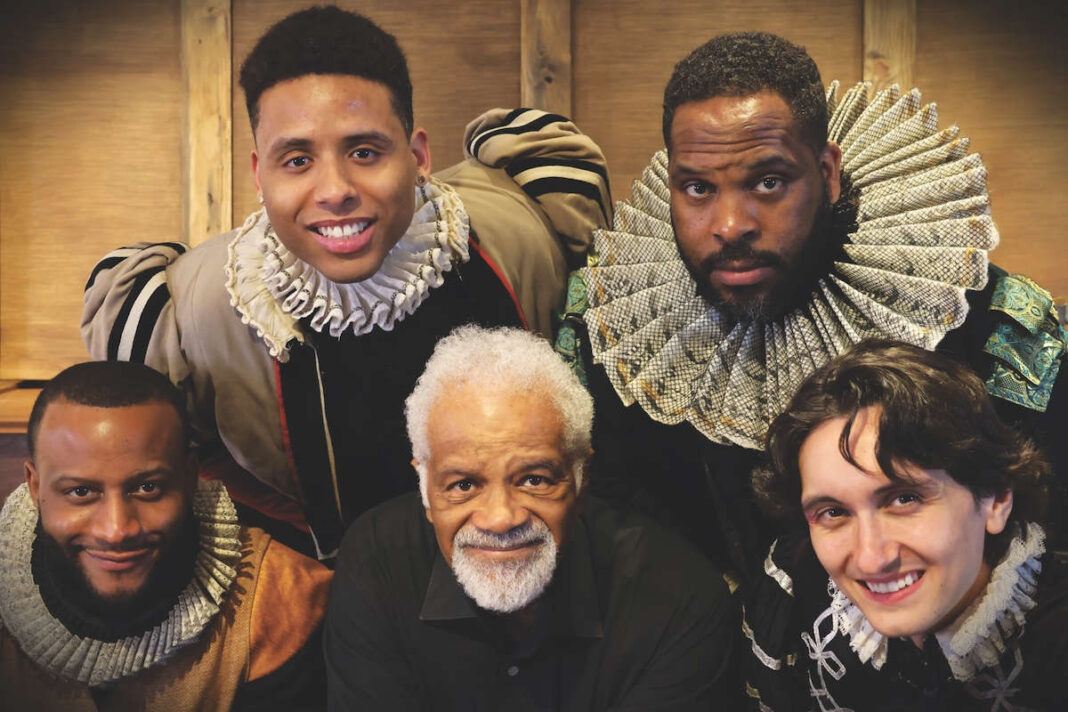
Apropos to the current moment is one question that since 1967 has stuck like a burr in Lange’s mind: Did Shakespeare actually pen Othello, or was it Edward DeVere, Christopher Marlowe or Sir Francis Bacon? Lange is convinced the play’s disputed authorship is a topic ripe for today’s audiences. Fittingly, the African-American Shakespeare Company in San Francisco presents Lange’s Shakespeare Over My Shoulder, opening May 15. The show’s three-week run has Black actors portraying three of the white historical figures—DeVere, Marlowe and Sir Francis Bacon—with Shakespeare played by a white actor.
From decades of research, Lange knows the foursome met at the White Heart Tavern in 1593 when the bubonic plague had shuttered London’s theaters. The new play is anchored in history, but also delivers a story beyond scholarly discourse. Lange’s naturally buoyant imagination and enthusiasm for drama does not exclude humor. Embedded in the play’s weighty factual, social, racial and authorship implications is witty entertainment.
In an interview, Lange says that his authorship suppositions in his latest play have evidentiary foundation, and his practical approach to playwriting is long-held. “Years ago, I wrote a prequel to Othello because Black people saw me doing Othello and some of the stuff they didn’t get,” he says. “I did a Twelfth Night. I tossed out the Shakespeare songs, put in Bob Marley. I kept the text’s iambic pentameter, but it takes a minute for your ear to adjust to that. The songs helped the audience stay in the theater until their ears adjusted and they got it.”
Lange emphasizes that the new play guarantees laughter and the opportunity to learn a great deal about Shakespeare. Audiences will also encounter topics for deep reflection.
“My play is historical fact wrapped into theater,” he says. “I call myself a footnote historian. Because whenever they deal with the history of a Black person in an American event, we’re a footnote. I’ve written another play about John Brown at Harper’s Ferry. They talk about Brown’s sons and there were five Black guys with him, and they barely mention these guys. And my play about George Washington, I wrote it from the perspective of William Lee, his favorite slave who he freed on his deathbed.”
Bringing this new play to the Bay Area holds particular significance. “I grew up in Oakland and did Shakespeare at 14,” Lange says. “I played Macbeth in junior high school, then again in high school. I played Romeo in 1968 in San Francisco.”
He adds, “I have a love for Shakespeare, and it was born here in the Bay Area. It started at the First Episcopal Church on Bush and Gough doing Romeo and Juliet for two years. So, you start at 14 with an awareness of Shakespeare and you come back in your 70s and still love doing it.”
Lange recalls growing up in the 1960s, an era that included the Black Panthers and the Free Speech movement. His mother was a powerful example of a Black woman moving confidently in a predominantly white, male world.
“She worked for John Shelley, the mayor of San Francisco, then Scott Newhall, editor of the Chronicle,” Lange says. “And my father, he brought his friends who were Black Hollywood actors to the house. They talked to me about the business.
“My mom’s favorite statement to me was, ‘Teddy, there’s room at the top, it’s the bottom that’s crowded.’ I carry that with me. I’m not letting prejudices hold me back. That’s part of being a Black man in America,” Lange continues.
Multiple experiences created the sturdy architecture of Lange’s primary philosophies and habits. Participation in a KQED talk show that had high school students voicing opinions about the Vietnam War, free speech and being a Black person in the Bay Area established his critical thinking skills.
“Black people in America have always dealt with the negative,” he says. “We told people for years about how police we called ‘pigs’ treated Black people. Finally, when George Floyd is killed and it’s shown on television, white people get it. It’s like Black music that white people used to call ‘race music.’
“When Elvis Presley started doing it, they called it rock ’n’ roll and called him the King,” Lange adds. “White folks have been known to take credit for things they haven’t invented or done, so when someone says that Shakespeare didn’t actually write all those plays, I say, ‘Let me investigate.’”
Society at large taught Lange a way to survive. “If a Black man starts yelling at a white person for injustice, they don’t hear that,” he says. “I learned to debate without rage.”
Writing and directing The Love Boat episodes provided specific lessons. Lange learned the craft of writing: about structure, characterization, plot progression, fact checking. “The whole thing is opportunity,” he says. “Television can give a rap people use not for you but against you. I can’t listen to that. I wrote a play about Michelangelo and Love Boat episodes. How does that make sense? I just have to do my art.”
For all his positivity, Lange says America’s perennial, pervasive racism cannot be denied. He remembers once being the only Black person in the lobby during the intermission of the opera, La Boheme. “There was a white woman who saw my Black face and was so surprised, she walked right into a pole,” he says. “But I say art has no color. Writing this play—yes, a Black man writing about Shakespeare—the train is racing down the track and the cast and I are having a ball.”
‘Shakespeare Over My Shoulder,’ presented by African-American Shakespeare Company, May 12–June 7 at Theater 33, 533 Sutter St., San Francisco. african-americanshakes.org/shakespeare-over-my-shoulder