
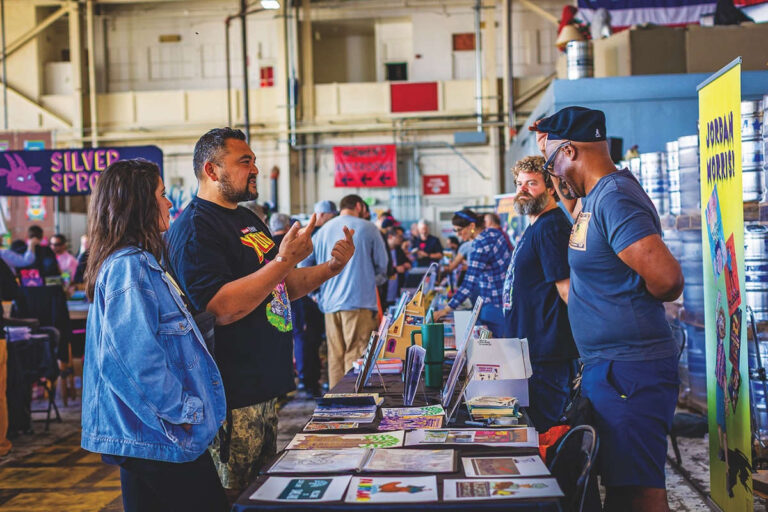
Everyone knows a kid who spends her entire weekly allowance on comic books, or a child constantly scolded for “doodling” instead of doing homework. Then, there’s the immigrant family in America in which the parents speak only their native language. The children learn English while watching cartoons on television and soon serve as the family’s essential translators. Lastly, there are the countless Black and brown children who wonder if superheroes can be something other than white men with bulging biceps and if YA graphic novels ever tell stories of living with a mentally ill caretaker or growing up in a country that labels them as “other.”
Anyone who wants to know whatever happened to some of those kids needs only to show up at the fourth annual Cape & Cowl Con. The free community comics convention Aug. 30 at Faction Brewing in Alameda brings those creative young folks—now award-winning adult comics creators, writers and artists—full circle.
Hosted by Oakland-based Cape & Cowl Comics, the event includes programming for all ages and is geared to support literacy. Among the local cartoonists, writers, artists, publishers and community organizations are Gene Luen Yang, Patrick Horvath, Mariko Tamaki, Tini Howard, Babs Tarr, Thien Pham and Maggie Tokuda-Hall, along with Chronicle Books, Alameda Free Library and Bay Area comic shops in addition to Cape & Cowl.
New features this year include panels and live presentations that expand the attraction of the comics, graphic novels and merchandise available. A Kids Area offers games and art activities, and food trucks and beverages from Faction Brewing make it an easy, all-day affair.
Graphic novelist Thien Pham (Family Style: Memories of an American from Vietnam) has participated in Comic Con since its inception.
“I do it because I love the Cape & Cowl store,” Pham says. “It’s amazing for customers and supportive of local cartoonists and comic books creators. We used to have Comic Relief, a store in Berkeley that was home base. When the owner passed away, we didn’t have a hub for a long time. Cape & Cowl opened up and is so organized, well-run and a well-stocked store.”
Pham is enthusiastic about a new panel organized by Juliet Capra. “One of the coolest things this year are the added panels,” Pham says. “I, Briana Loewinsohn, Gene Yang and others will be on it together to discuss the history of the Bay Area comic scene; what it was and has become today.”
According to Pham, the artists are likely to talk about how the comics industry has “blown up” with stories from people with diverse backgrounds and racial and gender identities. Content also “runs the gamut,” with traditional superhero stories told with a slant. That means a main character might be African American, Asian, LGBTQ+, Muslim and more. The plots might veer from standard action tales to sci-fi, memoir, biography and other genres.
A darker subject is how the entire comic community has been rocked by book bans. The thunderbolt is felt less in the East Bay, where Pham says 99% of the artists, librarians and bookshop owners support the resistance effort.
“It’s a haven of like-minded people who love to create stories for people to read,” Pham says. “The hard part is earning a living, but there are more revenue sources, like merchandising and Kickstart crowd-funding.”
In a separate interview, Tokuda-Hall picks up the trail. As a founding member of and until recently the president of Authors Against Book Bans, she rides the anti-book-banning front line in the national coalition of writers, illustrators, editors and over 5,000 readers across the country.
“They are united on the single principle that the government should not tell us what we can and cannot read,” Tokuda-Hall says. “It was the first time we’d organized within our cohort.”
Tokuda-Hall says a sister organization, Publishing Professionals Against Book Bans, cropped up; the largest traditional publisher in town, Penguin Random House, invested funds; and other movements surfaced to “fight the fight.” Hearing stories from librarians in Idaho about getting doxed, harassed and sent death threats raised her own awareness of book banning from “a quaint problem” to “hostility that’s really quite violent.”
Resistance is robust in the area, but Tokuda-Hall says fear is also intense. Creators worry whether publishers will cut them checks or forever ban them if they write about something “controversial.” Nevertheless, she and others recognize the protest is actually not about what and who they write about.
“Those were just catalysts to allow bigots to do the dirty work of defunding our public institutions,” Tokuda-Hall says, “at the behest of deep-pocket, dark-money interests who don’t believe in public education.”
The real question, she insists, is dramatic, but real—“Are we going to be allowed to have books?” She cites states in which the First Amendment is being argued as the legal reason the government should be allowed to ban books and withhold funds if schools are not compliant.
“It’s a moment of inflection,” she says. “That being said, Bay Area creators are awesome. The antidote to all of this is hanging out with people who support this work. The curiosity is wide, and the things available are so vast and varied. I’m just thrilled.”
Tokuda-Hall will participate in a YA graphic novels panel and will sell her new book, What Do People Do at the Science Museum? (Chronicle Books).
Cape & Cowl Con, 11am to 6pm on Sunday, Aug. 30, at Faction Brewing, 2501 Monarch St., Alameda. Free. capeandcowlcomics.com/cape-and-cowl-con