The oasis resurrects. It systematically electrifies the parched, emboldening the furtherance of a dream. It is the contrast, a node in the logic of the desert that defines the aridness of its surroundings by just how wet its waters are. It is a gathering place to breathe, relax and reset.
There’s a distinction between hiding and omission. By definition, hiding is a defensive reaction to a threat. Omission, on the other hand, is a deliberate choice about disclosure made on one’s own terms. Blaq Outside was never hiding. The location isn’t kept quiet because the organizers are afraid of who might show up. It’s withheld on purpose, dropped the morning of, so the people it’s for get there first. Hiding says, “I hope you don’t find me.” Omission says, “You’ll know when you’re supposed to know.”
First comes the poster drop. A snapshot, a scene from Set It Off. Queen Latifah’s glance, welcomed, dominating the shape of her woman frame. The image die-cut, stamped out, encircled by the words “Blaq At.” For weeks prior, online videos tease a DJ lineup that would cost a whole summer and hundreds of dollars to chase all over one spot. DJ Ris. DJ Kurren$i. DJ PrincessDxddy. DJ Hardware Femme. DJ Melly. DJ Starr. Burdeaux. Performers like Aroma. Each one gets their own circle graphic, colors, headshot, dropped one at a time so the countdown has a face attached to every day of it. Community agreement videos follow on conduct expectations; how-to-keep-yourself-and-others-safe info laid out plain. The organizers show their faces on purpose, because they want folks to be able to find them.
Berlin buried its people this summer. A crowd marching for pride met a car built for hate. The flowers at Brandenburg Gate are still fresh, still wilting. Dolores Park held its own reckoning, too. Trans Day of Action, meant to be a sanctuary, cracked into shouting and shoving and cameras catching all of it. Even the ground built for the most vulnerable isn’t immune to explosive fracture.
The oasis is identifiable. The desert around it imbues it with value. Scarcity is what makes a landscape legible in the first place and water finds the lowest point, breaks the surface where it can and life clusters there because it has nowhere else to go. The oasis is a destination, the only place that can sustain. Caravan routes across North Africa were strung oasis to oasis, because the need for water dictated where a path could go. The crossroad exists because the oasis existed first. People converge there not by choice but by instinct.
Saber A. Minton remembers the ocean. First NYC Dyke March, 1994. Dolores Park by 2004. An ocean of dykes, they called it: 95% sapphic. Lively. Fun. Fiercely guarded by the people who belonged there.
That ocean is drying up now, diluted one invitation at a time, until “everyone is welcome” stopped meaning generosity and started meaning erasure. DJ Hardware Femme, a.k.a. Jasmine Summers, lived through the same slow drain in Oakland and calls it by its real name: “When it comes to gentrification, the torch is being stamped out. What is there to pass? A flame? Is it a little spark?” She traced her own lineage looking for the fire. Oh So Lovely. DJ Lady Ryan and Denise. Nectar Social Club. Ghost Ship. Rent that just keeps rising. Rooms that just keep closing. “Dilution,” she calls it.
Volunteering at Blaq at the Lake, Minton and their partner KndAwks Ntr Perrault put it plainly: “When boundaries stretch that thin, the truth underneath is simple: Black queer people no longer have their own sacred grounds.”
Nya Tindal, a.k.a. Burdeaux, put it another way: “I think that’s why they tried to separate us so much, because they know how powerful it is when we connect and we respond to one another.”
Separatism isn’t nostalgia. It’s a tool, sharpened generation after generation. The old separatists did their best—a singular womanhood, a flattened idea of who suffers, but the instinct underneath was right. There’s power in building on one’s own terms. That history can be honored without repeating its dimensions.
The oasis is rest. Like Blaq at Dolores and Blaq at Lake Merritt by Blaq Outside California, the oasis is filled with the mutual aid of shared understanding. It started small, the way sanctuaries usually do. A Juneteenth picnic. An idea from Marisa Hatcher, who’d become DJ Ris: “We should create a space for Black people to be at Dolores Park … it’s largely white space, where people hang. We used to hang out there before the Dyke March, historically.”
Burdeaux made the introduction, connecting Ris to DJ Hardware Femme. A pop-up tent was community-sourced. A brown paper bag repurposed into a sign because people kept losing the group in the crowd. Hardware Femme became a resident DJ and sound technician. “It was never about being for profit,” Ris said, “but obviously wanting to honor and highlight the joys.”
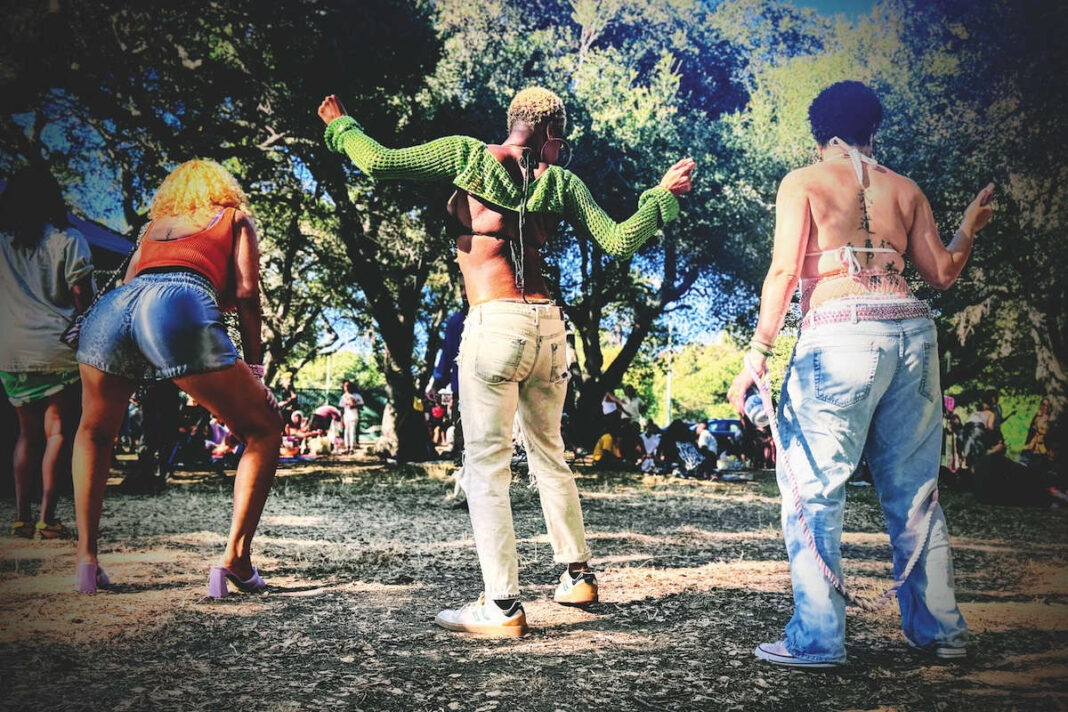
High energy. Deliberate inclusion. Still totally chill. At Blaq @ Dolores, watching a Black, queer-centered collective reclaim Dolores Park on what used to be Dyke March weekend feels like proof. No matter how much erasure is faced, people find a way. People self-organize. People build new sanctuaries on old ground.
Outside isn’t just scenery. DJ Hardware Femme put it plainly. She’d lived the failure mode already, in Black hiking collectives that were “often very straight,” where femmes “were treated like the mules when the men were getting all the glory.” So this outside, the lake and the park, isn’t recreation. It’s correction. Oakland, she said, is “the world’s biggest little city,” full of people hungry for community with Black queer folk. “It’s like, we’re outside, we are visible, we are in communion.”
The oasis isn’t accidental safety. It’s very chosen. “That’s why there’s no tickets there. Permits are hella expensive,” Ris said.
But when one asks what actually held the border, the answer is plainer than any permit could be. The method was to stay disarmingly calm. “Hey, excuse me, we’re actually holding this space, you know, as a Black queer space,” DJ Ris would say. No badge required. Just a flag line marking the grass, and a volunteer named Trey who, when a man on a bike claimed he didn’t speak English to avoid leaving, answered him fluently in Spanish and got the same result anyway.
Burdeaux’s response to being asked how they avoided police interaction at Lake Merritt, while slightly humorous, is indicative: “Spirit protected us. That’s my official answer.”
The pressure to soften the line never stopped coming. “But then if we did that, then we would … be selling out,” said DJ Ris. “And this is what makes it special.” They’ve caught backlash for it, even from other Black folks online. They hold the space anyway. Keeping it exclusive is a refusal, Ris said, to become tokens in their own space.
Look at what the flyer for Blaq at Dolores Pt. 2, held this past July, actually says: “DJs, potluck, kink tent, more. Free entry.” Eleven in the morning until seven at night, back on the same grass. Printed right on the page, plain as the time and location: “exclusively Black + queer space,” with a note of thanks to the non-Black family for understanding why the boundary has to hold. No velvet rope. The boundary isn’t held by gender. It’s foundationally dualistic, the “crosshairs” of Black and queer, together, no hierarchy between the two. A kink tent means desire doesn’t get policed at the gate.
A whole lineup of DJs—masc, femme and everything unlabeled—sharing the same set of decks, means nobody has to shrink a piece of themselves to be let in. Even the wording of the thank you is inference-worthy. It doesn’t say “no.” People don’t react well to “no.” It says “understanding”: Black queer people can carve out ground for themselves without asking anyone outside it to disappear, only to wait and help make space.
The oasis isn’t just one gathering. It’s an ecosystem of support. There/There in Oakland. Soulovely. Golden Ratio. The Sweet Spot. B.Tourmaline. San Francisco Black Pride. AfroPortals. Blaq Outside. Acclaimed DJs like those behind On Momma’s volunteer their time and energy, too. Many organizations, different rooms, the same house, all defending, challenging, celebrating the community in the same breath.
That ecosystem runs on more than DJs and organizers. It runs on the people who show up to build the ground itself, vendor by vendor. At Blaq at Lake Merritt, Zahra, who’s run her own business in Oakland since 2019 and now leads Queer Fem Parties, found “the event was exceptionally organized, locations scouted ahead of time, enough security to keep the surrounding blocks safe too.” As a performer, she said, what stayed with her wasn’t the production, it was the permission, that she felt “empowered to dance freely in the forest with other Black people.”
The proof of it isn’t abstract. It’s aunties in their 50s walking up to say, “Thank you, we really needed this.” It’s people two generations apart on the same patch of grass.
“We were a glow on the hill,” Ris said. “Maybe outside is chaos, at least around. Within each other, we have peace for that moment in time.”
The violence doesn’t stop because of omission. But the oasis was never about pretending the danger isn’t real. It’s about building somewhere that danger has to work harder to reach.
That’s the revolution. Keep the escape: It is time for construction.
For more info, visit @BlaqOutsideCA on Instagram.