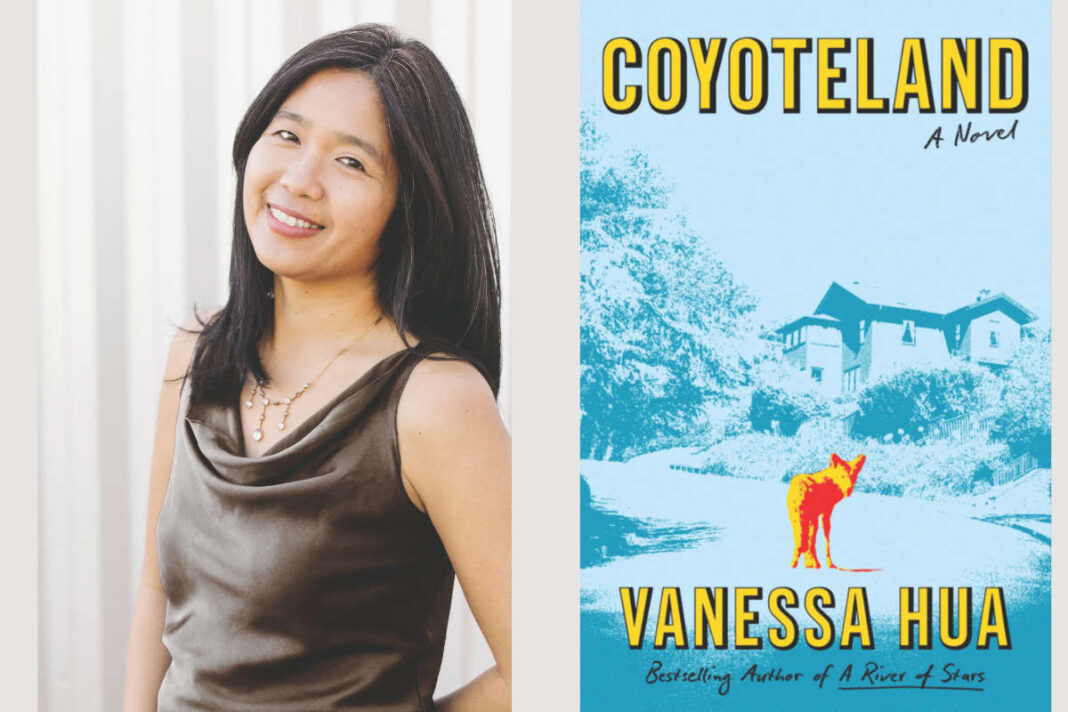
In the midst of pandemic lockdowns, Zoom classes, wildfires and family life, Vanessa Hua went for an early morning walk in her neighborhood, where the East Bay Hills descended into leafy suburbia. The resulting scene helped trigger her new novel, Coyoteland.
“I’m walking and I hear what sounds like high heels clattering, almost like ladies outside of a nightclub,” Hua says. “And I turn, and it’s the clatter of deer hooves. I see a coyote running at me full speed, chased by two deer.”
Astonished at how the wildlife trio eventually ran right past her, Hua began thinking about predator, prey and territory. At the same time, the country was going through a racial reckoning over police brutality. Northern California wildfires transformed Bay Area skies into apocalyptic expanses of red-orange and gray. The emotional, wary moment was filled with potential material.
Unlike other canonical works that might feature the urban landscape as an actual character, Coyoteland instead captures the machinations of upmarket suburbia in all its forms. In the fictional hamlet of El Nido, real estate syndicates and NIMBY coalitions mobilize to outmaneuver each other. Housing developments threaten people, but not people the builders expected to threaten. White nuclear families dismiss their own mixed-race ancestry while exhibiting fear over their mixed-race neighbors. Jocks, nannies and alienated teenagers interact in unpredictable ways. Everyone is suspicious of everyone else, and everyone has something to hide.
The suburb as character arrives as a wonderful follow-up to one of Hua’s previous novels, A River of Stars, which took readers deep into the gritty underbelly of San Francisco’s Chinatown, in ways clearly informed by Hua’s career as a newspaper reporter. For Coyoteland, she fled across the bridge to the East Bay Hills.
“I’ve written about cityscapes or covered it as a journalist,” Hua says, “but I felt like suburbia, or in particular these suburbs that really sit at that urban-wildlife interface, was a really interesting territory to be able to mine for a novel.” She adds some data about how the ’burbs have diversified over the last 30 years. Demographics are not as clear cut as before, especially when it comes to who sides with who, and for what cause.
“We have a situation where it’s more different—people’s backgrounds, what kind of conflicts, what kind of alliances might spring up that are unexpected, that go beyond surface level binaries of race relations that are usually posited for the country,” Hua says.
Suburbia is a lot more complicated these days. And what better way to explore it than in a novel?
In Coyoteland, the characters operate in a shifting morass of plot and counterplot. Jin and Kai Chang move into their newly purchased home, right next door to Blair Belle and her husband Sam, whose plot to develop a former walnut grove into lifelessly uniform housing is about to hit a few snags. Unbeknownst to the Belles, the Changs are secretly trying to derail the Bellavista project because it will interfere with their own plot to flip their house at the behest of their Chinese benefactors.
At the same time, each family’s kids become embroiled in their own dramas, along with insufferable suburban neighborhood association types, establishing other dimensions of problems for the Changs, the Belles and their kids. We then relish the relentless uneasiness, never quite knowing just who is backstabbing who or which scheme is about to backfire any second.
The universal perspective soon emerges, speaking to a larger idea: We never really know what’s going on with anybody. We never really know someone else’s story, especially our neighbor’s. Even when people make questionable decisions, we want to know what drove them to it, why they felt compelled to do so, even with the best of intentions.
As the collisions of nature and the built environment transform suburban California, so do they transform the novels of suburbia. Coyoteland is a welcome addition.
Vanessa Hua will read from ‘Coyoteland: A Novel’ at 2pm on Saturday, May 16, at Orinda Books, 276 Village Square, Orinda. orindabooks.com