
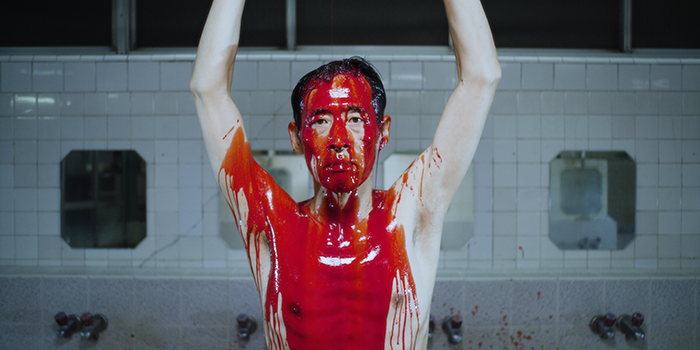
Provocative Japanese psychodrama addresses the issue of image versus reality
Kai, the main character of Woman of the Photographs, is a taciturn, inwardly directed, middle-aged man (played by actor Nagai Hideki) who operates a photography studio in a quiet neighborhood. He spends most days shooting portraits of walk-in customers and retouching their digital photos—one of his frequent clients is a woman who’s never quite satisfied with her likeness, and keeps asking him to remove another blemish or give her image a bigger smile.
Aside from that, Kai devotes most of his personal energy to studying his pet praying mantis. In fact, bachelor Kai seems far more interested in insects than in his meager social life.
That changes one day when Kai is in a forest, busily taking pictures of bugs. Startled by a sound from a nearby tree, he notices a young woman perched up high in the branches. When she climbs down, he can see that there’s a dangerous-looking contusion on her chest. Kai offers help, and so begins a strange relationship. The attractive Kyoko (Otaki Itsuki) makes her living as a social media influencer with a large group of followers and a photo portfolio of glamor poses.
The two people seem to have almost nothing in common, and yet Kyoko is curiously attracted to the solitary Kai, especially after he uses his touch-up skills to improve her online image. Before long, they are spending serious time together, with Kyoko in the lead and Kai obligingly deferring to her wishes. He appears to be especially uneasy in the company of women, despite the fact that he lets her move in with him (although there’s apparently no sex).
Their rapprochement bristles with danger signals, and yet the story progresses at a measured pace, with sparse dialogue and lots of meaningful silences. The apprehension steadily grows as the visual metaphor of the mantis repeatedly asserts itself—the praying mantis is notable for its sexual cannibalism, in which the female devours the male after mating.
With such a plot framework, one would expect that writer-director Kushida Takeshi’s offbeat romance is poised for a dive into full-fledged horror. But Kushida’s narrative is a bit more subtle than that. In their most candid moments, Kyoko and Kai talk about a subject near and dear to both of them: the relation of visual imagery to real life.
Foremost in their discussion is the idea that a photo image can alter the outward perception of the real subject behind the photo. In Kyoko’s case as a social media figure, her followers’ concept of her is the key to her livelihood. Her stated belief is that: “We can love ourselves only through others’ eyes.”
Who, in fact, are the real Kyoko and Kai? Kyoko addresses her dilemma by deliberately opening her unsightly wounds and picking at them, then asking Kai to electronically accentuate her scars in photos. In her dreams, Kyoko imagines her double sensually caressing the unhealed wounds. Kai’s fantasies are much bloodier.
Suddenly Kyoko’s career is revived by her bold decision to not airbrush her faults, and she regains her social media popularity. Running parallel to their transformations is the story of Kai’s longtime customer (Inomata Toshiaki), who desires to have a photo of his deceased daughter “aged” in order to keep his memory of her alive.
By this point in the film, Kai and Kyoko’s eerie romance has entered its “mutual mutilation” phase—although the ostensible sadomasochistic games never quite take place in graphic terms, only by inference. It’s not often that a commercially released narrative film takes such an obsessive interest in the error of dwelling on the surface of things.
Kai and Kyoko are both being held prisoner, in a sense, by artificial images and their perception. As such, their relationship is as tender and vulnerable as the spindly legs of a mantis. Woman of the Photographs is a poor English-language title for such a thought-provoking drama. Maybe The Real Me conveys it more succinctly.
* * *
In theaters