
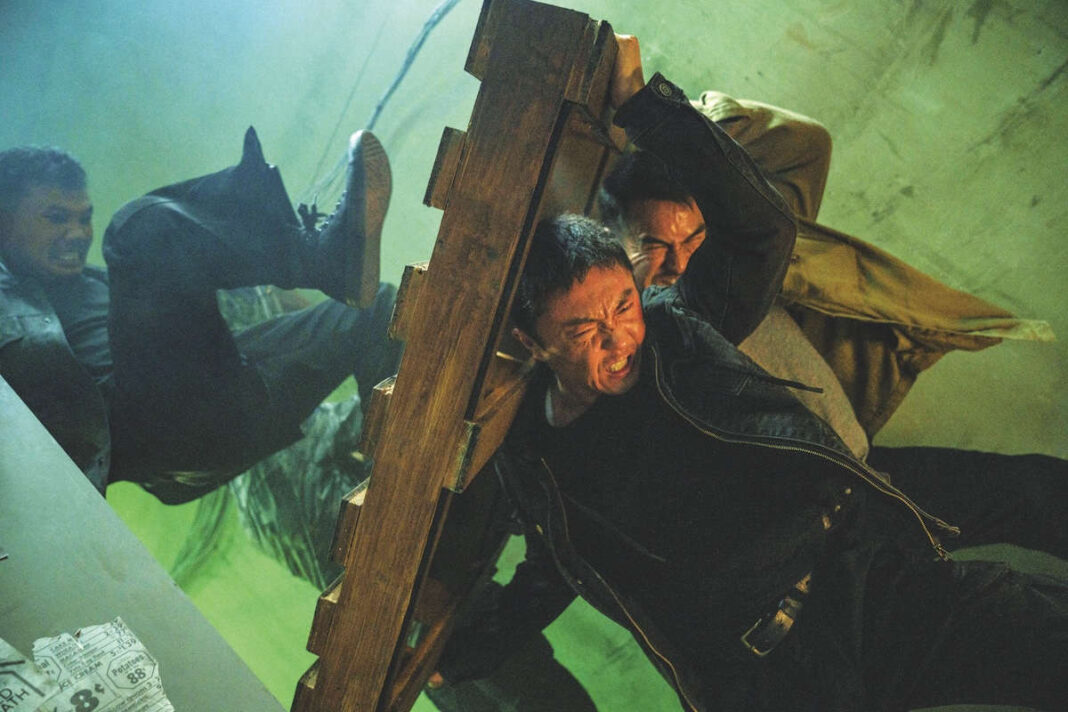
In the first five minutes of the new Hong Kong/China action pic The Furious, we’re reminded of one of the time-tested truths of the exploitation subgenre: In real life, a character cannot get repeatedly slammed in the face with a steel automotive transmission housing without bleeding, at least slightly. In a movie, however, anything goes.
That lowbrow movie-house truism, and others, have been inspected and rigorously analyzed many times over the years, traditionally at drive-ins but lately more often in streaming horror and action items, in which the ultra-violence floats to the top like pond scum.
The Furious, directed by Japanese former stuntman Kenji Tanigaki from a screenplay by a trio of veteran mainland China and Hong Kong writers, and released in the U.S. by Lionsgate, is an eager case study of “Anything Goes.” In it, the young daughter of a tough but comparatively innocent man named Wang Wei (played by Miao Xie) gets kidnapped by brutal thugs bent on sex trafficking.
The same thing simultaneously happens to Navin, a fistically adept journalist played by Indonesian-Chinese actor Joe Taslim. The two adolescent girls are part of a group of helpless victims stolen by a cabal of loathsome gangsters.
Whereupon the two wronged fathers join forces to get their kids back and teach the hoods a lesson they’ll never forget. Cue an avalanche, a deluge and an eventually tedious torrent of mega-violent retribution. Punches; kicks; Muay Thai—the film was shot in Bangkok; electro-shock; a sledgehammer; a barefoot chase sequence over a street littered with broken glass—ouch!; bows and arrows; and more. When they run out of weapons in the last reel they even hurl bicycles at each other. The only missing piece of skulduggery is a pie fight—gotta save something for the sequel, after all.
There’s nothing here that industrious, bottom-feeding movie audiences haven’t seen before. The Furious passes in front of the spectators’ gaze in an all-too-familiar blur. Liam Neeson supposedly perfected the righteous avenging-dad routine in the Taken series—Charles Bronson’s game-changing string of vigilante Death Wish flicks notwithstanding. For nonstop chop-socky, writer-director Gareth Evans’ The Raid: Redemption (2011) and its follow-ups also set a seemingly impregnable bar, with their series of Indonesian-based bloodbath policiers about a rough night at a police station. Then, on the old-fashioned good clean fun side, let’s not forget the Three Stooges, or Laurel and Hardy’s silent, slapstick, pie-throwing extravaganza, The Battle of the Century (1927), in which the boys destroy downtown Los Angeles.
The Furious is neither a documentary nor a meditation on the inherent ugliness of everyday life. Instead, it belongs to a potent comic mythology probably most amusingly illustrated by Kit ’n’ Kaboodle writer Brian McConnachie and illustrator Warren Sattler’s 1973 National Lampoon takeoff on the Tom and Jerry cartoon franchise, pound for pound one of the most violent popular juvenile narratives of all time. And yes, that includes John Kricfalusi’s Ren & Stimpy as well, not to mention the Brothers Grimm.
Generations of kids have guffawed at the war between the predatory cat Tom and his dangerously underestimated “victim,” a mouse called Jerry—created by William Hanna and Joseph Barbera and brought to movie and TV screens by MGM. The Lampoon sendup’s premise is that if what the funny cat and mouse did to each other were realistically presented—with severed limbs, protruding organs and more—it might be too gruesome to laugh at, even for pint-sized devotees of Saturday morning TV mayhem.
So where does that leave The Furious?
Out on a limb. Nothing about the characters—neither the juvie victims, their determined action-hero guardians nor the menacing goons—rises above Tom and Jerry-style characterizations. The bald-headed bad guy, double-teamed by Wang Wei and Navin, gets a sledge hammer to the face followed by a speed bag to the skull. We’re not sure if that actually kills him, but we can hope. Laugh yourselves silly, cartoon fans.
* * *
In theaters June 11
NOTE FROM KELLY VANCE 6/22: In my review, I accidentally misstated the situation of a secondary character. In the case of the journalist Navin, it was his wife, not his daughter, who was victimized by the kidnappers. Thanks to the alert readers who helped clarify this plot point.








When you can’t even get the plot details right, it may be time to hang it up, brother.
here before the audience tears your b hole up.
What a pretentious, condescending P.O.S you are. Sounds like you haven’t gotten laid in ages. Here’s a tip..go grab somw forceps, remove the stick from your ass and reeeeelaaaax. Carry on
Darling, It’s an audacious, over-the-top celebration of the human body and its potential for violent athleticism, and if it doesn’t give you at least a little bit of a kick, you might want to check your pulse.
its sad that people like you are allowed to review movies and make an impact on a rt score. this review is so unnecessary and honestly disrespectful. of course you want to get your clicks.
Proud to be one of the industrious bottom feeding audience that loved this movie. Im a little sad for you though.
You really sound like a pretentious, condescending blowhard. Anything for attention, huh? Did you even watch the film. You couldn’t even get the plot correct. You lowered the movie’s perfect score to 99% with your holier than though, clueless review. Mission accomplished, pseudo intellectual. You got the attention you wanted. This film was a perfect representation of the genre, masterfully executed. Find a different occupation. You’re inept, incompetent and striving for validation at any price. Stop embarrassing yourself and insulting everyone else.
Came to see the only negative review that dragged down the 100% Rotten Tomatoes score. As expected, it’s total bullcrap from a reviewer who watches too few action films but thinks they know them all.
You’re a lousy critic! Because of you, this masterpiece dropped from 100% to 99%. You’re a senile, mediocre old fool. You know nothing about film.
It’s people like you who think they are better than everyone else that make this world a lesser place. Go work in a noisy factory where we don’t have to hear your bull***t opinions!
Terrible review. One on the best action movies to come out in years and the fighting sequences are truly artwork and amazing . This is a huge cinematic feat and I applaud all who had anything to do with it . Taken wishes it was this good. Get the stick out of your ass and just have fun at the movies .
Kelly, are you Karen’s cousin?
Did you even watch the movie? Because you sure got major parts of the plot wrong, and to be blunt, it really wasn’t that hard to understand. You lose Kelly Vance!
Absolute terrible review
What a bitchy review, couldn’t be more wrong to. This movie rocks, please ignore this trash talking review
I also thought the movie was terrible but sir, they are not two wronged fathers. The secondsry protagonist lost his wife and this is shown throughout the movie. Did you watch it???
Yo this was bad review you couldn’t even get the characters relations right first try nor the Martial Arts styles for the individual fighters