Charlie Looker’s affection for the Gothic runs deeper than
guyliner.
“I’m interested in the connection between Goth and actual Gothic
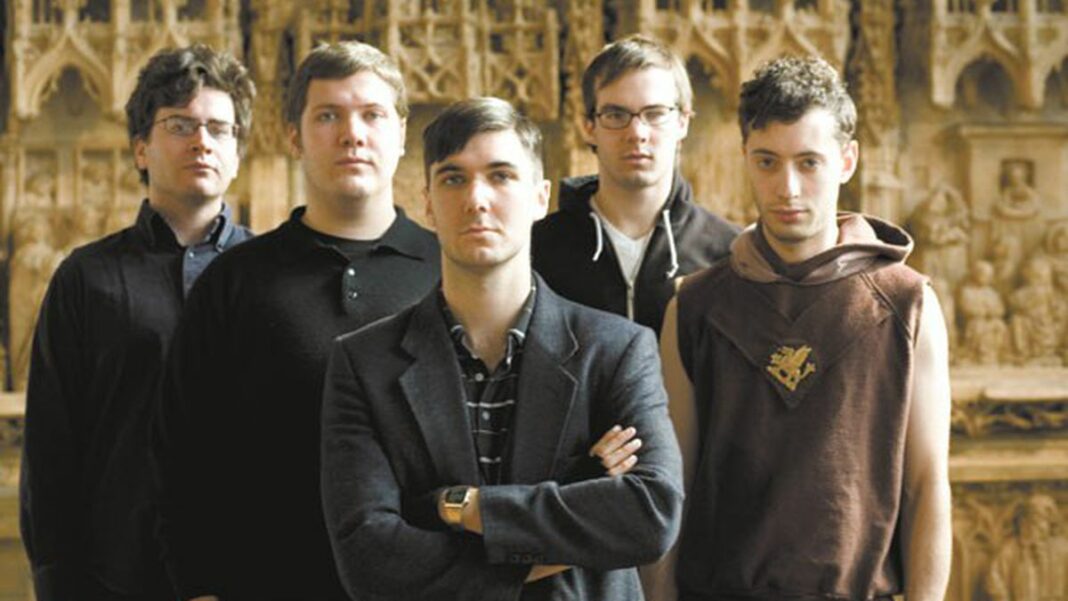
music,” he says, conjuring an apt mission statement for his band Extra
Life, a wildly inventive quintet equally fluent in metal, medieval folk
and Bauhaus.
Snowflakes are falling quietly outside of the Verb Café in
Williamsburg, where Looker’s effusiveness suggests that he might be on
his third cup of coffee. In actuality, he’s just pre-caffeinating for
the work day ahead. A music teacher by trade, Looker has private
lessons booked throughout the afternoon. “But we don’t want this
interview to be all about my life as a guitar teacher,” he says with
mock-seriousness. “You’re totally demystifying my whole vibe!” Trying
to unravel Extra Life’s vibe, however, isn’t quite as easy. The group’s
2008 debut, Secular Works, strikes a curious balance between
angular instrumentation and ancient melody — metallic guitars
zigging and zagging around hulking drum beats while Looker’s boyish
vocals float overhead, as if imitating Arthur Russell, a cello, or
maybe just Arthur Russell’s cello.
There are sleigh bells, quivering violins, and smudged bass lines
worthy of the Jesus Lizard. Most songs contort themselves well beyond
the seven-minute mark. It comes as no surprise that Looker was a
founding member of Zs, a Brooklyn-based chamber-rock troupe with a
penchant for ornately composed, exceedingly complex song structures.
“Zs was one of those things you can’t just half-do,” Looker says of his
time in the group. “Zs was deep. There’s so much stuff that I learned
from playing in that band. Without it, Extra Life would not be
possible.”
And while he found the band engrossing, Looker’s slow withdrawal
from Zs started in 2006. “I just started playing solo and doing these
loose songs that had some loose structure to the guitar parts,” he
says. “It was semi-improvised, dealing more with my interest in
medieval music and renaissance music and straight-up pop.” By the end
of the year, Extra Life had begun to take shape. “I wanted to form a
band behind it to give it some of the compositional rigor that Zs had,”
he says. In 2007, Looker left Zs on good terms, focusing full time on
the hooks and crannies of Extra Life. “By striking out on my own, I was
just re-investigating stuff I was interested in when I was younger,”
Looker says. “Synths, big string sounds, goth elements. Just dark rock
type stuff.” And early music. “My dad used to have this comp record of
medieval Christmas music,” says Looker. “I always heard it around the
holidays, but it never occurred to me to, like, really check it out.
This music was so beautiful and cold. And around that same time, I was
getting into modern classical music and I started to see similarities
to 20th- and 21st- century European concert music and pre-Enlightenment
music. There’s a certain detachment, a certain coldness, a certain
interest in asymmetry and asymmetrical melodies.”
With its panoply of influences, the early music flourishes are
exactly what makes Secular Works so striking — as if the songs
were written to be performed exclusively in cold, candle-lit
cathedrals. Instead, Looker and his band mates will be playing them in
DIY punk venues across the country this month as the group embarks on a
coast-to-coast US tour. After that, Extra Life heads to Europe for
Barcelona’s Primavera Sound Festival in May. Looker hopes the
15th-century influences will win Extra Life some 21st-century hearts.
After all, he says, “There’s some really weird shit out there that has
mass appeal.”