Screenshot of the new Chowhound.com interface, which launched on September 10.
It is a truism in the world of user interface design that if you make changes to a popular website, someone is going to complain — quite loudly, in all likelihood. Anyone who has lived through the past three or four iterations of Facebook can attest to that.
Even so, the overwhelmingly negative response to a recent revamp of the popular food discussion website Chowhound.com is notable for its intensity — and for its possible long-term ramifications on what had been a tight-knit, hyper-knowledgeable community, particularly here in the Bay Area. In the two weeks since the launch of the new site, longtime users have openly wondered if the Chowhound they had known and loved was either dead or dying, and at least one has already taken it upon himself to launch a new website as an alternative.
[jump]
On September 10, users who logged on to the website found that the old interface had been replaced by one that featured a much larger font size and sleek, oversized graphics, but was riddled with bugs and, in the words of user “mcsheridan,” was “slower than molasses in January ever was.”
Posting under the username “vipgeorges,” Georges Haddad, general manager of the San Francisco-based company, wrote a lengthy “Welcome to the New Chowhound” introduction in which he hailed a number of more fundamental changes — most significantly, that the site’s active regional discussion boards would be replaced by a “tagging”-based organizational structure.
Almost immediately, longtime Chowhound users began to freak out. Hundreds of them flooded the Site Feedback board with their complaints, which ranged from lamenting the new “Pinterest-like” visual aesthetic to describing the interface as “chaotic and nearly impossible to navigate.” One thread was posited as a simple poll of whether users preferred the old format or the new. As of Monday afternoon, the results were stunningly lopsided: 170 users voted for the old design; only four cast ballots for the new. Many vowed to leave the site altogether.
Longtime users are critical of how few discussion threads now fit on the screen on a smartphone.
Most of the criticisms have fallen into two categories. The first has to do with the usability of the site. Most notably, the new design meant that instead of being able to scan the titles of fifteen or twenty discussion threads at a time, now you could only see two or three — even fewer on a mobile device. As a result, users had to do a lot more scrolling — past several more advertisements — to access the same information they used to be able to get in an instant.
The other concern was the fact that the regional boards, which had long been the foundation of the site, had been replaced by a “tagging” system that many users found confusing and cumbersome. The fear is that if the sense of solidarity at, for instance, the board for discussing San Francisco Bay Area restaurants is weakened enough, and enough of the site’s core users choose to leave, then Chowhound will simply cease to be the area’s go-to online community for the food-obsessed.
It’s that loss of community that is of greatest concern to Felice Lu, an Oakland resident who has been posting under the username “felice” since 2002. In an interview, Lu said she had already been worried that the Bay Area board had been less active in the past several months. “With the site change, it’s almost on its last legs, I worry,” she said. What’s more, Lu said that many of the longtime users feel disrespected because the concerns they raised during the redesign’s beta phase seemed mostly to be ignored. When a website such as Facebook loses a disgruntled user, it’s just a drop in the bucket, but Chowhound is unique in the sense that the users — particularly the core users — are the ones actually generating most of the content that makes the site such a valuable resource.
When I spoke to Haddad, the Chowhound executive, about the blowback, he said, “I don’t think you respect people by not innovating on their tools.” And he pointed to the bright side: “There is an increasing number of users starting to say, ‘I’ve been using this for the past few days, and it’s not that bad.’”
Haddad was quick to take responsibility for the changes, explaining that Chowhound’s parent company, CBS Interactive, hadn’t given him any directives. In fact, he said he sold his superiors on his vision for a new Chowhound right around the time he was hired in March 2014. Mostly, the new design is intended to make the site more accessible to newcomers — to the person who stumbles on a discussion thread as a result of a Google search.
As for the complaints about the inefficiency of the new layout, Haddad said, “We expect people to scroll more, to be completely blunt about it. Even five or ten years ago, the expectation for users to scroll would be too much. Today it’s not.”
Haddad also cited several improvements to the site that he believes are being overlooked; for instance, the new tagging capability means that in the future, a user might run a search on Chowhound for “mojitos,” and find not only great user-generated discussions, but also recipes, videos, and image galleries. “We would have the best mojito page on the internet,” he said.
But is that the kind of thing that will appeal to the longtime Chowhound users — folks who have been scooping professional food journalists and finding hidden deliciousness in unlikely places for nearly twenty years?
Time will tell. For now, many users seem to be taking an extended break from the site. Haddad declined to share any post-redesign site metrics, but by one measure, it’s clear that activity on the site is way down: For the past two weeks, there have been anywhere from ten to twenty new comments posted each day with the “San Francisco Bay Area” tag — far fewer, longtime users say, than the hundred-plus posts a day that used to be typical on the board.
Sampson Shen, a Palo Alto resident who posts under the username “ckshen,” is one of several longtime Chowhound users who left the site due to his disillusionment with the redesign. Even though he doesn’t have any background in website design, he’s started a new, not-for-profit food discussion site, Hungry Onion, whose streamlined appearance recalls Chowhound’s olden days in the late Nineties, when a New York City trombone player named Jim Leff founded the site and ran it, ad-free, as a labor of love. So far, Shen said, several dozen users have signed up.
Lu, for her part, is holding out hope that Chowhound won’t collapse outright, but if it does, she’s eyeing eGullet. And she has already made her first post — a review of the Uptown Oakland restaurant Calavera — on Hungry Onion.
Disclosure: I, too, am a longtime Chowhound user and have posted for many years under a pseudonymous account that I created before becoming the Express’ food editor. In the future, if I do post on the forum, it will be using my real name. This decision is unrelated to Chowhound’s redesign.
1. San Francisco Bay is inundated with billions of tiny pieces of plastic — likely caused by plastic microbeads in cosmetics and toothpaste and bits of synthetic fabric, such as fleece, that break down when washed, the Mercury News$ reports, citing a new groundbreaking study from the San Francisco Estuary Institute. Researchers found about 1 million tiny pieces of plastic per square kilometer in the bay — a concentration far greater than what had been previously recorded in the Great Lakes, Chesapeake Bay, and other US bodies of water. Governor Jerry Brown has not yet indicated whether he will sign legislation that would ban the use of plastic microbeads in cosmetics and personal care products in California.
Barbara Lee.
2. Congressmember Barbara Lee, D-Oakland, announced that the federal government has awarded a grant to Oakland to help pay for fifteen new police officers, the Trib$ reports. The $1.875 million grant, however, will only pay about one-third the cost of fifteen cops, so the Oakland City Council will need to appropriate the rest of the funds — or, the city will lose the grant.
3. A federal judge upheld most of Berkeley’s cellphone warning label law, but struck down an aspect of it that sought to warn consumers that the radiation risks from cellphones are greater for children, the Chron reports. Judge Edward Chen ruled that the law’s language on children is not based on scientific consensus, while the rest of the city’s law is — and follows federal guidelines. The cellphone industry sued to overturn all of Berkeley’s law, and will appeal Chen’s decision.
[jump]
4. Governor Brown has not indicated whether he will sign earthquake retrofit legislation that is backed by the cities of Oakland and Berkeley, the LA Times$ reports. The legislation would provide tax credits to California landlords and building owners who retrofit their buildings, and proponents, including mayors Libby Schaaf and Tom Bates, say it will provide a much-needed financial incentive to make housing structures earthquake safe. But Brown has stated previously that he does not, in general, support the use of tax credits to finance capital improvements in California.
5. Some East Bay MUD customers — primarily in central Contra Costa County and the San Ramon Valley — are complaining about bad tasting water that officials say is being caused by shipments of Sacramento River water during the drought, the CoCo Times$ reports. East Bay MUD normally gets its water from the pristine Mokelumne River in the Sierra, but the drought has forced the agency to buy water from the Sacramento.
6. Because of fierce opposition from homeowners and landlord groups, the Bay Area Air Quality Management District has killed a proposal that would have required fire places in the region to be replaced with clean-burning devices whenever a home is sold or rented out, the CoCo Times$ reports. The proposal was designed to improve air quality in the Bay Area.
7. Two powerful water agencies — the Westlands Water District, which represents Big Ag in the dry San Joaquin Valley, and the Metropolitan Water District, which represents Southern California residents — are considering buying four islands in the Delta, in a move that could speed up construction of Governor Brown’s controversial plan to build two giant water tunnels in the region, the SacBee$ reports
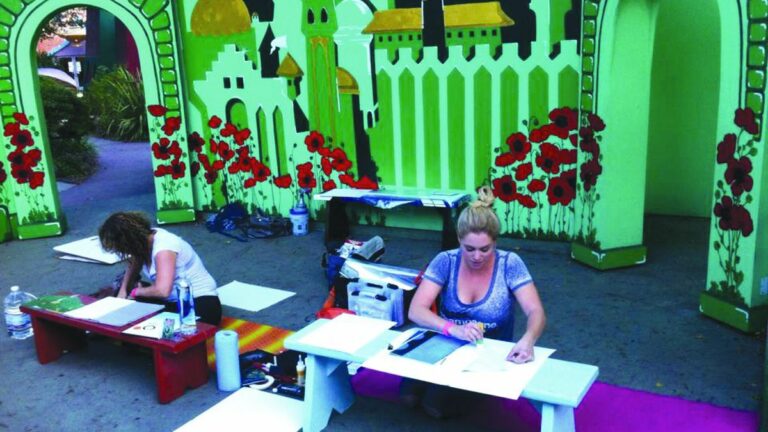
Every year, for at least one night, Children’s Fairyland (699 Bellevue Ave., Oakland) lets in adults without their children. Drawn Together, which will take place on September 25, is a nighttime party for big kids at the magical theme park for which more than fifty artists from Oakland and the broader Bay Area create more than one hundred works of art inspired by the classic Fairyland design. While the artists paint, attendees are welcome to roam around, drink complimentary beer and wine, eat, and listen to Russell E. L. Butler spin records. All works of art will be sold for $40 at the end of the night, and all proceeds will go to providing reduced and free Fairyland experiences for youth in need. Artists to look out for include the wildly imaginative John Casey, seasoned Oakland muralist Dan Fontes, typography expert and muralist Marcos LaFarga, and local printmaker and comic book extraordinaire Veronica Graham.
“Free spirit” is the motto of rapper Beejus, who embraces being a misfit on his recent album of the same title. The Oakland MC is the curator and headliner of FreeSpirit Fest Two, a showcase of similarly left-field local rappers at Legionnaire Saloon (2272 Telegraph Ave., Oakland) on Thursday, September 24. Performing alongside is Tia Nomore, a fiery, up-and-coming lyricist and #GirlGang ambassador who recently toured with HBK Gang’s Iamsu! Though Nomore’s highly anticipated debut album, Halloween, still doesn’t have an official release date, she has released a string of well-received singles over the past year, including the no-holds-barred ex-boyfriend diss track, “Suck It Easy,” and the infectious boast rap “CakeWalk,” which features HBK Gang affiliate Show Banga. Oakland MCs Anthony Dragons, a member of the collective Them Hellas alongside Duckwrth and Queens D.Light; Beejus’ frequent collaborator Oops, who produced the entirety of FreeSpirit: The Album; and introspective storyteller Legendvry are also performing.
Game of Thrones is a veritable cultural phenomenon. The show is HBO’s most commercially successful series to date — transcending the fantasy genre’s niche appeal in a way that is unprecedented in television. So who better to produce a tribute show than local, live variety company Tourettes Without Regrets, whose eclectic performances appeal to fans of burlesque, slam poetry, live music, and stand-up comedy alike? The upcoming show, “Game of Thrones Live — Hodor’s Revenge” on September 26 at the Oakland Metro Operahouse (630 3rd St.), features Yee Olde Dragon Master’s Guide to the Mighty Labyrinth Quest, a local “choose your own adventure” band whose live show involves twelve-sided dice the size of beach balls. As per the night’s theme, the group will perform new material inspired by Game of Thrones. If a night of bawdy burlesque, role-playing folk metal, and fantasy fandom seems disparate at first glance, that only speaks to the power of endless war in the Lands of Ice and Fire to bring us all together.
The annual Watershed Environmental Poetry Festival is back in Berkeley on September 26 to celebrate its twentieth year. The 2015 festival is dedicated to its co-founder and former director Mark Baldridge, who died late last year. Baldridge was also deeply involved with Poetry Flash, which has been an invigorating force in the East Bay literary community since 1972. The festival will begin at 10 a.m. with a walk along Strawberry Creek led by poet and “eco-educator” Chris Olander and featuring readings by Emily Johnston, Maya Khosla, MK Chavez, and others. At noon, the main festivities will begin. This year, celebrated poets Brenda Hillman, Jane Mead, Francisco X. Alarcón, John Shoptaw, and — as always — poet laureate Robert Hass, will be on the main stage. But that’s just a taste of the long lineup of nature-oriented readings and musical performances that will continue until 4:30 p.m. at Martin Luther King Jr., Civic Center Park (2151 Martin Luther King Jr. Way, Berkeley). Tents, chairs, and carpet squares are provided, but sitting in the grass is also recommended, along with a farmers’ market lunch from around the corner.
Edward Burtynksy’s photographs offer a sense of the sublime — that feeling you get when standing at the top of a mountain that makes you realize how small you are relative to the rest of the world. But his grand photographs are also terrifying, because, upon closer inspection, they reveal barren landscapes, ravaged by the extraction of natural resources. Many of the renowned photographer’s large-format works will be on view at the David Brower Center (2150 Allston Way, Berkeley) for its annual Art/Act exhibition, which honors one artist doing outstanding work in the intersection of art and activism. Burtynsky’s show will primarily highlight his series Water, which features once rich water sources that have dried up into shriveled landscapes with magnificent topographical patterns. In the midst of California’s detrimental drought, the photographs from all over the world both hit home and speak to the dangers that our ecosystem faces worldwide. The show opens on September 18, with a free reception from 7–9 p.m. during which the artist will give a public lecture about his work.
In 1983, the Richmond Art Center (2540 Barrett Ave., Richmond) put on the landmark exhibition, Poetry for the Body: Clothing for the Spirit, which highlighted fashion as fine art. Now, with Body as Agent: Changing Fashion Art, its current show featuring all California designers, RAC surveys how fashion has evolved as an art form since then. The show places the work many of the artists from the original exhibit alongside more recent designers who are building on their work, and totals more than thirty participating artists. The new additions contribute a shift toward upcycling and innovative uses of unconventional materials that reflect a growing consciousness around environmentalism. They also offer nuanced social and political commentary — often assumed to be reserved for traditional art mediums — through a wearable vocabulary. Overall, the display puts forth an updated vision of ways in which the body can be used as a roaming billboard for artistic expression.
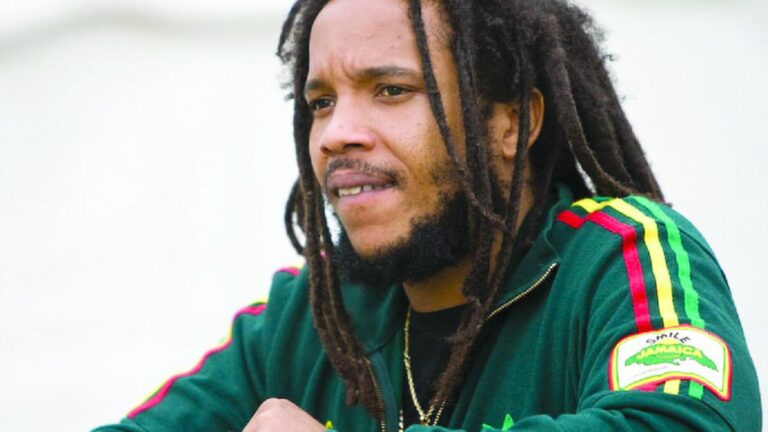
Oakland residents typically have to cross the Bay Bridge to catch the live shows of reggae and hip-hop’s all-time greats, but the Bay Area Vibez Festival brings world-renowned artists to our backyard this weekend. Taking place September 26 and 27 at Middle Harbor Shoreline Park in West Oakland, the festival includes a lineup of influential musicians, including six-time Grammy-winning reggae artist Stephen Marley, Illmatic rapper Nas, Damian Marley (Stephen’s brother and Nas’ frequent collaborator), and dubstep producer Bassnectar — one of the few artists in the lineup who hails from the Bay Area. Lesser-known acts to look forward to include Meshell Ndegeocello, a neo-soul songstress and multi-instrumentalist who has worked with Madonna, Chaka Khan, and Indigo Girls. The Grouch & Eligh, a duo composed of two stalwarts of Oakland and Los Angeles’ underground hip-hop scenes, is also not to be missed.
9/22/2015 10:00am: Last night’s city council hearing on the health and safety impacts of coal ran late into the night. According to Oakland City Clerk LaTonda Simmons, 694 members of the public signed up to speak.
[image-14]At the end of the night, councilmember Dan Kalb moved a motion to keep the city’s hearing on the health and safety impacts of coal open until October 5. The public is invited to continue submitting comments and evidence until then. Kalb’s motion sets a deadline for a city decision, which could result in permitting or banning coal shipments through the city: December 8.
A few things were apparent from last night’s council hearing. Pro-coal speakers are worried mainly about securing jobs. They repeatedly said if the city bans coal it could cost Oakland thousands of jobs.
Opponents of coal said, however, that this isn’t a jobs versus environment battle. Leaders from the ILWU Local 10, ILWU Local 6, SEIU 1021 (including the leader of its port chapter) all said that the city doesn’t have to accept coal to successfully create jobs at the Oakland Global project and its bulk commodity terminal.
What was also apparent last night was that CCIG and TLS, the companies behind the coal export proposal, bused in dozens of construction workers to the council hearing, and signed them up for the public comment period, but none of these workers were allowed to speak to the council.
All night long I attempted to interview at least 20 of the workers brought to the council meeting by but none of them would utter a word. Instead they would look down at the ground. Some would mutter in Spanish that they didn’t speak English. Two of them actually fled me and ducked into a bathroom to avoid my questions. All I wanted to know was why they came to the council meeting, and how they felt about the possibility of shipping coal through Oakland.
But one of these workers did talk to me.
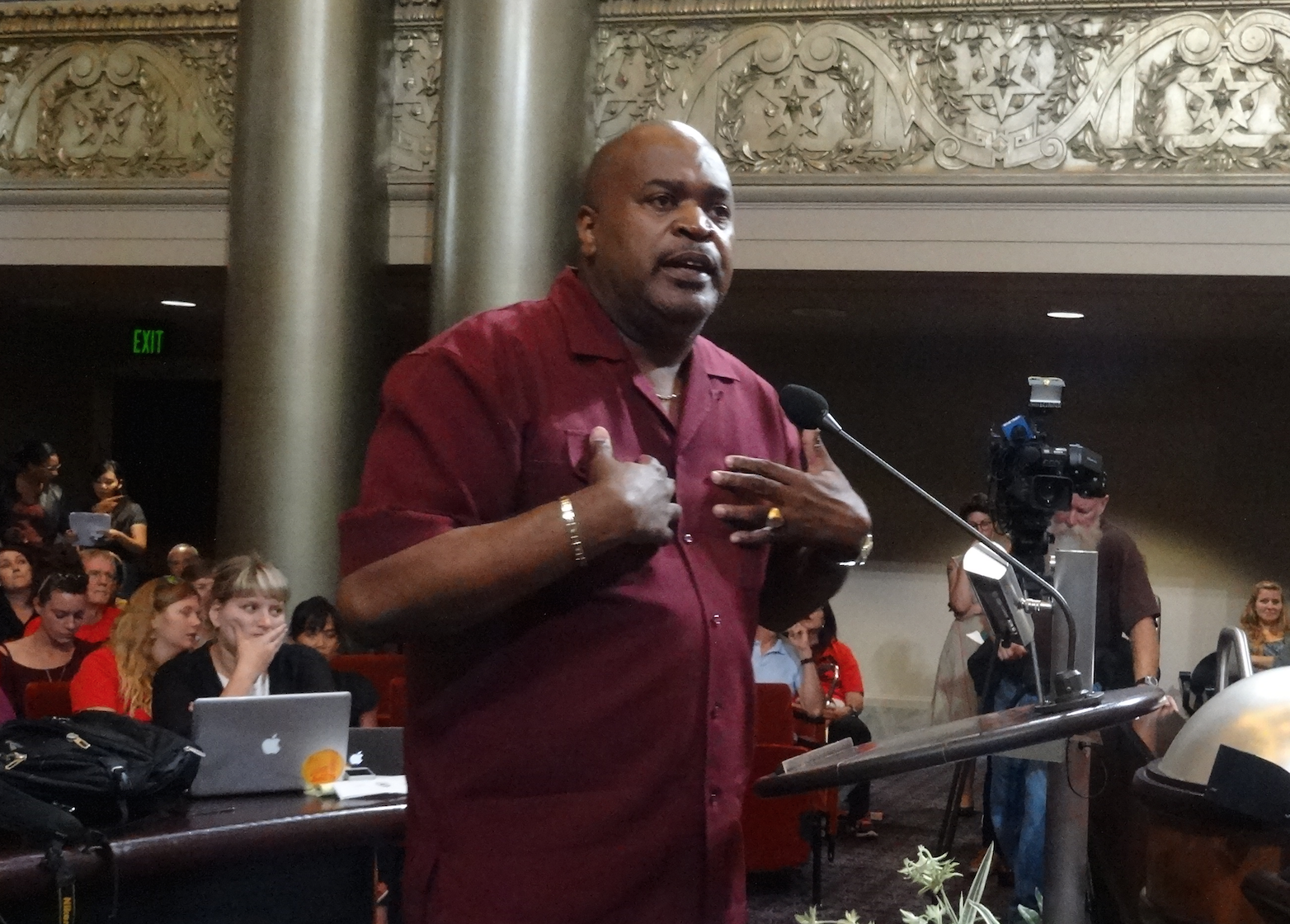
“Lots of these guys are getting paid their regular hourly wage to be here. They were given free lunches and these T-shirts too,” said Oscar Madrigao, a construction worker brought to the meeting by Alarcon Construction, one of CCIG’s subcontractors.
“They’re being used,” said Madrigao about his fellow workers.
[jump]
I tried talking with CCIG’s representatives as well as leaders from the Laborers Local 304 Union about Madrigao’s claims. Fernando Estrada, the business manager of the Laborers Local 304 said he couldn’t comment. Several of CCIG’s lobbyists refused to identify themselves to me, let alone explain the situation with the dozens of workers they had brought to the meeting.
At least two people in the council chambers were shepherding workers in and out of the meeting so that they could cede their time to CCIG’s spokespersons. They would bring the workers in through a side door, hustle them to the podium to state their name for the record, and then hustle them out of the chambers. I tried several times to speak with these workers on their way out of the chambers, but several times a woman working with Greg McConnell, CCIG’s lobbyist, literally pushed me to prevent me from speaking with the workers. When I asked her who she was, she refused to tell me.
Outside the council chambers I asked other workers if they had been coached to say nothing to the press. I asked them where they got their yellow T-shirts. I asked them if they were being paid to be there. And above all I tried to ask them how they personally felt about coal. None of them would utter a word.
9:15pm: There’s still a line of speakers against coal, but I’m packing it up for the night. I’ll write a re-cap of the meeting tomorrow.
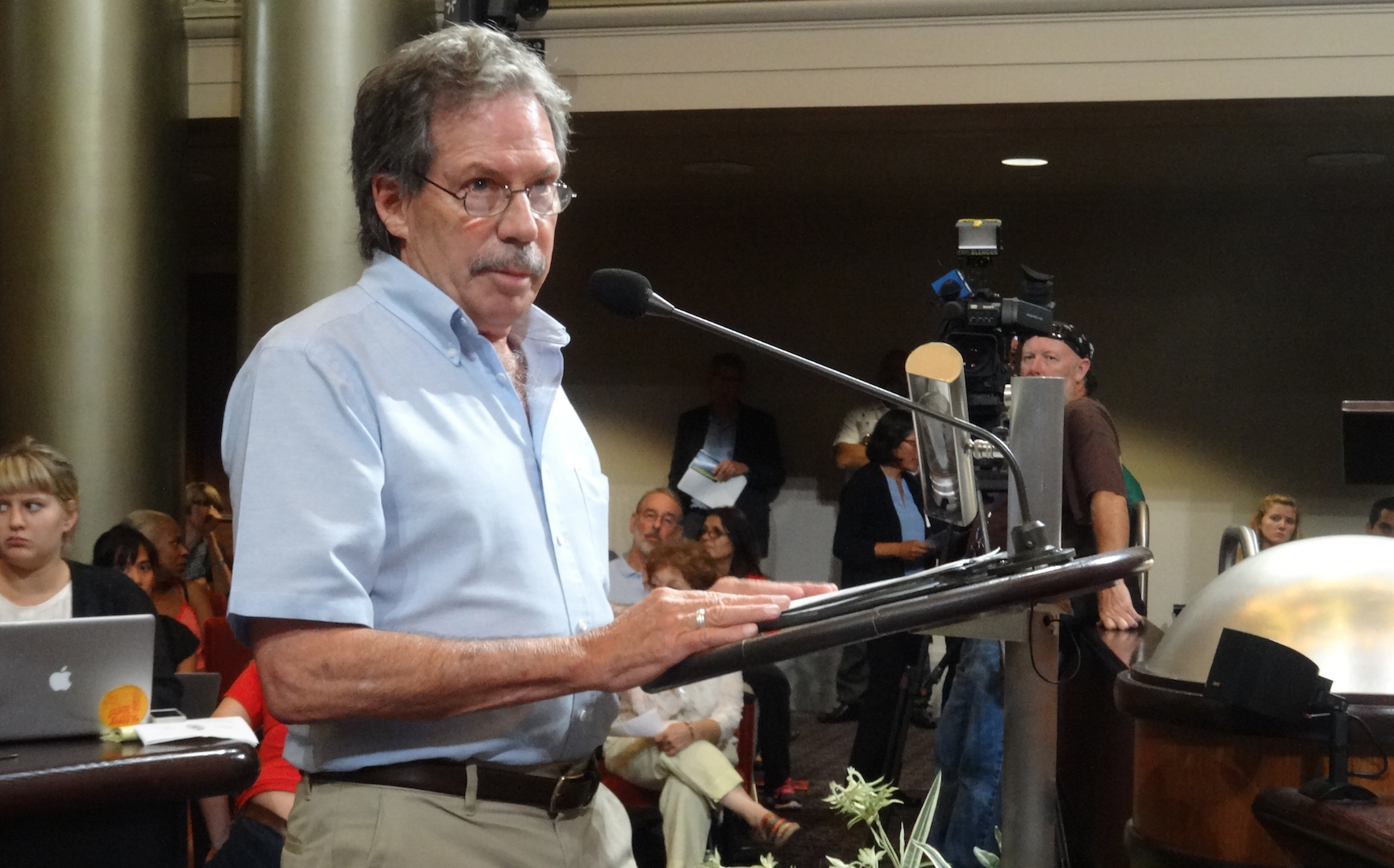
9:00pm: Richard Grasetti is a California Environmental Quality Act expert. He also knows a lot about the federal environmental law, the National Environmental Protection Act. Both laws, CEQA and NEPA for short, require that governments study the impacts of their decisions, including projects like the Oakland Global trade center. Grasetti has helped numerous governments review major projects across California in order to comply with CEQA and NEPA.
[image-13]According to Grasetti, the proposal to export millions of tons of coal from Oakland were never studied in any environmental impact analyses for the Oakland Global Project.
“This is a major change to project,” said Grasetti about the coal export plan that only became publicly known in April of this year.
“CEQA requires you reopen the project,” said Grasetti, meaning that Oakland might need to conduct a new environmental impact study that examines coal shipments before any forward movement with the project.
“I suggest that you enact emergency moratorium on coal terminals in Oakland, and while that’s active, move ahead on CEQA analysis of coal terminals in Oakland.” said Grasetti.
8:20pm: Danny Kennedy, one of the founders of Sungevity, told the Oakland city council that the coal industry is dying.
[image-12]The city shouldn’t invest in a dinosaur industry, but instead in the future, he said. Kennedy’s comments aren’t merely the self-serving comments of a solar industry executive.
Coal company executives worry in their financial reports that government efforts to address climate change are rapidly phasing out their industry’s ability to turn a profit.
Kennedy said his industry is growing and adding jobs, but coal is a dead end.
“This is asbestos, this is tobacco. Oakland doesn’t need this albatross around it’s neck,” Kennedy told the council.
Kennedy said also that renewable energy companies, like Sungevity, which is headquartered in Jack London Square, will likely avoid Oakland if the city ties its future to coal.
8:02pm: Several years ago in his newsletter chronicling the transformation of the the old Oakland Army Base into the Oakland Global logistics and trade center, Phil Tagami pledged that his company, CCIG, would not be building a coal facility.
[image-11]
The statements were meant to prevent community members from opposing Tagami’s plans on the Oakland waterfront. And they seemed to work. Oaklanders got behind Tagami’s project. Elected officials committed millions in subsidies to Tagami’s project. Here’s the full text from the CCIG newsletter:
“It has come to my attention that there are community concerns about a purported plan to develop a coal plant or coal distribution facility as part of the Oakland Global Project,” Tagami said. “This is simply untrue. The individuals spreading this notion are misinformed. CCIG is publicly on record as having no interest or involvement in the pursuit of coal related operations at the former -Oakland Army Base.”
Marie Walcek of the California Nurses Association brought the newsletter to tonight’s hearing to remind the councilmembers of Tagami’s promise.
7:31pm: Jean Quan made an appeal to her former colleagues tonight. Perhaps it’s a sign that Quan is planning a political comeback at some point? In the very least the hearing is making clear that coal will be a political issue for some time to come in Oakland.
[image-10]
Quan, who led the city when the Oakland Army Base redevelopment project was negotiated, said that coal was never part of the plan. She’s shocked it’s now a central part of Tagami’s plans.
“The approval process would have been very different had Phil Tagami said ‘we’re going to do coal.’” Quan told the council. “There would have been a different EIR. Margaret [Gordon] would have been on our backs and Nancy [Nadel] would have demanded a much more stringent [environmental review].”
Quan was also clearly upset about the use of hundreds of million in taxpayer money to build what would be one of the largest coal export terminals on the west coast. “There’s $400, $500 million in state and Measure BB dollars,” said Quan about public funds being used to build the Oakland Global projec. “Do you think when we went to voters, if we had said, ‘give us this money so we can build a coal terminal?’ Do you think they would have supported it? I don’t think so.”
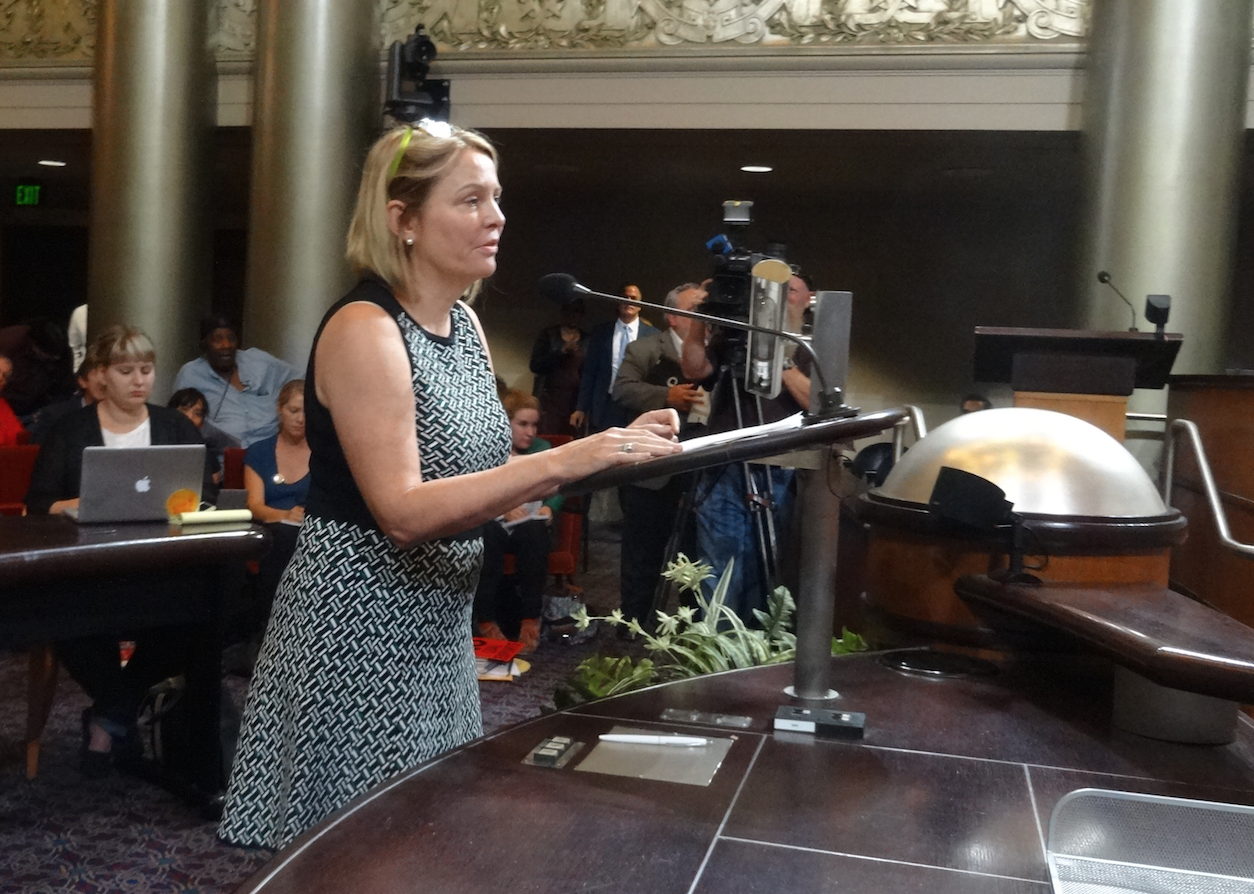
7:10pm: Kathryn Floyd, a lawyer that CCIG paid to appear before the council tonight, argued that federal laws pertaining to railroads preempt local laws.
Kathyrn Floyd, a lawyer representing CCIG.
Credits: Darwin BondGraham
The implication is that Oakland can’t ban coal shipments through the city because it would interfere with federal railroad laws.
“Theoretically if this city were to take a position that coal could not be transported in interstate commerce, that would be a problem and would be preempted,” Floyd told the council.
Multiple members of the council interpreted her point as meaning, however, that because federal laws preempt any regulations pertaining to the shipment of coal, the city cannot hold TLS to any promises it makes about covering railroad cars that would ship coal through the city.
Project proponents pointed out in a letter to the city council today that while shipment of coal via rail might be regulated purely by federal law and beyond Oakland’s reach, the city certainly can regulate what gets built on the Oakland Global project site, which is owned by the city.
6:30pm: “All money ain’t good money.”
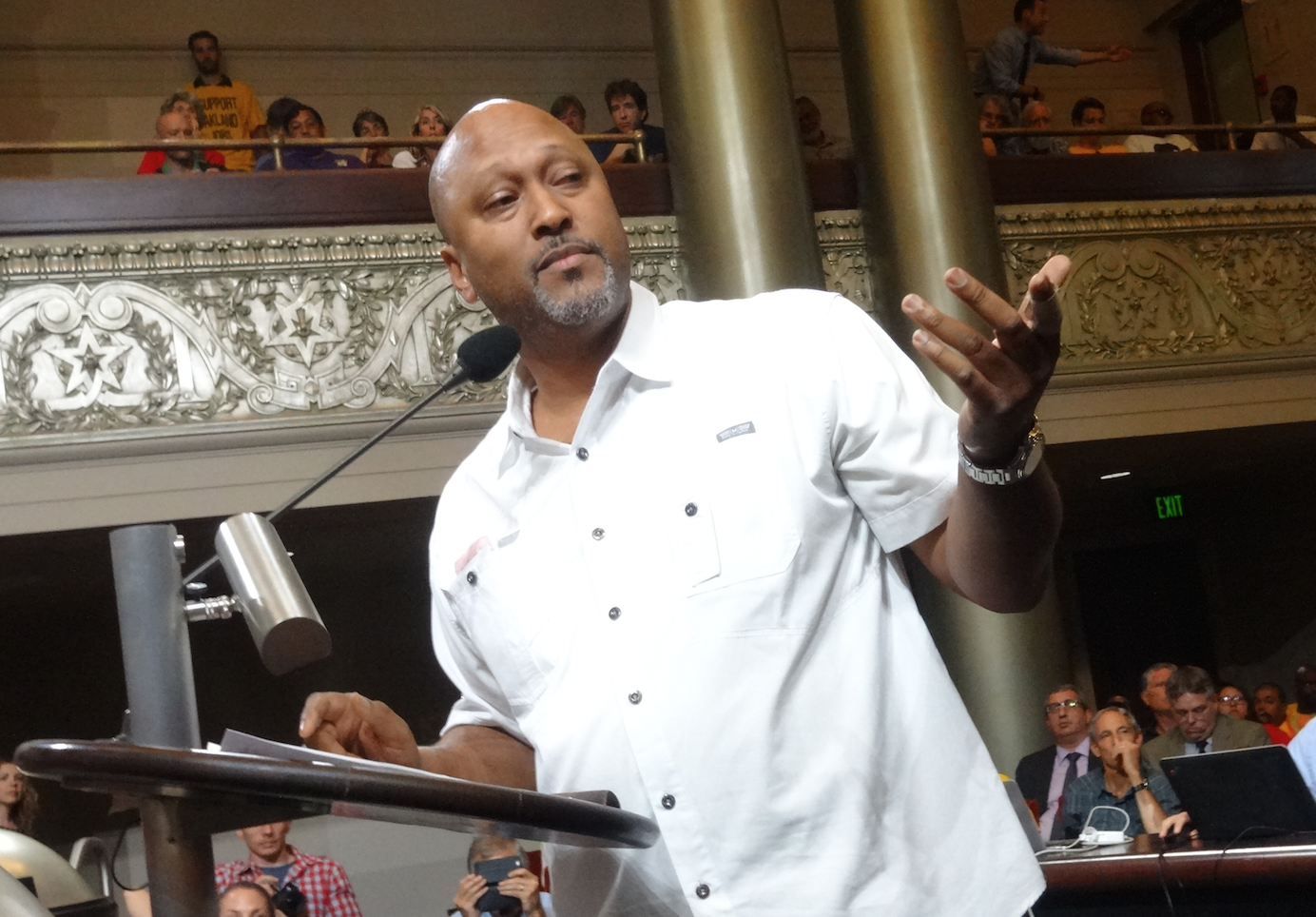
Derrick Muhammad, business agent for ILWU Local 10.
Credits: Darwin BondGraham
That’s ILWU Local 10’s message to the Oakland city council regarding coal.
“Dope dealing represents employment for some people,” Derrick Muhammad, the business agent for the longshore workers’ union that represents waterfront workers in multiple Bay Area ports. “But we know it’s detrimental to the health and safety of some in the community.”
Muhammad noted that the railroads and port facilities that would ship coal are adjacent to majority black neighborhoods that already suffer from the highest rates of asthma in northern California.
“So no to coal,” Muhammad concluded.
6:22pm: The US EPA just weighed in on plans to export coal from the Oakland waterfront.
Richard Grow of the US Environmental Protection Agency.
Credits: Darwin BondGraham
Speaking in official capacity for the nation’s top environmental regulatory agency, Richard Grow, a project officer for Region 9 of the Environmental Protection Agency, warned the city council that the kinds of environmental issues raised by coal transportation and storage have never been studied for the Army Base redevelopment project. He cast uncertainty on the rights of the Oakland Global developers and the city to permit the shipping of millions of tons of coal through the city.
“The kinds of environmental issues you’re hearing about haven’t been subject to any federal environmental review since 2001,” said Grow. “In our view the kinds of impacts associated with coal haven’t been subject to state or federal environmental review.”
What this means for the project isn’t clear. But Grow also said he finds the secretive nature of CCIG and TLS’s dealings with Utah coal companies disturbing.
“I would have to say it’s been unsettling, some parties we’ve ben sitting around with over the past 3 years, those same people have been off in Utah trying to establish coal deals and contracts. None of that was in our discussions. We find that very unsettling.”
6:01pm: Some church leaders are in strong support of the plan to export coal from Oakland. Pastor Kevin Hope of Acts Full Gospel Church told the council that the terminal will produce 2,400 jobs. He said TLS has “done more than their due diligence with the liabilities that come with transporting coal.”
Pastor Kevin Hope supports shipping coal through Oakland.
Credits: Darwin BondGraham
Hope said shipping coal will generate jobs. “I really want to drive that point home: we would like to see this in our community. It would help us.”
Pastor Kevin Barnes of Oakland’s Abyssinian Missionary Baptist Church concurred. “I’m not an environmentalist. I dont know much about that stuff,” said Barnes. Barnes talked about the work his church has done feeding poor people in the community. He said the council needed to approve coal shipments to give young unemployed men “hope.”
“These guys are looking for an opportunity,” Barnes said about unemployed young men his church encounters in charity work. “We need your help to help us. I’m a preacher, not an environmentalist.”
“I’m a leave you with this,” said Barnes, speaking to the council like the preacher he is. “You mean to tell me that all this cocaine that’s around us, that’s killing our young men, and you’re worried about coal?”
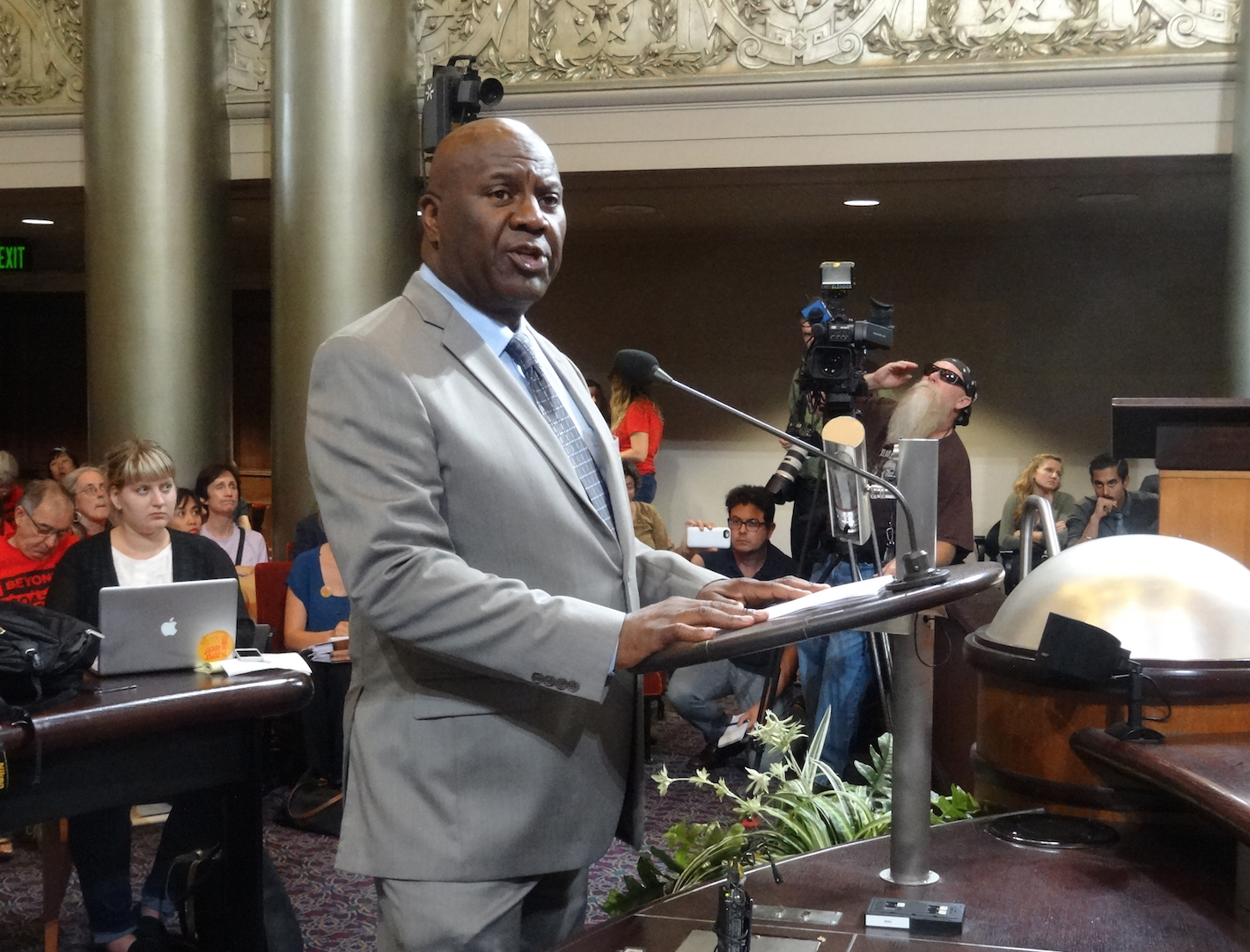
5:15pm: Jerry Bridges, the president and CEO of TLS just spoke to the Oakland city council defending his plan to export coal from the city’s waterfront. But bridges emphasized that coal would be one among many commodities the terminal handles.
Jerry Bridges of Terminal Logistics Solutions.
Credits: Darwin BondGraham
“We are soliciting interest from a full range of legal materials that the bulk terminal is expected to handle. We must be able to handle the multitude of legal materials the bulk market demands.”
Bridges said the terminal will operate with new technologies to supposedly reduce pollution and hazards. “It’s important to realize this is an opportunity for Oakland to set and example for the world for the transportation of a commodity that’s needed around the world. We’re doing our best to raise the bar to demonstrate to all the world that this commodity can be shipped safety.”
Bridges called the coal his terminal would ship a clean burning fuel that would improve the environment. “This will be the highest quality coal available in the world,” said Bridges. The comment elicited laughter from opponents. “We believe that by using western bituminous coal,” continued Bridges,” we will elevate the environmental profile because it’s better to burn this than wood or other products that emit more matter into the atmosphere.”
Greg McConnell speaking in support of coal.
Credits: Darwin BondGraham
She said the proposed project will definitely have a direct and proximate impact on Oakland’s environment and the health and safety of workers.
“This project will release as much as 646 tons of fugitive coal dust per year,” said Niemeir. “That’s the same as more than 1 million pounds per year.”
“The proposed 10.5 million tons of coal shipped annually through Oakland will generate 30 million tons of CO2,” added Niemeir. “That’s the size of seven average power plants.
Next up was Greg McConnell, a lobbyist who said he had been retained by the California Capital Group to give an overview of the plan to export coal.
“Coal is just one of many bulk commodities considered for this terminal,” McConnell told the council. “We should be real clear about what we’re talking about: a bulk commodity terminal that will make Oakland competitive throughout the western US and world.”
McConnell said the bulk commodity terminal will create 11,970 jobs. He did not say how the exclusion of coal would impact that number.
“Everything it’s going to do will be in full compliance with air quality mandates,” McConnell added about environmental concerns.
4:24pm:
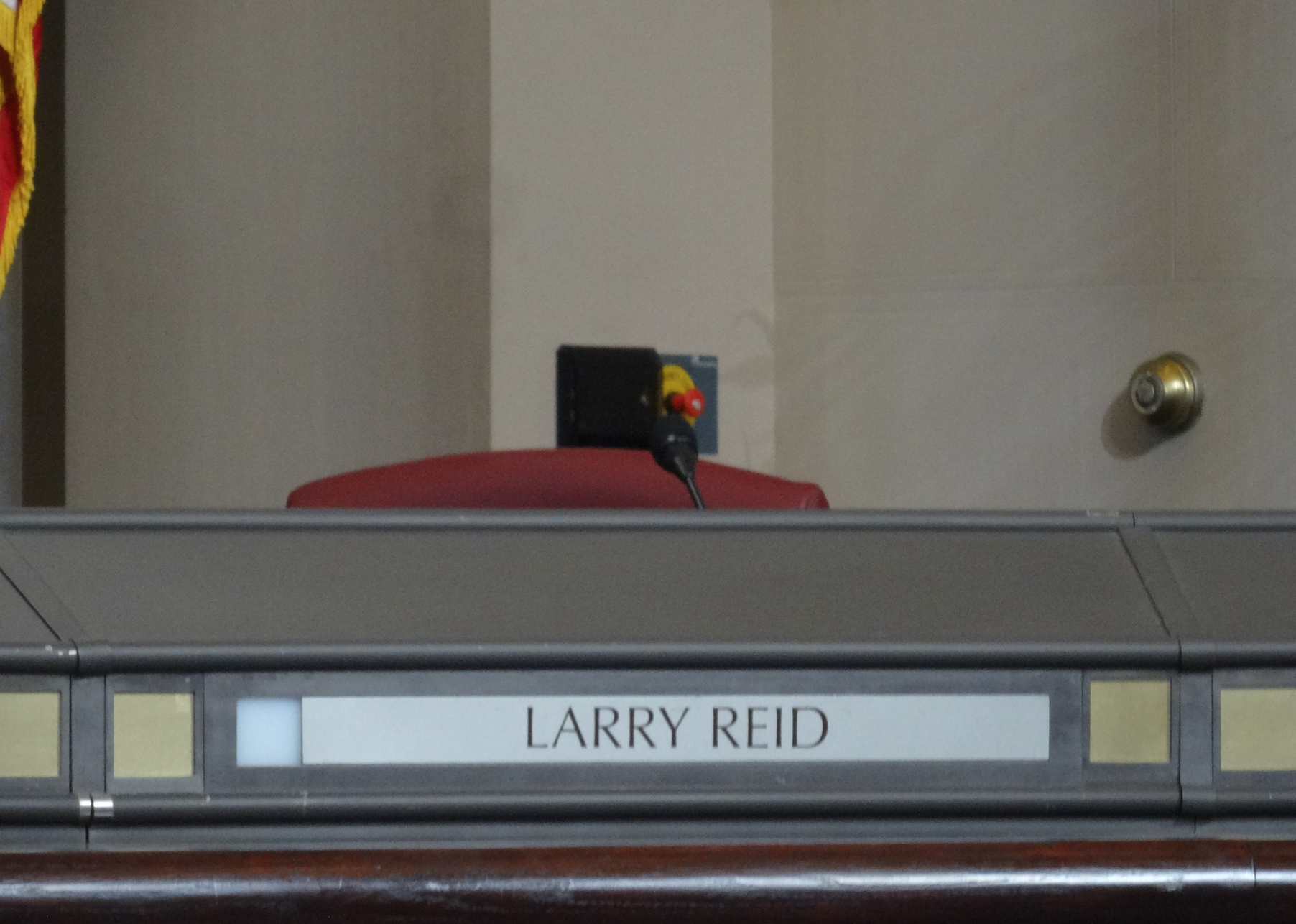
Larry Reid was one of the city councilmembers who called the special meeting on coal transportation through Oakland, but he’s absent tonight.
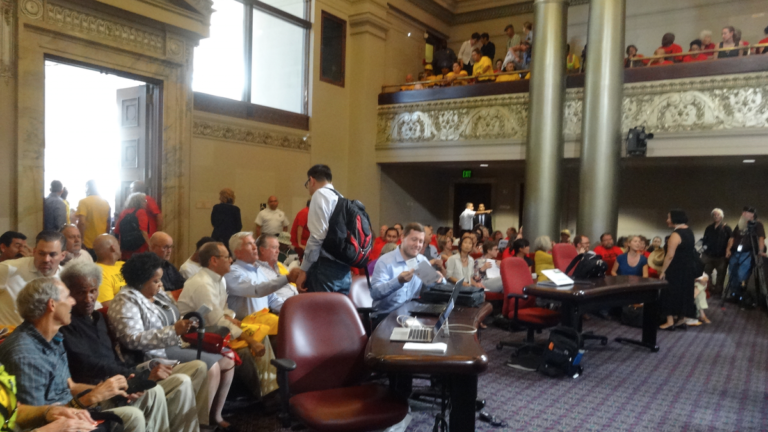
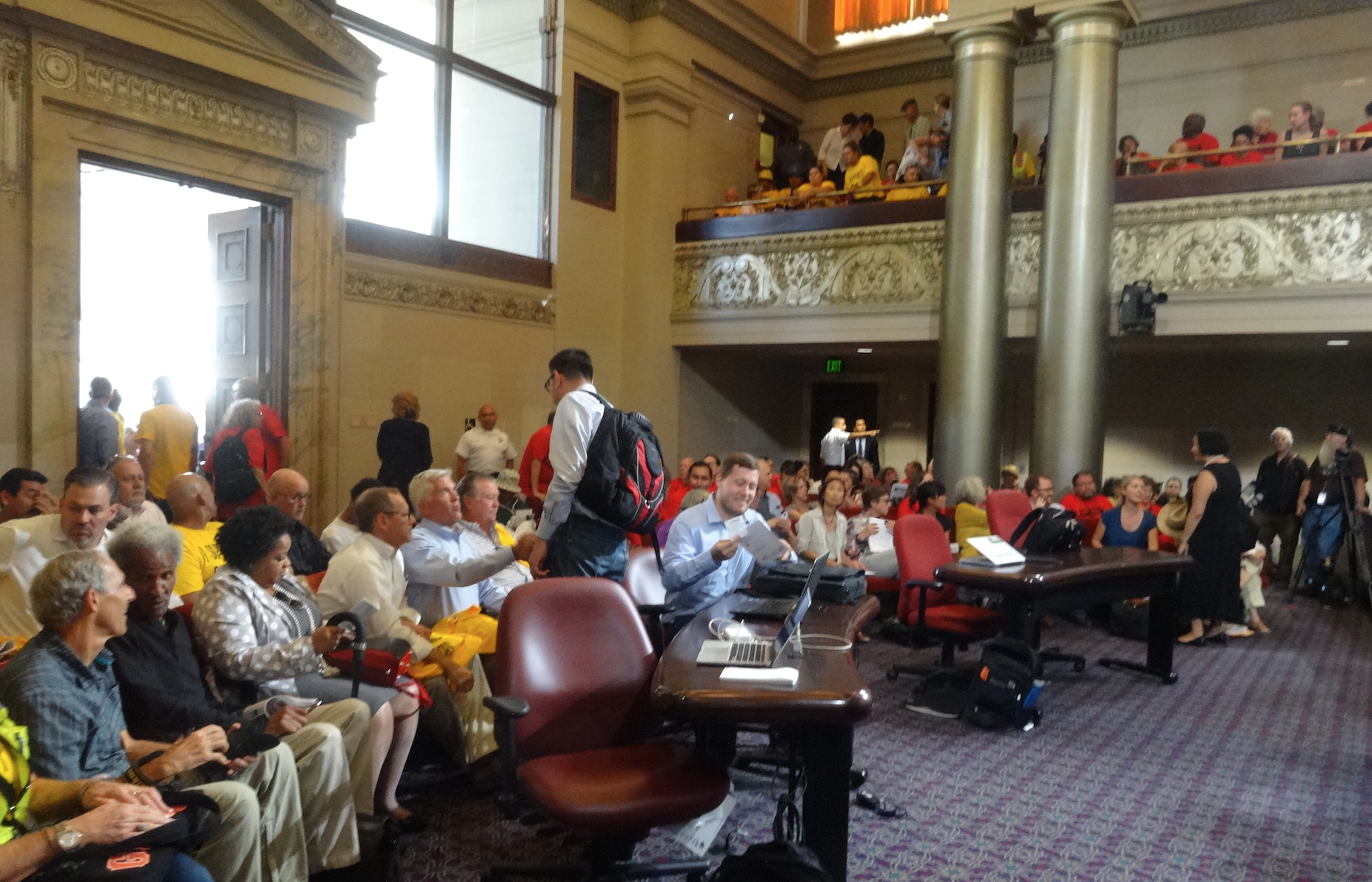
According to the Oakland City Clerk approximately 583 people have signed up to speak on the issue. The chambers are packed, as are overflow rooms in City Hall.
Assistant City Administrator Claudia Cappio is about to give a presentation on the issue.
4:09pm:
The Oakland City Council is hearing testimony today regarding the potential health and safety impacts related to the transportation of coal through the city.
Oakland city council chambers are packed for today’s hearing on coal.
Credits: Darwin BondGraham
The hearing was called after it was revealed months ago that developers hope to export millions of tons of coal from a terminal that will be built at the Oakland Global project at the old Army Base.
I’m live blogging the hearing today. Check back on this page for updates throughout the afternoon.
Hundreds have turned out for the hearing. The Laborers Union Local 304 turned out dozens of workers waring bright yellow T-shirts with “I support Oakland jobs” written on them. The Laborers hope to secure jobs by building the coal export terminal.
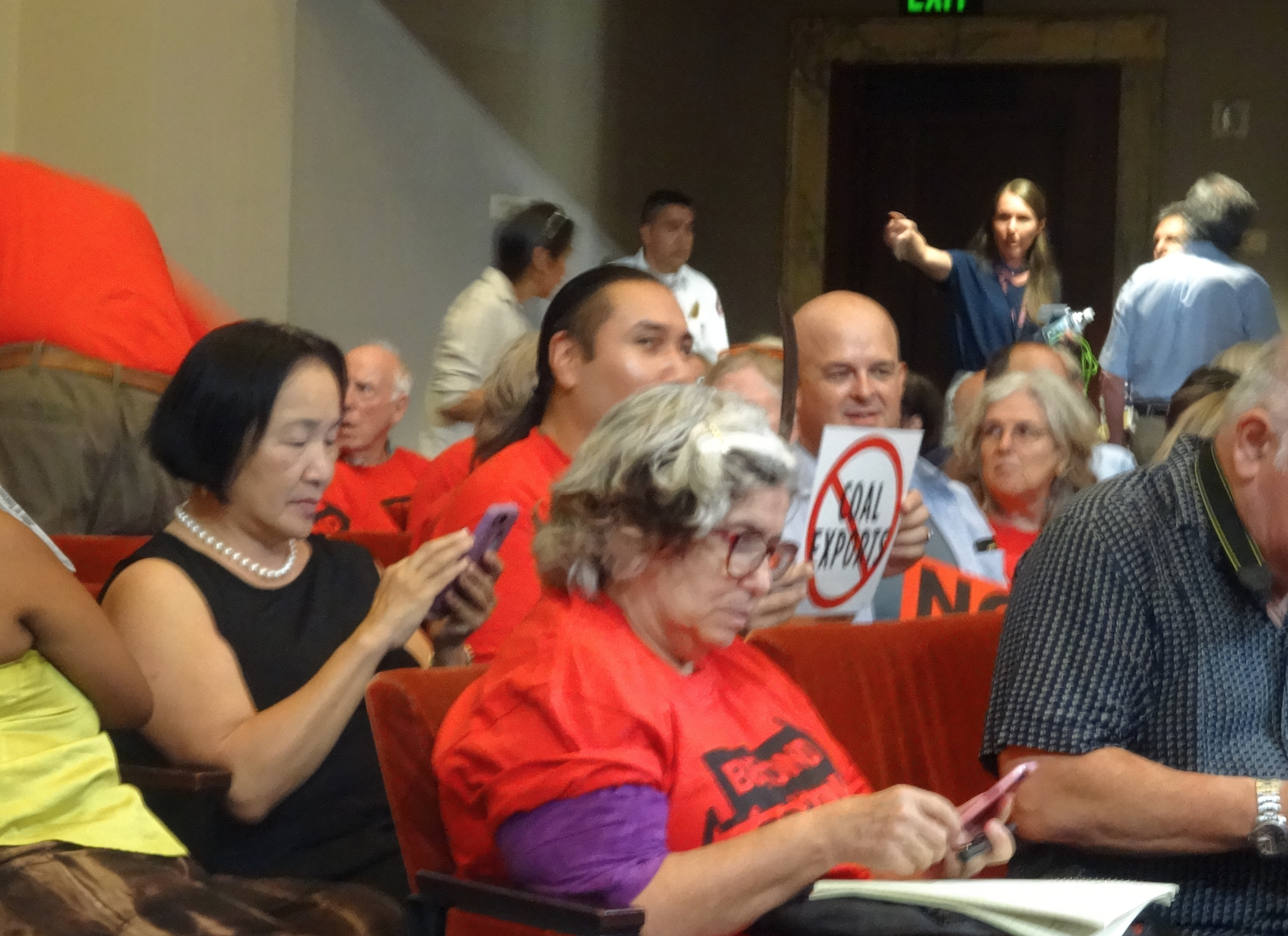
Most other unions, including the California Nurses Association and SEIU 1021, oppose the coal export plan. Dozens of community groups and environmental organizations like the Sierra Club and West Oakland Environmental Indicators Project have rallied opponents also.
Former Oakland Mayor Jean Quan among opponents of the coal export plan.
Credits: Darwin BondGraham
“This project has already produced many jobs,” said Fernando Estrada, the business manager of the Laborers Local 304. “We understand the environmental issues, but the key is to reach compromise on all sides.”
Former Oakland Mayor Jean Quan is among the many opponents of the project in the chambers today. Yesterday Quan sent an email newsletter to her supporters calling the coal proposal a threat to public health. Quan added that she believes coal threatens the viability of the massive Army Base redevelopment project: “I think the inevitable environment lawsuits would delay our development and the project would tie up our shipping capacity to a “dirty” out-of-state product that puts our future at risk,” she wrote.
Jean Quan.
Credits: Darwin BondGraham
Danny Kennedy of Sungevity.
Credits: Darwin BondGraham
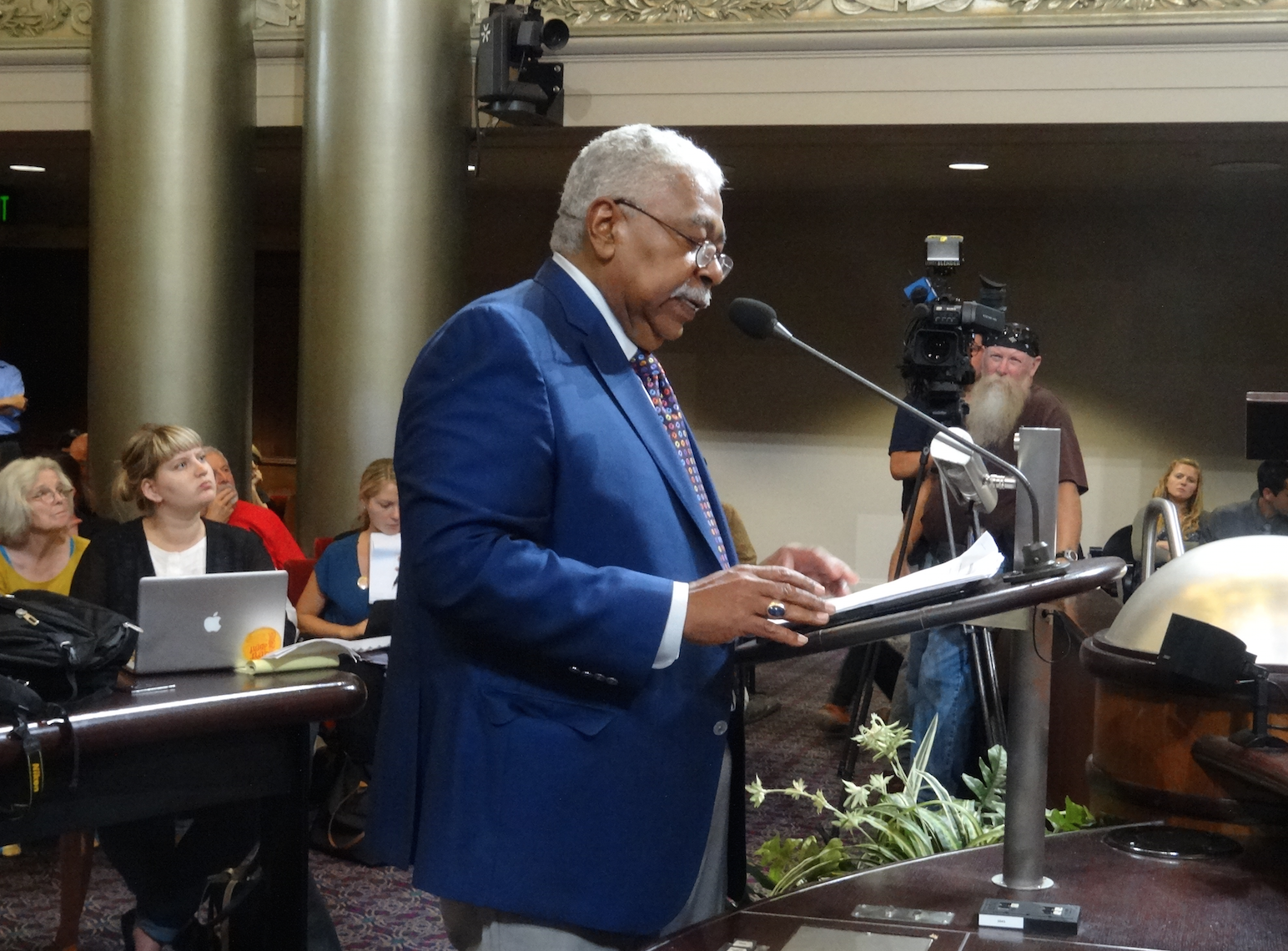
Members of the city council listen to Grasetti talk about CEQA law.
Credits: Darwin BondGraham
A worker cedes his time to Jerry Bridges, president and CEO of TLS.
Credits: Darwin BondGraham
It is a truism in the world of user interface design that if you make changes to a popular website, someone is going to complain — quite loudly, in all likelihood. Anyone who has lived through the past three or four iterations of Facebook can attest to that.
Even so, the overwhelmingly negative response to...
Stories you shouldn’t miss:
1. San Francisco Bay is inundated with billions of tiny pieces of plastic — likely caused by plastic microbeads in cosmetics and toothpaste and bits of synthetic fabric, such as fleece, that break down when washed, the Mercury News$ reports, citing a new groundbreaking study from the San Francisco Estuary Institute. Researchers found about 1 million tiny...
Every year, for at least one night, Children’s Fairyland (699 Bellevue Ave., Oakland) lets in adults without their children. Drawn Together, which will take place on September 25, is a nighttime party for big kids at the magical theme park for which more than fifty artists from Oakland and the broader Bay Area create more than one hundred works...
“Free spirit” is the motto of rapper Beejus, who embraces being a misfit on his recent album of the same title. The Oakland MC is the curator and headliner of FreeSpirit Fest Two, a showcase of similarly left-field local rappers at Legionnaire Saloon (2272 Telegraph Ave., Oakland) on Thursday, September 24. Performing alongside is Tia Nomore, a fiery, up-and-coming...
Game of Thrones is a veritable cultural phenomenon. The show is HBO’s most commercially successful series to date — transcending the fantasy genre’s niche appeal in a way that is unprecedented in television. So who better to produce a tribute show than local, live variety company Tourettes Without Regrets, whose eclectic performances appeal to fans of burlesque, slam poetry,...
The annual Watershed Environmental Poetry Festival is back in Berkeley on September 26 to celebrate its twentieth year. The 2015 festival is dedicated to its co-founder and former director Mark Baldridge, who died late last year. Baldridge was also deeply involved with Poetry Flash, which has been an invigorating force in the East Bay literary community since 1972. The...
Edward Burtynksy’s photographs offer a sense of the sublime — that feeling you get when standing at the top of a mountain that makes you realize how small you are relative to the rest of the world. But his grand photographs are also terrifying, because, upon closer inspection, they reveal barren landscapes, ravaged by the extraction of natural resources....
In 1983, the Richmond Art Center (2540 Barrett Ave., Richmond) put on the landmark exhibition, Poetry for the Body: Clothing for the Spirit, which highlighted fashion as fine art. Now, with Body as Agent: Changing Fashion Art, its current show featuring all California designers, RAC surveys how fashion has evolved as an art form since then. The show places...
Oakland residents typically have to cross the Bay Bridge to catch the live shows of reggae and hip-hop’s all-time greats, but the Bay Area Vibez Festival brings world-renowned artists to our backyard this weekend. Taking place September 26 and 27 at Middle Harbor Shoreline Park in West Oakland, the festival includes a lineup of influential musicians, including six-time Grammy-winning...
9/22/2015 10:00am: Last night’s city council hearing on the health and safety impacts of coal ran late into the night. According to Oakland City Clerk LaTonda Simmons, 694 members of the public signed up to speak.
At the end of the night, councilmember Dan Kalb moved a motion to keep the city’s hearing on the health and...