In a comment appended to the online version of our November 11 news story, “Richmond Developer Pushes Two Ballot Measures,” developer Richard Poe disputed an assertion made in the original version of the report that he had recently purchased a mansion in Florida. As a result, we clarified the story to read as follows:
According to public records, Poe has identified himself as a resident of Florida for a substantial portion of the past decade. Multiple sources also said Poe told them that he plans to retire to a newly purchased mansion in Florida. 
World leaders from more than 190 countries will convene in Paris during the first two weeks of December for the long-awaited United Nations Climate Change Conference. Will the governments of the world finally pass a binding global treaty aimed at reducing the most dangerous impacts of global warming or will they fail in this task?
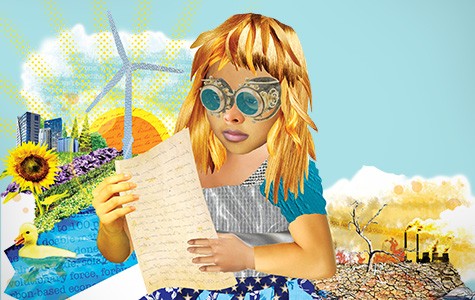
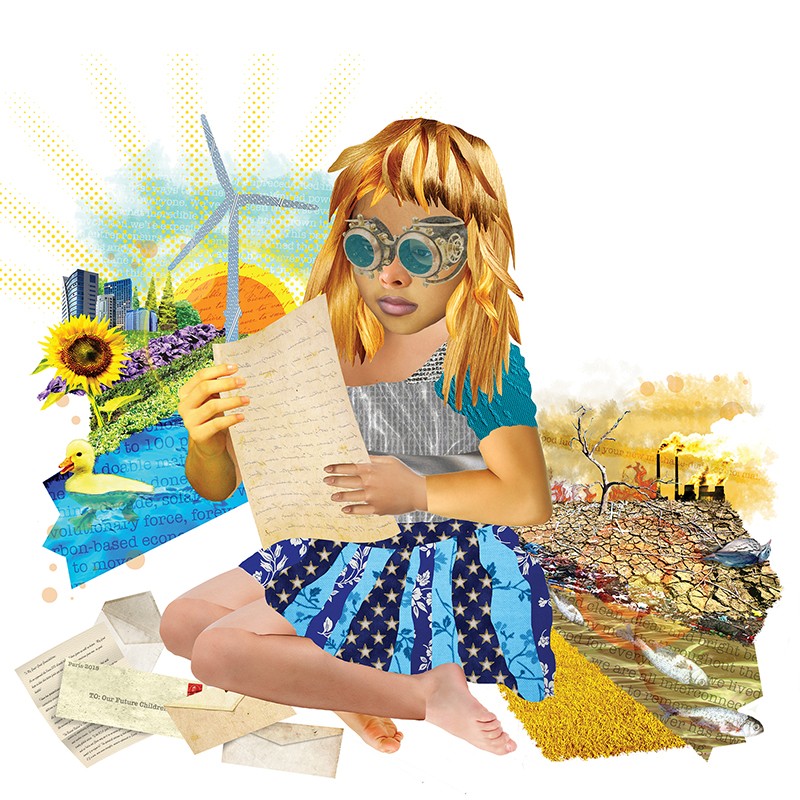
Letters to the Future, a national project involving more than forty alternative weeklies across the United States, set out to find authors, artists, scientists, and others willing to get creative and draft letters to future generations of their own families, predicting the success or failure of the Paris talks — and what came after.
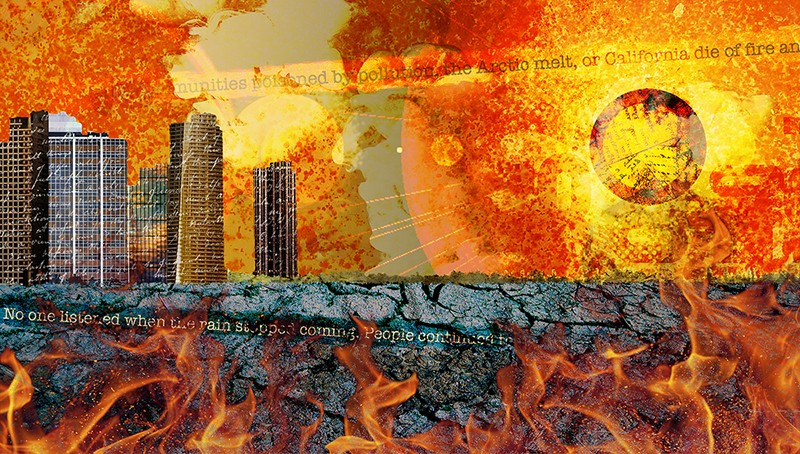
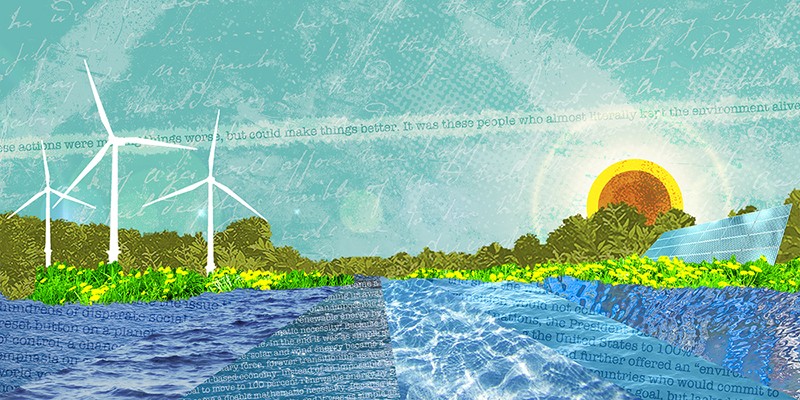
Letters to the Future Climate Timeline. Sources: UNFCC, IPCC, New York Times.
Credits: Illustration by Hayley Doshay.
Some participants were optimistic about what is to come — some not so much. We hereby present some of their visions of the future.
[image-14]
Stephen K. Robinson
My Endless Sky
Dear Future Robinsons,
Back around the turn of the century, flying to space was a rare human privilege, a dream come true, the stuff of movies (look it up), and an almost impossible ambition for children the world around.
But I was one of those fortunates. And what I saw from the cold, thick, protective windows of the Space Shuttle is something that, despite my forty years of dreaming (I was never a young astronaut), I never remotely imagined.
Not that I was new to imagining things. As you may know, I was somehow born with a passion for the sky, for flight, and for the mysteries of the atmosphere. I built and flew death-defying gliders, learned to fly properly, earned university degrees in the science of flight, and then spent the rest of my life exploring Earth’s atmosphere from below it, within it, and above it. My hunger was never satisfied, and my love of flight never waned at all, even though it tried to kill me many times.
As I learned to fly in gliders, then small aircraft, then military jets, I always had the secure feeling that the atmosphere was the infinite “long delirious burning blue” of Magee’s poem, even though of all people, I well knew about space and its nearness. It seemed impossible to believe that with just a little more power and a little more bravery, I couldn’t continue to climb higher and higher on “laughter-silvered wings.” My life was a celebration of the infinite gift of sky, atmosphere, and flight.
But what I saw in the first minutes of entering space, following that violent, life-changing rocket-ride, shocked me.
If you look at Earth’s atmosphere from orbit, you can see it “on edge” — gazing towards the horizon, with the black of space above and the gentle curve of the yes-it’s-round planet below. And what you see is the most exquisite, luminous, delicate glow of a layered azure haze holding the Earth like an ethereal eggshell. “That’s it?!” I thought. The entire sky — MY endless sky — was only a paper-thin, blue wrapping of the planet, and looking as tentative as frost.
And this is the truth. Our Earth’s atmosphere is fragile and shockingly tiny — maybe 4 percent of the planet’s volume. Of all the life we know about, only one species has the responsibility to protect that precious blue planet-wrap. I hope we did, and I hope you do.
Your ancestor,
Stephen K. Robinson
After 36 years as an astronaut — with a tenure that included four shuttle missions and three spacewalks — Robinson retired from NASA in 2012. He is now a professor of mechanical and aerospace engineering at UC Davis.
[image-12]
Jane Smiley
Brief Opportunities
Dear Great-Great-Granddaughter,
Do you remember your grandmother Veronica? I am writing to you on the very day that your grandmother Veronica turned seven months old — she is my first grandchild, and she is your grandmother. That is how quickly time passes and people are born, grow up, and pass on. When I was your age — now 20 (Veronica was my age, 65, when you were born), I did not realize how brief our opportunities are to change the direction of the world we live in. The world you live in grew out of the world I live in, and I want to tell you a little bit about the major difficulties of my world and how they have affected your world.
On the day I am writing this letter, the speaker of the House of Representatives quit his job because his party — called “the Republicans,” refused absolutely to work with or compromise with the other party, now defunct, called “the Democrats.” The refusal of the Republicans to work with the Democrats was what led to the government collapse in 2025, and the breakup of what to you is the Former United States. The states that refused to acknowledge climate change or, indeed, science, became the Republic of America, and the other states became West America and East America. I lived in West America. You probably live in East America, because West America became unlivable owing to climate change in 2050.
That the world was getting hotter and drier, that weather was getting more chaotic, and that humans were getting too numerous for the ecosystem to support was evident to most Americans by the time I was 45, the age your mother is now. At first, it did seem as though all Americans were willing to do something about it, but then the oil companies (with names like Exxon and Mobil and Shell) realized that their profits were at risk, and they dug in their heels. They underwrote all sorts of government corruption in order to deny climate change and transfer as much carbon dioxide out of the ground and into the air as they could. The worse the weather and the climate became the more they refused to budge, and Americans, but also the citizens of other countries, kept using coal, diesel fuel, and gasoline. Transportation was the hardest thing to give up, much harder than giving up the future, and so we did not give it up, and so there you are, stuck in the slender strip of East America that is overpopulated, but livable. I am sure you are a vegan, because there is no room for cattle, hogs, or chickens, which Americans used to eat.
West America was once a beautiful place — not the parched desert landscape that it is now. Our mountains were green with oaks and pines, mountain lions and coyotes and deer roamed in the shadows, and there were beautiful flowers nestled in the grass. It was sometimes hot but often cool. Where you see abandoned, flooded cities, we saw smooth beaches and easy waves.
What is the greatest loss we have bequeathed you? I think it is the debris, the junk, the rotting bits of clothing, equipment, vehicles, buildings, etc. that you see everywhere and must avoid. Where we went for walks, you always have to keep an eye out. We have left you a mess. But I know that it is dangerous for you to go for walks — the human body wasn’t built to tolerate lows of 90 degrees Fahrenheit and highs of 140. When I was alive, I thought I was trying to save you, but I didn’t try hard enough, or at least, I didn’t try to save you as hard as my opponents tried to destroy you. I don’t know why they did that. I could never figure that out.
Sadly,
Great-Greatgrandma Jane
Winner of the Pulitzer Prize for Fiction in 1992 for A Thousand Acres, Smiley has composed numerous novels and works of nonfiction.
[image-13]
T.C. Boyle
Sorry About That
Dear Rats of the Future,
Congratulations on your bipedalism: it’s always nice to be able to stand tall when you need it, no? And great on losing that tail, too (just as we lost ours). No need for that awkward (and let’s face it: ugly) kind of balancing tool when you walk upright, plus it makes fitting into your blue jeans a whole lot easier. Do you wear blue jeans — or their equivalent? No need, really, I suppose, since you’ve no doubt retained your body hair. Well, good for you.
Sorry about the plastics. And the radiation. And the pesticides. I really regret that you won’t be hearing any birdsong anytime soon, either, but at least you’ve got that wonderful musical cawing of the crows to keep your mornings bright. And, of course, I do expect that as you’ve grown in stature and brainpower you’ve learned to deal with the feral cats, your one-time nemesis, but at best occupying a kind of ratty niche in your era of ascendancy. As for the big cats — the really scary ones, tiger, lion, leopard, jaguar — they must be as remote to you as the mammoths were to us. It goes without saying that with the extinction of the bears (polar bears: they were a pretty silly development anyway, and of no use to anybody beyond maybe trophy hunters) and any other large carnivores, there’s nothing much left to threaten you as you feed and breed and find your place as the dominant mammals on earth. (I do expect that the hyenas would have been something of a nasty holdout, but as you developed weapons, I’m sure you would have dispatched them eventually).
Apologies too about the oceans, and I know this must have been particularly hard on you since you’ve always been a seafaring race, but since you’re primarily vegetarian, I don’t imagine that the extinction of fish would have much affected you. And if, out of some nostalgia for the sea that can’t be fully satisfied by whatever hardtack may have survived us, try jellyfish. They’ll be about the only thing out there now, but I’m told they can be quite palatable, if not exactly mouth-watering, when prepared with sage and onions. Do you have sage and onions? But forgive me: of course you do. You’re an agrarian tribe at heart, though in our day we certainly did introduce you to city life, didn’t we? Bright lights, big city, right? At least you don’t have to worry about abattoirs, piggeries, feed lots, bovine intestinal gases and the like — or, for that matter, the ozone layer, which would have been long gone by the time you started walking on two legs. Does that bother you? The UV rays, I mean? But no, you’re a nocturnal tribe anyway, right?
Anyway, I just want to wish you all the best in your endeavors on this big blind rock hurtling through space. My advice? Stay out of the laboratory. Live simply. And, whatever you do, please — I beg you — don’t start up a stock exchange.
With Best Wishes,
T.C. Boyle
P.S. In writing you this missive, I am, I suppose, being guardedly optimistic that you will have figured out how to decode this ape language I’m employing here—especially given the vast libraries we left you when the last of us breathed his last.
A novelist and short story writer, Boyle has published fourteen novels and more than one hundred short stories.
Annie Leonard
Incredible People
It’s hard to imagine writing to the granddaughter of my own daughter, but if you’re anything like her — strong, smart, occasionally a little stubborn — then I have no doubt the world is in good hands.
By now your school should have taught you about climate change and how humans helped to bring it about with our big cars, big homes, big appetites, and an endless desire for more stuff. But what the teachers and textbooks may not have passed on are the stories of incredible people who helped make sure the planet remained beautiful and livable for you.
These are stories of everyday people doing courageous things because they couldn’t stand by and watch communities poisoned by pollution, the Arctic melt, or California die of fire and drought. They couldn’t bear to think of New Orleans under water again, or New York lost to a superstorm. Right now, as politicians weigh up options and opinion polls, people are organizing and uprising. It’s amazing to see and be a part of.
In the year that led up to the 2015 meeting of global leaders on climate change in Paris, kayakers took to the water to stop oil rigs. Nurses, musicians, grannies, preachers, and even beekeepers took to the streets. The message was loud and clear: “We want clean, safe, renewable energy now!”
Were it not for this glorious rainbow of people power, I don’t know whether President Obama would have stepped up and canceled oil drilling in the Alaskan Arctic or the sale of 10 billion tons of American coal that were set to tip the planet toward climate chaos. But he did. This paved the way for an era of unprecedented innovation, as entrepreneurs and academics fine-tuned the best ways to harness the unlimited power of our wind, waves and sun, and make it available to everyone. We’ve just seen the first ever oceanic crossing by a solar plane and I can only imagine what incredible inventions have grown in your time from the seeds planted in this energy revolution we’re experiencing right now.
[image-15]
I want to tell you about this because there was a time we didn’t think any of it was possible. And there may be times when you face similar challenges. Generations before you have taken acts of great courage to make sure you, too, have all the joys and gifts of the natural world — hiking in forests, swimming in clean water, breathing fresh air. If you need to be a little stubborn to make sure things stay that way, so be it.
Onwards!
Annie
Currently the executive director of Greenpeace USA, Leonard made the 2007 film, The Story of Stuff, which chronicles the life of material goods and has been viewed more than 40 million times. She also wrote the 2010 New York Times bestseller by the same name.
Bill McKibben
Seize the Moment
Dear Descendants,
The first thing to say is, sorry. We were the last generation to know the world before full-on climate change made it a treacherous place. That we didn’t get sooner to work slowing it down is our great shame, and you live with the unavoidable consequences.
That said, I hope that we made at least some difference. There were many milestones in the fight — Rio, Kyoto, the debacle at Copenhagen. By the time the great Paris climate conference of 2015 rolled around, many of us were inclined to cynicism.
[image-16]
And our cynicism was well-taken. The delegates to that convention, representing governments that were still unwilling to take more than baby steps, didn’t really grasp the nettle. They looked for easy, around-the-edges fixes, ones that wouldn’t unduly alarm their patrons in the fossil fuel industry.
But so many others seized the moment that Paris offered to do the truly important thing: Organize. There were meetings and marches, disruptions and disobedience. And we came out of it more committed than ever to taking on the real powers that be.
The real changes flowed in the months and years past Paris, when people made sure that their institutions pulled money from oil and coal stocks, and when they literally sat down in the way of the coal trains and the oil pipelines. People did the work governments wouldn’t — and as they weakened the fossil fuel industry, political leaders grew ever so slowly bolder.
We learned a lot that year about where power lays: less in the words of weak treaties than in the zeitgeist we could create with our passion, our spirit, and our creativity. Would that we had done it sooner!
An author, educator and environmentalist, McKibben is co-founder of 350.org, a planet-wide grassroots climate change movement. He has written more than a dozen books.
Geraldine Brooks
This Abundant Life
I just flushed my toilet with drinking water. I know; you don’t believe me: “Nobody could ever have been that stupid, that wasteful.” But we are. We use air conditioners all the time, even in mild climates where they aren’t a bit necessary. We cool our homes so we need to wear sweaters indoors in summer, and heat them so we have to wear T-shirts in mid-winter. We let one person drive around all alone in a huge thing called an SUV. We make perfectly good things — plates, cups, knives — then we use them just once, and throw them away. They’re still there, in your time. Dig them up. They’ll still be usable.
Maybe you have dug them up. Maybe you’re making use of them now. Maybe you’re frugal and ingenious in ways we in the wealthy world have not yet chosen to be. There’s an old teaching from a rabbi called Nachman who lived in a town called Bratslav centuries ago: “If you believe it is possible to destroy, believe it is possible to repair.” Some of us believe that. We’re trying to spread the message.
Friends are working on genetic editing that will bring back the heath hen, a bird that went extinct almost eighty years ago. The last member of the species died in the woods just a few miles from my home. Did we succeed? Do you have heath hens, booming their mating calls across the sand plains that sustain them? If you do, it means that this idea of repair caught on in time and that their habitat was restored, instead of being sold for yet more beachside mansions. It means that enough great minds turned away from the easy temptations of a career moving money from one rich person’s account to another’s, and instead became engineers and scientists dedicated to repairing and preserving this small blue marble, spinning in the velvet void.
[image-17]
We send out probes, looking for signs of life on other worlds. A possible spec of mold is exciting — press conference! News flash! Imagine if they found, say, a sparrow. President addresses the nation! And yet we fail to take note of the beauty of sparrows, their subtle hues and swift grace. We’re profligate and reckless with all this abundant life, teeming and vivid, that sustains and inspires us.
We destroyed. You believed it was possible to repair.
Brooks is an Australian-American journalist and author. Her 2005 novel, March, won the Pulitzer Prize for fiction. She became a US citizen in 2002.
Pam Houston
Rock, Ice, Air, and Water
Dear Future Inhabitants of Earth,
I was speaking with an environmental scientist friend of mine not too long ago and he said he felt extremely grim about the fate of Earth in the hundred-year frame but quite optimistic about it in the five hundred-year frame. “There won’t be many people left,” he said, “but the ones who are here will have learned a lot.” I have been taking comfort, since then, in his words.
If you are reading this letter, you are one of the learners, and I am grateful to you in advance. And I’m sorry. For my generation. For our ignorance, our short-sightedness, our capacity for denial, our unwillingness or inability to stand up to the oil and gas companies that have bought our wilderness, our airwaves, our governments. It must seem to you that we were dense beyond comprehension, but some of us knew, for decades, that our carbon-driven period would be looked back on as the most barbaric, the most irresponsible age in history.
Part of me wishes there was a way for me to know what Earth is like in your time, and part of me is afraid to know how far down we took this magnificent sphere, this miracle of rock and ice and air and water.
Should I tell you about the polar bears, the great white creatures that hunted seals among the icebergs; should I tell you about the orcas? To be in a kayak, with a pod of orcas coming toward you, to see the big male’s fin rise in its impossible geometry, six feet high and black as night, to hear the blast of whale breath, to smell its fishy tang — I tell you, it was enough to make a person believe she had led a satisfying life.
I know it is too much to wish for you: polar bears and orcas. But maybe you still have elk bugling at dawn on a September morning and red tail hawks crying to their mates from the tops of ponderosa pines.
Whatever wonders you have, you will owe to those about to gather in Paris to talk about ways we might reimagine ourselves as one strand in the fabric that is this biosphere, rather than its mindless devourer.
E.O. Wilson says as long as there are microbes, Earth can recover — another small measure of comfort. Even now, evidence of Earth’s ability to heal herself is all around us — a daily astonishment. What a joy it would be to live in a time when the healing was allowed to outrun the destruction. More than anything else that is what I wish for you.
With hope,
Pam Houston
Author of short stories, novels and essays, Houston wrote the acclaimed Cowboys Are My Weakness, winner of the 1993 Western States Book Award.
[image-19]
Kim Stanley Robinson
Our Best Achievement.
Dear Great-Great-Grandchildren,
I’ve been worried about you for a long time. For years it’s seemed like all I could say to you was, “Sorry, we torched the planet and now you have to live like saints.” Not a happy message. But recently, I’ve seen signs that we might give you a better result. At this moment the issue is still in doubt. But a good path leading from me to you can be discerned.
It was crucial that we recognized the problem, because otherwise we wouldn’t have acted as we did. A stupendous effort by the global scientific community alerted us to the fact that our civilization, by dumping carbon into the air, and disrupting biosphere processes in many other ways, we were creating a toxic combination that was going to wreak havoc on all Earth’s living creatures, including us. When we learned that, we tried to change.
Our damaging impact was caused by a combination of the sheer number of people, the types of technologies we used, and how much we consumed. We had to change in each area, and we did. We invented cleaner technologies to replace dirtier ones; this turned out to be the easiest part. When it came to population growth, we saw that wherever women had full education and strong legal rights, population growth stopped, and the number of humans stabilized; thus justice was both good in itself and good for the planet.
[image-18]
The third aspect of the problem, our consumption levels, depended on our values, which are always encoded in our economic system. Capitalism was wrecking the biosphere and people’s lives to the perceived benefit of very few; so we changed it. We charged ourselves the proper price for burning carbon; we enacted a progressive tax on all capital assets as well as incomes. With that money newly released to positive work, we paid ourselves a living wage to do ecological restoration, to feed ourselves, and to maintain the biosphere we knew you were going to need.
Those changes taken all together mean you live in a post-capitalist world: Congratulations. I’m sure you are happier for it. Creating that new economic system was how we managed to dodge disaster and give you a healthy Earth. It was our best achievement, and because of it, we can look you in the eye and say, “Enjoy it, care for it, pass it on.”
Mars
A writer of speculative science fiction and winner of the Nebula and Hugo awards, Robinson has published nineteen novels including the award-winning Mars trilogy.
Alexis Bonogofsky
Wild Things
Dear Future Montanans,
I have asked that you not open this note until 2115. There is a place I want you to go to read this letter, the place where I wrote it. It is a river valley in southeast Montana that thousands of people fought to protect from a massive coal mine in my time. We won. For centuries before me, people cherished and protected this land you are sitting on, and I have no doubt they are still doing so in your time. I know this because people will always come for what is underneath the ground in the Tongue River country. Our fights do not have an end; they are passed down from one generation to the next.
Your Montana, no doubt, is a much different place than my Montana. Although you are a hundred years and thousands of miles away from the 2015 Paris climate summit, what happened there was consequential to your life. The climate treaty that emerged was historic but it did not save us.
Decades of political timidity and inaction put things into motion that could not be undone. The treaty did not save the glaciers in Glacier National Park (have they renamed it yet?) or the wildlife that could not adapt or the people who live on the coasts.
I never put much faith in the idea that pieces of paper produced by governments create change. I have faith in the land. I have faith in people. I know promises made by politicians only have meaning when the people make them have meaning.
If you are living in a world where we have managed to mitigate the most severe impacts of climate change, it isn’t because governments agreed to reduce climate emissions at Paris; it is because while world leaders were negotiating in board rooms, citizens were shutting down coal plants, stopping coal mines, protecting their homelands, and taking control. It is because we took what they gave us, said it wasn’t enough, and demanded more the next year, the year after and the year after.
We mourned deeply for what we knew we had already lost and yet had the courage to move forward. It was our only option. Only you know how we did.
Be still for a moment, the wild things might let you see them.
A young Montana goat rancher, writer, and climate change activist, Bonogofsky is featured in the new documentary This Changes Everything, based on Naomi Klein’s book of the same name.
Good day, my beautiful bounty. It probably feels redundant to someone rockin’ in 2070, a year that’s gotta be wavy in ways I can’t imagine, but. …
Your great, great-grandpappy is old school.
And when my old-school ass thinks about how the backdrop to your existence changed when the Paris climate talks failed, it harkens to the late-20th century rap duo Eric B. & Rakim. Music is forever. Probably, it sounds crazy that the musical idiom best known in your time as the foundation of the worldwide cough syrup industry could ever have imparted anything enlightening. You can look it up though — before the Telecommunications Act of ’96 such transformations happened not infrequently.
But that’s another letter. MC Rakim had this scrap of lyric from “Teach the Children” — a pro-environment slapper that hit the atmosphere closer to Valdez newspaper headline days than when the web gave us pictures of death smoke plumes taking rise above Iraq. For you, these are abstract epochs. Alaska still had permafrost, the formerly frozen soil that kept methane safely underground. The domino that fell, permafrost. And I could tell you that humans skied Earth’s mountains. Yes, I know: Snow. An antique reference, no question.
That Rakim verse. It went: Teach the children, save the nation/I see the destruction, the situation/ They’re corrupt, and their time’s up soon/But they’ll blow it up and prepare life on the moon.
My bounty, it’s easy to Monday morning quarterback* from my 2015 vantage point. But I did not do an adequate job of teaching the children about what our corporate overlords had in store for them. Didn’t do it with Exxon or Volkswagen. Didn’t do it when Rakim initially sold me on the premise. And to be honest I haven’t done a bunch of it this year, as sinkholes form and trees fall in parts of the Arctic that Mother Earth could only ever imagined frozen solid.
Make no mistake, I want these words to function as much as a godspeed note as one of confession. Good luck with your new methane-dictated normal, and the sonic pollution and spiritual upset of those executive flights to colonized Mars. Or, as the President calls that planet, the Home Office. Conditions should have never come to this though. And we’ll always have Paris, to remind us of what might have been.
Grandpappy Donnell
*The NFL will be around forever, like herpes.
A former staff writer for ESPN The Magazine, LA Weekly, and freelancer for other publications, Alexander wrote the memoir Ghetto Celebrity. His audio narratives have formed the basis of two documentaries.
Michael Pollan
Shift the Food System
Dear Future Family,
I know you will not read this note until the turn of the century, but I want to explain what things were like back in 2015, before we figured out how to roll back climate change. As a civilization we were still locked into a zero-sum idea of our relationship with the natural world, in which we assumed that for us to get whatever we needed, whether it was food or energy or entertainment, nature had to be diminished. But that was never necessarily the case.
Donnell Alexander.
In our time, the US Department of Agriculture still handed out subsidies to farmers for every bushel of corn or wheat or rice they could grow. This promoted a form of agriculture that was extremely productive and extremely destructive — of the climate, among other things.
Approximately one-third of the carbon then in the atmosphere had formerly been sequestered in soils in the form of organic matter, but since we began plowing and deforesting, we’d been releasing huge quantities of this carbon into the atmosphere. At that time, the food system as a whole — that includes agriculture, food processing, and food transportation — contributed somewhere between 20 to 30 percent of the greenhouse gases produced by civilization — more than any other sector except energy. Fertilizer was always one of the biggest culprits for two reasons: It’s made from fossil fuels, and when you spread it on fields and it gets wet, it turns into nitrous oxide, which is a much more potent greenhouse gas than carbon dioxide. Slowly, we convinced the policy makers to instead give subsidies to farmers for every increment of carbon they sequestered in the soil.
Over time, we began to organize our agriculture so that it could heal the planet, feed us and tackle climate change. This began with shifting our food system from its reliance on oil, which is the central fact of industrial agriculture (not just machinery, but pesticides and fertilizers are all oil-based technologies), back to a reliance on solar energy: photosynthesis.
Carbon farming was one of the most hopeful things going on at that time in climate change research. We discovered that plants secrete sugars into the soil to feed the microbes they depend on, in the process putting carbon into the soil. This process of sequestering carbon at the same time improved the fertility and water-holding capacity of the soil. We began relying on the sun — on photosynthesis — rather than on fossil fuels to feed ourselves. We learned that there are non-zero-sum ways we could feed ourselves and heal the earth. That was just one of the big changes we made toward the sustainable food system you are lucky enough to take for granted.
Pollan is a teacher, author, and speaker on the environment, agriculture, the food industry, society, and nutrition. His letter is adapted from an interview in Vice Magazine.
If you are reading this, then you must exist, and so my greatest fears haven’t been realized. We didn’t manage to eradicate our kind from the universe. In my darkest hours, routinely arriving at four in the morning, that’s what I feared, a universe in which our species had disappeared, taking along with it many other life forms that had once flourished on Earth. I’d lie awake mourning all those life forms, but — call me anthropocentric — most especially the humans. A universe emptied of humans, with all of our fancies and follies, seemed to me an immeasurably reduced universe.
So at least you exist — only under what conditions I can’t begin to imagine. I don’t know whether you’re reading this on Earth and, if you are, whether you’re huddled inside an artificial environment to protect yourself from deadly radiation. Or perhaps you’ve colonized another planet or built a system of space stations, using your human ingenuity to adapt to an alien environment for which evolution didn’t naturally equip you. Perhaps you only know about what it was like to welcome each changing season on Earth — smell the fecund moist earth of spring, feel the silky sultriness of summer nights, listen to the silence of snow falling heavily in the forest — by reading the writings of us ancients.
Wherever you are, struggling with whatever hostile conditions constraining the choices that we took for granted, you must look back at your ancestors — us — with outraged incredulity. How could we not have cared about you at all, you wonder? You are our kith and kin. Didn’t we consider that you deserved the same rights to flourish as we presumed for ourselves?
It’s ironic, because we often looked back at our ancestors with outraged incredulity, wondering how they couldn’t have seen, say, that slavery or misogyny were wrong.
Were they moral monsters, we’d wonder?
Do you wonder exactly the same about us?
Well, we weren’t monsters. Really, we weren’t. We were human, all too human. And being human we tended to prioritize our own lives, our own self-interest, over those of others. It’s not that other selves meant nothing at all to us. But our own selves always meant so much more.
And here’s another feature of our evolution-shaped human nature that, through no malice at all, conspired to doom you. (You understand, I’m not justifying our behavior, just trying to explain it to you.) We discounted the future. The future seemed so hazy, so uncertain, while the present … well, it was present. The now was vividly pressing on us, always, real and fully formed.
Our psychology evolved out of a past when human life was “nasty, brutish, and short.” And because we weren’t able to overcome that psychology, to think in ways larger and more generous, the future we’ve bequeathed you is at least as precarious as the past out of which we emerged. I fear it is unimaginably nasty.
You just weren’t very real to us, you others who didn’t even enjoy the privilege of existing. How could your claims, so ghostly as to be ungraspable, constrain our choices, reign in our desires? And we were so inventive in our technologies, which pelted us with more and more things to want, amusements to distract us from what we should have been thinking about — which was you.
And now it’s we who no longer exist. Perhaps you’d just as soon forget about our existence, as we forgot about yours. If only you could, I imagine you thinking, if only you could blot us out of your consciousness just as thoroughly as we blotted you out of ours.
If there are still storytellers among you — if that’s a human capacity that you can still indulge — then do a better job than we did in making the lives of others felt — each and every life, when its time comes, a towering importance.
May you flourish. May you forgive us.
A philosopher and novelist, Goldstein won a MacArthur “Genius” grant and was recently presented the National Humanities Medal by President Barack Obama.
Alexis Bonogofsky.
Rhea Suh
I’m Fighting for You
Dear Grandchildren,
I can only imagine the wonderful world you are growing up in. I think of that world — your future — almost every day. I think about how to make sure it is a place where all your hopes and dreams can come true.
A long time ago, my parents traveled across the world from Korea to the United States in search of a brighter future for me and my sisters. Today, I am writing you from Paris, a city that I have traveled across the world to get to, in order to make sure the world does the same for you. I’m fighting for you, for everyone in your generation across the world, to ensure that you have more than a fighting chance at that bright future. A world without the dangers of global climate change is the world that you will inherit.
What is climate change? Never heard of it? I’m so very glad if you haven’t. Let me try to explain. I warn you though, this can be kind of scary.
Michael Pollan.
When we first started building up our cities, roads, and towns in what was called the Industrial Revolution, we burned all sorts of fuels — coal, oil, and natural gas. While these things helped us heat our homes, drive our cars, and expand our cities, we didn’t realize that they also clouded our air, dirtied our water, and made us sick. More than that, the burning of all those fuels made our planet sick. All the other animals and plants that we share this world with were getting sick, too. The planet became warmer, which created a mixed up chaos of terrible hurricanes, tornadoes, raging wildfires, drought and increased hunger, growing rates of asthma and lung disease, and the extinction of animals at an unprecedented rate.
So, my dear grandchildren, we faced a choice. We could keep doing what we had been doing, or we could make the choice to take a stand for our future — your future and the planet’s future — by creating the framework to begin to move away from this scary legacy.
The wind turbines and solar panels that power your world, electric cars, high-speed trains, and solar airplanes weren’t so commonplace in my time. They required a revolution in how we think about energy, about our relationship to the world, about our faith in our own capacity to innovate and change.
What took us so long? Sigh. It’s a long story, but like many of the children’s books you grew up with, it was a story of greed, short-sightedness, and wizards with too much gold. But against these challenges, sometimes with great bravery, people — young and old from every nation — stood up and demanded that we take the steps to curb this terrible scourge.
I hope you will know this to be true. I hope you will remember that many years ago, your grandma and many others across the world stood up and demanded that we make the world a better place. I hope you know that it was a difficult path, just like my parents so many years ago. And I hope you know we did it thinking of you and the future you now inherit.
Suh is president of the Natural Resources Defense Council.
Rebecca Newberger Goldstein.
Sara Paretsky
Don’t Lose Faith
My dear great-granddaughter, I wish my bequest to you could be the childhood I had, lazy afternoons playing baseball or hopscotch in the sunshine, long walks through fields filled with butterflies and birds. Instead, you live indoors, breathing air that tired old filters are hard-pressed to scrub clean of radiation, coal dust, and the molds that grow a hundred feet underground.
When your grandmother, my daughter, bought the condo in the old missile silo, I wouldn’t join her: the thought of living underground with a hundred other survivalists turned my stomach.
By then the average daily temperature in Chicago was 127 in the summer, 101 in winter. We were all scrambling for ways to avoid the killing heat, but I was too old to give up life above ground.
We couldn’t keep up with the daily dead and bulldozed them into pits, where we didn’t dare burn them.
I wish I could bequeath you the wonderful fruits and vegetables we used to eat, which I used to carelessly overbuy and discard. Now I wonder how long the water will last to grow enough cabbage to feed your little commune — cabbage being nutrient rich and easy to grow even in hydroponic tanks. I hope somewhere a few birds found shelter, so that if the earth ever recovers, you will hear birdsong.
And, dear God, even as the temperatures rose and the crops died and the glaciers in the Himalayas melted with a flood that drowned 700 million Chinese and Indians in a single week, we couldn’t agree that human behavior caused the problem and human behavior needed to change. Our American billionaires and their sycophants in pulpit and statehouse kept claiming human responsibility for climate change was a myth; they blocked any acts that could have reversed the damage in time.
As the heat rose, and the death tolls, blame and furious accusations rose with them: it was the Jews, the capitalists, the infidels, the Muslims, the communists. We’ll never know who dropped the first bomb, but little was left to sustain life by the time the last one fell.
I don’t ask your forgiveness — my generation doesn’t deserve it. I ask you not to lose faith or hope that you can solve these problems. I ask you to do the hard work we never did. I ask you to remember poets and music to sustain your spirit.
Your loving grieving great-granny,
Sara
An award-winning author from Chicago, Paretsky is best known for her detective novels and infamous female protagonist V.I. Warshawski.
Rhea Suh is president of the Natural Resources Defense Council.
Credits: Rebecca Greenfield
Nitanju Bolade Casel
For My Children
As we move toward the 2015 UN climate talks in Paris, my prayers are for you, your children and your children’s children’s children. May the outcome be in your favor; for your future. I pray that you will be blessed not only with a better world than we have today, but also the courageous wisdom to nurture and respect all living things. It is a privilege to inhabit the Earth; a gift we share with all other forms of Life. I pray that you will honor and protect this special treasure. I pray that you will see yourselves in one another, understand that we are all connected and move forward with love for humankind; for all living things. And although we have not always been kind, you can begin. Be kind. Humanity has repeatedly moved against itself toward destruction throughout history; rarely seeming to learn from past mistakes. Learn. Please know that there were also visionaries who worked endlessly for positive changes in this world — changes to benefit the many, not just the few; you may have to do the same. Work.
And remember to pray for your children’s children’s children. Your prayers will be waiting for them when they arrive. … Pray.
Bolade Casel is a member of the Grammy award-winning troupe Sweet Honey in the Rock, an all-woman, African-American a cappella ensemble.
Jack Miles
We Are Sorry
We are sorry, so very sorry. You are living in a wrecked world, those of you who have not already perished, but you did not wreck it. We did, we of the early 21st century.
The great nations of our day knew that climate change was their greatest enemy and that no military could defeat it. They knew that no invading enemy could do them the terrible harm that climate change had already begun to do. But despite this knowledge, our leaders continued to squander their wealth on massive military establishments rather than on what they well knew could have been done to defeat the climate change enemy.
As you now know all too well, the climate change enemy won, and though we are gone, you are living in the ruin that we created. India against Pakistan, America against Russia, China against Japan, Arabia against Iran — how silly, how almost trivial these conflicts must seem to you in retrospect. Alas, we chose to arm against one another rather than uniting against the enemy that has now defeated us all.
We are sorry, so very sorry.
Winner of the Pulitzer Prize for biography or autobiography in 1996 for God: A Biography, Miles is professor of religion at UC Irvine.
Roxana Robinson
Beautiful Creatures
Dear Descendants,
Already I know some of you, with your quick liquid eyes, your supple movements, the way you look and listen in your world. I’ll write to you, and to your descendants, the ones I will never know, whose lovely quick shapes and minds will illuminate their own world.
Let me tell you what this world is like, the world I grew up in, about its beauty and variety.
[image-10]
Let me tell you about the miraculous Monarch butterfly, a shimmering flicker of amber that alights in our meadows and feeds on our ragged milkweed plants. It lays eggs on the leaves, eggs that become fat striped caterpillars, which become tiny glowing gold-rimmed jade urns. These, magically, contain the butterflies, which turn dark and vivid as the moment of their emergence approaches. The butterflies themselves, flimsy, erratic, fly thousands of miles to a place they’ve never seen, to spend the winter. This quick amber miracle has been mine to admire every summer of my life.
And let me tell you about the polar bear, the largest land mammal, a bear of unimaginable size, with a pelt of pewter-white, a color to freeze your blood, and well it might, because they live at unimaginable temperatures, cold so deep it will freeze your breath inside your chest, freeze the salt sea, freeze the wind in the sky, but not the polar bear. Vast and unstoppable, the polar bear will swim through the frozen seas, pad over wrecked floes, slide in and out of water, fog, ice, and snow. He is an apex predator, 12 feet high and weighing 2,000 pounds. He has 42 curved ivory teeth, and his paws are 12 inches across, armed with curved, lethal claws. Beautiful, wild, invincible, he has no animal enemies. It took 100,000 years for the polar bear to evolve from their nearest cousins, the brown grizzly, and now polar bears rule the arctic, with their lazy gait, their deadly black stare, their great majestic presence.
Let me tell you about the little brown bat, a small nocturnal flier that kindly eats our insects, flickering wildly through our evenings in pursuit of our mosquitoes. Bats flooded out of those louvers in our old barn — you’ve seen the pictures of it — every evening, all summer, hundreds of them, speeding out into the quiet dusk. We watched them, standing on the lawn: It was like a natural fireworks show, the silent, darting glimpses of wings flashing against the darkening sky.
Let me tell you about the frogs, leopard-spotted, with dark spherical marks ringed with gold, green frogs with round black eyes that sat motionless beneath a leaf, waiting for an insect. Or the gray tree frog, the tiny one that climbs into the tall eupatorium plants in the garden, disguising its tiny mottled body among the leaves.
There are more I could tell you about, thousands of animals and birds and insects that we are lucky to have now in our lives. But I think you won’t know them, dear descendants. I think that by the time you read this many of them will be gone. There is always a reason to kill a creature, it turns out, and it always makes money for someone to do so. That’s how it is in our world.
I wish I could show you these quick and beautiful creatures, who were entrusted into our care, and not just describe them. I wish I could show them to you.
A novelist and essayist who writes often about the natural world, Robinson is president of the Authors Guild.
[image-11]
Jim Hightower
Political Boneheads
Hello? People of the future … Anyone there? It’s your forebears checking in with you from generations ago. We were the stewards of Earth in 2015 — a dicey time for the planet, humankind, and life itself. And … well, how’d we do? Anyone still there? Hello.
A gutsy, innovative, and tenacious environmental movement arose around the globe back then to try lifting common sense to the highest levels of industry and government. We had made great progress in developing a grassroots consciousness about the suicidal consequences for us (as well as those of you, future earthlings) if we didn’t act pronto to stop the reckless industrial pollution that was causing climate change. Our message was straightforward: When you realize you’ve dug yourself into a hole, the very first thing to do is stop digging.
Unfortunately, our grassroots majority was confronted by an elite alliance of narcissistic corporate greedheads and political boneheads. They were determined to deny environmental reality in order to grab more short-term wealth and power for themselves. Centuries before this, some Native American cultures adopted a wise ethos of deciding to take a particular action only after contemplating its impact on the seventh generation of their descendants. In 2015, however, the ethos of the dominant powers was to look no further into the future than the three-month forecast of corporate profits.
As I write this letter to the future, delegations from the nations of our world are gathering to consider a global agreement on steps we can finally take to rein in the looming disaster of global warming. But at this convocation and beyond, will we have the courage for boldness, for choosing people and the planet over short-term profits for the few? The people’s movement is urging the delegates in advance to remember that the opposite of courage is not cowardice, it’s conformity — just going along with the flow. After all, even a dead fish can go with the flow, and if the delegates don’t dare to swim against the corporate current, we’re all dead.
So did we have the courage to start doing what has to be done? Hello … anyone there?
A national radio commentator, writer, and public speaker, Hightower is also a New York Times best-selling author.
Jay Youngdahl
Push Your Parents
Dear Children of Oil Lobbyists and Lawyers,
I am sure your parents were very nice people, but they stole much of the future from all of us. I wish you had told them to stop.
Back in 2015, The New York Times ran stories with these headlines — “The Pacific Ocean Becomes a Caldron” and “Greenland is Melting Away.” Sea level rise caused repeated and unprecedented flooding along America’s southeastern states. The East Bay was facing future flooding of the Oakland Airport and rail lines leading to the Port of Oakland. In California, forests were shrinking. Even though it was clear that Big Oil companies were the prime culprits, many, like your parents, served those companies and cynically blocked any attempts to get them to stop their harmful ways.
Your parents worked in support of ExxonMobil and Chevron and the Western States Petroleum Association. In 2013, Chevron spent more than $5 billion to look for new fossil fuel. In 2015, California’s legislature was faced with a choice about trying to do something about the harm to our planet. But your parents, with the Western States Petroleum Association, helped gut a bill that would have cut oil use in California. Your moms and dads helped spend millions to defeat the bill. They won, but we all lost.
In 2015, your parents worked at two Bay Area law firms that protected polluters. A major lobbyist for the Western States Petroleum Association was Steven Lucas from San Rafael. His law firm, Nielson Merksamer, protected many oil companies. Another firm, Pillsbury Winthrop Shaw & Pittman in San Francisco, was the main outside law firm for Chevron. They bragged that they “have influenced and shaped not only the law, but also the geopolitical landscape, helping to set policy” on “energy and the environment.” I know you are proud of all the accolades that your parents have received. But their actions played a role in destroying our planet.
People can change — even those who make bundles of money from bad works. Tom Steyer is one example. He was once associated with large coal projects in Australia as a private equity mogul, but he began putting his money and his mouth in service of confronting climate change.
Kids in the United Kingdom also started an organization called Push Your Parents. It was part of a movement there to get those with the most at stake, the youth of the planet, to make their parents stop their destructive ways.
I wish you had joined them — and pushed your parents.
Youngdahl is president of the Express. He is also a labor attorney, an author, and an expert on socially responsible investment.
Disputes between landlords and tenants are overwhelming Oakland’s rent adjustment program. According to city officials, petitions filed by tenants to stop excessive rent increases and questionable evictions have doubled during the past three years, from 385 in 2012 to 739 so far this year. And appeals by landlords seeking to uphold rent increases or pass other costs onto tenants, have more than quadrupled, from 20 to 98.
Last week, Connie Taylor, director of Oakland’s Rent Arbitration Program, which is responsible for enforcing Oakland’s tenant-landlord laws, told members of the city council that the city needs to triple the existing fee that funds the program, from $30 to $110 per every rental unit, or it will be unable to enforce its rent adjustment rules and resolve tenant landlord disputes. However, both landlord and tenant advocates are opposing the proposed fee increase, on the grounds that it’s excessive. “This seems ill-timed,” Jill Broadhurst, executive director of the East Bay Rental Housing Association, a landlord advocacy group, told members of the council’s finance committee at a meeting last week. “The city needs more affordable housing, and this isn’t going to help that.”
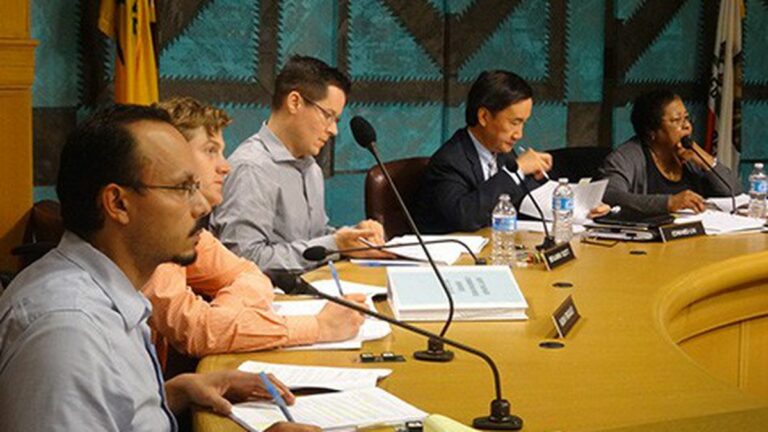
The Oakland rent board discussed the proposed fee hike at last week’s meeting.
Credits: Darwin BondGraham
The Oakland rent board discussed the proposed fee hike at last week’s meeting.
Credits: Darwin BondGraham
Under the current rules, landlords can pass 50 percent of the fee along to their tenants. Broadhurst said most landlords would surely do that, upping the tenant’s yearly share from $15 to $55. For some landlords who own dozens or hundreds of units, the fee increase would be in the thousands of dollars.
“It’s not a good idea at all,” said James Vann of the Oakland Tenants Union, in an interview. Both Vann and Broadhurst said the city should conduct a performance audit of the Rent Adjustment Program to see if its staffers can do more with their existing resources.
Taylor said in an interview that she met with City Auditor Brenda Roberts several months ago and answered questions about how the program is funded and works. “She said she might want to look at some cases, but I haven’t heard from her since,” said Taylor, who added that she wasn’t opposed to an audit. “We’re doing this as efficiently and as fast as we can, but we only have ten people.”
Taylor said that for years, the rent adjustment program was able to hear most petitions filed by tenants within the sixty-day timeframe called for under Oakland’s rent adjustment ordinance. But spillover from San Francisco’s white-hot housing market is rapidly increasing rents in Oakland, leading some landlords to push through large, often illegal rent hikes, while other landlords attempt to force out low-income tenants. Recently, petition hearings have started to take ninety days on average, said Taylor. Appeals, which are frequently filed by landlords who are unhappy when hearing officers uphold a tenant’s petition against a rent increase or other issue, now take even longer because the rent board, composed of members appointed by the mayor, and approved by the city council, has been lacking a quorum at its meetings.
“It takes way too long for the tenants to get a hearing,” said Ana Baires Mira, an attorney with the nonprofit Central Legal de la Raza. “We file, and three months later they have a hearing, then it takes one month to get a decision, so by the time anything happens, it has been six months.”
Baires Mira argues that Oakland needs to hire more hearing officers so more petitions could be heard quickly. “If the board was bigger, with more alternates, that would speed up appeals,” she said.
Vann said, however, that the program suffers from deeper flaws. He and other tenant advocates want to see Oakland adopt true rent control.
According to Vann, Oakland’s rent adjustment program doesn’t provide the same level of protections for tenants as real rent control because Oakland landlords can legally raise rents as high as the want to, even on rent-controlled units — unless a tenant files a petition with the rent board to stop the rent hike from going into effect. A hearing officer then considers whether or not the rent increase is permissible, and tenants and landlords make their arguments in formal hearings. The same process holds for other problems like reduced housing services. The problem is that the law requires a tenant to not only know the city’s rules, but also have the time and skills to argue his or her case.
Robbie Clark of the tenants’ rights group Causa Justa/Just Cause said tenants could be more effectively protected from rent gouging if the law were reversed so that landlords have to petition the city to raise rents above the permitted amounts, instead of putting the onus on tenants to petition against illegal rent increases. According to Clark and Vann, many renters simply don’t know their rights, so illegal rent increases go into effect because tenants don’t file a petition.
“The simple fix is just make landlords petition,” said Clark. “If you have a landlord that owns five different properties, and they have to petition to increase the rent on them, then you know what the rents are and what’s happening at those properties.”
According to Vann, a longtime tenants’ advocate, Oakland’s current rent laws were written by landlords as a means of derailing a campaign for true rent control in the late 1970s. “In early 1980, tenant advocates fielded an initiative petition for rent control modeled on the best parts of Berkeley, San Francisco, and Santa Monica ordinances,” Vann wrote in an email. “When the measure began circulating for signatures in early spring, real estate and landlord representatives got together with [then-] Mayor Lionel Wilson and hurriedly wrote and rushed [through] city council approval [of] the Residential Rent, Relocation and Arbitration Board Ordinance.” According to Vann, the rent control ballot initiative was narrowly defeated after real estate interests outspent them during the campaign.
“We’re in this severe crisis, and we have this ineffective policy,” said Clark about the existing rent adjustment program. “Putting more money in a broken system, you could argue that’s not going to help tenants much. This program fee should be coming with many other changes to the program.”
Baires Mira said the core problem is that the city isn’t doing anything proactive. “I think there’s a lot of landlords who don’t even follow rent control laws,” she said. “In the typical week, I see maybe ten to twenty clients, and I would say one-third of their landlords have nothing to do with the rent board and are just refusing to follow the law.
“A way to fix this would be, as Santa Monica does it, maybe Los Angeles, they have proactive rental inspection programs where the city checks units to make sure they conform with habitability laws,” Baires Mira continued. “If Oakland did that and had a proactive program, tenants would know they have rights.”
I’ve always been a big believer in the common-sense obviousness that monogamy is hard. Additionally, I like the idea of my wife getting fucked. I don’t have any desire to be denigrated or emasculated; I just get off on the idea of her being satisfied and a little transgressive. Early in our relationship, we talked about monogomish guidelines: I’d like to be informed and consulted, and she would rather I kept mine to myself. Last weekend we were having sex, and she asked me if I “wanted to hear a story,” code for treating me to a tale of a sexual contact. She’d been out of town for work most of the summer, and she told me that one of her roommates had gotten in the shower with her and fingered her until she came. I asked her if she’d fucked him, and she said yes. It was all hot and awesome. But a few hours later, I was experiencing pangs: Why hadn’t she told me or asked me at the time? Also, I felt very alone and depressed that summer, and when I’d gone to visit her, my wife and this roommate acted very strangely. I told her that I thought it was hot and cool, but that I didn’t think it was cool that she’d kept this from me for so long. Things got worse from there: Over the last week, we’ve had some great sex and open conversations but also a lot of anger and hurt. The truth is that she carried on with this guy all summer. It’s not the sex that bothers me so much as the breadth of the deception, the disregard for my feelings, and the violation of our agreement. And, yes, I’m feeling a little emasculated. How does a loving husband who intellectually believes that fooling around is okay — and who finds it hot sexually — get over this kind of hurt and anger? Help me get right with GGGesus.
Cocked Up Cuckold Keeps Stressing
Two things have to happen in order for you to move on. One thing your wife has to do, CUCKS, and one thing you have to do.
Your wife has to express remorse for this affair — and it was an affair, not an adventure — and take responsibility for the anger, the hurt, and, um, all the great sex you two have been having since the big reveal.
You don’t give her version of events — why she kept this from you — but you were depressed and lonely while she was away, and she may have concluded that informing and consulting you about this guy (first when she wanted to fuck him, and then when she was actually fucking him) would’ve made you feel worse. This conclusion is a massive self-serving rationalization, of course, because she knew you would veto the affair if she informed and consulted you. Figuring it would be easier to ask for forgiveness than permission, she went ahead and fucked the guy all summer long and then disclosed when your dick was hard.
Your wife needs to own up to the deception, the dishonesty, and the manipulation, and then take responsibility for the hurt she caused — that requires a sincere expression of remorse — and promise it won’t happen again. She shouldn’t promise not to fuck around on you again. You don’t want that, right? What she’s promising is not to deceive you again, not to go in for self-serving rationalizations again, and not to avoid informing and consulting you again.
And one more thing that won’t do: She won’t humiliate you again. You feel emasculated in the wake of this affair because her summer fuck buddy knew what was up when you two met and you didn’t. He knew who you were (the husband), but you didn’t know who he was (the fuck buddy).
Now here’s the thing you have to do, CUCKS: You have to forgive your wife. Mistakes were made, feelings were hurt, massive loads were blown. The fact that there was an upside for you even in this messy affair (see: massive loads, blown) should make forgiving your wife a little easier.
I’m a 27-year-old straight woman. I’ve spent this last year back on the dating market, and it’s HORRIBLE. I have a reasonably pretty face, I’m fit, and I take care of myself. I have my life together — friends, interests, job —and I’m emotionally stable. I go out, I enjoy meeting people, I’m on Tinder. And I keep hearing that with a huge influx of young dudes, Seattle is an easy place to date as a woman. So why am I finding it so hard? I can get casual sex, and that’s fun. But as far as finding a relationship beyond just fuck buddies, it’s depressingly predictable: Guy acts interested, texts me all the time, but eventually starts fading away. I’ve asked close friends to be honest with me; I even had a heart-to-heart with an ex-boyfriend. Everyone says I’m not doing anything wrong. Are they all lying to me? I’m currently seeing someone I really like. When we’re together, it seems like he likes me a lot. But now he’s starting to do the fade. I’m really sad and anxious. It’s killing my soul to be rejected constantly.
Bummed About Dating
You’ve been “back on the dating market” for one year, BAD. Twelve measly months! And in that time, you’ve dated/fucked a handful of men and nothing panned out. That sounds pretty normal. If you expected to be back in a committed relationship within weeks, BAD, then your unrealistic expectations are the source of your grief, not your thoroughly typical dating/mating/fading experiences.
There are worse things than being single for a year or two in your twenties. Get out there and meet men, pursue those non-men interests, and throw yourself into your work. Being single is not an aggressive cancer — there’s no immediate need for a cure — and panicking about being single isn’t the secret to romantic success. (And being single means being miserable only if you convince yourself that single = miserable.)
So here’s what you can do: Chill the fuck out; listen to your friends, your ex, and your advice columnist; and stop melting down about what sounds like a thoroughly normal love life, BAD, not an unfolding catastrophe.
This is NGAA, the guy you advised to make a gay friend and listen to some musicals with him. I didn’t find a gay friend, but I did buy recordings of the shows you suggested and I’ve been listening to the songs you recommended. I don’t know them by heart yet, so I have more listening to do. But Mr. Stephen Sondheim’s message seems to be that I need to quietly move on. Thanks for your answer, Dan. It really helped.
No Good At Acronyms
Thank you for writing back, NGAA, and for listening to the shows I recommended: Company, Follies, and A Little Night Music. My advice for you made a lot of my other readers angry — really angry. They accused me of blowing you off and not answering your question and failing at this whole advice column thing. But I didn’t blow you off. I directed you, as I’ve directed many other readers, to the expert I thought could help you. In your case, NGAA, that person was Mr. Stephen Sondheim.
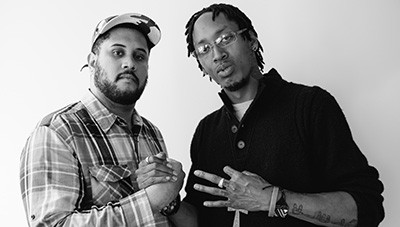
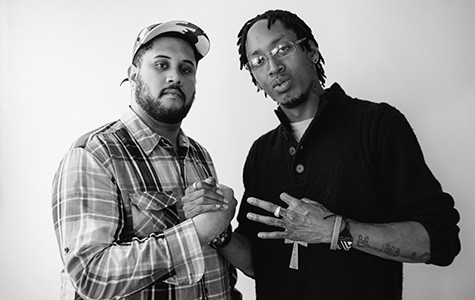
“I fell for it,” says Dominic Ware, his voice tinged with sarcasm. “For that brief moment, I was like, okay, this is how you get the American slice of the pie.”
Ware, an Oakland native, is talking about his first days as a cart-pusher at the Walmart in San Leandro, and he’s having a conversation with a new acquaintance, Luis DeLeon, a cook on a cruise ship. DeLeon chuckles, probably because he has heard this kind of pull-yourself-up-by-the-bootstraps narrative all too many times: “You hear so many stories of people working nine days a week and doing it, and then they become — ten years from now — really successful.”
Food workers Luis DeLeon and Dominic Ware.
Credits: Emmanuel Camacho
Dominic Ware.
Credits: Emmanuel Camacho
The conversation is part of “Voices of the Food Chain,” a new oral history project produced by the Food Chain Workers Alliance and Real Food Media in collaboration with StoryCorps, whose tear-jerking, minute-long segments are beloved by so many longtime NPR listeners. The multimedia project, which also includes a short video and gorgeous black-and-white portraits of food workers, officially launches at VoicesOfTheFoodChain.com on November 18.
Joann Lo, co-director of the Food Chain Workers Alliance, explained that the project gets to the heart of the work of the alliance, which was founded in 2009 under the belief that a coalition of food-worker organizations would, collectively, be able to wield more influence on all sectors of the “food chain” — big industrial farms, meatpacking plants, supermarket chains, and restaurants. The problem, Lo explained, is that many people who work at the lowest levels of the food industry are essentially voiceless.
At a retreat in Washington, DC for labor organizers in the food industry, Lo and her colleagues paired together people who had worked in different sectors of the food industry. In one audio clip, a cook in Virginia and a bartender in Cincinnati commiserate about their respective employers’ sketchy — and highly illegal — labor practices. In another, a woman who now helps run a camp for the children of migrant farmworkers recalls, movingly, the time when she and several other children were badly burned when she was a young child of migrant farmworkers.
The story that Ware, the Walmart worker, shared was bittersweet. Despite the company’s promises that hard work would allow him to move up the ladder from his minimum-wage position, his hours were slashed again and again — for no particular reason he knew of. Eventually, though, Ware found a sense of purpose when he became an organizer for Organization United for Respect at Walmart (OUR Walmart), the workers’ advocacy group whose efforts helped push Walmart to raise the wages of its 500,000 lowest-paid workers earlier this year from $8 an hour to $9 an hour — and to $10 an hour by next year, the company has promised.
Credits: Emmanuel Camacho
The goal of the project, Lo explained, was to allow these different workers to find common ground and allow listeners to “relate to a worker as a person — not just an anonymous food worker or restaurant worker.” And so Ware and a handful of other current and former food industry workers will be on hand to participate in a star-studded — and sold-out — dinner and panel discussion that will take place at Berkeley’s David Brower Center on Wednesday, November 18, and will serve as a formal launch for the “Voices of the Food Chain” project. Speakers at the event will include some huge names in the sustainable food movement: Alice Waters, Anna Lappé (the sustainable food advocate behind Real Food Media), and noted journalist and Fast Food Nation author Eric Schlosser.
But Schlosser, for his part, said he hopes the focus will stay on the stories of the workers themselves. In an interview, Schlosser said the importance of a project like this is that “it takes a statistic and turns it into a human being.” Often, he said, the food movement focuses — rightly — on animal rights and sustainable agricultural practices, but gives too little attention to the human rights issues inherent in the exploitation of workers throughout the food industry.
The Berkeley dinner, along with the rollout of the StoryCorps project, will help kick off the fourth annual International Food Workers Week, which the alliance has traditionally organized right around Thanksgiving. This year’s multi-pronged, November 22–28 celebration will include an online petition that urges Darden Restaurants — the Orlando-based mega-corporation that owns Olive Garden and several other national restaurant chains — to adopt more sustainable practices, both in terms of ingredient sourcing and the company’s treatment of its employees. On November 27 — Black Friday — activists will have a day of fasting and protest at Walmart locations around the country in an effort to pressure the company to pay its workers a $15 minimum wage.
The timing of these actions is deliberate, Lo explained. “It’s a time to give thanks. We should also give thanks to the workers we depend on to have food on our table.”
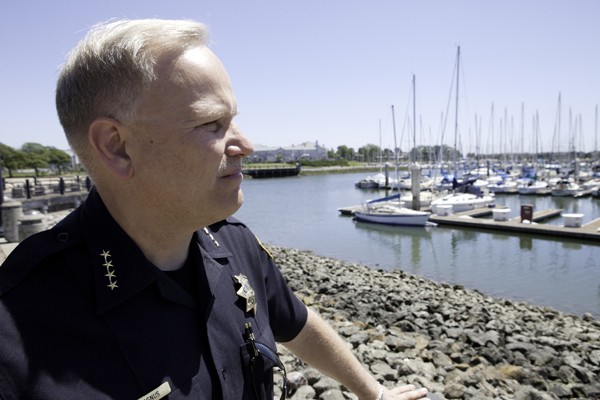
Chris Magnus.
Credits: Joseph Schell/File photo
1. Chris Magnus, the Bay Area’s most progressive police chief — and its most successful — has decided to become the police chief of Tucson, Arizona, the CoCo Times$ reports. In Richmond, Magnus eschewed tough-on-crime policies like stop-and-frisk in favor of community policing and improving relations between cops and residents, and the results were dramatic: The city experienced huge drops in crime in the past several years. Magnus, the first openly gay chief in the region’s history, also made headlines last year when he publicly embraced Black Lives Matter. Magnus said he’s looking forward to a new challenge in Tucson.
[jump]
3. The massive El Niño weather pattern forming in the western Pacific Ocean produced the highest temperatures on record, indicating that it’s stronger than the monster El Niño that rocked California in the winter of 1997–98, the LA Times$ reports. The temperature of a key area of the Pacific was 5.4 degrees Fahrenheit higher last week than this historic average, breaking the previous record of 5 degrees.
5. And Oakland-based Pandora announced that it purchased online music service Rdio for $75 million, the Chron$ reports. Pandora recently bought TicketFly for $450 million and the company hopes that the acquisitions will stem the company’s stock decline and help it compete more effectively with Spotify.
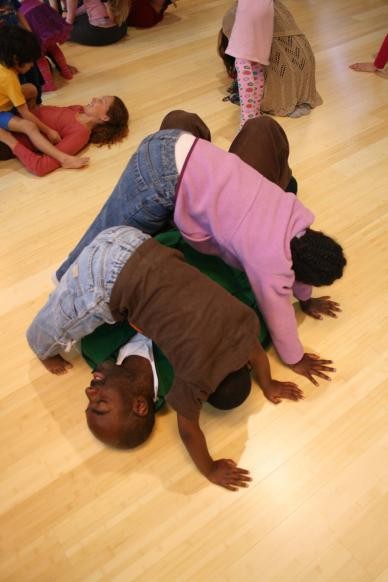
A family performs over and under shapes at a Luna Dance Institute Moving Parents and Children Together class.
The Berkeley-based Luna Dance Institute recently won a $120 thousand grant, which will allow it to expand its dance education services for East Bay families.
The two-year grant will go to the institute’s Moving Parents and Children Together (MPACT) program, which was founded in 2001
with the goal of bringing together previously separated families within the Alameda County dependency court and child welfare systems. The money comes from First 5 Alameda County, a public entity funded by a state proposition to improve childhood education.
“They’re working with very high risk families in a totally supportive, non-stigmatizing, fun way,” said First 5 CEO Janis Burger, of the MPACT program. MPACT uses dance to work through themes of attachment and separation, specifically designed for families who are learning to live together again after being separated because of issues such as drug use or domestic violence. The program also offers courses in parent education, and plans to bring classes to several Oakland organizations — including the Boys & Girls Club, Magnolia Women’s Recovery Programs, Allen Temple Health and Social Services, and Project Pride at East Bay Community Recovery Project — over the next two years.
[jump]
MPACT’s free dance classes take place at Oakland libraries: 81st Avenue, West Oakland and Cesar Chavez branches.They are open to the public, and specifically designed to serve families that are under duress for a variety of reasons, such as being separated by immigration status or burdened by a parent’s grueling work hours.
While the classes are meant for families, MPACT teaching artist and communications manager Cherie Hill noted that the word “family” can include less traditional caretakers such as grandparents or foster parents. “We get a variety of different definitions of what family is,” Hill said. “As long as it’s a grown up and a child dancing together, they all benefit from the class.”
MPACT received notice of the grant money in the summer, and launched its first public classes at the Boys & Girls club and 81st Avenue Library in October. In addition to more class offerings, the grant will fund two new teachers and an internship program. The new instructors are in training and will likely start co-teaching classes by winter, Hill said.
Luna Dance Institute keeps a current schedule of public MPACT classes posted on its website. The institute also offers classes at its Berkeley location.
See you can get in where you fit in/But you ain’t about to fit in with me/And you know I stay fly to a T/I’m international, I’ll have you think you thuggin’ when you hear this beat, rhymes Washington, DC spitter Queen Kyi on the title track of her most recent mixtape, Trilluminati. Like her regal stage name suggests, the project’s opulent club anthems brim with high-femme boast raps that position femininity as a source of power. Queen Kyi’s flow is smooth and icy, and she serves disses with nimble wordplay in her nonchalant monotone. Kyi performs on Friday, November 20, at Swagger Like Us, the Bay Area’s premiere queer hip-hop dance party, at Oasis in San Francisco. This edition of Swagger features resident DJ davO of the electro-pop duo Double Duchess and Boston DJ Leah McFly, who is a veteran of her city’s party scene. Gather your cool-girl posse and come prepared to stunt.
For five months at the beginning of 2014, Oakland artist David Wilson occupied the Berkeley Art Museum with The Possible, an amorphous gathering of artists that reimagined the parameters of a museum by filling it with a constantly evolving array of workshops presented by more than one hundred artists. He began the project by snail-mailing invitations to all of the participating artists. For many of his projects, he indulges his affection for paper goods by making maps, invitations, or mailers — and when making these, he often uses a Xerox machine. On Saturday, November 21 at Land and Sea (5428 San Pablo Ave., Oakland), Wilson will present a project that uses the Xerox machine “as a tool towards its own ends.” Wilson plans to explore the act of copying by enlarging one of his drawings, cutting it into pieces, enlarging those pieces, cutting each of them into pieces, and repeating that process until he fills an entire wall. Wilson, who is also known for his playful walking tours, will also be leading a walk through the neighborhood around Land and Sea at some point during the reception.
In a comment appended to the online version of our November 11 news story, "Richmond Developer Pushes Two Ballot Measures," developer Richard Poe disputed an assertion made in the original version of the report that he had recently purchased a mansion in Florida. As a result, we clarified the story to read as follows:
According to public records, Poe has...
World leaders from more than 190 countries will convene in Paris during the first two weeks of December for the long-awaited United Nations Climate Change Conference. Will the governments of the world finally pass a binding global treaty aimed at reducing the most dangerous impacts of global warming or will they fail in this task?
Letters...
Disputes between landlords and tenants are overwhelming Oakland's rent adjustment program. According to city officials, petitions filed by tenants to stop excessive rent increases and questionable evictions have doubled during the past three years, from 385 in 2012 to 739 so far this year. And appeals by landlords seeking to uphold rent increases or pass other costs onto tenants,...
I've always been a big believer in the common-sense obviousness that monogamy is hard. Additionally, I like the idea of my wife getting fucked. I don't have any desire to be denigrated or emasculated; I just get off on the idea of her being satisfied and a little transgressive. Early in our relationship, we talked about monogomish guidelines: I'd...
"I fell for it," says Dominic Ware, his voice tinged with sarcasm. "For that brief moment, I was like, okay, this is how you get the American slice of the pie."
Ware, an Oakland native, is talking...
Stories you shouldn’t miss:
Chris Magnus.
Credits: Joseph Schell/File photo
1. Chris Magnus, the Bay Area’s most progressive police chief — and its most successful — has decided to become the police chief of Tucson, Arizona, the CoCo Times$ reports. In Richmond, Magnus eschewed tough-on-crime policies like stop-and-frisk in favor of community policing and improving relations between cops and residents, and the results...
The Berkeley-based Luna Dance Institute recently won a $120 thousand grant, which will allow it to expand its dance education services for East Bay families.
The two-year grant will go to the institute's Moving Parents and Children Together (MPACT) program, which was founded in 2001
with the goal of bringing together previously separated families...
See you can get in where you fit in/But you ain’t about to fit in with me/And you know I stay fly to a T/I’m international, I’ll have you think you thuggin’ when you hear this beat, rhymes Washington, DC spitter Queen Kyi on the title track of her most recent mixtape, Trilluminati. Like her regal stage name suggests,...
For five months at the beginning of 2014, Oakland artist David Wilson occupied the Berkeley Art Museum with The Possible, an amorphous gathering of artists that reimagined the parameters of a museum by filling it with a constantly evolving array of workshops presented by more than one hundred artists. He began the project by snail-mailing invitations to all of...