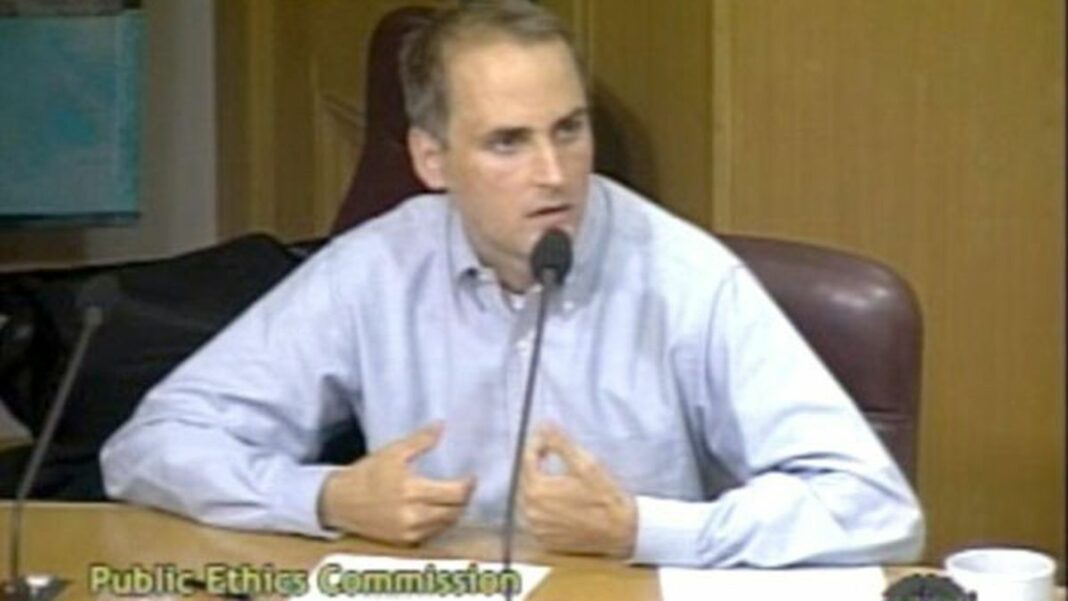
Good-government activists are raising questions about whether
Oakland Public Ethics Commissioner Alex Paul has an ethical
conflict. It’s the job of the ethics commission to regulate lobbyists
and political action committees in the city. And yet Paul is the
registered domestic partner of Michael Colbruno, an in-house
lobbyist for Clear Channel and the chairman of OakPAC, an influential
committee closely tied to the Oakland Metropolitan Chamber of
Commerce.
Over the past year, Paul has repeatedly engaged in discussions and
enforcement decisions involving lobbyists, even though those decisions
could ultimately affect his finances. In his statements of economic
interests filed with the city earlier this year, he acknowledged that
he financially benefits from Colbruno’s work — although he only
mentioned Clear Channel and not Colbruno himself.


Paul also apparently didn’t disclose his relationship to Colbruno
until after he was appointed to the ethics commission and sworn in.
Paul’s résumé and commission application make no mention
of the relationship, and commission President Andrew Wiener, who
vetted applicants, said he didn’t learn of it until Paul was already on
the commission.
Ethics experts say Paul’s domestic partnership with Colbruno doesn’t
represent a direct legal conflict that would disqualify him from being
on the commission. Bob Stern, president of the Center for
Governmental Studies in Los Angeles and former general counsel to the
state’s Fair Political Practices Commission, said Paul is only legally
required to recuse himself during discussions and decisions involving
Colbruno. However, Stern said the perception that Paul may be biased
toward lobbyists and PACs is a problem. “I would probably recuse myself
for ethical reasons,” Stern said. “It seems to me that he’s too close
to the situation.”
Former Oakland Public Ethics Commission President Ralph Kanz
agrees. “Anything involving lobbying of any kind — I believe he
should be recusing himself,” he said. “To my mind, it could affect his
income.” Kanz also questions whether Paul’s continued service on the
commission is harming its reputation. “Public perception is the most
central part of public ethics,” Kanz said. “But he has so many
potential conflicts. I don’t see how he can go forward on that
commission without people questioning everything he does.”
Commission Executive Director Dan Purnell said Paul recused
himself from discussions earlier this year over a lawsuit brought by
Colbruno and OakPAC against the city and the ethics commission. The
lawsuit concerned an Oakland law that limits contributions to PACs.
Paul, however, has not recused himself from discussions and enforcement
involving other lobbyists or PACs. The commission has the power to levy
fines against people who violate city lobbying and campaign finance
laws. But if the commission decides not to punish a lobbyist who
appears to violate the law, it’s generally considered a signal to other
lobbyists that they can do the same thing without worry.
Paul did not return two phone calls seeking comment for this story.
But since joining the commission in January, he has exhibited a
penchant for preferring lax ethics rules. For example, earlier this
year, after a complaint was filed against Oakland lobbyist Carlos
Plazola, Paul voted on the issue without disclosing that Plazola
serves on the OakPAC board with Colbruno. And then last week, Paul
voted to reject a proposal that would have required commissioners such
as himself to publicly disclose wedding gifts or gifts of out-of-state
travel, including first-class air fare.
Paul also grew obviously perturbed at last week’s meeting during a
discussion about commissioners being married to or partners of
lobbyists. Kanz and the leaders of the Metropolitan Greater Oakland
Democratic Club, including president Judy Cox, have proposed
that people like Paul who benefit from their spouse’s lobbying should
be prohibited from serving on the commission.
Although the club’s proposal carves out an exemption for Paul, he
instead chose to interrogate Kanz and Cox rather than discuss the
merits of their idea. “Who do you represent?” he asked repeatedly,
according to a video of the meeting provided by KTOP. “Whose views do
you represent?” Later, he asked pointedly if the club would pay the
city’s legal costs if it were sued over their idea.
Deputy City Attorney Alix Rosenthal, who is assigned to staff
the ethics commission, told Full Disclosure that she could think of no
legal grounds for why anyone would ever sue the city if it were to
adopt the Democratic club’s proposal. Also, it would be unprecedented
for a community group to pay the city’s legal bills simply because the
city had adopted the group’s proposal.
In an interview, current commission president Wiener said that if he
were Paul, he would recuse himself from all discussions and decisions
involving lobbyists and PACs. But Wiener expressed concerns about the
club’s proposal to disqualify future commissioners with conflicts like
Paul’s. Instead, he said he would prefer that commissioners recuse
themselves. If they refused, then the other commissioners should have
the power to exclude them from a particular issue, he said.
As for Colbruno, who also is chairman of the Oakland Planning
Commission, he also did not return a phone call seeking comment for
this story. But earlier this year, he strongly defended Paul in an
e-mail to Kanz, city councilwoman Nancy Nadel, and others.
Police Union Breaks Law for Perata
The Oakland police union violated state and local laws last week
when it turned an event partially financed with taxpayer dollars into
an endorsement for mayoral candidate Don Perata. It is illegal
to use public funds for political purposes. The public meeting had been
billed as a chance to meet Oakland’s new police chief Anthony
Batts and was paid for in part by the city’s Neighborhood Services
Division, which also sent out the invitations for the event.
Nicholas Vigilante, chairman of the Neighborhood Watch
Steering Committee, which sponsored the event with the Oakland Police
Officers Association, said he didn’t learn that police union president
Sergeant Dom Arotzarena planned to announce the union’s
endorsement of Perata and invite the former state senator to speak
until just before the event. The event was held at the police officers
union headquarters near downtown. “I said, ‘That’s not what we agreed
to,'” Vigilante said he told Arotzarena about the Perata endorsement
announcement. “He said, ‘It’s our house and that’s what we’re going to
do.'” Vigilante said that he then suggested to Arotzarena that
Councilwoman Jean Quan, who is running against Perata, also be
allowed to speak. “He said, ‘No, that’s not going to take place,'”
Vigilante said.
After Batts finished speaking, he left the event. According to
Oakland activist and Quan supporter Pamela Drake, Arotzarena
then took the stage and complained about Oakland’s lack of leadership,
without noting that Batts had been selected by Mayor Ron
Dellums. Drake said that Arotzarena then announced the union’s
endorsement of Perata and invited him to speak. “It was clear that it
was an endorsement meeting,” Drake said, adding that a group of people
became disgusted and walked out.
After Perata finished talking, he handed the mic to Vigilante, who
had decided that he would invite Quan to speak as well about her
campaign for mayor, despite Arotzarena’s objections. Witnesses said
Quan’s appearance didn’t go over well with the police union members. In
an e-mail sent out after the event, Vigilante, who is also a Quan
supporter, apologized for the politicking. “Neighborhood Watch is a
non-partisan organization, and as its chairperson, I truly regret what
happened,” he wrote.
After the event, City Administrator Dan Lindheim said in a
statement that he was “conducting an investigation to determine whether
disciplinary or other action is appropriate.”
Arotzarena did not return a call asking whether the union planned to
reimburse the city for the funds it used for the event. The union also
has yet to issue a public apology.