When Dan Das Mann moved to the Bay Area in 1996, one of the first
things he did was help build a metal shop at a large San Francisco
artist collective. People at the Cell Space arts complex were always
going on and on about “Burning Man, Burning Man, you got to go to
Burning Man!” So in 1997, Dan made his way out to the desert for the
first time. “I’m just walking around looking for something to do and I
walk up to this guy,” he recently recalled. “And he’s been working
trying to make this ten-foot ball of ice in the middle of the
desert.”
The guy was Jim Mason, a prominent Bay Area artist. Mason had
started out with a team of assistants, but after a few days his project
seemed hopeless and the crew lost interest. However, something about it
all attracted Das Mann. “Everyone had abandoned the project because it
was failing; it was falling apart,” he recalled. “And he was walking
around talking to himself. He’d been up for three days trying to finish
this thing.” That’s when Das Mann offered his assistance.
Credits: Joshua Emerson Smith
Credits: Joshua Emerson Smith

Credits: Joshua Emerson Smith

Credits: Joshua Emerson Smith

Credits: Joshua Emerson Smith
Credits: Joshua Emerson Smith
Mason turned him down. But Das Mann was nothing if not persistent.
“He can’t even move anymore,” he recalled of Mason. “And I’m up there
cutting the mold, doing crazy stuff and electrocuting myself, and he’s
like, ‘Dan I just can’t go anymore. I’m just too far gone.'”
“I said, ‘Go to sleep, and when you wake up this thing’s going to be
done.'”
As Das Mann tells the story, when eight in the morning rolled
around, there was a ball of ice in the middle of the desert.
So he and Mason struck up a friendship, and the following year Mason
introduced Das Mann to some people who would prove to be important to
him. “He brought Larry Harvey over to my studio in the spring, and he’s
like, ‘I want you to meet Larry Harvey, the founder of Burning Man,'”
Das Mann said. “Jim and Larry were good friends because Jim was this
maniac artist doing the coolest stuff.”
Harvey ended up helping to fund Das Mann’s 1998 project for Burning
Man — a 25-foot-tall copper tree that spouted fire and water. He
also gave Das Mann a coveted spot in which to display his tree, where
Burners could walk up and play in the water during the day and marvel
at the blasting fire at night. Eventually, Das Mann received
commissions to build several more trees, including one for a private
investor and another for an Australian aboriginal tribe.
“That was the beginning,” Das Mann recalls today. “I had always had
these visions — small concepts, but I wanted them to be major
installations — interactive things that people could experience
in a full way that would emotionally change them. You can do that with
small things, but big things at Burning Man can really do that. And
that spoke to me.”
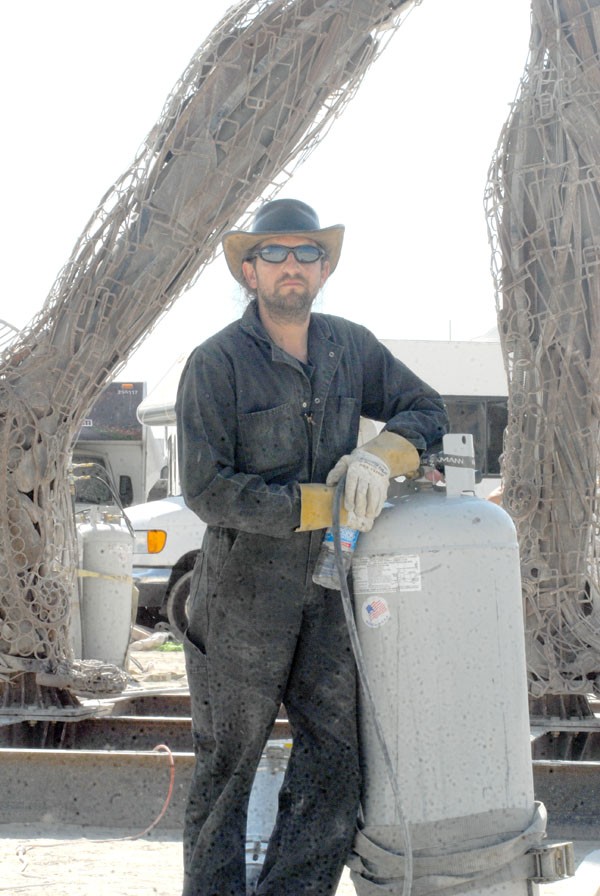
So Das Mann went on to become a Burning Man regular. And if he
didn’t know anybody thirteen years ago during his first visit, by this
year he pretty much knew everybody. As he sat in a chair under a large
shade structure looking up at a thirty-foot-tall metal woman named
Ecstasy, all around him people lazed on couches, some smoking, others
fixing breakfast in a kitchen area equipped with several refrigerators
and a stove.
“Our goal for many years was to do it all: make the art, make the
camp, have the good fun times, not burn yourself out,” he said
contentedly, reveling in his eighty-person camp. “And we solved it
after thirteen tries.”
The accommodations certainly impressed. His camp provided
electricity, a meal plan, a mostly operational shower, a graywater
evaporation pond, plenty of camping space, a commodious shaded common
area, and prime real estate on the main drag, facing the action. Not to
mention the camp’s festive amenities, which included a twenty-foot-wide
dance pit beneath the giant metal woman — encircled by a ring of
fire.
But perhaps most notably, the fabled drama of years passed seemed
nonexistent at this year’s camp. “I came up with the idea to do a
performance deposit,” he said. “So everybody in the camp has to do an
eight-hour shift … and everyone pays a $200 deposit against their
work. So when they do their job they get the money back. And that
little maneuver changed the entire dynamic because now everyone’s
working together.”
Organizing volunteers in the desert may not seem impressive to
people who are familiar with Das Mann’s large metal sculptures. But he
doesn’t see it that way because lately he’s been focused on fine-tuning
his managerial skills. “I’ve been calling myself a conductor,” he said.
“I think of what I do, and what the people I work with do, kind of like
a symphony.”
Das Mann’s latest symphony is taking place at an enormous building
in West Oakland. He and his business partner, Karen Cusolito, recently
became the sole leaseholders of the Big Art Studios at American Steel.
It’s a 250,000-square-foot warehouse housing eighteen bridge cranes and
300 to 400 artists at any given time. Many tenants use the space to
create metal sculptures. But there’s a whole warehouse for painters,
jewelry designers, and other fine artists, as well as a recording
studio for DJs and others musicians. They also rent space to small
nonprofits.
West Oakland is home to many art studios, but nothing else as big or
diverse as this. Not so long ago, the American Steel building was
slated for demolition in order to build condos. But Das Mann and
Cusolito hope to create an environment so appealing that no one would
dare tear it down. And where many such studios live under the constant
threat of being closed down because they don’t comply with city
building or fire codes, Das Mann and Cusolito have worked hard to
develop a relationship with the City of Oakland.
It’s hard to imagine that a party in the desert could help change
the face of West Oakland. But that’s exactly what’s happening. If the
Big Art Studios at American Steel succeeds, it could redefine an entire
neighborhood.
Das Mann has a reputation for taking on big projects and making them
work. It seems to be part of his hardwiring.
“I pulled my first all-nighter when I was ten,” he said, fondly
remembering the working bubblegum machine he built out of Legos. It
took him 24 hours, but he didn’t quit until family members were pumping
pennies into his multicolored plastic machine.
Dan’s original surname was Lowry, which he replaced with Das Mann at
age seventeen. At twenty, he helped his mother and brother start a
pizza business called Lowry Food Company. At its height, he said, they
were making 50,000 pizzas a day for Walmart, Albertsons, and other big
grocery stories. “It was a very exciting and interesting experience,”
he said, “but ultimately not for me.”
At 21, Dan escaped his hometown of Dallas to attend a landscape
architecture program at Rutgers University on Long Island. But he
didn’t get along with his professors all that well. Part of the problem
was that he was better at going to the bar than to class. But he also
resisted the rules of conventional landscape architecture. “I was
always turning my pieces into these huge sculptures,” he said. “They
wanted things to be a little more structured and I was building theme
parks with rivers through them instead of beautiful winding infinity
pools.”
By the time he graduated, the family business was booming and his
mother and brother invited him to return to Dallas to become a partner
in Lowry Food Company. He accepted, but only stayed for two years.
That’s when he moved to the Bay Area for a fresh start.
“I immediately found Burning Man and started making art out here,”
he said. “It was kind of like my art school.”
This year at Burning Man, he turned forty on the night of the burn.
Hovering above, Ecstasy’s hands clenched against her metal chest,
periodically bursting into flames. People blew in and out of his camp
like sand, an endless storm of acquaintances swirling amongst his
closest friends as everyone danced to the music and fire effects
blasted from above and below. A photo booth built onto the back of a
Cushman meter-maid vehicle, known as the Photo Boof, projected strange
and familiar faces across the sand in front of the camp. One night
turned into the next. The birthday party seemed to go on for days. “I’m
kind of amazed at what I’ve accomplished,” Das Mann confessed.
But less than a week later, it was back to work at American Steel.
Trucks of dusty gear pulled into a large storage bay and people waited
around to recoup their deposits by cleaning metal poles and dusty
kitchen equipment. Ecstasy lay supine next to the Photo Boof on a huge
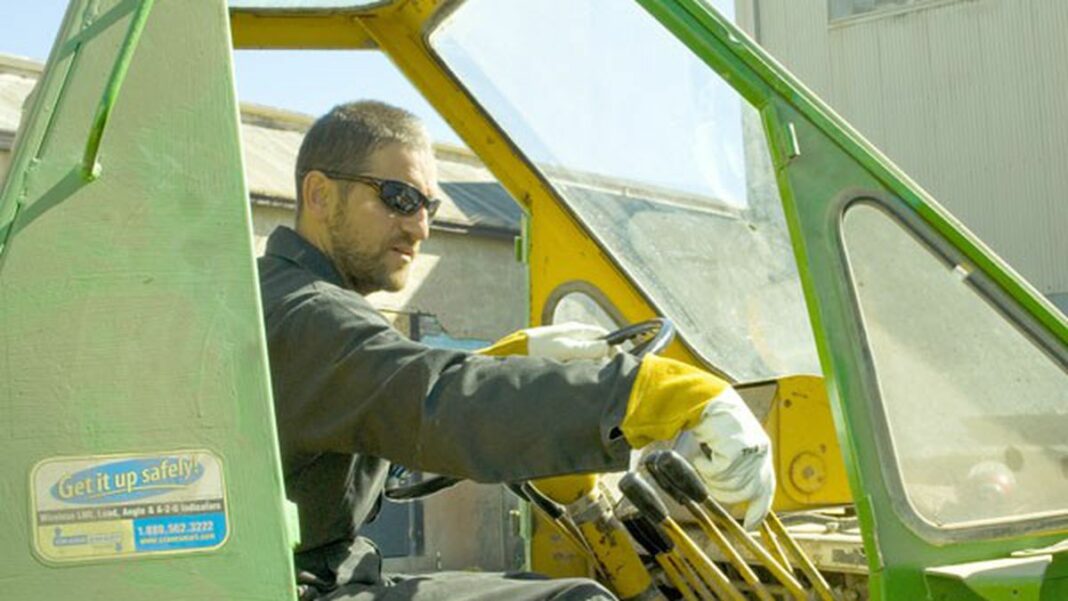
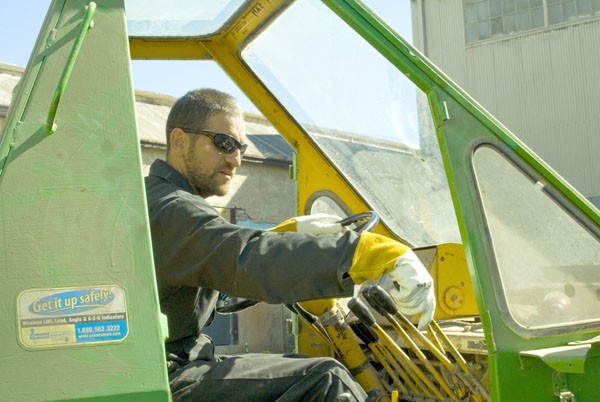
truck trailer. Das Mann came zipping around the corner on a forklift.
Immediately, a team of people swarmed around him helping to keep the
Photo Boof balanced as he used the forklift to ease it onto the
ground.
Such scenes are typical at American Steel. Whatever Das Mann’s
working on, there seems to be a team of loyal volunteers on hand to
help. Dale Holden is one of them. He hooked up with American Steel
through a friend. “I showed up one day and helped out with unloading a
truck and realized what the place was about and decided to stay because
it was freaking amazing,” he said.
Holden has been involved with American Steel for more than three
months now, and on that particular day he was in charge of the cleanup
effort. Toward the evening, he calmly started rounding up volunteers to
help him with a side project. A city building inspector had discovered
people affiliated with American Steel squatting in a storage lot across
the street. It was Holden’s job to clean out the lot within 24
hours.
But eventually the cleanup effort turned into a late-night party.
Everything seemed extremely relaxed and it was questionable whether the
lot would be ready for the inspector in the morning. Then Das Mann
emerged out of the shadows, and the partying turned to work. By the
next morning there was a lock on the gate and the place was cleaned
out.
Such violations are rather common in the free-form world of artist
work spaces. Vincent Crudele, a City of Oakland fire inspector, said
usually only about one third of such work spaces are up to code. “On
any given day, when we conduct our inspection process and we go into
these types of spaces, we typically find violations to the fire code
and the building code.” But Crudele counts the Big Art Studios at
American Steel among the compliant third. Still, keeping a space like
Big Art Studios up to code is tricky because of the wide variety of
artists working side by side. “This has been a challenge,” he said,
“but the difference here is, they want to do it correctly.”
Of course, American Steel takes up four city blocks, so it would be
hard for tenants to hide even if they wanted to. For instance, in July,
Das Mann and Cusolito threw a giant fund-raiser for the studios called
“Sand By the Ton.” Basically a mini Burning Man, the party was so
successful that Crudele, who was on the scene that night along with a
small team of police officers, stopped letting people enter. By the end
of the night, almost a thousand people were lined up outside while the
party raged on.
Cusolito said the fire inspector worked very hard with her to get
the building ready for that event, which included putting in exit
signs, fire extinguishers, and a new sprinkler system. And those
upgrades are only the beginning, she said. “There are different levels
of things that need to happen,” Cusolito said. “But there’s a budget
that needs to be considered. It’s not like I can make everything happen
at once.”
American Steel was the direct result of Das Mann’s and Cusolito’s
infectious drive to create art on a massive scale. In 2005, they were
looking for a place to create two huge metal sculptures called “The
Passage,” a thirty-foot scrap-metal woman walking hand in hand with her
twenty-foot-tall child. At the time, Das Mann ran a San Francisco art
space called Headless Point, but he and Cusolito needed space with
higher ceilings to construct the figures.
“It was just a lark, but I said, ‘Dan, let’s call that guy Tom in
that big space in West Oakland and see if he’ll let us borrow a little
space.'” And it turned out that Tom, a structural engineer named Tom
Dias, with whom Das Mann has briefly worked, was amenable. “So we came
in, busted out the piece in two months, packed up, and left,” Cusolito
said. The next year, Dias let them come back to construct two more
metal figures. Then, in 2007, the Burning Man organization funded a
massive installation project proposed by Cusolito and Das Mann.
“When we got approved to do ‘Crude Awakening,'” Cusolito said, “we
realized we needed our own space. And that’s when this all started
happening.”
Cusolito and Das Mann are grateful for Dias’ support over the last
four years. In addition to helping them rent their own space at
American Steel, he assisted them with several structural issues on “the
Passage.” And he looked over their shoulders during the construction of
“Crude Awakening.”
“That’s how we forged our relationship,” Dias recalled. “I guess I
sort of schooled Dan a little bit in how to do steel work. I think what
this thing did for Dan was change his paradigm of what a shop space
should be. I think his shop before was small and crowded. And to all of
a sudden have overhead cranes and places where trucks can come make
deliveries and was zoned correctly, all of that stuff maybe opened his
eyes.”
The creation of “Crude Awakening” — a 2007 installation that
featured eight giant metal figures, including Ecstacy and an exploding
oil derrick — drew a sizable cast of workers, volunteers, and
friends. Some started renting their own spaces at American Steel.
Steve Valdez is a metalworker who has been renting space there since
2007. He really enjoys the facility’s community. “A lot of us have been
associated through Burning Man,” he said. “I guess that same kind of
… utopian society that you have out there translates to the working
world here.” People at American Steel are willing to share their tools
and materials, and nobody really abuses the privilege. “If you need
something in the desert, somehow it just shows up. It’s kind of the
same thing here.”
Valdez said the space at American Steel feels relatively stable, but
he noted that you can’t take any such work space for granted in the Bay
Area. And indeed, before Cusolito and Das Mann took over the lease, the
building was slated for demolition. When the housing boom was still
booming, the long-range plan was to replace American Steel with condos.
Renting to artists was a good temporary use of the space, and more and
more artists moved in. Then the economy collapsed and the condo project
got tabled. That’s when Cusolito and Das Mann made their move.
On April Fool’s Day of this year, they became responsible for
hundreds of subleases and a total rent neither would discuss. While Das
Mann had run artist workspaces before, a facility of this scale took
things up a notch.
Taking on a lease of this size and renting space to artists amidst a
nasty recession might seem crazy to some people, and it’s still far
from clear whether American Steel’s immense size will eventually make
or break the project. But Das Mann and Cusolito’s connection to a giant
community of artists has certainly helped them rent out a lot of space.
And having so much space has made it relatively cheap for renters.
Still, Dias noted, there was significantly less action this year during
the months before to Burning Man. And Das Mann conceded that the poor
economy has affected things. But the studios are still growing at a
steady clip, he said, and he and Cusolito remain powerfully
optimistic.
“The inspiration with all this cross-pollination is so rich,” she
said. “I love coming to work.”
Metalwork is still the primary business at American Steel. But
recently Das Mann and Cusolito renovated a warehouse for other types of
artists. For 70 cents a square foot per month, painters and sculptors
can now rent partitioned cubicles. But like everything at American
Steel, this space is adjacent to industrial activity. At least one
painter has complained that her canvases get dirty from dust and
various kinds of debris in the air. Das Mann promises that a cleanup is
in the works.
Painter Daniel White notes the dust, but doesn’t find it a problem.
“I figure Leonardo put up with it,” White said. “He didn’t have air
conditioning or anything. If Michelangelo, Leonardo, all those guys
dealt with the dust, I can deal with the dust.” Some people may want a
pristine or quiet workspace, but White said he likes the close
proximity of so many different projects happening at once.
“I get a lot of inspiration,” he said. “I get a lot of feedback.
People come by and look at the work. Then I can also look at other
people’s work. It really helps fuel what I do.” For instance, White was
working on an elaborate chair, featuring nails and crosses, that dealt
with religious themes. And being at American Steel has inspired him to
envision the project completely differently. “I’m thinking, ‘Wow, I can
make that big.’ I’m thinking, ‘Hey, why not push it and do a whole
dining-room set?’ Then yesterday I was thinking, ‘Why not just do a
whole room?'”
Other tenants have similarly big plans, although their art is
perhaps less obvious. Ernest Lawson works for the West Oakland Greening
Project, a nonprofit that builds wooden benches and planters and
installs them around the city. Lawson might not seem like an artist,
especially next to a bunch of painters and sculptors. But as Cusolito
and Das Mann see it, they’re all essentially trying to beautify their
environments. Lawson calls American Steel a “big little community”
where there’s a lot going on but everyone’s willing to help at a
moment’s notice.
“Basically, if you need to borrow a truck, someone will let you
borrow it,” he said. “Anything you need to do. It’s real close-knit in
here.” Lawson is trading services with someone he calls “the worm
lady.” He’s making her a box for her worms and, in return, she’s going
to make the West Oakland Greening Project a web page.
Das Mann recently returned from a trip to Los Angeles. It was the
middle of the week around noon and Ecstasy and another giant metal
figure were again strapped to a truck trailer. The driver pulled around
to the side of the building, unhitched his cargo, and drove away. Das
Mann and a small crew sat on the trailer, preparing to move the
14,000-pound Ecstasy with cranes. Das Mann had good news.
“We talked with Pascal, who runs E.D.C. and all these big raves, and
he’s basically hired us to build the second biggest stage at
E.D.C.”
E.D.C., or Electric Daisy Carnival, is a 100,000-person
electronic-music festival held in the spring at the Los Angeles
Coliseum. Pasquale Rotella produces that and several other events. Das
Mann had let Rotella rent Ecstasy and two other figures with full fire
effects for an event called “Nocturnal” the previous weekend. That’s
when Das Mann pitched him the idea of building a “custom stage.”
Apparently, Rotella liked it.
“There’s a limited amount of money to do installations like we do,”
Das Mann said. “Burning Man probably has the biggest grants. But that’s
limited, too. The maximum they give is like $60,000 or $70,000. That
doesn’t take you that far. So I was thinking, ‘What if we turn these
stages that have big budgets into huge sculptures?’ So a stage isn’t
just a stage for a DJ anymore, it’s a major art installation in its
entirety.”
If the Electric Daisy Carnival stage goes well, Das Mann hopes to
contract with Rotella to create approximately fifty stages a year.
“That would be an entire company unto itself that would run out of
American Steel. It would be two bays of stage construction, art making
year-round.”
For Das Mann, the idea is damn near perfect. The budget for a stage
can be anywhere from $80,000 to $300,000, which would provide work not
only for him, but also for many other people at American Steel. Das
Mann said he would love to give Dias the work of building the stage’s
frame. “Every kind of artist — the painters, the glassblowers,
the ceramicists, everyone — can have pieces of this thing. … It
just goes on and on.”
It’s hard to pin down just where Das Mann’s insatiable desire to
create ever-larger projects comes from. It seems partly inborn and
partly the result of Burning Man culture. But there’s something else,
too. He’s an artist, but he’s also a promoter and a people person. A
gathering is a work of art for Das Mann. Organizing a camp, a party, an
art installation, a giant artist workspace, a
DJ–stage-turned-sculpture — each is a work of art for
him.
“It’s about giving people the chance to have ownership in what they
do,” he said. “I learned a long time ago that if I wanted to be a
micromanager, I might as well quit while I’m behind. Because people are
skilled. They’re smart. They have great ideas and a lot of vision. I
only know some things. It’s a lot more interesting to come up with some
ideas, put them in motion, and allow everyone to fill in where they fit
best — to do the part that suits them and that they’re happy
doing. So if you think about it in that sort of conductor-symphony
scenario, I don’t play the violin. I mean, I could probably play it a
little. I could probably play a little bit of trumpet. I could probably
play a little bit of drums and some xylophone. I’m not great at any of
those things. But I can be the glue.”