
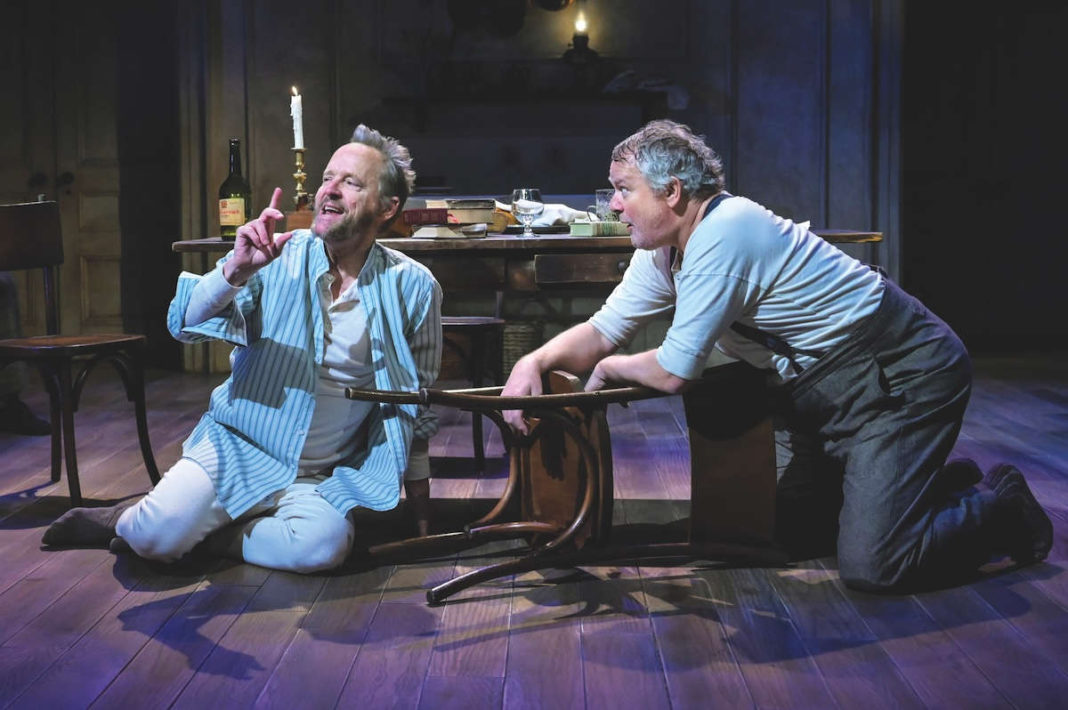
People look to theater, concerts, sports and other live entertainment to experience the vicarious thrill of life’s dramatic highs and lows. But face it: Most folks spend actual, everyday life slogging along in the muddled middle.
So it is with the characters in playwright Conor McPherson’s adaptation of Anton Chekhov’s Uncle Vanya. Playing at Berkeley Repertory Theatre in a co-production with Shakespeare Theatre Company through March 23, the adaptation is directed by Shakespeare Theatre’s highly regarded Sam Godwin and features film/television/theater actor Hugh Bonneville (Downton Abbey, Paddington and more) in the titular role.
In an interview prior to opening night, Bonneville says, “As Judy Davis said, ‘The great thing about live theater is that tomorrow night, you can get it right.’ I had every intention of becoming a barrister when I was at university. I reversed out of that idea and decided to roll the dice and gave myself three years to get my equity card, which in the U.K. at that time you needed. I’m still waiting for that tap on my shoulder that means I have to head back and attend law school.”
Bonneville is joined by a marvelous cast that showcases the multitalented John Benjamin Hickey, impressively layered as Astrov, a country doctor who self-medicates with vodka; and Melanie Field, playing Sonya, Vanya’s niece and the family’s emotional lynchpin. Field is so dynamic she would steal every scene if she was not also a sensitive, generous performer.
No less compelling are Tom Nelis as Alexander Serabyakov, an ego-fluffy, aged professor; Ito Aghayere, the professor’s very-much younger wife, Yelena, garbed from head to toe in creamy off-white fashion, who drives Vanya and Astrov to love’s excesses; along with Sharon Lockwood as Mariya, the professor’s over-adulating former mother-in-law; Nancy Robinette, who injects terrific and subtle humor as Marina, Sonya’s “nana”; and Craig Wallace, the household’s hang-about lodger, Telegin, otherwise known as “Waffles.”
Uncle Vanya, written by Chekov in 1899, tells the story of a dysfunctional family suddenly forced by economic circumstances to be together on the professor’s country estate. Vanya, the on-site caretaker overseeing the property for the professor, has reached the end of his career and now writes useless pamphlets no one reads. His second marriage to the luscious Yelena, and their presence, causes ample turmoil when both Vanya and Astrov fall in love—or at least in lust—for the young woman.
Meanwhile, Sonya pines for Astrov, who has lost his devotion to medicine and finds dedication and purpose imbibing strong spirits while seeking Yelena’s favor—and more. From the start, emerging in a stained-undershirt from under a pile of quilts on the floor, Vanya seethes, mocks, boils and eventually erupts with resentment at his situation of having abandoned his dreamed-of career as a writer to oversee the estate’s always-in-the-red accounts. The mother-in-law remains blind to the professor’s obvious failings, Marina attempts to push worry away with tea and humor, and Waffle carries around a guitar he cannot play, and … waffles.
Most ironically, every member of the misfit crowd has only him or herself to blame. Be it career frustration, failed romances, resentment towards blustery or boring relatives, they fail to take responsibility for their lives and continually repeat the same mistakes. Projecting clouds of resentment, shame, other-blame, depression and disappointment, the atmosphere is gloomy.
Which makes it surprising that McPherson’s adaptation is also incredibly lively and fun. Actors frequently break the fourth wall by addressing the audience directly, inviting them in as if they are members of the family whose perspectives are more worldly and wise. Without altering most of the original script or sacrificing the play’s understory about climate change and the devastating havoc it causes, the language remains strikingly relevant; issues and relationships easily relate to contemporary times. The overall relaxed, humanistic approach lends intimacy to what otherwise might feel like watching goldfish commit slow suicide inside an antiquated glass bowl.
Among the most uplifting features is Bonneville’s deft take on his Vanya that seamlessly blends humor, pathetic self-pity, embarrassment and underplayed anger towards the professor but also at himself, the world, fate and so on. Costumes by Susan Hilferty and Heather C. Freedman are equally astute, adding dimension with textiles—not talk—to each character. Fluid set design by Robert Brill manages to become a country garden, a kitchen and a front parlor.
“Uncle Vanya is a witty guy with an incredibly wounded heart,” Bonneville says. “Drawing out the humor means you laugh when they come out with great sweeping statements about the meaning of life. You also laugh with them, self-mockingly, when they show they’re flawed in ways anyone might recognize.”
One note of interest: The male characters rarely see the world outside of themselves and their career and romantic aspirations—or look beyond the edge of a glass of vodka or wine. Chekhov assigns the women similar obsessive disorders, but at least Sonya looks to hard work, Marina to the soothing power of a cup of tea, Mariya to her son-in-law and academia, and Yelena to independence rare for a woman—even she must gain her financial security at the cost of enduring a loveless marriage.
The final gem in the play’s crown is arguably cellist Kina Kantor. During scene transitions—one wishes they were longer—Kantor renders exquisite interpolations of Arvo Pärt’s Fratres, and sections of Shostakovich’s cello and piano sonata, “Op 40 in D Minor.” The music provides solace for a heartrending aura of loss that trials long after the final scene.
‘Uncle Vanya’ plays at the Berkeley Rep through March 23 at 2025 Addison St.,Berkeley. 510.647.2949. berkeleyrep.org