Paul Klee said he lived with the dead and the unborn, beyond time;
it is even his epitaph. Today we consider such Romantic pantheism
passé, and even embarrassing: it’s America — we’ve got a
lot of living to do! Exploring instead what art can become in a
technological, consumerist society is what we do, so art is now a
constantly moving target, which is bracing, of course, but also
exhausting: everyone occasionally hankers for the simplicity (imagined
or not) of unchanging shared values. The Renaissance painter Fra
Angelico saw his Dominican monastery frescos as embodying communal
beliefs and transmitting them to a future brotherly audience —
nice work if you can get it! No artists today can aspire to such
timelessness, but perhaps the current market stumble may lead us back
to a more considered art appreciation (in the aesthetic sense, not the
pecuniary one) — at least until we get back on our happy
feet.
Derek Weisberg‘s ceramic-sculpture installation at Rowan
Morrison Gallery, “Echoes Illuminating the Darkness,” grapples with
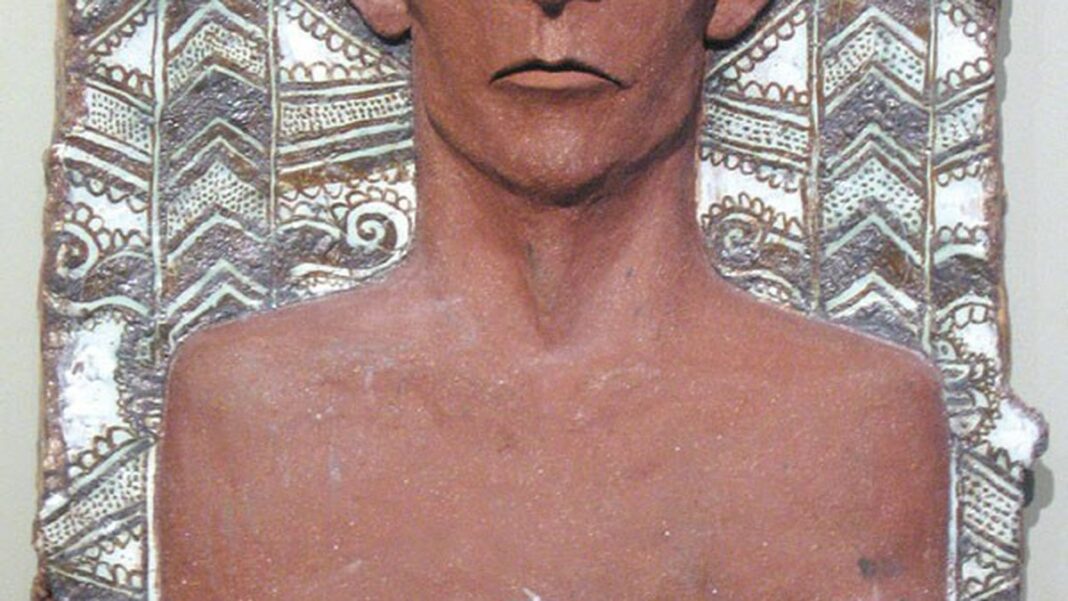
magic, mystery, and metaphysics. The figures he made previously —
lugubrious androgynes, bald and depilated, with wide eyes, large ears,
and tiny mouths that suggest the feline — could, with their pale
complexions and impoverished physiques, be interpreted as people who
spent too much time indoors. For this show, Olam Haba,
“the world to come” in Hebrew, Weisberg transforms his cast of
characters into monks or saints inhabiting bust-length plaques or slabs
simulating stained, mottled, cracked, and eroded marble, porcelain,
bronze, and stone. They’re determinedly archaic: the hairless closed
eyes, like soft, smooth oyster shells, denote introspection and
ecstasy, suggesting Madonnas, buddhas, and enraptured saints, and
classical/medieval elements like rosettes, columns, and arches fill the
backgrounds. With its arrays of busts facing each other, the gallery
become temple/crypt/catacomb exudes an elegiac atmosphere that is only
slightly relieved by occasional flashes of anachronistic humor (big
feet, hoodies in “May the Stars Welcome Without Judgment”).
Despite the humor, though, Weisberg’s intent is serious. The figures
are “emotional and psychological self-portraits” that perform a ritual
farewell to his late mother. “While still philosophically closer to a
secular point of view, for my mother’s sake, I want to believe in an
afterlife. In traditional Jewish thought, the voyage of the soul is
dependent upon the actions of the … living … Making this work
became a ritual to continue the existence of my mother or at least a
spiritual existence. The [physicalized] actions … bless, help, and
accompany the deceased on its journey.” Through March 28 at Rowan
Morrison Gallery (330 40th St., Oakland). RowanMorrison.com or 510-384-5344.