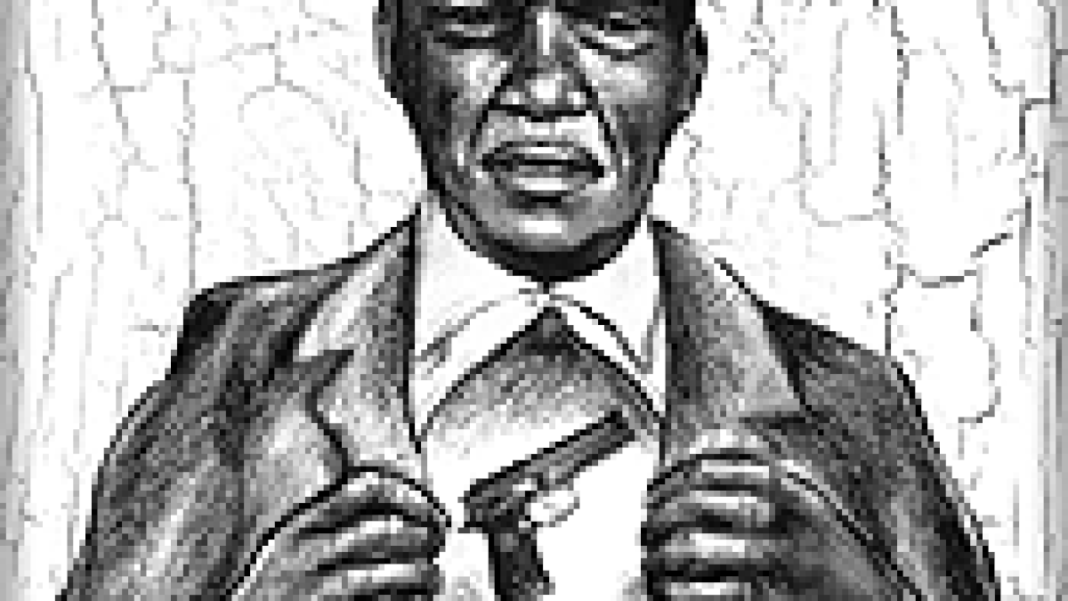
James Robinson built himself the second-prettiest house on the block, and that just about sums up the first 64 years of his life. He didn’t write the Great American Novel or cure polio, but he raised five kids, worked as an Oakland electrician and a San Francisco cop, and lived with the same woman for 45 years. As an old country boy from Louisiana, he couldn’t stay away from the land, and bought himself a small farm in Solano County, where he spent thirty years raising cattle, turkeys, and chickens. His youngest son put the roof on the house, learning as he worked.
Five seconds during the morning of December 7, 1995, destroyed everything he had. “I was inside in my bedroom and my wife asked me, she says, ‘Look out your window,'” Robinson recalls. “I looked out the window and said, ‘I don’t see nothin’.’ She said, ‘Look out the window again.’ I said, ‘I don’t see nothin’.’ She said, ‘Where are your chickens?’ ’cause every time you look out my house, you’re gonna see some chickens. And there was no sound, no rooster crowin’, there was nothing going on.”
A dog had snuck into Robinson’s yard and was going to work on his birds. Robinson grabbed his shotgun and strode out into the yard, past feathers littering the grass and a flock of terrified chickens perched among the branches of his trees. When he saw the first dog with a chicken writhing in its maw, Robinson took aim and fired, but his shotgun was loaded with birdshot, and the dog raced off, trailing blood. “He took off into the back field, and I took off after him,” he says. “And lo and behold, here was a black dog ripping the back out of one of my turkeys. And I shot him, and he took off too. I went and found the brown dog, and I killed him. Then I went to finish off the black dog, ’cause you don’t leave an animal hurt like that.”
As Robinson rooted through the bushes along the road, one of his neighbors ran toward him and shouted that he didn’t have to kill her dogs. The two exchanged a few salty words, and Robinson went back to his house. Leaning his shotgun against the wall, he told his wife what had just happened. “I said, ‘Maybe we should call the sheriff and let ’em know that I just dusted this dog, so we make an end of it,'” he says. “Right about this time, I hear sirens, it sounds like every siren in the county was coming. The neighbor called the police and said there’s a black man out in the street with a gun. When I looked out the window, I saw sheriffs, police, security guards — everything you can think of. So I said I guess I better tell ’em what happened.”
Robinson never got that chance. As he walked up to the nearest car, a Solano county sheriff’s deputy pointed his gun at Robinson’s head and ordered him not to move. In that instant, Robinson says, he believed he was going to die. “That’s when I saw my death,” he says. “That’s right, I saw me die. And there was nothing I could do. I turned to the left, because I didn’t want him to shoot me in the face. And then he came up behind me, and I felt them put their hands on me. And then I felt relieved; I figured the fool wasn’t gonna kill me with my back to him.”
While Robinson sat, cuffed, in the back of a patrol car, the deputies checked out his story with his wife, determined that no one had committed any crimes, confiscated his shotgun, and let him go. According to Terence Cassidy, the attorney representing Solano County in Robinson’s subsequent lawsuit, the cops were simply following procedure, given what they knew at the time. “From the officers’ perspective, there’s a report from dispatch that there’s a hysterical woman who claims that there’s a man with a shotgun outside her house, who’s shot her dog and is not leaving,” he says. “To any reasonable officer, that would send up red flags, to approach with caution.”
As stories of police violence go, this one is fairly mild. No one got shot or beaten, and everyone walked away after twenty minutes. But those five seconds stuck with Robinson for the rest of his life. Media accounts and movies have exposed us to endless loops of acrobatic ultraviolence, inuring us to the visceral reality of a single man’s fear and adrenaline. We have all watched countless depictions of operatic death, but almost none of us has ever experienced that gotta-shit instant when the barrel is right in your face. But as Robinson’s story illustrates, the psyche is a lot more fragile than we care to remember, and even one brief encounter with mortality can reverberate long after the headlines fade.
Robinson learned that lesson the hard way. He’s in his early seventies now, a man with a country honesty and easy vulnerability to him. He swears a little, in a gravelly, sad voice, but not too much, and mostly when he gets started about the joke fate played on him. He was never given to self-reflection, and didn’t truck with psychobabble about post-traumatic stress disorder. But over the years, he has learned to properly mourn the life he lost, even as he leavens it with a little gallows humor.
At the time, one of his electrician customers was a psychotherapist, and she noticed his sullen demeanor. When she found out what had happened, she got him some professional help. “She said, ‘James, you need to talk to someone right away,'” he recalls. “I said what for? ‘Cause I didn’t hold psychotherapy in much regard. So I called Kaiser, and I came in and talked to a therapist. Just talking to him just calmed me down, it really did. Just blowing off steam. He said, ‘I want you to talk about this every chance you get.’ I said, ‘Man, as mad as I am about this shit?’ He said, ‘You do that. That’s what gonna help you. ‘”
The dreams started a few weeks later. “I had a nightmare, a terrible nightmare,” he says. “Man, it scared the hell out of me. And then I had another, and another and another. All of them, every one of them, involved a grisly murder. A stabbing. Dogs tearing me apart, getting thrown off a train. Always me dying. And I would cry out a death scream. And it scared the hell out my wife. It got so bad that I wouldn’t let myself go to sleep; I would try to keep myself up till I was so tired I wouldn’t dream.”
Robinson’s night terrors bolted his wife Mildred out of bed over and over. Her blood pressure began to rise, and she worried that he might hurt her, especially once he started throwing punches in his sleep. At first, she disconnected their twin beds and moved her side across the room. But his screams kept wearing at her, and she eventually decided to sleep in the guest room. That, she says, was the beginning of the end of their 45-year marriage. “Yeah, we had problems, but what marriage doesn’t?” she says. “But if you’re still in the same bedroom, even if you had a fight, you can still talk things over. But then we didn’t have a bedroom together anymore.”
Robinson hired an attorney and sued Solano County — mostly, he claims, to force them to acknowledge the wrong they did to him. But as he obsessed on the case, his life with Mildred was coming to an end. Snipe by snipe, over the course of so many silent evenings, their marriage withered away. “I am the plain person of the family,” she says. “I’m the religious person. And I remember going over to his side of the bed and telling him I was going to pray that he would get over this. Then later, when we had a fight, he’d say, ‘You see, your prayer didn’t work.’ Which I didn’t appreciate. … And when you have a fight, I’ll say, ‘Now I’m not gonna get to sleep tonight.’ Which wasn’t a nice thing to say. I’m trying to be a loving, caring wife. But this thing, it’s taking me down.”
Mildred and James divorced in 1999. They had to sell the house and the farm and move back to the East Bay; Mildred lives in Hayward, with a dog she named Happy to help her see the good things the Lord has given her. James lives in Oakland, nursing a bum heart and taking care of his ailing father. The nightmares still plague him. Although Mildred doesn’t regret ending their marriage, she remembers her ex-husband as a man of honor, and sometimes wishes she had had the strength to see it through. “So that’s my life now,” she says. “But yes, we were thinking we’d be in Fairfield for the rest of our lives. When we built that house, we built it all on one level, ’cause we joked to each other, ‘I don’t wanna have to carry you up the stairs when you’re older.’… He was there for the boys; he made the boys into men. So they are better men today, because of their daddy. So I have to give him credit for that. He made my boys stronger men. And I made them Christian men. I gave them a sense of God in their lives, and I see it nowadays.”
After a long and circuitous adventure, Robinson’s case may finally come to court this September. The judge in the initial trial threw out the claims he filed, but his new lawyer, Oakland attorney Bill Simpich, appealed the judgment all the way to the Ninth Circuit Court of Appeals. The court reinstated the claims and further established that when the Solano County deputies pointed their guns at Robinson, they violated his constitutional rights. In such dramas is policy made: Federal case law now prohibits officers from pointing guns at someone simply because they received a report that the man had a gun and was acting out in public. For Robinson, the ruling was a triumph of sorts. “In a society that calls itself civilized, what in the world is the protocol for pulling a gun on someone?” Simpich says. “These Solano County cops were dead wrong. We’re not asking for a complicated formula, we’re just saying you gotta have a good reason. … He feels vindicated by the Ninth Circuit court decision. He knows he made some good law for other people.”
Still there’s no looking past the shambles that Robinson’s life has become. The deputies may not have committed some terrible crime — in fact, who could even say they wouldn’t have done exactly the same thing in their place? And the marriage obviously had its problems to begin with. Perhaps Robinson’s life was ready to crumble — maybe his darker memories as a cop were unearthed by what happened that day. We’ll never know what in his 64 years of living and memory collided with those five seconds, but that brief interval set in motion the unraveling of Robinson’s world.
“Of course I miss her,” he says of his wife. “We slept in the same bed for 45 years; that’s gotta speak for something. So when that fell apart, I lost a lot, man. I lost a lot. I had a beautiful house and a beautiful wife. Now I live in a basement. That’s what they did to me. I lost everything when he pointed that gun at my head.”
Someone else now lives in the second-prettiest house on the block. They probably have no clue how they came to own it.