
After its military incursion into Venezuela, the Trump administration called American oil company executives to the White House. The administration demanded these companies invest billions to extract Venezuelan “dirty” oil—defined as extra-heavy, highly acidic crude, comparable to Canada’s oil sands.
The companies punted—with one major exception. Chevron has already operated in Venezuela for more than 100 years. “After the meeting,” AP reported, “Energy Secretary Chris Wright told reporters that the companies showed ‘tremendous interest,’ adding that Chevron made a specific pledge.”
There is another connection. On Jan. 15, MS NOW reported that John Hess, a Chevron board of directors member, and his wife, Susan Hess, “each contributed $1 million to MAGA Inc. on Dec. 12, 2025, just weeks before the U.S. took military action to capture Venezuelan President Nicolás Maduro.”
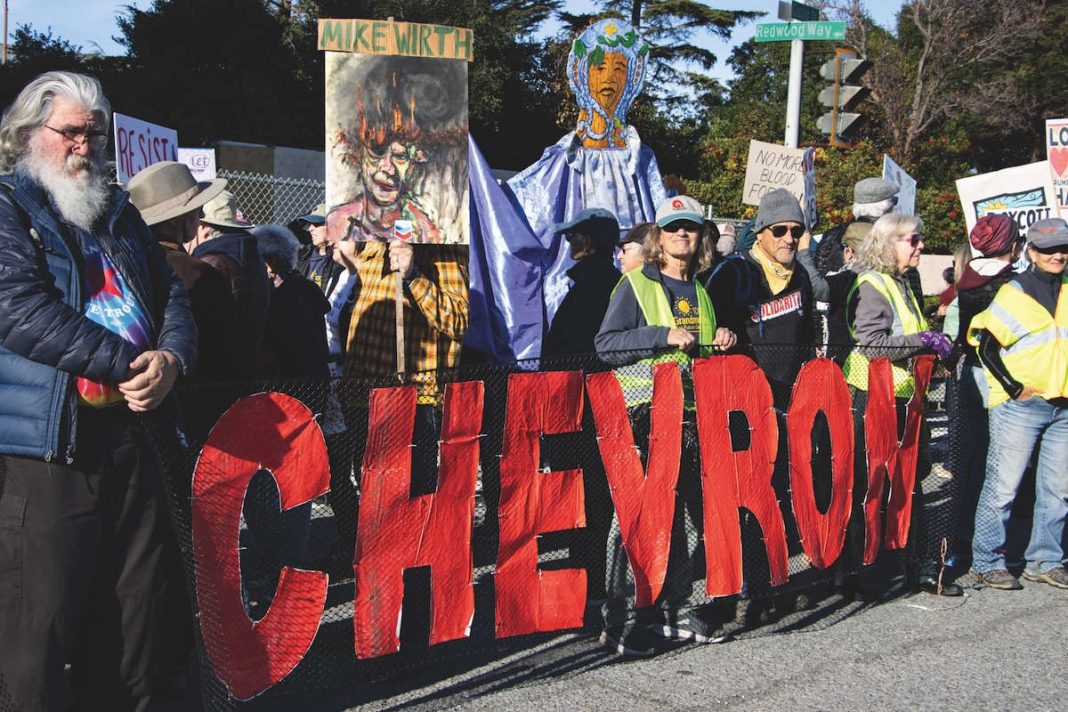
Local environmental organizations took note. On Jan. 10, Amazon Watch, Oil & Gas Action Network, Asian Pacific Environmental Network and others staged a protest at Chevron’s Richmond refinery.
“With its Texaco subsidiary, Chevron has been established in the Amazon since the 1960s,” said Paul Paz y Miño, deputy director of Oakland’s Amazon Watch. But, he emphasized, not only the Amazon is being affected. The company’s unchecked pollution, flouting of local laws, history of profiting from illegal activities and concurrent history of attacking those who confront it, has been widely reported.
Which is why, he said, it isn’t surprising that Chevron would be a main player in further South American exploitation, as its CEO has a close relationship with Trump.
Ilonka Zlatar, California organizer at Oil & Gas Action Network, said a rapid response to the situation in Venezuela organized the Jan. 10 protest. She noted the long history of protests at the Richmond refinery, and that it ties to the larger BoycottChevron campaign. She believes the environmental organizations will attend the March 28 third “No Kings” national event.
Paz y Miño stressed California will send a delegation to the upcoming International Conference on Just Transition Away from Fossil Fuels, cohosted by Columbia and the Netherlands and taking place in April. “[The conference] will focus on drilling in South America,” he said. He also expects a big turnout during the May 22 International Anti-Chevron Day, being held at RYSE Youth Center in Richmond.
California’s legislature, he added, will be moving forward with implementation of SR51, passed last August, which calls for a full investigation into the state’s ties to crude oil extracted from the Amazon rainforest and urging an end to these imports.
Both Paz y Miño and Zlatar advocated for additional citizen involvement on these issues. “Refineries in California are shutting down,” Zlatar said. “But there is no consistent plan for a just transition away from fossil fuels. If people live in the East Bay, they need to learn how the local refineries are impacting their health.”
Paz y Miño noted that Chevron is well known for its “greenwashing” efforts, meaning claiming environmental actions that mask what damage the company does in multiple places around the world. “The Venezuela situation puts Chevron even more in the spotlight,” he said, suggesting people educate themselves about the real situations.
He also drew attention to the actions of the Richmond Police Department during the Jan. 10 protest. For the first time in the history of these protests, the RPD closed off Castro Street, where the entrance to the refinery is located, eliminating close-range parking and likely causing many potential attendees to forgo attending the rally. The organizers have contacted the Richmond City Council to address this, he said.
Those committed to fighting climate change, opposing illegal military actions and supporting Indigenous peoples’ efforts to protect their lands—and also local populations’ rights to clean air, water and land—can join the multiple nonprofits dedicated to those issues and watch for additional actions taking place this year, said Zlatar and Paz y Miño.









To understand the sleaze-side of Chevron, see http://www.truecostofchevron.com.