
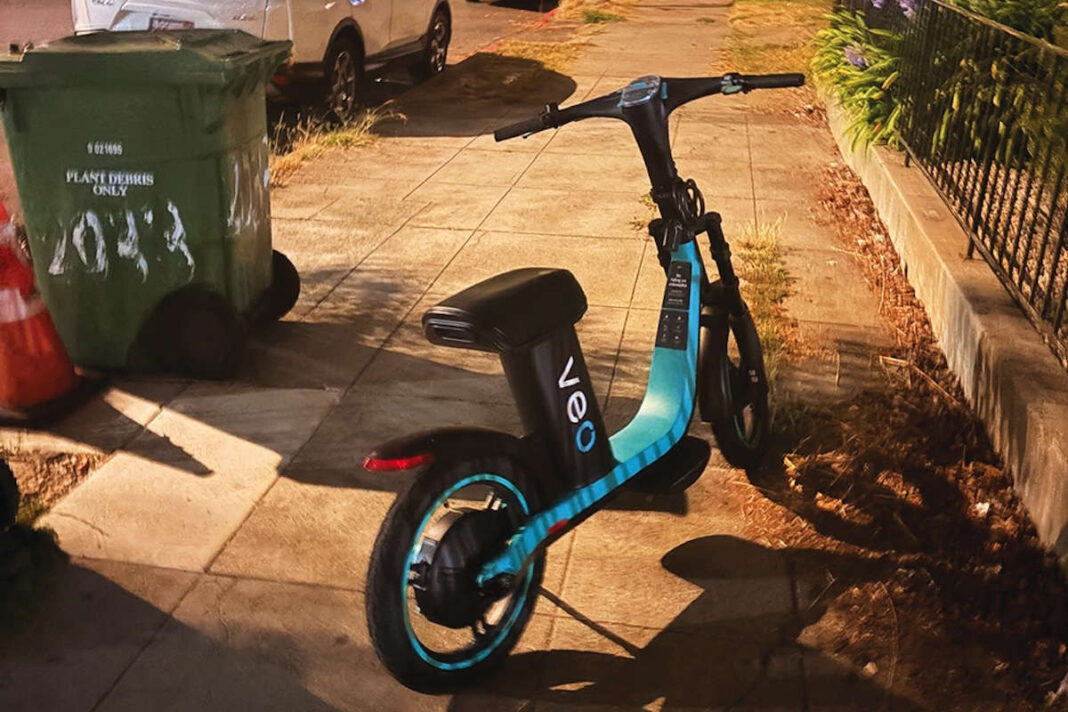
Electric scooters: Once one notices them, they’re hard to miss. In many neighborhoods around Berkeley it’s common to encounter two, and sometimes even three, wheeled scooters directly in the middle of a sidewalk.
A mild hindrance for some can be a harsh injury for others, leading advocates and members of disabled communities in the city to seek change. On Aug. 14, a Zoom meeting was held for community members to voice their concerns and suggest solutions to the problem of e-scooters infringing on the daily lives of blind and otherwise disabled Berkeley residents. It was attended by organizations such as Streets of Equality and the East Bay Center of the Blind, and Jeff Hoover, a government affairs and mobility and transportation policy representative from the rental scooter company, Veo.
Other notable attendees included Rena Fischer of the Berkeley Commission on Disability; ADA program coordinator for the City of Berkeley, Thomas Gregory; and Judy Wilkinson, former state president for the California Council of the Blind.
Streets of Equality is a project born of disability advocacy for safer street and sidewalk conditions that works with the East Bay Center of the Blind under the larger umbrella of Berkeleans for Accessible Rights-of-Way.
Erik Knaresboro, founder of Streets of Equality, is legally blind and has had many personal encounters with scooters. When he doesn’t bring his guide dog out, there’s a constant possibility he will run into one, hurting his ribs or even falling over from tripping on those that aren’t left upright.
“Shared scooters account for a lot of my injuries,” he said.
Knaresboro feels the scooters have become a larger issue in the last two to three years, with an increasing number of blind people he knows becoming hindered. He acknowledges that micromobility might be a thing of the future, but says it should be implemented in a way that takes everyone’s safety into account.
The micromobility movement is a shift towards small vehicles, such as electric bicycles and scooters, in urban areas. These reduce traffic, mitigate carbon emissions and can be convenient for students and people who use public transport. However, it comes at a cost.
“They all add up to making our journey just that much more cluttered and difficult,” said Mike Cole, director of the East Bay Center of the Blind.
In many cities across the world, rentable e-scooters have been outright banned due to the injuries and even fatalities that they’ve caused in both standstill injuries and speed-related incidents. Paris banned them in 2023, followed by Melbourne and Madrid a year later due to public concerns about footpath safety and failure of rental companies to meet strict safety and parking criteria. Some areas of New York allow them, but they’re not licensed in Manhattan, the most densely populated borough.
A 2026 study in the National Library of Medicine titled “The Fast and the Fragile: Neurosurgical Trauma in the Age of Micromobility,” found that pedestrians experienced the most severe injuries in micromobility-related accidents. They also found that annual case volume and electric device involvement increased over time.
Cole himself is blind, but noted that some members who have partial vision have seen scooters on wheelchair ramps that often stay there for more than 24 hours. The scooter company does include instructions for reporting a stray bike and the City of Berkeley, in partnership with the Public Works Department, has designated appropriate parking zones. Many say this is not enough.
At Friday’s meeting, Hoover explained the process of reporting a scooter, including taking photos of it and scanning a QR code, to which many in attendance laughed due to the sight-related barriers that these protocols come with.
“Some things got said that were important,” Cole said. “I think that the scooter company guy did his best to tell us about the product and their efforts to make it safe. Obviously, they’re not. This is all a work in progress.”
Some advocates aren’t personally affected, but are passionate about the issue just the same. A group of concerned neighbors started an Instagram account called @berkeley_scooterland that advocates for e-scooters to be locked to bike racks and put in designated parking areas. Most of its posts, of which there are nearly 800, consist of photos that neighbors have taken around Berkeley of scooters blocking pedestrian walkways.
Shirley Kirsten is a piano teacher who’s nearly 80 years old and belongs to Save Hopkins Street, an organization that advocates for a common sense design for Hopkins Street in Berkeley. She’s deeply involved in pedestrian safety and accessibility, and routinely worries about fellow seniors running into scooters.
“Fortunately, I have enough vision that I can go around them,” Kirsten said. “But I see how other people are impacted.”