

In the wake of a presidential election that’s being called America’s
most important ever, holiday book-shopping just got easier. That’s
because it was also America’s most divisive election, hacksawing this
country in half. So now some folks on your gift list are ecstatic.
Others envision an apocalypse. Some are shouting from the rooftops.
Others want to jump off the roof. Brand-new books, carefully chosen,
can inspire (or at least distract) them all.
Right now, millions are wondering how — or even whether
— they’ll survive the next four (or more!) years. They’d
welcome a copy of Chris McNab’s Special Forces Survival Guide:
Wilderness Survival Skills from the World’s Most Elite Military
Units, which includes instructions on ground-to-air signals and on
using icebergs as a water source.


Cultivate compassion. The season of giving is no time to gloat.
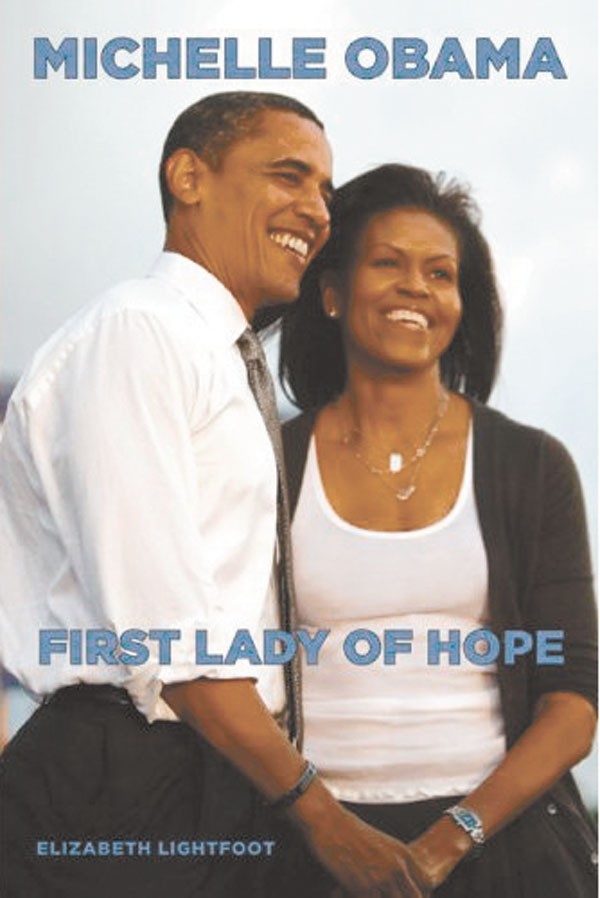
Think twice about who should get Elizabeth Lightfoot’s Michelle
Obama: First Lady of Hope.
And consider what you would want if, thanks to a few thousand
votes, you suddenly needed high-quality distraction, enough to last
four years or more. You’d want soothing books, instructive books, and
books to keep you busy. Heck, you’d want Tim Birkhead’s massive
illustrated history of ornithology, The Wisdom of Birds. You’d
want Emily Farris’ Casserole Crazy; its recipes include pigeon
pot pie, lamb cobbler, and chicken-noodle “souperole.” You’d want UC
Press’ exhaustive The Encyclopedia of Earth. You’d want The
Gourmet Garden, in which Virginia Hayes demonstrates how to fill
fuchsias with jam (for cute breakfast trays) and snare slugs with beer.
You’d want Stephen Cope’s The Wisdom of Yoga. You’d want to
spend weeks sewing and stuffing felt elephants and ice-cream sandwiches
with Therese Laskey’s adorable toymaking manual, Softies: Simple
Instructions for 25 Plush Pals. You’d want to take virtual
vacations with Richard Cavendish’s huge 1001 Historic Sites You Must
See Before You Die — if only its title didn’t seem so
frickin’ prophetic.
If you’d backed a failed candidate who lacked charisma, you’d want a
crash course right now to understand what went wrong. You’d want
Clinton Kelly’s Freakin’ Fabulous: How to Dress, Speak, Behave, Eat,
Drink, Entertain, Decorate, and Generally Be Better Than Anyone
Else. Dress up for dental visits, Kelly urges, and don’t kiss in
restaurants.
If political antagonists had spent all year mischaracterizing you as
a member of the Christian Right, you’d want to prove them wrong by
reading Brenda Shoshanna’s Jewish Dharma: A Guide to the Practice of
Judaism and Zen or Sandra Kynes’ Sea Magic, packed with
spells and divinations involving limpets, manatees, and the Assyrian
sea god Ungal-a-abba.
Or say those haters had called you a hawk. You’d want Dexter
Filkins’ The Forever War, whose tearingly tender true anecdotes
convey horror and humanity in Iraq. Say they’d called you a hick. You’d
want Thomas Hobbes’ newly reissued Leviathan: Or the Matter, Forme,
and Power of a Commonwealth Ecclesiasticall and Civil. Say they’d
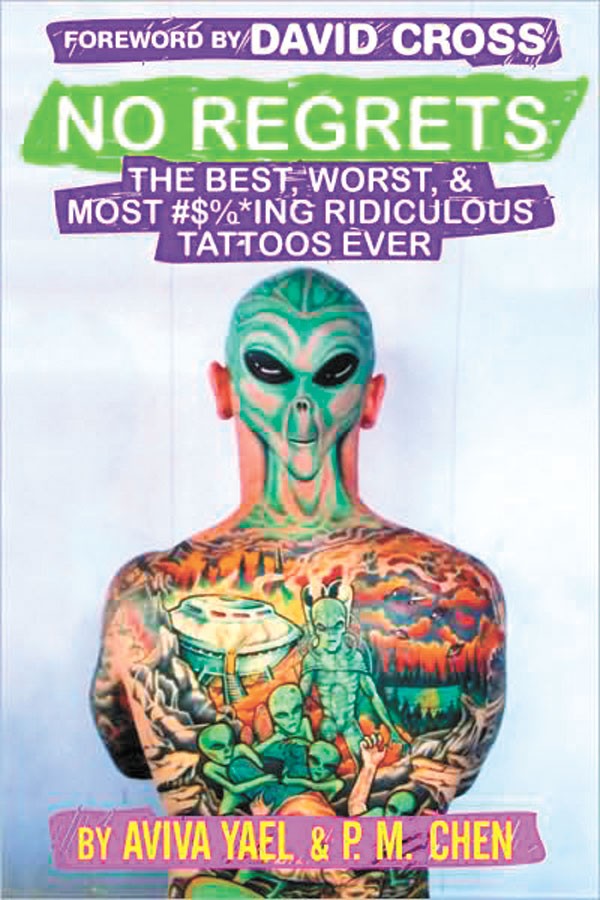
assessed you as repressed. You’d want Aviva Yael and P.M. Chen’s No
Regrets: The Best, Worst, and Most #$%*ing Ridiculous Tattoos Ever.
Among its hundred-plus examples, photographed in color, is a bloody
(and burning) tampon tattooed onto an arm, Dr. Phil’s face tattooed
onto a buttock, and a tattoo in which one leering thorn-crowned Jesus
Christ anally penetrates another, who is wearing a ball gag.
And say — just say — they’d said you weren’t a good
global citizen. Well, mierda and pihua to that. You’d
want 2008’s most gripping international fiction, such as Smile as
They Bow, Nu Nu Yi’s novel about a Burmese tranny spirit medium;
Breath, Tim Winton’s heartstoppingly beautiful Australian-surfer
coming-of-ager; The Swap, Antony Moore’s savagely funny take on
British comic-book collectors; and The Pets, Bragi
Ólafsson’s eerie Icelandic tale of trying to escape a deranged
ex-friend. (Ólaffson was the bassist in Björk’s old band,
the Sugarcubes.) Nail-biting new international thrillers include
Guillermo Martínez’s The Book of Murder (drowning and
vengeance in Argentina), Tana French’s The Likeness
(impersonation and arson in Ireland), and a spate from Sweden,
including Asa Larsson’s The Black Path (electrocution and
blindfolds) and Ake Edwardson’s Frozen Tracks (abduction and
branding irons).
But hey. Many on your gift list voted for the guy who won. What
sweeter souvenir for them than Michael Moore’s Mike’s Election Guide
2008? After eight years of angst and/or activism, these folks are
regaining their energy, feeling that anything’s possible. Feed their
hope for change with Peter Walsh’s Does This Clutter Make My Butt
Look Fat?, in which the TV/radio host shows how to streamline rooms
and rumps. Prep their pep with Johan Tell’s 100 Ways to Save
the World. Tell’s ways include recycling batteries, rowing boats,
and “demanding better train connections.” Pal around with William
Ayers’ memoir Fugitive Days, poignantly reissued on November 5.
In his new afterword, the bomber-turned-professor calls our
president-elect a “famly friend.” Congratulate the electorate with
State by State: A Panoramic Portrait of America; along with
stats on military enlistment and suicide, its fifty chapters are by
fifty writers: Ha Jin on Georgia; Alison Bechdel on Vermont, Mohammed
Naseehu Ali on Michigan, et al.
Some books, albeit fewer and fewer, still spread joy on both sides
of the electrified, blood-splattered razor-wire fence. Augmenting 180
dazzling, dizzying photographs with essays by fellow climbers, Galen
Rowell: A Retrospective memorializes a Berkeley genius gone too
soon. Art and memories merge again in Annie Leibovitz at Work
— and again in Posters for the People: Art of the WPA,
edited by Ennis Carter. (“Don’t Gamble With Syphilis,” warns one of
these 500 bold, beautiful, purposeful posters. “Sew for Victory,”
orders another.) The Japanese version of Batman comics that debuted in
1966 are kitschy-cool in coffee-table-big Bat-Manga! The Secret
History of Batman in Japan, edited by Chip Kidd and translated by
Anne Ishii.
Eating isn’t very political — yet. So
consider Frederick Kaufman’s amusing, informative A Short History of
the American Stomach. To wit: Witch-hunting minister Cotton Mather
had a “passion for cathartics,” and “the Puritans, perhaps necessarily,
adored laxatives.” To research America Eats!, Pat Willard toured
the country seeking Depression-era staples such as trotters and
shoo-fly pie. Molecular gastronomist Hervé This and chef Pierre
Gagnaire theorize revolutionarily about culinary aesthetics in
Cooking: The Quintessential Art, applying science and math to
tarragon-flavored marshmallows and assessing such creations as
button-mushroom sponge cake, which “is not meant to shock; on the
contrary, it’s almost an obligatory exercise from the point of view of
flavor.” Naturellement.
After such an exhausting year, who wouldn’t love a laugh? But few
jokes are generic anymore. In a cloven America, humor is defined by
whom it horrifies. Condoleezza Rice is an army-uniformed dominatrix,
American soldiers kill civilians, and white kids are racists in The
Best American Comics 2008; its dozens of contributors include Chris
Ware, Lynda Barry, and the East Bay’s own Gene Yang. Steve Lowe and
Alan McArthur’s Is It Just Me Or Is Everything Shit? is
refreshingly inclusive in a divisive age, savaging abstinence programs,
Bono, and Che Guevara T-shirts in an uproarious
anti-modern-culture A to Z.
Did someone say Che? Speaking of radicals who facilitated hundreds
of executions, Young Che was penned adoringly in the ’80s by the
dude’s dad, Ernesto Guevara Lynch. (Regarding his baby daughter, Che
wrote in a 1956 letter home: “My Communist soul swells with pride as
she is identical to Mao Tse-Tung.”) Biographies and memoirs are great
gifts, provided you know who admires whom or what. New ones include
Alan Parker’s Sid Vicious, Stephen Weissman’s Chaplin,
Andrew Lycett’s The Man Who Created Sherlock Holmes, and
Isadora Duncan, by cartoonist Sabrina Jones. (Sample lines:
“Isadora danced the struggles of the oppressed” and “Please call me
Comrade Duncan.”) Gus Van Sant wrote the introduction to Dustin Lance
Black’s Milk: The Shooting Script. In The House at Sugar
Beach, Helene Cooper remembers the violent coup d’etat that ended
her childhood in a massive Liberian mansion. In The Elfish Gene,
Mark Barrowcliffe espouses his exploits as a fantasy-role-playing geek.
In Family Outing, Troy Johnson recounts what happened after he
learned at age ten that his mom was a lesbian.
Someday, after the dust settles, we can be friends again. We’ll
hunker down around fires and read Kenneth Grahame’s newly reissued
The Wind in the Willows or the new version of L. Frank Baum’s
The Wizard of Oz that Graham Rawle illlustrated with photographs
of huge-headed plastic dolls. We’ll sing in unison the classic songs
immortalized in Amanda Petrusich’s It Still Moves and Graeme
Thomson’s I Shot a Man in Reno. Will those blazes be the bonny
bonfires of a better age — or our nuked cities going up in
flames? Depends on whom you ask. Now pass the nog.