
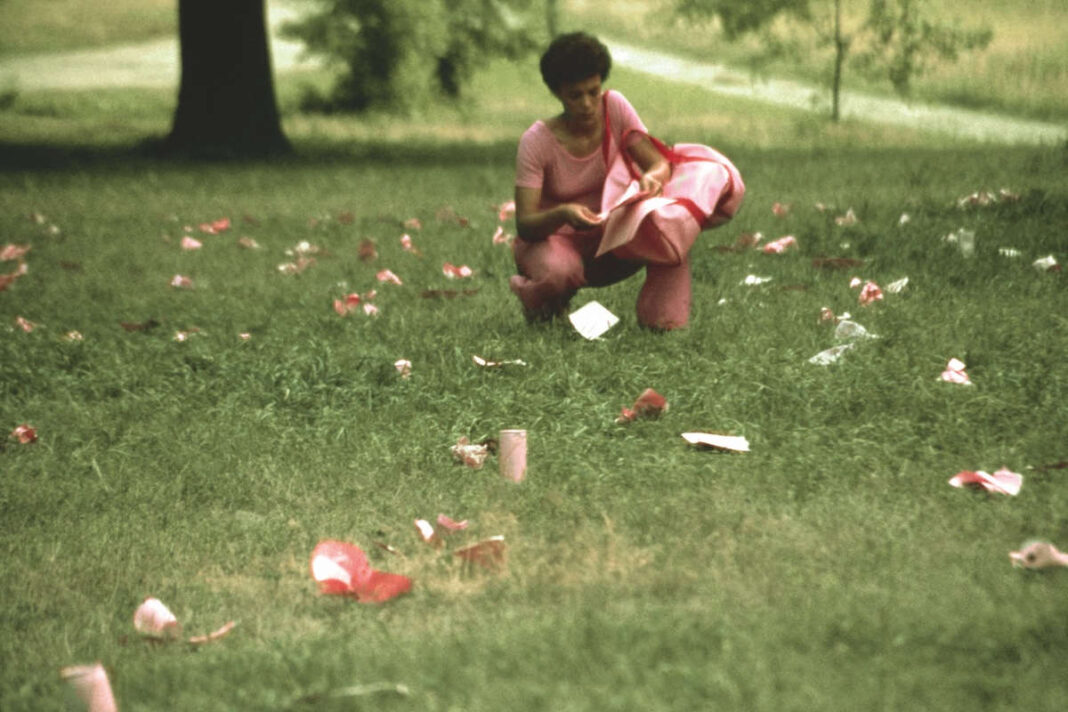
Watch for a scramble in September, when Cal undergraduates will line up to help scatter—and then reclaim—trash. As part of the ongoing retrospective at the Berkeley Art Museum and Pacific Film Archive (BAMPFA), “Maren Hassinger: Living Moving Growing,” the sculptor/performance artist/teacher will restage one of her most famous performances, Pink Trash, for only the third time since 1982.
The students will toss the litter onto UC Berkeley’s Crescent Lawn, then gather it up and repaint it pink. This is a statement, said BAMPFA materials, of “a powerful metaphor for humanity’s obligation to care for the natural world.”
Pink Trash is only one example of performance art pieces that will be recreated for the exhibition. Hassinger, now 79, is widely considered one of the most influential artists of her generation. The retrospective, which opened June 6 at BAMPFA, examines 50 years of her work, including large-scale sculpture, site-specific installation, video and performance. “Carefully choosing materials for their innate characteristics, Hassinger has explored the subjects of movement, family, love, nature, environment, consumerism, identity, and race,” BAMPFA materials note.
Another interactive opportunity will take place on the exhibition’s opening day. Visitors can join Hassinger to help create pieces that will be used in a new, large-scale installation, Wrenching News. Participants will twist and knot newspapers, which will then be assembled at BAMPFA in a public workshop led by the artist. A series of workshops during the exhibition will continue to add to the piece.
Senior curator Andrew Graham described the inspiration for “Living Moving Growing” as “kismet.” When he and chief curator Margot Norton both came to BAMPFA more than three years ago, they discovered Hassinger was an artist they jointly admired. “We jumped at the chance to work on this exhibition together,” he said. They visited Hassinger in New York, saw a show at her gallery there, and made the connection with her. “Collaboration is the crux of how she operates,” Graham noted.
From the beginning, the co-curators aimed to bring together many diverse works to the exhibition. The major sculptures yes, but, said Graham, “some of the lesser-known aspects of her practice.” The show features, for example, archival photos of her performance art work, including previously unseen photos of the artist early in her career taken by Adam Avila, an early collaborator of Hassinger’s. The black-and-white images, which will also be included in the exhibition catalog, serve as important documentation of early works by the artist that no longer exist.
As the most ambitious retrospective to date of the artist’s body of work, according to BAMPFA, “Living Moving Growing” includes recreations of temporary installations, such as Love (2008), a site-specific sculpture composed of pink plastic bags inflated by human breath and filled with love notes; Beach (1980), a floor installation of plaster and wooden dowels; and multiple sculptures that incorporate recently harvested tree branches, which the museum will realize in partnership with the University of California Botanical Garden.
Hassinger, said Graham, is part of a generation of artists, but her work demonstrates what he calls a “unique sensibility… committed to bringing people together.” She emerged alongside a community of artists working together in the ’70s as Studio Z, including Senga Nengudi, Ulysses Jenkins and David Hammons. In turn, Hassinger has been a direct influence on contemporary artists, such as CiCi Wu, Graham said.
Graham also highlighted the importance of honoring the Earth in Hassinger’s work. “The loss of nature was a defining vision of her generation,” he said. “[She believes] we have to take care of the Earth and of each other.”
Berkeley-based artist Julia Goodman will lead the monthly workshops that continue building “Wrenching News.” This is an ideal match, by Goodman’s own assessment. “I have worked with repurposed materials for over 20 years,” she said in a phone interview. Her An Unimaginable Unit of Time, for example, was created during the pandemic by tearing synthetic bedsheets and creating a rope. “It was my way of marking time,” she said. It also provided a release from the ongoing stress of a highly uncertain time.
The idea for her to lead the rest of the workshops came up in 2025, and she immediately said, “Yes.” She has now met Hassinger and formed a connection. She will shadow Hassinger in the first workshop. At subsequent ones, which will take place on an alternate Saturday and Sunday schedule, she will welcome participants of various ages. “I like intergenerational workshops,” she said.
Goodman spoke to the importance of tactile experiences in understanding much of Hassinger’s work. “It’s an opportunity to echo the handiwork of an artist,” she said. Asked if she has a favorite Hassinger work, she cited pieces using galvanized wire rope, such as Paradise Regained, in which thick wire strands evoke reeds bending in the wind. These pieces, she said, “shifted my take on the material…it changes the way I feel when I cross the [Bay Area] bridges.”
To celebrate the exhibition, BAMPFA is publishing a fully illustrated catalog on Hassinger. It will include an introductory essay by Graham and a roundtable discussion moderated by Norton with some of Hassinger’s collaborators, including Just Above Midtown gallery founder, filmmaker and activist Linda Goode Bryant, and artists Senga Nengudi and Ava Hassinger, Maren Hassinger’s daughter. A new interview with the artist is also included, along with additional essays.
“It’s so important to hear women artists in their lifetimes,” Goodman said. Both interviewees recommended multiple visits to “Living Moving Growing” during its exhibition to see how Wrenching News, for example, evolves, and to re-absorb the ties between the works.
“Her work is so moving,” Graham said. “You feel the dynamism.”
‘Maren Hassinger: Living Moving Growing,’ now through Nov. 29, BAMPFA, 2120 Oxford St., Berkeley. 510.642.0808. bampfa.org