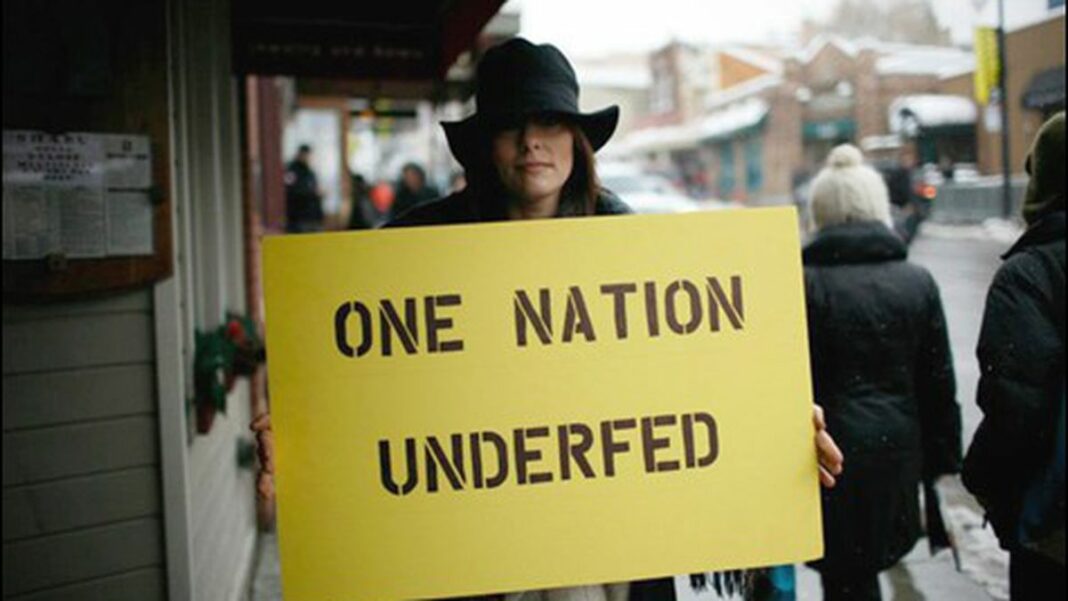
It’s one of our saddest little secrets. According to the
producers of A Place at the Table, 49
million Americans exist without enough to eat in a nation with more than enough
food.
The prevalent notion of a country of fatties waddling through
shopping malls with corn dogs and Pop-Tarts in their hands is deceptive. The
poorest Americans may not be stick-thin but they’re probably undernourished
just the same, overdoing it on cheap, empty calories — remember Food, Inc.;Fast Food Nation; Super Size
Me, etc. — while struggling with the accompanying health issues, like
diabetes. Kristi Jacobson and Lori Silverbush’s blistering “outrage
documentary” is angry, incisive, and unafraid to get down to root causes. The
roots of American hunger aren’t pretty, but they need to be talked about.

According to the producers, “food insecurity” is defined as the
condition of not knowing where your next meal is coming from. The US ranks
worst for FI on the IMF’s list of Advanced Countries. To drive home the point,
the filmmakers visit three low-income families. Rosie is a small-town Colorado
fifth grader, living with her single mom in her grandparents’ home, who says
she can’t concentrate at school because she’s hungry. Barbie, a Philadelphia
single mother looking for work and living on food stamps, has a son with
developmental problems from malnutrition. Mississippi second-grader Tremonica, surprisingly,
may be the lucky one of the film’s subjects — her community is involved with a
children’s health project that’s trying to bring fresh, affordable food to kids
in the state with the highest rates of both FI and obesity.
The celebrity volunteers (actor Jeff Bridges, chef
Tom Colicchio) and food activists (Mariana Chilton, et al.) in the film are not
shy about assigning blame for the situation. The USDA supports mega-farm
corporations and legislative agriculture committees kill all food reform, essentially
taking money away from people who can’t defend themselves. Author Raj Patel
notes that: “Welfare for the poor is scorned but welfare for corporations is
heartily endorsed.”
US Representative Jim McGovern (D-Mass.), co-chair of the
Congressional Hunger Center, tried to live on food stamps (average benefit: $3
per day) and discovered what many already knew — that processed foods are
cheap, and fresh fruits and vegetables are prohibitively expensive. Says author
Marion Nestle, that’s due to what we subsidize and what we don’t. A Pentagon
official, assessing the pool of potential military personnel, is
characteristically blunt in his analysis of the American diet: too much fat,
sugar, and sodium, and not enough fruits and veggies.
What’s to be done? Start by analyzing the money spent on
lobbying. Agri-business accounted for more than $121 million in political
“donations” in 2010, second only to the oil and gas industry. As always, follow
the money — or in this case the lack of. “The reason people are going hungry,”
declares Patel, author of Stuffed and
Starved and The Value of Nothing,
“is not a shortage of food, but poverty. Why are people poor?” A hard question for hard times. The “food deserts” in the US
— rural areas, inner cities, poor neighborhoods in general — are that way
because they cannot pay the price of a healthy diet. To earn a living wage is
all-important. So is teaching children about healthy food. So is applying
grassroots pressure on politicians. Also the work of NGOs
such as Bread for the World, Chilton’s Witness to Hunger, and ordinary food
banks. According to Bridges, “It’s about patriotism.” We need better
food to help our country.
The expressions on the faces of Rosie (hopeful but strained at a
young age) and her mother Trish, who works at a cafe for $60 a week, are
heartbreaking in the extreme. Wednesday evenings they join their neighbors for
free dinner at church. Meanwhile in Philly, Barbie finally lands a job, which
means that with the added income she no longer qualifies for subsidized
childcare or food stamps. So she’s back to the same spot. Down in Mississippi,
however, food organizer and cook Ree Harris is busy introducing vegetables to
enthusiastic school kids, who find they like the taste. On the music track,
T-Bone Burnett and the Civil Wars warble plaintively. And Rosie’s mom
enunciates the original American dream: “I want my kids to have a better life
than I do.” Food for thought.