Roger Lipsey in An Art of our Own: The Spiritual in Twentieth
Century Art describes our contemporary, postmodern, late-capitalist
mindset as one of “educated irony [and] cheerful laissez-faire.” That’s
way harsh, ignoring PoMo’s impressive technical/aesthetic ingenuity and
its sociopolitical bona fides, but the art of the past half-century
(which includes half of modernism) has generally disclaimed the utopian
spiritual aspirations that inspired modernism’s founding fathers,
Kandinsky, Kupka, Malevich, Mondrian, Marc, and Delaunay (“The goal of
painting is to represent the Universe”). Postwar formalist art embraced
symbolic flatness as eagerly as it banished perspective, space,
narrative, and illusion; the realm of the sacred, mysterious, and
metaphysical that preoccupied artists for millennia was declared an
aesthetic dead zone.
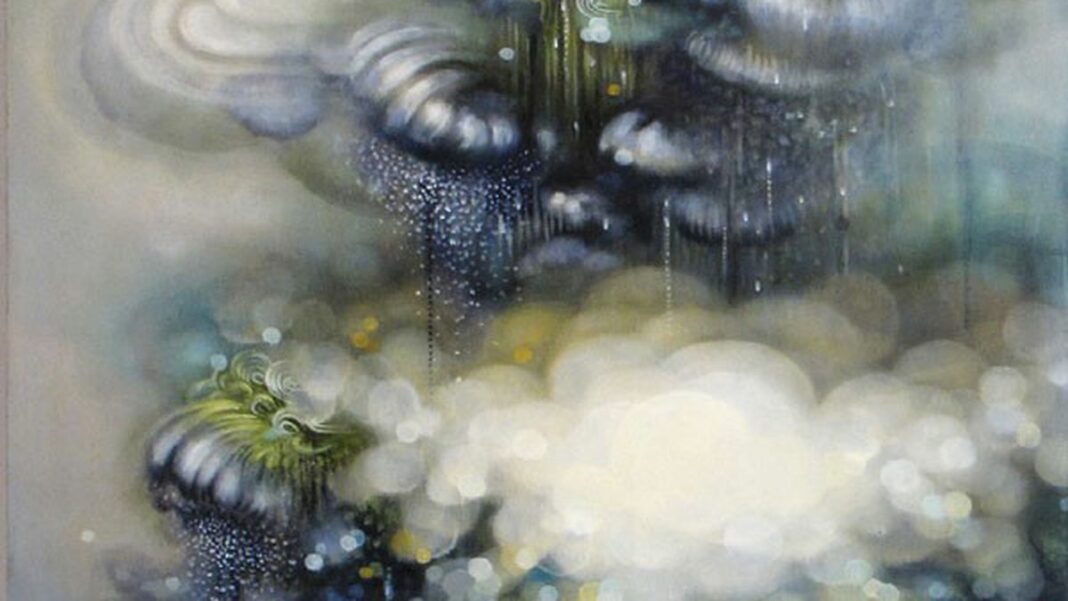
Nature’s creativity, rather than dead zones, is the subject of
Jenn Shifflet‘s paintings, marine fantasies that seem to derive
from the biomorphic surrealists (Tanguy, Arp, Ernst) and related
myth-minded souls (Baziotes, Rothko, Graves). These small- to
medium-size oils on panel provide intimate views into watery realms,
traditionally symbolizing the unconscious, where hidden life stirs in
curvilinear waves and currents; serpentine coils of smoke and cloud;
jewellike clusters of orbs either real (bubbles, eggs, pearls) or
optical (lens flares, reflections, afterimages); and linear strands of
protoplasm or ectoplasm. Shifflet’s works, which evolve through
multiple layers of glazing, balancing accident and intuition, inhabit
the old abandoned symbolic realm; they synthesize opposites, being both
“ethereal and organic …. [poised] between movement and stillness,
emergence and dissolution.” With their peeps into the depths through
transparent layers and membranes, they’re poetic paeans to the natural
world with its cyclical time and eternal present. With their
unconscious and immortal life forms, radially organized plants and
anemones, they suggest the deep past — before we bilateral
vertebrate mortals came along and screwed it up — or perhaps,
alternatively, the post-primate future, one million C.E.
Perhaps the apocalyptic interpretation is overly pessimistic,
however. Shifflet’s titles —”Waves of Spring,” “Cherished,” “A
Handful of Stardust for You,” “Spring Blossom Drops” — are full
of promise rather than portent. Spinoza’s phrase “natura naturans”
means “nature doing what nature does”; the romantic Coleridge defined
it as “nature in the active sense.” (He also invented the word
esemplastic: shaping or having the power to shape disparate
things into a unified whole.) Just as nature and divinity were once
united, perhaps the marriage of nature and humanity can be saved, and a
scorned and angry Mother Earth will not need to shake us enviro-sinners
from her palm into the flames. Dream Polls, Light Drifts
runs through September 26 at Chandra Cerrito Contemporary (25
Grand Ave., Oakland). ChandraCerrito.com/ccc or
415-577-7537