Thandiwe Thomas De Shazor should have been at gay meditation last
Wednesday night. Instead, he was loafing around his West Oakland
apartment, contemplating his most recent convenience store purchase
— a box of macaroni & cheese — with an air of
self-reproach. “My mother would kill me,” he said. “She has this thing
against boxed soul food.” De Shazor’s mother is a strict churchgoing
woman, someone who married right out of high school, didn’t pierce her
ears until she was about thirty, and just about fell apart when her
then-eighteen-year-old son told her he was gay. She’s become a
prototype for the prim, decorous Bible-thumpers who populate De
Shazor’s new one-man show, Children of the Last Days, which runs
through the first week of December at Oakland’s Noodle Factory Theater.
He hopes that one day she’ll see it and not freak out.
Children of the Last Days spawned from a novel that De Shazor
began last year, shortly after moving to Oakland from his native
Detroit. Originally the impetus was to write about “church queens”
— closeted gay people who play an active role in their church.
But as the characters began emerging in De Shazor’s mind, he wanted not
only to write about them, but to inhabit them. There’s Precious, the
tomboy in a pink crinoline dress who is shunned for un-dainty behavior
(her favorite pretend game, after all, is Freddy Krueger). There’s Pat
the God Warrior, who vociferously protests all things vice-related at
all times. Then there’s the Prophetess, an aggressive Bible-thumper who
sells “anointed prayer packages” at $35.95 a pop, and has the slick
demeanor of a used car salesman. She’s surpassed only by Alpha Hydroxy,
a disco queen who mans a local sex shop, and affronts the doctrinaire
attitudes of everyone around him. Hydroxy serves as the play’s somewhat
dubious moral compass.
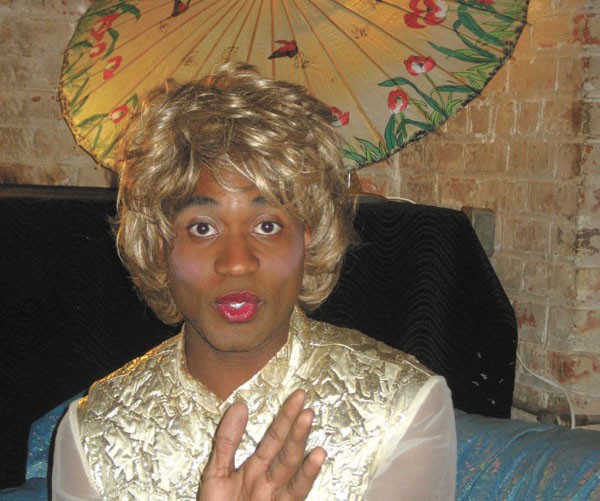
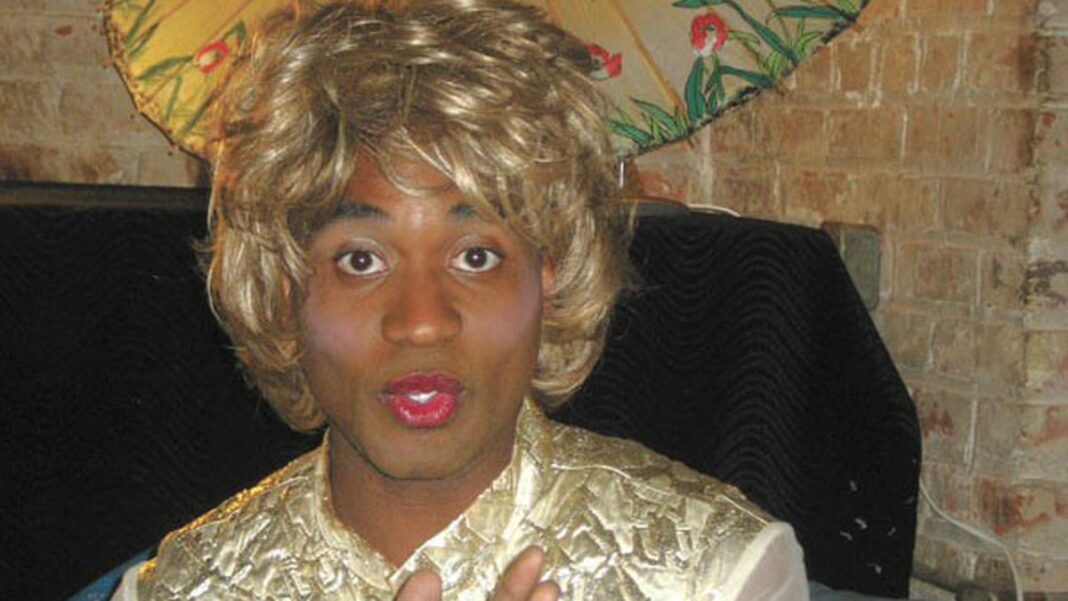
Thandiwe Thomas De Shazor as “the Prophetess.” 
Then, of course, there’s the big elephant in the room. Children
of the Last Days came to fruition at a timely moment — right
after the passage of the now-infamous gay marriage ban Proposition 8,
which had overwhelming support from African-American voters. (By now,
everyone’s familiar with that oft-quoted 70-30 statistic.) It’s a
pyrrhic victory for De Shazor since his play now has an added political
exigency, though most of the themes (i.e., social conservatism, gender
policing, and attitudes toward homosexuality in the black church) have
preoccupied him since childhood. “That struggle is not new,” he said.
“Conservative people have been using gay rights to break up the black
church for a while. That’s kind of that one issue that they can always
hammer in.”
De Shazor’s childhood provides an archetypal narrative about
Christianity and repressed homosexuality. Growing up in the suburbs
outside Detroit, he attended a strict Pentecostal church until age ten,
at which point his parents divorced. The family — which then
consisted of De Shazor, his mother, his sister, and his aunt —
switched over to a non-denominational church on the east side of
Detroit, whose congregation included the gospel singer Vickie Winans.
De Shazor’s aunt sang in Winans’ ensemble, and would bring him along to
band rehearsals at a tony house in West Bloomfield. There, young Tommy
De Shazor sat face-to-face with Winans, a woman who would inspire his
drag characters for years to come. “I would go downstairs and they
would have the band in the basement, and Vickie Winans would be sitting
there with all this hair, and shoulder pads, and just —
divadom,” he said. “And screaming because the sista can scream
when she’s singing, right? She’s probably the reason I’m queer right
now. I was this close to the holiest drag queen in the
world.”
With her garish clothes and flamboyant mannerisms, Winans pretty
much encapsulated everything that De Shazor loved about church. In
Children of the Last Days he takes great pleasure in satirizing
a Christian environment that’s so repressed but so campy at the same
time — part of the joke is that every character seems to be
locked in a prison of denial. Yet there’s a sinister side to De
Shazor’s humor, as well, since so much of the play’s subtext is about
intolerance and self-deception. De Shazor’s female characters all
retain elements of the matriarchs in his family. (In fact, the
Prophetess is really a composite of his grandmother, mother, and aunt.)
It appears that, in addition to poking fun at his church community, the
playwright also is paying tribute — and patching up a rift that
never quite healed in real life.
In retrospect, De Shazor has a hard time believing that his mother
never foresaw the day he would come out to her (in what turned out to
be a “big explosion”). Looking back, he assesses the signs: The fact
that he got smacked with a ruler in kindergarten for kissing boys; his
enthusiasm over getting enlisted to help his mom sell Mary Kay
cosmetics at age eleven, which allowed him to tell women about their
T-zones; his love of musical theater in high school, where he took
starring roles in Oklahoma and The Music Man. For years
De Shazor and his mother had a tight-knit relationship, discovering
secular music (Anita Baker) together after leaving the Pentecostal
church, and selling cosmetics as a team. When De Shazor came out at age
eighteen his mother was inconsolable. “My mother called my aunt, my
aunt called my grandmother,” he said. “They all assembled, and
everybody was like, ‘No you’re not, you’re lying.'” He continued: “See,
it’s so weird because we still don’t talk about it that much. It was
like this big explosion, and now it’s just here.”
In the years that followed, De Shazor embraced his gay identity with
new ardor. He wrote a weekly television column for Detroit’s LGBT
periodical Between the Lines, and became the paper’s de facto
ambassador to “black gay Detroit.” He found a chic high rise apartment
downtown, with a walk-in closet and a concierge. He bartended. He acted
in small theater productions. At age 25 De Shazor moved to Oakland,
landed a job at a women’s clothing store (which he blames for making
him more queer than he actually is), and continued acting, both in an
improv troupe and with Oakland Public Theater (which is co-producing
Children along with local arts collective the Nursha
Project).
De Shazor hasn’t quite wrenched himself from Pentecostal
conservatism, having spent so many years living with the double
consciousness of a church queen. In Children of the Last Days
he’s anxious to start dialogue around all the hot-button issues related
to gay civil rights and the black church. But he’s still apprehensive
about how the play will be perceived. “This lady who’s a regular
customer at the store came to see me play James Baldwin in an Oakland
Public Theater production,” he said. “She wants to bring her church
friends to see this show. Right after church, too. I tried to warn
them.”
VIDEO EXTRA Prayer for the Profit: The Prophetess Jackie McGee shows Rachel Swan her divine empire.