
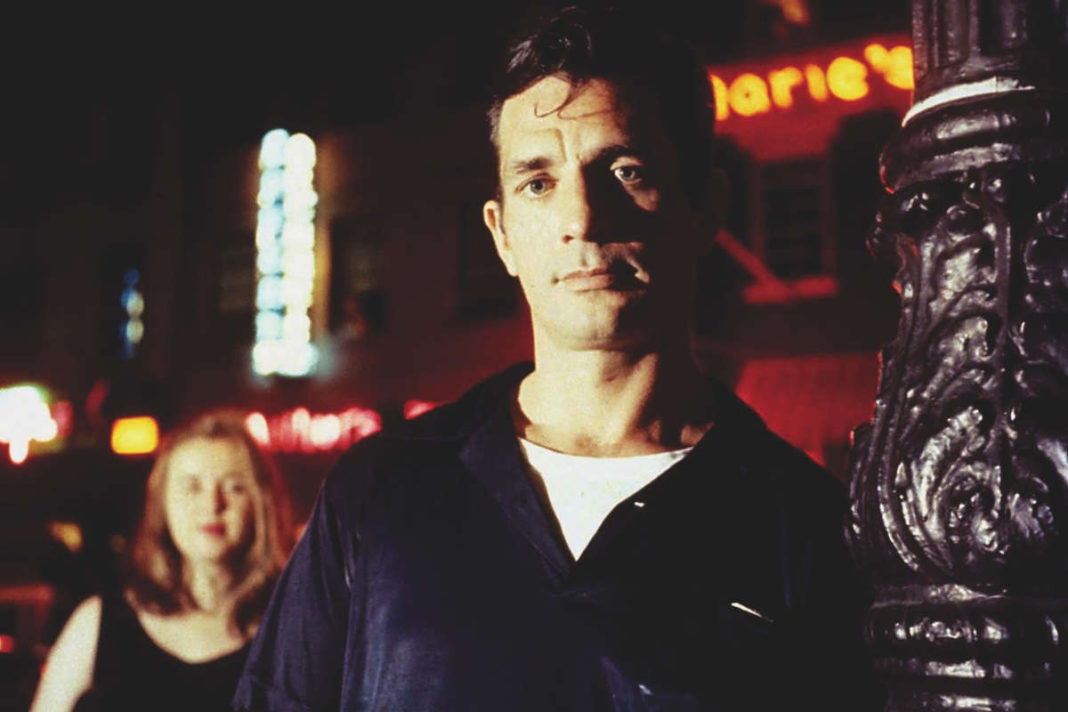
The world has had 68 years to chew on Jack Kerouac’s On the Road. But if the new documentary Kerouac’s Road: The Beat of a Nation is any indication, the final literary/cultural verdict on that 1957 landmark novel is a long way off. Farther even than the distance between the fictional Dr. Sax’s hilltop hideout in Lowell, Massachusetts, and Neal Cassady’s real-life cottage in Cow Hollow, San Francisco.
With Kerouac’s Road, director Ebs Burnough and writer Eliza Hindmarch take a different tack from most of the numerous treatments of the late author’s story. After a dazzling opening credits montage—bursting with library shots of ’50s America—the talking heads make their cases with appropriately surprising candor. They’re an impressive bunch of Bohos, neo-Bohos and never-Bohos, all making essentially the same point: Jack’s rebellious, freedom-seeking, boundaries-smashing coming-of-age tale isn’t, and really wasn’t, the same for everybody.
East Bay stalwart writer W. Kamau Bell, seated in Vesuvio Cafe in SF’s North Beach, imagines a path he might have taken if his and Kerouac’s lives had somehow been switched. Totally different. Singer/songwriter Natalie Merchant recalls her Kerouac-inflected adolescence while addressing the notion of myth-making in America, and now sees Kerouac as essentially self-destructive and self-delusional. Whose myths do we choose?
Actor Josh Brolin, who took his own youthful see-America road trip on a Harley, believes Kerouac created a political manifesto. Jay McInerney, author of Bright Lights, Big City and American Psycho, has his doubts about Kerouac’s supposedly spontaneous prose style—it was worked on intensively between 1951, when Kerouac began writing the novel, and the 1957 publication date. So, not exactly ad-lib. Prowling through a New York City record shop, actor Matt Dillon sees Kerouac as an American idol in the musical as well as the literary sense. Kerouac’s voice is played by actor Michael Imperioli.
Burnough and Hindmarch’s evocation of the Kerouac legend visits a list of places that would make Hank Snow grin: Amarillo, New Orleans, San Antonio, Philadelphia, Sedona, Saint Augustine, Atlanta, London, Manhattan, Havana, Los Angeles and others. It all begins in Lowell, the old Massachusetts mill town where “Ti Jean”—Jack’s family nickname—first realized he was an outsider, a French-Canadian working-class kid with an overactive imagination who missed his deceased older brother Gerard so much he inserted him into fantastically gothic dream scenarios.
The shifts in perspective that occur in the middle of Kerouac’s Road take the original mid-20th-century emotional travelogue to places and frames of mind that didn’t deserve to be overlooked.
The doc superimposes Kerouac’s curiosity and wanderlust onto the lives of a pair of contemporary people also in love with the road, Tenaj and Tino. Tino, a disabled Cuban-American veteran of the Iraq war is now raising a son with his Black wife Tenaj, all the while crisscrossing the country. We also drop in on a young Philadelphia Black man named Amir, who’s excited by his upcoming enrollment at Morehouse College. Finally getting out of Philly.
Compare and contrast these travelers of color with the freewheeling characters of Sal Paradise, fictional hero of On the Road, and the folks he encounters highballing across the country in the early ’50s, whooping and hollering and drunk. W. Kamau Bell points out that he, as a Black Man, could never have survived such a trip then, or even probably now. Bell likes to fantasize that Kerouac might have co-written a book with author James Baldwin—but of course that never happened. Kerouac gets accused of misogyny as well.
The doc decisively pulls away from the hedonistic Beat ethos, in favor of making it real for today. America is a sadder place now, and the racism is as bad as ever. Kerouac once stated that the first review of On the Road—a rave—made his career but ruined his life. Kerouac’s Road convinces us to accept that, and that he and the Beats lived in Dreamland.
* * *
In theaters









The movie has a wonderful cast of David Amram, Josh Brolin, Natalie Merchant, and Matt Dillon who do a wonderful job explaining how Kerouac inspired their lives. No comment about Charters and Johnson. However, the people in the doc that the producers compare to Kerouac’s ethos have no idea who Kerouac was and what he embodied. They never speak about Kerouac’s work, nor do they mention having read his work, so why are they in the movie?
I viewed it in Denver and almost fell asleep because the lives of the people on the road are boring and represent the 60 million who travel every year; they are not special and do not love Kerouac. There are thousands of Kerouac scholars and enthuists who love Kerouac and follow his archetypes, but the producers of this movie did not take their time to find any of them. Instead, I have no idea why the people in the movie are there. The history of Kerouac’s life is barely mentioned; instead, the movie follows these random people who, as far as the viewer knows, have no idea who Kerouac is and how his writing impacts society today.
The movie is an insult to Kerouac and his writing. Plus, it is boring and offers no new insights into how his writing is still influencing an international audience.
The movie does not add to Kerouac’s impact or influence today since they did not bother to find true Kerouac aficionados. It is disappointing since the world is filled with people who use On the Road as their Bible, but the producers could not find any of them and instead filled the screen with boring, mundane, people who do not worship Jack.