What do a famous artist from Chicago and fifteen high-school
students from West Oakland have in common? It sounds like the setup for
an art-world party joke, but the connection is real.
In January, the San Francisco Museum of Modern Art commissioned
artist Kerry James Marshall to paint a pair of murals in its six-story
atrium. In February, the museum commissioned fifteen Oakland teenagers
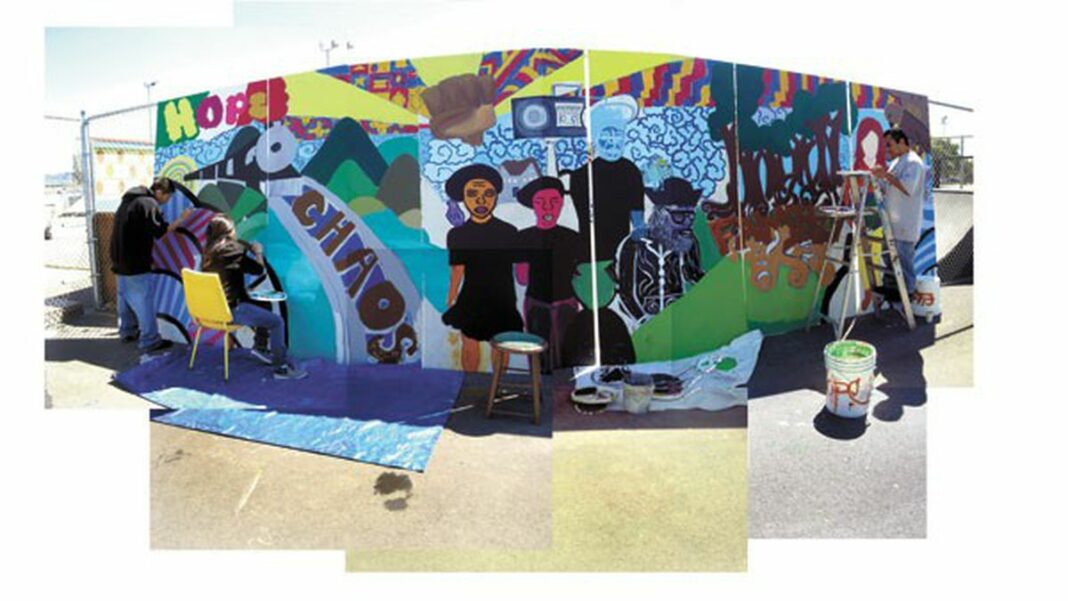
to paint a response mural at Town Park, a community-built skate park
within DeFremery Park.

Credits: Kris Vagner

Credits: Winnie Wintermeyer

Credits: Kris Vagner

The students attend Oakland High School, Oakland School of the Arts,
and Ralph J. Bunche Academy. Some are art students; most are skaters
who were already skating at Town Park; some are neither. Museum
staffers envisioned the project as a chance for the teens to respond to
Kerry Marshall’s ideas — he retells American history from the
point of view of those African Americans who were anonymous in the
textbook versions. The students also were asked to commit to research
and painting sessions for thirteen Saturdays. SFMOMA provided supplies,
pizza, hamburgers, a $400 stipend, and the opportunity to kick-start
the students’ résumés with a museum-sponsored
project.
While SFMOMA didn’t want to release Sonny, Devanio, Lionel, Harold,
Ramón, Alvin, Tamara, Sean, Dalena, Tony, Kimani, Jorge,
José, Nile, or Jacob’s last names out of concern for their
privacy, they did let a reporter tag along behind the scenes to watch
the project unfold.
First off, the students met with Marshall and saw his paintings.
Marshall had painted the indoor murals, “Visible Means of Support:
Monticello” and “Visible Means of Support: Mount Vernon,” each 32 feet
long and a couple flights above viewers’ heads, with the help of
painters from Precita Eyes, the San Francisco-based mural organization.
The paintings show Thomas Jefferson and George Washington standing in
front of their respective monuments, their authoritative postures
competing with the coloring-book style they’re rendered in. Scores of
slaves are camouflaged in unfinished dot-to-dot puzzles and
paint-by-numbers-type backgrounds. The Founding Fathers are grossly
elongated. They only start to look normally proportioned if you stand
right underneath them.
“I’m interested in what’s left out of the stories,” Marshall said
later at a press conference. “This is just one visual contribution to
the way that historical narratives continue to be revised and revealed
and presented.” The students were expected to make their own
contribution to that canon, to present a view of their world through
their own eyes.
To brush up on local history, they met with Steve Lavoie, a
librarian at the Oakland Public Library’s Oakland History Room. He told
them stories about the first transcontinental railroad and how the
Black Panthers had met at DeFremery Park in the 1960s. He showed them a
photo of a few Black Panther children with serious expressions, dressed
in clothes that now look archaically formal. “The themes did not seem
to be resonating,” SFMOMA Education Associate Aimee Shapiro later
recalled. “A lot of the students were lying on the table and acting all
bored.”
Annie Lawson, SFMOMA’s Manager of School, Youth, and Family
Programs, agreed. “We really thought it was a crash-and-burn moment,”
she said. “We were, like, ‘This is not working out so well.'”
But when the students started sketching out ideas for the mural, the
stories Lavoie had told them were on their front burners. The railroad,
the Black Panthers, the fact that parts of Oakland used to be farmland,
even the oak trees that had lent the city its name had captured their
attention.
Next, the teens visited Emeryville artist Brett Cook, who uses a
graffiti style and leads groups of kids and adults in community art
projects. Cook gave the students a tour of his studio and brainstormed
with them. They were impressed with his ample spray-paint collection,
and Cook imparted his theories about how art and everyday life don’t
necessarily have to be so separate. To him, living your life and being
part of a community can involve as much creative expression as making
paintings. He explained, “It’s not just, ‘I’m the best colorer in the
class.’ It’s also, ‘How do we make our life the best it can be?'”
This came as good news to a few of the students, who weren’t too
confident about their drawing skills. They could start sketching their
ideas by finding photos online instead of struggling with a new medium.
After a couple weeks of sketching, downloading, talking, and thinking,
facilitated by Fred Alvarado, a Fruitvale-based Precita Eyes muralist
who’d helped paint Kerry Marshall’s pieces, the group came up with a
draft of their own mural.
On a Saturday morning in February, the thirteen boys and two girls,
most wearing skater sneakers and black T-shirts or hoodies, met in a
classroom at SFMOMA. Alvarado was running late. As the students waited
for him, they watched YouTube, texted their friends, or snapped
pictures with cell phones. The atmosphere was casual and polite. Their
time didn’t seem precious. Alvarado arrived, baseball cap askance, as
usual. His tardiness was unusual. (But, to us anyway, understandable.
He’d been at an Express-sponsored party the night before.) He
was apologetic. The one joke someone cracked was so mild it seemed
intended more to let him off the hook than to razz him.
He unrolled a black-and-white mock-up of the mural and hung it on a
magnet board. The train, the oak trees, and the Black Panther children,
now dressed like skaters and holding a boom box, were all in there,
drawn with the passionate contour lines of a high-schooler’s sketchbook
and the swirly, peace-and-grooviness attitude of retro-Partridge-Family
graphics. The students had written “chaos” on the tracks and “hope” in
the clouds.” (The clouds later became a Mexican flag.)
“Now we need to write a paragraph,” Alvarado said. The paragraph
would describe the mural and guide the rest of the production process.
With ear buds still in ears, they wrote with Crayola markers about
Oakland’s geography and history, about the idea of working as a
community to overcome violence and chaos and replace them with love and
peace.
What kinds of violence and chaos are on their minds? Other than
mentioning that it’s become hard to choose what color to wear because
every color is associated with a gang, no one was saying. Alvarado
reported that even though he got to know the students pretty well,
there were a lot of topics they didn’t discuss outside their own peer
group. But in December, a former high-school teacher known as K-Dub
(Keith Williams), who was responsible for getting Town Park built, told
community news site East Bay West Online, “From teaching here I know at
least six students who are no longer here because of a bullet, and I’m
sure none of them warranted it.”
In the same conversation, K-Dub said, “Everybody seems like they are
afraid of these kids, instead of talking to them.”
Cook had suggested that we might all have something to learn by
trying to communicate across the boundaries implied by our own
demographics. Marshall has won popular and academic acclaim and awarded
a MacArthur genius grant for doing just that. Essentially, the mural
project was the students’ chance to have a go at communicating across
those boundaries.
You might expect that with the mike in their hands and a
museum-going audience to listen, the teens would want to jump up and
shout about who they really are or rail against the inequities of a
world where their peers could be caught in gunfire. Actually, the mural
reads more like a cheery scrapbook collection or a visual time capsule
of what the students discovered about their corner of the world. It
matches the statements they wrote at the museum about hope being their
main priority.
The students transferred their picture to eight-foot-high plywood
panels, which would be bolted to a concrete wall. Alvarado, a patient,
low-key leader, left the decision making and execution to his charges
but held them to a professional standard. He interjected with technical
advice (“We can’t use fluorescents in a mural; they’re not lightfast”)
and friendly admonishments (“Do it right”; “Don’t take shortcuts”; “We
problem-solve right here; then it’s going to cause less problems
later”). He pointed out that the mural will be there in the park
representing them for a long time.
“These kids are pretty on point,” he said. “They understand it’s a
pretty special project; not every kid is going to get to work with the
museum. They’re all motivated people. They’re going to come out with a
great accomplishment to give to the neighborhood and the skate
park.”
Shapiro said she was impressed with the teens’ passion and
commitment. She reported that on several occasions, they voluntarily
extended the required four-hour shift to six. Some skipped family
events (a wedding; the birth of new cousin) or football games they were
scheduled to play in so they could stay and work. Some had forgotten
about the $400 stipend they’d receive, and a few parents told Shapiro
their kids, who continued to play it relatively cool around their
artistic mentors, were full-on excited about the whole thing.
Over the next few Saturdays, the students painted in the park.
Strangers dropped by on sunny days to admire their progress, and tweens
checked out the mural as they sailed up and down skateboard ramps and
jumped their BMX bikes in Town Park.
In mid-May, they finished the painting and titled it “Change,
Family, Roots & Culture.” Kerry Marshall came back to town to
celebrate its unveiling and congratulate the young artists on adding
their own visual narrative Oakland’s historical record.