
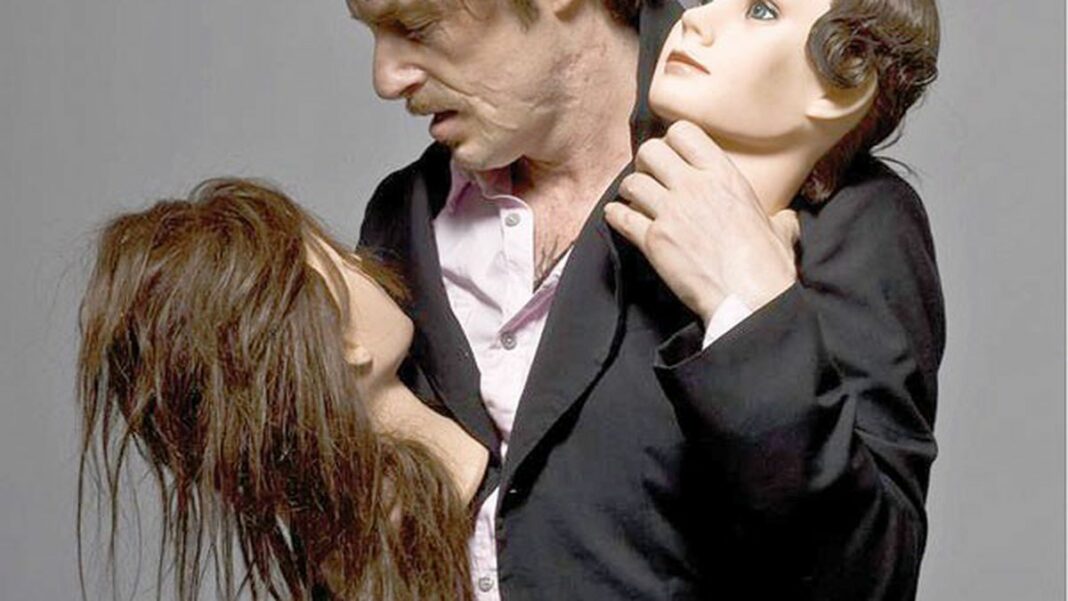
Andrew Whiteman sees no shame in taking ideas from elsewhere. In
fact, when he assembles his own work as the master chemist of
Torontonian duo (formerly trio) Apostle of Hustle — a project
that resembles unencumbered indie rock on the surface but is something
considerably more complex and unfamiliar underneath — he
needs to use concepts produced elsewhere.
“I’m like a crow when it comes to artistic, musical things,” says
the multi-instrumentalist, who’s especially potent with strings and
vocals. “If I see something that looks shiny, I’ll steal it. I’ll put
it in my mouth and take it back to my laboratory and examine it and see
whether I can use it or not.” As he lives in an overpopulated world
conquered by an excess of information, Whiteman’s artistic theft is his
way of balancing the creative eco-system. “My music is made up of
stolen things. That’s what it is,” he asserts. “Because, you know,
there is no room.”
Inspired by a trip he took to Havana, Cuba to see his godmother a
few years ago, Whiteman first separated Apostle of Hustle from a more
traditional rock aesthetic by embedding elements of Cuban rhythms into
his work. “I was pretty familiar with Cuban music before I went to down
there,” he said. “I generally am attracted to Spanish-speaking music
because it’s more rhythmically interesting.” The one particular pattern
that became an obsession of Whiteman’s is called the clave, a
word that translates to “key” and references a rhythm integral to many
Latin-American compositions. The Apostle frontman’s first exposure to
the concept came from listening to “Not Fade Away” by rock ‘n’ roll
pioneer Bo Diddley, which led Whiteman to investigate that it came from
the New Orleans school of playing. From there, he delved into even
further, reaching into its Cuban roots.
What’s important isn’t where each style came from but rather how
everything is connected. While discussing Cuban music, he jumps into
analyzing North African sounds and then rembetika, a Greek folk
style reflecting the seedier, sadder corners of city life. “One finds
[that] rembetika was this kind of music that was made in brothels and
hash dens in the Twenties,” said Whiteman. “It was totally frowned
upon. It was the music of the scummy people. Now, we listen to this
rembetika music and feel completely inspired.”
Whiteman’s skill at juggling subjects and chronologies is tied to
how he writes in Apostle of Hustle. Listening to Eats Darkness,
the group’s May release from Arts & Crafts, is similarly
perplexing. For stretches, Apostle unravels soothing, lush rock that
basks in starry guitar segments. However, these “regular” tracks are
scattered among short sound collages rife with hyperkinetic samples and
aggressive, incongruous chatter. When you’re expecting docility, all of
this is a shock to the senses.
Whiteman throws this havoc in on purpose. He dubs Eats
Darkness “an album based on the ideas of conflict and battle.”
However, it’s less of a traditional concept album in the vein of the
Who’s Tommy but instead is a work that shifts as “the vibrations
of the moment indicate what I should do.”
He calls the collages “soundscapes,” noting that they’re rich with
details that reveal more about the whole work itself. There are pieces
of poetry, sounds produced by roosters and bowling balls, and voice
clips from HBO shows appearing in mutated form (to steer clear of legal
trouble, Whiteman said he changed 30 percent of the wording). However,
most noticeable are the gunshots and sirens, inserted in tribute to
hip-hop mix tapes — evidently a major source of inspiration for
the songwriter.
“Eazy Speaks,” the crowning track from Darkness, is a bouncy,
almost breezy ode to Eazy-E, member of legendary rap outfit N.W.A. and
someone Whiteman considers “a mangy little badass.” In-between calls of
Eazy speaks to me, he beckons, Come forward/little
warlord.” Says Whiteman of his work: “Eazy E is the saint of not
turning the other cheek. This is basically a straight-up homage to a
hip-hop song. It’s a fight song.” He’s especially excited about
bringing the song with him to Thursday’s performance at the Fox
Theater. “When I get to California, I’m coming home,” he enthuses.
“Eazy’s coming home.”
This infinite stream of ideas indicates Whiteman’s deep appreciation
for Apostle of Hustle’s unusual, difficult-to-pinpoint approach.
Although he calls the project his “child,” as a member of indie rock
collective Broken Social Scene, he isn’t afforded much time to work on
it. However, even prior commitments can’t derail the songwriter’s
imagining of Apostle’s future. With a lean two-piece at work, he
asserts that it will “sound fucking primitivo, man.” Guitar, drums,
synth, and the like are wonderful but Whiteman thirsts for something
less conventional. In one go, he fires his thoughts out: “The next
thing we do is going to be stripped skin and bones. We’re recession
rock. We’re ancestor music. We play the bones of the dead. That’s where
it’s happening. It’s not math rock. It’s myth rock.”